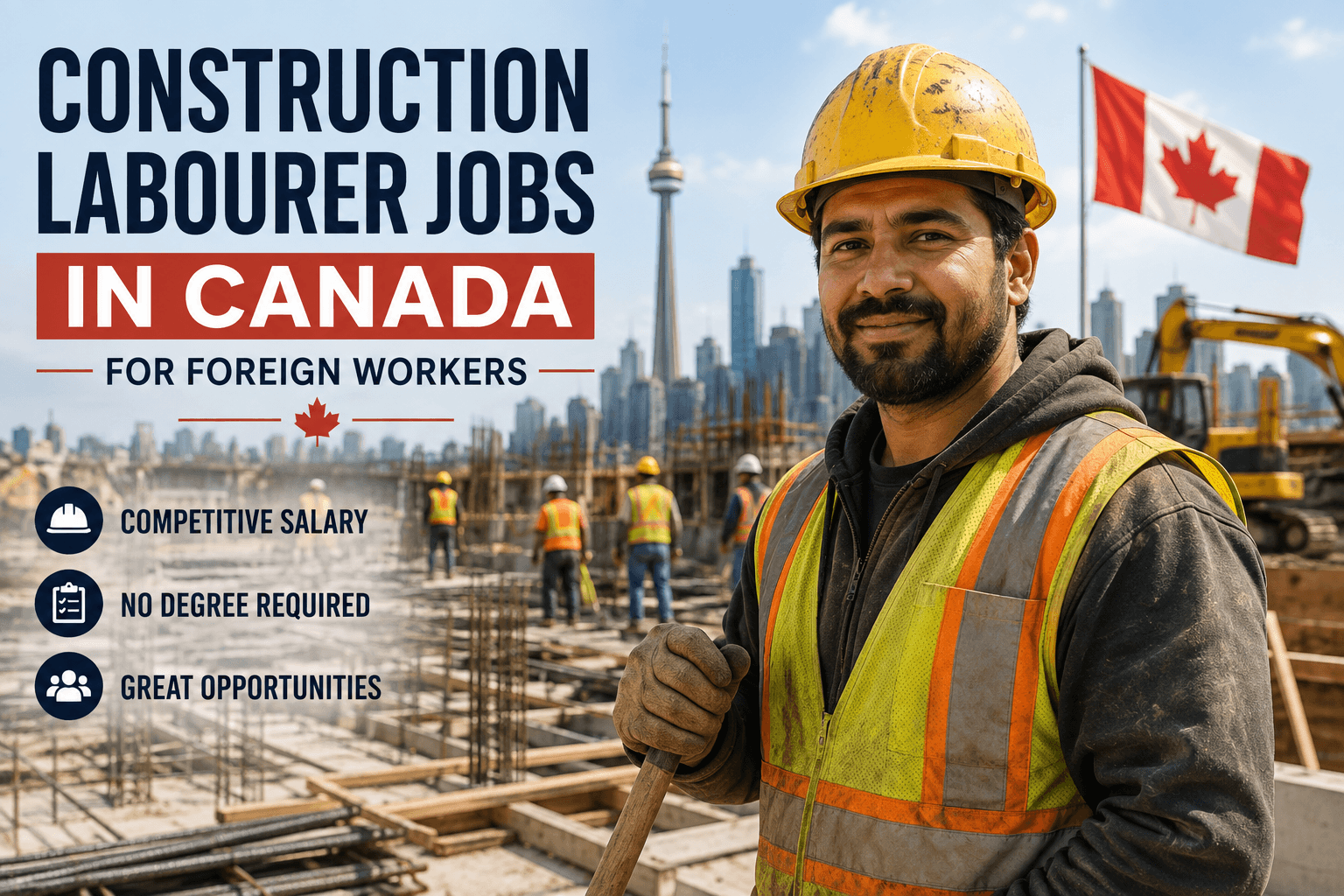
Construction labourer jobs can be one of the more accessible ways for foreign workers to enter Canada’s construction industry.
Unlike occupations such as electricians, plumbers and crane operators, becoming a general construction labourer does not usually require years of apprenticeship training before you can perform basic construction work.
Canada’s Job Bank states that construction trades helpers and labourers usually require short-term work experience and no formal education, while on-the-job training may be provided.
The earning potential is also worth considering.
The national median wage for a construction labourer in Canada is currently approximately C$25 per hour. At 40 hours per week, that would equal roughly C$52,000 in annual gross earnings before taxes and deductions.
However, wages vary considerably between provinces, employers and projects.
Foreign workers also need to understand an important distinction: being qualified to perform construction work does not automatically mean you are authorized to work in Canada.
This guide explains construction labourer jobs in Canada for foreign workers, including salaries, requirements, duties, provinces to consider, work permits and how to search for legitimate opportunities.
What Does a Construction Labourer Do in Canada?
Construction labourers support skilled tradespeople and perform practical work at construction sites.
Canada classifies construction trades helpers and labourers under NOC 75110.
Workers in this occupational group can be employed by construction companies, trade contractors, labour contractors, surface mines and quarry operators.
The exact duties depend on the employer and project.
A construction labourer may:
- Load and unload construction materials
- Move materials around a construction site
- Assist carpenters and other skilled tradespeople
- Mix, pour and spread materials such as concrete
- Remove debris and waste
- Clean construction sites
- Dig trenches and holes
- Help erect or dismantle structures
- Operate basic construction equipment
- Direct traffic around construction sites
- Assist with demolition
- Help position pipes and other materials
- Perform basic maintenance work
- Follow workplace health and safety procedures
Some construction helpers specialize more heavily in assisting a particular trade.
For example, you might work as an electrician helper, carpenter helper, plumbing helper or roofing helper.
That experience can eventually help you decide whether you want to pursue formal training in a skilled trade.
Construction Labourer Salary in Canada
The Government of Canada Job Bank reports a national construction labourer wage range of approximately:
Low: C$18.25 per hour
Median: C$25.00 per hour
High: C$40.00 per hour
The figures show that experience, location and the type of construction work can have a significant effect on earnings.
A new worker may earn closer to the lower end, while an experienced labourer working on certain projects may earn substantially more.
Construction Labourer Salary Table by Province
The following figures use Government of Canada Job Bank wage data.
Annual estimates assume 40 hours per week for 52 weeks. They represent gross income before taxes and payroll deductions.
| Location | Low Hourly Wage | Median Hourly Wage | High Hourly Wage | Approx. Annual Pay at Median |
|---|---|---|---|---|
| Canada | C$18.25 | C$25.00 | C$40.00 | C$52,000 |
| Alberta | C$19.00 | C$25.00 | C$35.00 | C$52,000 |
| British Columbia | C$20.00 | C$25.00 | C$38.50 | C$52,000 |
| Manitoba | C$17.50 | C$22.00 | C$31.25 | C$45,760 |
| New Brunswick | C$16.00 | C$20.00 | C$26.00 | C$41,600 |
| Newfoundland & Labrador | C$16.35 | C$22.00 | C$39.45 | C$45,760 |
Wage data changes over time. Furthermore, a provincial median does not mean every construction company in that province will offer that rate.
Job type also matters.
A labourer helping with small residential renovations may have a different compensation package from someone working on major infrastructure or industrial construction.
Calculate Your Construction Labourer Take-Home Pay
An advertised hourly wage is your gross wage.
It is not necessarily the amount you will receive after deductions.
For example, at C$25 per hour and 40 hours per week:
C$25 × 40 = C$1,000 gross per week
Over 52 weeks:
C$1,000 × 52 = C$52,000 gross per year
Your actual take-home pay will be lower after applicable deductions.
Use the calculator below to estimate your income.
Enter an hourly wage, choose a country, and estimate monthly gross pay, tax and take-home income.
Planning estimate only. The preset uses a simplified flat percentage. Actual tax and payroll deductions can differ based on income level, province/state/region, allowances, social contributions, marital status and local tax rules.
The calculator provides a simplified planning estimate rather than an official Canadian payroll calculation.
Do Construction Labourer Jobs Require a Degree?
Usually, no.
This is one of the main reasons construction labouring may appeal to people who want to enter the Canadian construction industry without a university degree.
Canada’s Job Bank describes the occupation as usually requiring short-term work experience and no formal education.
Furthermore, Job Bank states that on-the-job training may be provided.
However, this does not mean every employer will hire someone with absolutely no experience.
Employers can establish their own requirements.
Previous experience in construction, renovation, agriculture, warehousing, manufacturing or other physically demanding work may help demonstrate that you can handle the job.
Do You Need Construction Experience?
Not necessarily for every vacancy.
Some employers may be willing to train workers, particularly for basic labouring duties.
However, Job Bank notes that some experience as a general construction labourer may be required for construction trade helper positions.
Previous experience becomes even more important when the position involves specialized work.
For example, pipeline workers can require previous pipeline construction experience.
Similarly, workers performing traffic-control duties may require a traffic-control certificate, while riggers and slingers may need rigging certification.
Therefore, read the requirements of each vacancy carefully.
Skills Construction Employers Look For
Formal education may not be the biggest barrier, but employers still need workers who can perform the job safely and reliably.
Useful qualities include:
Physical Fitness
Construction labouring can involve lifting, carrying, standing, bending, climbing and working outdoors.
You should be physically capable of performing the duties stated in the job description.
Safety Awareness
Construction sites contain potential hazards.
Employers need workers who can follow instructions, wear appropriate personal protective equipment and respect safety procedures.
Reliability
Construction projects operate according to schedules.
Repeated lateness or unexplained absence can affect an entire crew.
Employers therefore value workers who arrive when expected and complete assigned tasks.
Teamwork
Labourers rarely work completely alone.
You may work alongside carpenters, electricians, plumbers, equipment operators, supervisors and other labourers.
Being able to communicate and follow instructions is important.
Practical Ability
Experience with basic tools, materials or construction processes can make you more useful on a job site.
Willingness to Learn
General labouring can expose you to several skilled trades.
Workers who learn quickly can gradually take on more responsibility.
Construction Labourer Jobs Currently Exist Across Canada
Construction labour is not restricted to one Canadian province.
As of the Government of Canada Job Bank’s August 7, 2026 update, more than 1,200 construction labourer positions were advertised across Canada.
The largest numbers of advertised positions included:
| Province | Advertised Construction Labourer Jobs |
|---|---|
| British Columbia | 362 |
| Alberta | 256 |
| Quebec | 196 |
| Ontario | 181 |
| Nova Scotia | 52 |
| Manitoba | 45 |
| Saskatchewan | 36 |
| New Brunswick | 31 |
| Newfoundland & Labrador | 14 |
| Prince Edward Island | 8 |
Vacancy counts can change daily, so these numbers should be treated as a snapshot rather than a permanent measure of demand.
Nevertheless, they demonstrate that construction labour opportunities exist in multiple parts of Canada.
Construction Labourer Jobs in British Columbia
British Columbia had the largest number of construction labourer vacancies among the provinces in the Job Bank snapshot used for this guide.
The province had 362 advertised positions.
Its provincial median wage was approximately C$25 per hour, with reported wages reaching approximately C$38.50 at the high end.
British Columbia has construction activity involving housing, commercial developments, infrastructure and other projects.
However, workers considering cities such as Vancouver should also research housing costs.
A higher wage does not necessarily translate into greater disposable income if accommodation is substantially more expensive.
Construction Labourer Jobs in Alberta
Alberta is another important province for construction workers.
Job Bank showed 256 advertised construction labourer vacancies in the province.
The provincial median wage was approximately C$25 per hour, while the reported range was approximately C$19 to C$35 per hour.
Alberta has construction activity associated with residential projects, infrastructure, commercial development, energy and industrial projects.
Workers with previous experience in industrial environments may therefore find the province particularly interesting.
However, applicants should still compare individual vacancies rather than assuming every Alberta construction job pays above average.
Construction Labourer Jobs in Ontario
Ontario had 181 advertised construction labourer vacancies in the Job Bank snapshot.
As Canada’s most populous province, Ontario has a large construction sector covering cities such as Toronto, Ottawa, Hamilton and numerous growing communities.
Opportunities can include:
- Residential construction
- Commercial development
- Road construction
- Infrastructure
- Renovation
- Concrete work
- Demolition
- Trade-helper positions
Foreign workers should remember that a vacancy located in Ontario is not automatically open to overseas applicants.
Always check the eligibility section of the posting.
Construction Labourer Jobs in Quebec
Quebec had 196 advertised construction labourer positions in the Job Bank snapshot.
However, Quebec has its own labour-market and immigration considerations.
Language can also matter considerably depending on the employer and location.
Workers targeting Quebec should therefore research the requirements applying specifically to their occupation, employer and immigration situation.
Can Foreign Workers Apply for Construction Labourer Jobs in Canada?
Yes, but there is an important condition.
Foreign workers must have the appropriate authorization to work in Canada.
If you are currently outside Canada, you cannot assume that every construction labourer vacancy is available to you.
Canada’s Job Bank specifically advises foreign candidates to apply to jobs from employers recruiting international candidates.
Job Bank identifies these vacancies so foreign applicants can distinguish them from jobs intended for people already legally authorized to work in Canada.
This can save considerable time.
Instead of sending hundreds of applications to employers who cannot hire you, focus on positions that match your immigration and work-authorization situation.
Do Construction Labourer Jobs Come With Visa Sponsorship?
The phrase “visa sponsorship” is frequently used on job websites, but Canada’s system is more specific.
A Canadian employer does not simply issue you a Canadian work visa.
If you require an employer-specific work permit, you generally need an eligible job offer, and your employer must complete the applicable steps before you apply.
For many jobs, the employer may need a Labour Market Impact Assessment (LMIA).
Some employer-specific work permits are LMIA-exempt.
Therefore, a better question is:
“Is this employer able and willing to hire a foreign worker, and what work-permit process applies?”
That is much more useful than searching only for advertisements containing the phrase “visa sponsorship.”
What Is an LMIA?
LMIA means Labour Market Impact Assessment.
In situations where an LMIA is required, the Canadian employer applies for it.
A positive LMIA generally demonstrates that there is a need for a temporary foreign worker and that no Canadian citizen or permanent resident is available to fill the position.
The worker does not simply purchase an LMIA.
Be extremely cautious if someone claims that paying them a large amount of money guarantees you an LMIA, Canadian job or work permit.
Employer-Specific Work Permits
An employer-specific work permit allows you to work according to the conditions listed on the permit.
Those conditions can include your:
- Employer
- Work location
- Occupation
- Period of authorization
Before you apply, the employer must determine whether the position requires an LMIA.
If an LMIA is required, the employer completes that process first.
For certain LMIA-exempt positions, the employer may instead submit an offer through Canada’s Employer Portal and provide the worker with the required offer-of-employment number.
Documents You May Need
The exact documents depend on your situation and work-permit category.
For an employer-specific work permit application from outside Canada, IRCC may require evidence related to your employment and ability to perform the job.
Useful documents can include:
- Valid passport
- Canadian job offer
- Employment contract
- Résumé
- Reference letters from previous employers
- Proof of previous work experience
- Pay records from previous employment
- Training certificates
- Trade or safety certificates where applicable
- Proof that you meet the job requirements
- LMIA information where required
- Offer-of-employment information for applicable LMIA-exempt positions
- Other immigration documents requested for your situation
Keep records of your employment history before beginning an international job search.
Trying to obtain old employment letters after receiving an offer can delay your preparation.
How to Create a Construction Labourer Résumé
Your résumé should clearly explain what you can do.
Avoid filling it with vague statements such as:
“Hardworking individual looking for opportunities.”
Instead, describe relevant experience.
For example:
Construction Labourer — ABC Construction
- Loaded and transported building materials around residential construction sites.
- Assisted carpenters with measuring, cutting and positioning materials.
- Prepared concrete mixtures and assisted with pouring.
- Removed debris and maintained clean work areas.
- Used hand and power tools according to safety procedures.
- Assisted with loading and unloading trucks.
- Followed supervisor instructions and site safety rules.
This gives the employer evidence of practical ability.
If you have experience with particular equipment, mention it truthfully.
Never claim to operate machinery you have not been trained to use.
How to Find Construction Labourer Jobs Open to Foreign Workers
Start with Canada’s official Job Bank.
Foreign candidates should specifically search for jobs that are open to international applicants.
Useful search terms include:
- construction labourer
- construction worker
- construction helper
- general construction labourer
- construction trades helper
- carpenter helper
- concrete labourer
- demolition worker
- construction site worker
- road construction labourer
- pipeline construction labourer
You can combine these terms with locations.
For example:
Construction labourer Alberta
Construction helper British Columbia
Construction worker Ontario
General labour construction Calgary
Construction labourer Edmonton
Construction helper Vancouver
Do not limit your search to the word “sponsorship.”
An employer recruiting internationally may describe the process differently.
How Foreign Candidates Should Use Job Bank
Job Bank has a dedicated process for people searching from outside Canada.
International candidates should look for postings specifically identified as open to foreign applicants.
This matters because Job Bank warns that most Canadian employers will not hire candidates who do not already have a valid visa or work permit unless they are actively recruiting internationally.
Therefore, applying strategically can save time.
Check:
- Who can apply?
- Does the employer accept international candidates?
- Does your experience match the duties?
- Is the wage reasonable?
- Is the employer identifiable?
- Are you being asked for suspicious payments?
If a posting says only Canadian citizens, permanent residents and existing work-permit holders can apply, an overseas candidate without Canadian work authorization should not assume the employer will sponsor them.
Construction Labourer Certification Requirements
General construction labouring often has fewer entry barriers than regulated skilled trades.
However, certification rules can still apply.
Job Bank currently identifies regulatory or apprenticeship frameworks for construction craft workers or construction labourers in several provinces.
For example, relevant regulatory bodies exist in provinces including Alberta, British Columbia and Manitoba.
The specific requirements depend on the work being performed.
Certain duties can also require additional certificates.
For example:
- Traffic-control workers may need traffic-control certification.
- Riggers and slingers may need rigging certification.
- Specialized pipeline roles may require previous experience.
Therefore, check the requirements attached to the actual position.
Can You Get a Construction Job Without Canadian Experience?
Possibly.
Canadian experience can help, but it is not automatically required for every construction labourer position.
Foreign construction experience can still demonstrate valuable abilities.
The key is presenting it clearly.
If you worked on housing projects outside Canada, explain what you did.
If you assisted bricklayers, carpenters or concrete workers, state that.
If you used specific tools, mention them.
If you worked safely on busy construction sites for several years, include that experience.
Employers need to understand how your previous experience relates to their vacancy.
Can Construction Labouring Lead to a Skilled Trade?
Yes.
This can be one of the biggest long-term advantages of entering construction.
Working as a labourer exposes you to skilled occupations such as:
- Carpentry
- Electrical work
- Plumbing
- Welding
- Concrete finishing
- Roofing
- Heavy equipment operation
- Ironworking
- HVAC
- Pipefitting
You may discover a trade that suits you and later pursue the required apprenticeship or certification.
This can substantially increase your earning potential.
For example, the national median construction labourer wage is around C$25 per hour, while several skilled construction trades have median wages above C$30, C$35 or even C$40 per hour.
Therefore, construction labouring does not have to be the end of your career path.
It can be the beginning.
What Is the Work Environment Like?
Construction work can be physically demanding.
Depending on the project, you might work:
- Outdoors
- In hot or cold weather
- At heights
- Around heavy equipment
- In dusty environments
- Around loud machinery
- In unfinished buildings
- On uneven ground
Protective equipment may include:
- Hard hat
- Safety boots
- High-visibility clothing
- Gloves
- Safety glasses
- Hearing protection
- Respiratory protection where required
Workers must take safety seriously.
A construction site’s pace should never be used as an excuse to ignore safety procedures.
How Many Hours Do Construction Labourers Work?
Work schedules vary.
A common full-time comparison is 40 hours per week, which is why the salary calculations in this article use 40 hours.
However, real construction schedules can be different.
Some workers may:
- Work longer shifts
- Receive overtime
- Work weekends
- Work seasonally
- Experience gaps between projects
- Work fewer hours during bad weather
- Work rotational schedules on remote projects
Consequently, hourly wage is often a better starting point for comparing construction vacancies than simply looking at an advertised annual salary.
Can Construction Labourers Earn C$50,000 a Year?
Yes.
At Canada’s current national median wage of C$25 per hour:
C$25 × 40 hours × 52 weeks = C$52,000
That means the national median annualizes to slightly above C$50,000.
However, this assumes 40 paid hours every week for the entire year.
Actual earnings can be lower if work is seasonal or there are gaps between projects.
They can also be higher if you earn overtime or receive a wage above the median.
Can Construction Labourers Earn C$60,000?
Yes, depending on the hourly wage and number of hours worked.
To gross C$60,000 over 2,080 hours, you would need to average approximately C$28.85 per hour.
Some construction labourers earn above that amount.
Job Bank reports a national high wage of approximately C$40 per hour for the occupation.
However, the high wage should not be interpreted as the normal starting salary.
How to Improve Your Earning Potential
If you start as a general labourer, you can take several steps to increase your long-term earning potential.
Gain Experience
Workers who understand construction sites and require less supervision can become more valuable.
Learn a Skilled Trade
Moving into carpentry, plumbing, welding, electrical work, ironworking or another skilled occupation can provide a higher earning ceiling.
Obtain Relevant Certifications
Safety and occupational certifications can help qualify you for more responsibilities.
Learn to Operate Equipment
Appropriate training on construction equipment can open additional career paths.
Become a Supervisor
Experienced workers with leadership skills may eventually move into supervisory positions.
Consider Industrial Construction
Some industrial projects can offer higher wages than ordinary entry-level residential labouring, although the requirements may also be greater.
Watch Out for Fake Canadian Construction Jobs
Foreign job seekers can be targets for recruitment scams.
Be cautious if someone:
- Guarantees a Canadian visa
- Guarantees permanent residence
- Claims no immigration assessment is necessary
- Demands large unexplained payments
- Refuses to identify the employer
- Uses an email address unrelated to the company
- Offers an unusually high salary for simple labour
- Pressures you to pay immediately
- Requests sensitive banking information before legitimate recruitment steps
- Claims you can buy an LMIA directly from them
Research the company independently.
Do not rely only on contact details supplied by the recruiter.
How Long Can the Work-Permit Process Take?
There is no single processing time for every foreign construction worker.
The timeline can depend on factors including:
- Whether an LMIA is required
- Employer preparation
- Your country of application
- Work-permit category
- Biometrics
- Medical requirements
- Document completeness
- Government processing volumes
Use the tool below for a general planning estimate.
Choose your destination and preferred entry route, then tell us how far you have progressed.
Timeline results are planning estimates only and are not a guarantee of visa approval or travel date.
The result should not be treated as an IRCC processing-time guarantee.
Always check current official Canadian immigration information before making financial or travel decisions.
Frequently Asked Questions
How much does a construction labourer earn in Canada?
The Government of Canada Job Bank reports a national wage range of approximately C$18.25 to C$40 per hour, with a median wage of C$25 per hour.
Can foreigners get construction labourer jobs in Canada?
Yes. Foreign workers can work in Canadian construction if they have the appropriate authorization. Applicants outside Canada should focus on employers recruiting international candidates.
Do construction labourers need a university degree?
Generally, no. Job Bank says this occupation usually requires short-term work experience and no formal education.
Can I get a construction job in Canada without experience?
Some employers may provide on-the-job training. However, experience can be required for certain construction-helper positions and can make your application more competitive.
Is construction labouring a skilled job in Canada?
Construction trades helpers and labourers fall under NOC 75110. The occupation differs from apprenticeship trades such as electrician or plumber, although certain construction labour roles and duties can still involve certification or regulatory requirements.
What is the NOC code for construction labourers?
Construction trades helpers and labourers are classified under NOC 75110.
Can a construction labourer earn C$50,000 in Canada?
Yes. C$25 per hour at 40 hours per week for 52 weeks equals approximately C$52,000 in gross annual earnings. Actual earnings depend on hours worked and the wage offered.
Which province has the most construction labourer jobs?
In the Job Bank vacancy snapshot used for this guide, British Columbia had the largest number, with 362 advertised positions, followed by Alberta with 256.
Do I need an LMIA?
Not every foreign worker needs an LMIA. Most employers hiring temporary foreign workers need one unless an exemption applies or the worker already holds an applicable open work permit.
Does an LMIA guarantee a work permit?
No. An employer completing the required employment steps does not automatically guarantee approval of your work-permit application.
Final Thoughts
Construction labouring can provide a relatively accessible entry point into Canada’s construction industry.
The occupation usually does not require a university degree, on-the-job training may be available, and the current national median wage is approximately C$25 per hour.
Furthermore, Job Bank showed more than 1,200 construction labourer vacancies across Canada in its August 2026 snapshot, with significant numbers in British Columbia, Alberta, Quebec and Ontario.
For foreign workers, however, finding a construction vacancy is only part of the process.
You also need to determine whether the employer is recruiting internationally and whether you have, or can obtain, the appropriate Canadian work authorization.
Start with legitimate job sources, prepare a strong résumé documenting your practical experience and concentrate on vacancies that genuinely match your skills.
If you enter the industry as a general labourer, you can also consider construction as a long-term career path.
Experience, certifications, apprenticeships and specialized skills can eventually help you move into higher-paying construction trades.
MimBlog is an independent information website and is not a recruitment agency, employer, immigration authority or government agency. Salaries are estimates and may vary by employer, experience and location. Job availability and immigration requirements can change. Always verify vacancies, eligibility and visa requirements through employers and official government sources.