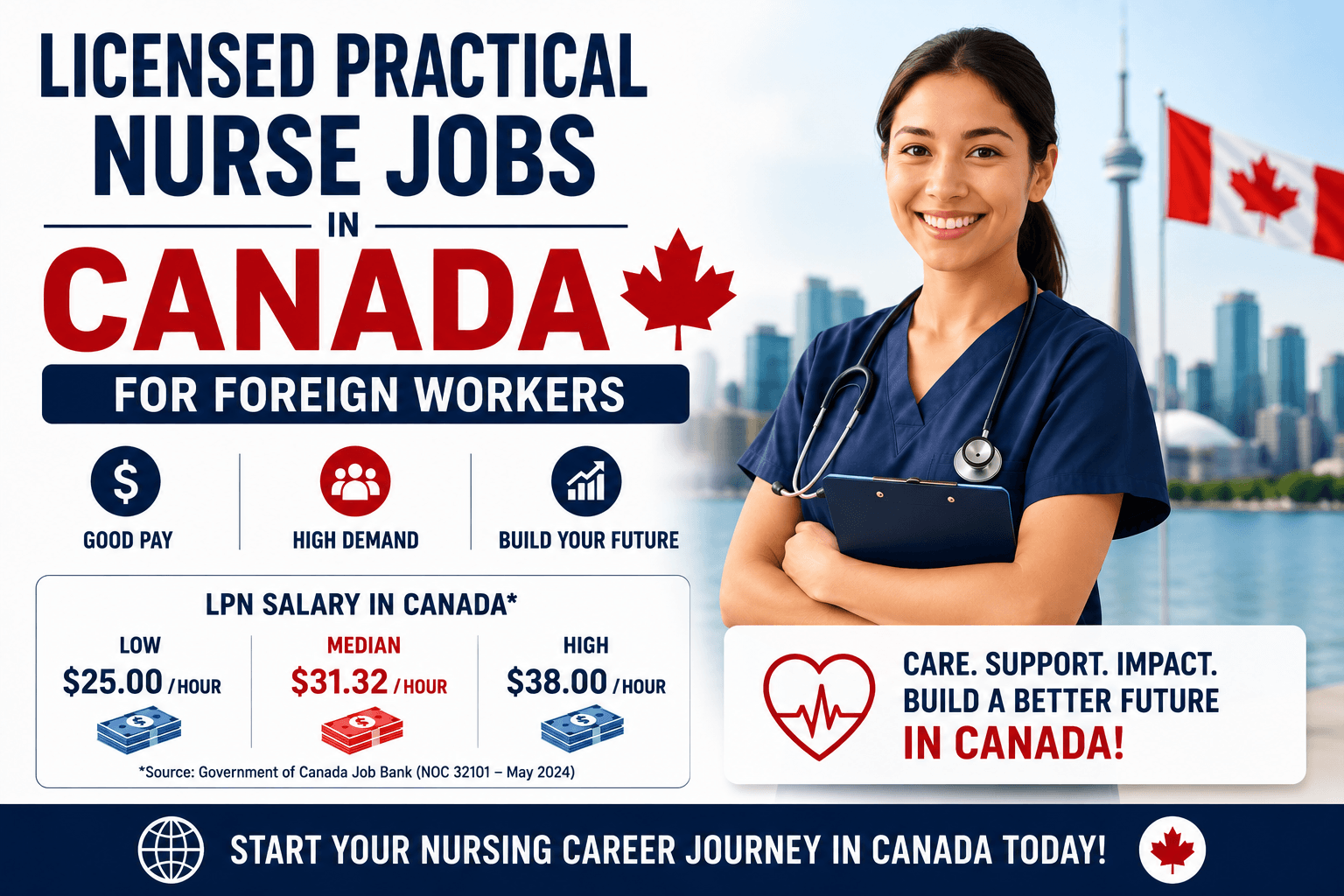
Licensed practical nursing can be an attractive healthcare career for foreign workers who want to work in Canada’s hospitals, long-term-care facilities, nursing homes, community healthcare services and other clinical environments.
The occupation also provides relatively strong earning potential.
Current Government of Canada Job Bank data places national wages for licensed practical nurses at approximately:
Low: $25.00 per hour
Median: $31.32 per hour
High: $38.00 per hour
At the current national median, someone working 40 hours per week for 52 weeks would have a simple gross annual equivalent of approximately:
$65,146 per year.
At $38 per hour, the equivalent reaches approximately:
$79,040 per year.
Some Canadian provinces and regions report higher wage levels.
However, internationally educated practical nurses need to understand that nursing is regulated in Canada.
A foreign nursing qualification does not automatically give someone permission to work as a licensed practical nurse in Canada.
Professional registration and Canadian immigration/work authorisation are separate processes.
This guide explains licensed practical nurse jobs in Canada for foreign workers, including salaries, provincial wages, requirements, professional registration, work permits and immigration considerations.
What Is a Licensed Practical Nurse in Canada?
Licensed practical nurses provide nursing care within their authorised professional scope.
The occupation is commonly abbreviated as:
LPN
However, terminology differs in Quebec, where the comparable professional title is generally licensed nursing assistant.
Government of Canada Job Bank classifies licensed practical nurses under:
NOC 32101
This occupation includes licensed practical nurses and related practical-nursing titles.
LPNs work under professional standards established by the applicable provincial or territorial regulator.
Where Do Licensed Practical Nurses Work?
LPNs can work in healthcare environments such as:
- Hospitals
- Nursing homes
- Long-term-care facilities
- Rehabilitation centres
- Medical clinics
- Community healthcare
- Home-care services
- Physicians’ offices
- Extended-care facilities
The exact responsibilities depend on the workplace, province and professional scope.
What Does an LPN Do?
Typical responsibilities can include:
- Providing nursing care
- Monitoring patients
- Taking vital signs
- Assisting with treatment
- Administering medications within authorised scope
- Supporting patient comfort
- Recording patient information
- Communicating with healthcare teams
- Supporting rehabilitation
- Providing health education
- Assisting patients with aspects of daily care
Actual duties depend on provincial regulations and employer requirements.
Licensed Practical Nurse Salary in Canada
Current Government of Canada Job Bank wage data reports national LPN wages of approximately:
| Wage Level | Hourly Wage | Approx. Annual Equivalent |
|---|---|---|
| Low | $25.00 | $52,000 |
| Median | $31.32 | $65,146 |
| High | $38.00 | $79,040 |
These annual figures use a simple calculation of 40 hours per week for 52 weeks.
They are gross estimates before tax and payroll deductions.
Actual earnings depend on location, employer, experience, hours and employment agreement.
How Much Do LPNs Make Per Month?
At the current national median of $31.32 per hour:
Weekly gross: approximately $1,253
Monthly gross equivalent: approximately $5,429
Annual gross: approximately $65,146
At $35 per hour:
Monthly gross equivalent: approximately $6,067
Annual gross: approximately $72,800
At $38 per hour:
Monthly gross equivalent: approximately $6,587
Annual gross: approximately $79,040
Enter an hourly wage, choose a country, and estimate monthly gross pay, tax and take-home income.
Planning estimate only. The preset uses a simplified flat percentage. Actual tax and payroll deductions can differ based on income level, province/state/region, allowances, social contributions, marital status and local tax rules.
Use these numbers for planning rather than assuming they represent guaranteed take-home income.
Can LPNs Earn $70,000 in Canada?
Yes.
At 40 hours per week for 52 weeks, someone needs approximately:
$33.65 per hour
to gross $70,000 annually.
Several Canadian regions currently have LPN median or upper wages above this level.
For example:
$35/hour = $72,800/year
$38/hour = $79,040/year
$40/hour = $83,200/year
Overtime and shift premiums can increase earnings further in some jobs, although applicants should not assume overtime when evaluating a position.
LPN Salary by Province
Licensed practical nurse wages vary across Canada.
Current Job Bank data shows that several western provinces have particularly competitive wage levels.
Approximate current provincial medians include:
- Saskatchewan — $38.09/hour
- British Columbia — $34.57/hour
- Manitoba — $33.57/hour
- Alberta — $32.00/hour
- Newfoundland and Labrador — $31.00/hour
- Ontario — $31.00/hour
- Nova Scotia — $30.83/hour
- New Brunswick — $30.00/hour
- Prince Edward Island — $30.00/hour
- Quebec — $28.00/hour
These figures can change as wage data is updated.
Applicants should check the latest wage information for their chosen province and region.
LPN Jobs in Saskatchewan
Saskatchewan currently stands out for licensed practical nursing wages.
The provincial median is approximately:
$38.09 per hour.
At 40 hours weekly:
$38.09 × 40 × 52 = approximately $79,227 per year.
That is considerably above the current national LPN median.
However, salary alone should not determine where you apply.
Compare:
- Available positions
- Registration requirements
- Housing
- Taxes
- Cost of living
- Immigration options
- Community preferences
LPN Jobs in British Columbia
British Columbia currently reports an LPN median of approximately:
$34.57/hour.
That equals approximately:
$71,906 per year
under a simple full-time calculation.
Employment opportunities can exist in:
- Vancouver
- Surrey
- Victoria
- Burnaby
- Kelowna
- Nanaimo
- Prince George
- Smaller communities
Housing costs should be considered, particularly in Metro Vancouver.
For other healthcare careers in the province, see Healthcare Jobs in British Columbia for Foreign Workers.
LPN Jobs in Manitoba
Manitoba currently reports a median around:
$33.57/hour.
That annualises to approximately:
$69,826 per year.
Winnipeg is Manitoba’s largest employment market, although healthcare services operate throughout the province.
LPN Jobs in Alberta
Alberta’s current LPN median is approximately:
$32/hour.
At 40 hours per week:
$66,560 per year
is the simple annual equivalent.
Major employment areas include:
- Calgary
- Edmonton
- Red Deer
- Regional communities
- Northern Alberta
Applicants interested in Alberta should also read Healthcare Jobs in Alberta for Foreign Workers.
LPN Jobs in Ontario
Ontario currently reports an LPN median of approximately:
$31/hour.
At 40 hours weekly:
$64,480 per year
is the simple annual equivalent.
Major employment centres include:
- Toronto
- Ottawa
- Hamilton
- London
- Mississauga
- Brampton
- Windsor
- Kingston
- Kitchener-Waterloo
Long-term care is another important area to research alongside hospital employment.
See Healthcare Jobs in Ontario for Foreign Workers for the broader healthcare market.
LPN Jobs in Atlantic Canada
Atlantic Canada provides another group of markets for practical nurses.
Current approximate medians include:
Newfoundland and Labrador — $31/hour
Nova Scotia — $30.83/hour
New Brunswick — $30/hour
Prince Edward Island — $30/hour
Foreign workers should compare current vacancies and immigration requirements rather than focusing only on Canada’s largest cities.
LPN vs Registered Nurse Salary
One important question for internationally educated nurses is how LPN earnings compare with RN earnings.
Current national medians are approximately:
| Nursing Occupation | Median Hourly Wage |
|---|---|
| Registered Nurse | $43.27 |
| Licensed Practical Nurse | $31.32 |
Using 40 hours weekly:
RN: approximately $90,002/year
LPN: approximately $65,146/year
That represents a difference of approximately:
$24,856 per year.
However, these occupations have different education, professional scope and registration requirements.
Someone should not choose an occupation solely because the registration process appears easier.
Your Canadian nursing category should reflect your education and professional circumstances.
Read our Registered Nurse Jobs in Canada for International Nurses guide for the RN route.
LPN vs Healthcare Assistant
LPNs should also be distinguished from healthcare assistants.
An LPN is a regulated nursing professional.
“Healthcare assistant” can describe support occupations whose responsibilities and requirements differ.
The titles should not be treated as interchangeable.
Our Healthcare Assistant Jobs in Canada for Foreign Workers guide will examine support roles separately.
LPN vs Nurse Aide
Licensed practical nurses and nurse aides also have different responsibilities.
Current national median wages illustrate the difference:
Licensed Practical Nurse — approximately $31.32/hour
Nurse Aide — approximately $24/hour
Nurse aides generally support patient care under the direction of nurses and other healthcare professionals.
LPNs perform regulated nursing duties within their authorised professional scope.
See Nurse Aide Jobs in Canada for Foreign Workers for the support occupation.
Is Licensed Practical Nursing Regulated?
Yes.
Practical nursing is regulated in Canada.
This means foreign workers cannot simply use overseas nursing credentials to begin practising as Canadian LPNs without satisfying the applicable professional requirements.
Registration is handled by the relevant provincial or territorial nursing regulatory body.
Internationally Educated Practical Nurses
Someone who completed practical nursing education outside Canada may need to undergo credential assessment before becoming registered.
The process can involve:
- Identity verification
- Nursing education
- Academic transcripts
- Registration verification
- Employment history
- Language proficiency
- Competency assessment
- Examinations
- Additional education where required
- Criminal-record checks
The exact requirements depend on the regulator and applicant.
NNAS for International LPN Applicants
The National Nursing Assessment Service, or NNAS, is involved in the credentialing process for many internationally educated nurses pursuing registration in Canada.
NNAS currently provides pathways involving:
- Registered Nurse
- Licensed Practical Nurse
- Registered Psychiatric Nurse
depending on the participating jurisdiction and applicant.
NNAS verifies information about international nursing credentials.
However:
NNAS does not itself grant your provincial nursing licence.
The applicable nursing regulator ultimately determines registration eligibility.
NNAS Expedited Service
NNAS currently offers an Expedited Service for eligible internationally educated nurses.
Eligible applicants can begin credentialing for both RN and LPN through this service.
This may be relevant to internationally educated nurses whose qualifications need to be considered against Canadian nursing categories.
Always follow the latest NNAS instructions because procedures can change.
Documents You May Need
International LPN applicants may need documents such as:
- Passport
- Birth or identity documents
- Nursing diploma
- Nursing degree where applicable
- Academic transcripts
- Nursing registration
- Licence verification
- Employment records
- Professional references
- Language results
- Credential-assessment information
Some documents may need to come directly from the issuing organisation.
Language Requirements
Nursing requires accurate communication.
LPNs communicate with:
- Patients
- Families
- Registered nurses
- Physicians
- Pharmacists
- Healthcare assistants
- Other clinical professionals
The nursing regulator can require proof of English or French proficiency.
Professional language requirements are separate from immigration language requirements.
Professional Examinations
Depending on the province and circumstances, internationally educated practical nurses can have examination or competency requirements.
Applicants should obtain current information directly from the relevant nursing regulator.
Be suspicious of anyone claiming they can bypass official professional requirements.
Work Experience
Previous nursing experience can be valuable.
Applicants should maintain accurate documentation showing:
- Employer
- Job title
- Employment dates
- Hours
- Department
- Main responsibilities
- Clinical environment
These records can be useful for professional, employment and immigration processes.
Do Foreign LPNs Need a Work Permit?
Professional registration alone does not provide Canadian immigration status.
Foreign nationals generally need appropriate authorisation to work in Canada unless an exemption applies.
Possible situations include:
- Employer-specific work permit
- Open work permit
- Permanent residence
- Other authorised status
Your professional registration and immigration process should therefore be planned separately.
Employer-Specific Work Permits
An employer-specific work permit generally limits the foreign worker according to the conditions stated on the permit.
Depending on the situation, the employer may need:
- A Labour Market Impact Assessment
or
- To use an applicable LMIA-exempt process.
The immigration route depends on the circumstances.
What Is an LMIA?
LMIA means:
Labour Market Impact Assessment.
Where required, the Canadian employer applies for the LMIA before the foreign worker applies for the associated employer-specific work permit.
A positive LMIA does not itself give the worker permission to enter or work in Canada.
The worker still needs the appropriate immigration approval.
LPN Jobs With Visa Sponsorship
Search terms such as:
LPN jobs in Canada with visa sponsorship
are common.
However, “visa sponsorship” is not a universal Canadian immigration category.
An employer recruiting internationally might:
- Obtain an LMIA where required
- Use an applicable LMIA exemption
- Recruit someone who already has work authorisation
- Participate in another relevant immigration arrangement
Always verify the exact process.
Are LPNs Eligible for Healthcare Express Entry Draws?
Licensed practical nurses under:
NOC 32101
are currently included in Canada’s Express Entry Healthcare and Social Services occupations category.
This can make the occupation particularly relevant to foreign workers who already have qualifying practical-nursing experience.
But category eligibility does not guarantee an invitation.
Current Healthcare Category Requirement
Under current category-based selection rules, candidates generally need at least:
12 months of full-time work experience, or an equivalent amount of part-time experience, within the previous three years
in one eligible occupation.
The qualifying experience can currently have been obtained:
in Canada or abroad.
This is important for internationally experienced practical nurses.
Example
Suppose someone has:
- Two years of qualifying LPN-equivalent experience abroad
- NOC 32101 duties
- An eligible Express Entry profile
- Required language results
- Other applicable qualifications
Their foreign work experience could potentially be relevant to the current healthcare category requirements.
However, professional registration remains separate.
Provincial Immigration
Practical nurses can also be relevant to provincial immigration programs.
Provincial programs can consider:
- Occupation
- Job offer
- Professional registration
- Work experience
- Language ability
- Express Entry status
- Provincial employment
Programs and requirements can change.
Check the current provincial rules before applying.
How Long Can the Process Take?
There is no universal processing time for becoming an LPN in Canada as a foreign worker.
The overall process can involve:
- Obtaining overseas documents
- Credential assessment
- Nursing regulator assessment
- Language testing
- Competency assessment
- Professional examinations
- Additional training
- Employer recruitment
- Work-permit processing
- Immigration processing
One applicant’s timeline may therefore be very different from another’s.
Choose your destination and preferred entry route, then tell us how far you have progressed.
Timeline results are planning estimates only and are not a guarantee of visa approval or travel date.
The result should be used for planning only. It is not a guaranteed immigration or professional-registration timeline.
Start Your Documents Early
International healthcare workers can lose considerable time waiting for old documents.
Before receiving a job offer, consider organising:
- Academic records
- Nursing registration history
- Employment references
- Identity documents
- Professional certificates
This can make later steps easier.
How to Find LPN Jobs in Canada
Start with reliable sources such as the Government of Canada’s Job Bank.
Search by exact occupation and location.
Useful searches include:
- Licensed practical nurse Canada
- LPN Ontario
- LPN Alberta
- LPN British Columbia
- LPN Saskatchewan
- Practical nurse Canada
- Long-term care LPN
- Hospital LPN
You can also research healthcare employers directly.
Potential Employers
LPN employers can include:
- Hospitals
- Provincial health authorities
- Long-term-care facilities
- Nursing homes
- Rehabilitation centres
- Medical clinics
- Community healthcare organisations
- Home-care organisations
Visit official employer career pages whenever possible.
Create a Strong LPN CV
Your CV should immediately communicate your nursing background.
For example:
Licensed Practical Nurse — Long-Term Care
or:
Practical Nurse — Medical & Elderly Care
Then highlight relevant:
- Nursing experience
- Clinical environment
- Patient population
- Certifications
- Skills
- Professional-registration status
Show Your Canadian Registration Status Accurately
If your professional assessment is underway, you can indicate this where appropriate.
However, do not claim to be registered in Canada until registration has actually been granted.
Accuracy is particularly important in regulated professions.
Avoid LPN Recruitment Scams
Foreign nurses can be targeted by fraudulent recruiters.
Watch for:
- Guaranteed work permits
- Guaranteed LMIA
- Guaranteed nursing licence
- Guaranteed permanent residence
- Requests to purchase a job
- Fake hospital employment letters
- Recruiters using suspicious email addresses
- Claims that professional registration is unnecessary
Verify employers independently.
Frequently Asked Questions
Can foreigners become LPNs in Canada?
Yes. Internationally educated nurses can potentially become licensed practical nurses after satisfying the applicable professional and immigration requirements.
How much does an LPN earn in Canada?
Current Job Bank data reports a national median of approximately $31.32 per hour.
How much is $31.32 per hour annually?
At 40 hours weekly for 52 weeks, approximately $65,146 gross.
Can an LPN earn $70,000 per year?
Yes. $70,000 requires approximately $33.65/hour at 40 hours per week. Several Canadian regions currently report LPN wages above that level.
Which province has a strong LPN wage?
Current Job Bank data places Saskatchewan’s median around $38.09/hour, British Columbia around $34.57 and Manitoba around $33.57.
Are LPNs regulated?
Yes. Practical nursing is a regulated profession in Canada.
Can foreign nurses use NNAS?
NNAS provides credentialing services for internationally educated nurses pursuing participating Canadian nursing categories, including LPN pathways.
Does NNAS give me an LPN licence?
No. The applicable provincial or territorial nursing regulator determines professional registration.
Is NOC 32101 eligible for healthcare Express Entry selection?
Licensed practical nurses under NOC 32101 are currently included in Canada’s Healthcare and Social Services category.
Can foreign LPN experience count?
Current category rules allow qualifying work experience obtained in Canada or abroad, provided the other requirements are satisfied.
Does being an LPN guarantee permanent residence?
No. Occupation-category eligibility does not guarantee an Express Entry invitation or permanent residence.
Do I need both registration and a work permit?
Professional registration and immigration authorisation are separate. A foreign worker generally needs both the right to practise the regulated profession and appropriate authorisation to work in Canada.
Final Thoughts
Licensed practical nursing can provide foreign healthcare professionals with a strong Canadian career option.
Current Government of Canada Job Bank data puts the national median at approximately:
$31.32 per hour
or:
$65,146 per year
under a simple full-time calculation.
Some provinces currently offer substantially higher median wages.
Saskatchewan is around $38.09/hour, while British Columbia is approximately $34.57/hour.
But internationally educated nurses should consider professional registration before focusing exclusively on salary.
A practical sequence is:
Identify your Canadian nursing category → choose a province → research the regulator → prepare your credentials → understand your immigration options → target legitimate employers.
For the wider sector, start with Healthcare Jobs in Canada for Foreign Workers.
If you are comparing nursing careers, read Nursing Jobs in Canada for Foreign Workers and Registered Nurse Jobs in Canada for International Nurses.
If you are considering healthcare-support careers instead, continue to Healthcare Assistant Jobs in Canada for Foreign Workers, Nurse Aide Jobs in Canada for Foreign Workers, Personal Support Worker Jobs in Canada and Home Support Worker Jobs in Canada.
MimBlog is an independent information website and is not a recruitment agency, employer, immigration authority or government agency. Salaries are estimates and may vary by employer, experience and location. Job availability and immigration requirements can change. Always verify vacancies, eligibility and visa requirements through employers and official government sources.