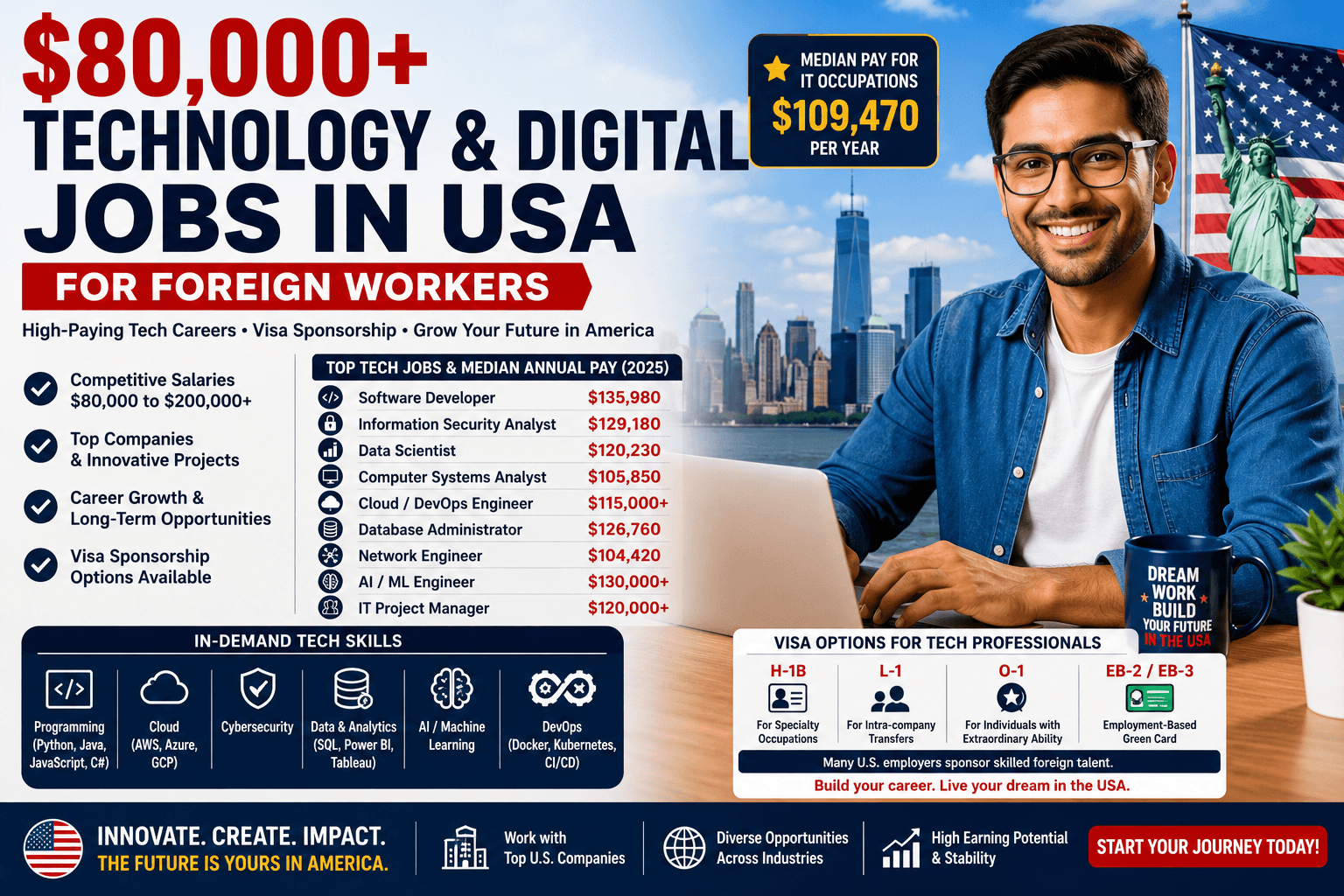
The United States has one of the world’s largest technology industries, creating career opportunities across software development, cybersecurity, data, cloud computing, artificial intelligence, networking and digital products.
For foreign technology professionals, salaries can be particularly attractive.
Current U.S. Bureau of Labor Statistics data show that computer and information technology occupations had a median annual wage of:
$109,470 in May 2025.
That was more than double the $50,980 median for all U.S. occupations.
Several individual technology careers have median salaries above $100,000.
Examples include:
- Software Developer — $135,980
- Information Security Analyst — $129,180
- Data Scientist — $120,230
- Computer Systems Analyst — $105,850
- Database Administrator and Architect category — $126,760
- Web Developer and Digital Designer category — $99,520
This makes an annual income of $80,000+ realistic across many skilled technology careers.
However, a high-paying American technology job does not automatically give a foreign worker permission to move to the United States.
Foreign applicants need to separate two questions:
Can I get the job?
and:
Do I qualify for the immigration route needed to work there?
Potential immigration options can include H-1B, L-1, O-1 and employment-based permanent-residence categories, depending on the worker and employer.
There is no universal:
“USA tech visa.”
This guide explains technology and digital jobs in the USA for foreign workers, including salaries, occupations, qualifications, visa sponsorship and how international applicants can improve their chances.
Why Work in Technology in the USA?
The American technology industry extends far beyond famous Silicon Valley companies.
Technology professionals work in:
- Software companies
- Banks
- Hospitals
- Insurance companies
- Government contractors
- Manufacturing
- Telecommunications
- Retail
- Consulting
- Universities
- Media
- Logistics
- Energy
- Automotive companies
- Startups
Almost every large modern organisation needs technology workers.
The U.S. Bureau of Labor Statistics projects computer and information technology occupations to grow faster than the average for all occupations from 2025 to 2035.
Approximately:
280,000 openings per year
are projected across computer and IT occupations over the decade, including openings caused by growth and workers leaving occupations.
Technology Salaries in USA
Technology is one of the higher-paying broad occupational groups in America.
The current median for computer and information technology occupations is:
$109,470 per year.
However, salaries vary significantly.
A junior IT support worker and an experienced software engineer should not expect the same compensation.
Factors affecting pay include:
- Occupation
- Experience
- Education
- Technical skills
- Location
- Employer
- Industry
- Security clearance requirements
- Management responsibility
- Specialisation
What Does $80,000 Per Year Mean?
An $80,000 gross annual salary equals approximately:
$6,667 per month
before taxes and deductions.
Weekly equivalent:
approximately $1,538.
At 40 hours per week, the simple hourly equivalent is:
approximately $38.46 per hour.
Salary Examples
| Annual Gross | Approx. Monthly Gross |
|---|---|
| $60,000 | $5,000 |
| $70,000 | $5,833 |
| $80,000 | $6,667 |
| $90,000 | $7,500 |
| $100,000 | $8,333 |
| $120,000 | $10,000 |
| $150,000 | $12,500 |
| $200,000 | $16,667 |
These figures are simple gross calculations rather than guaranteed salaries.
Enter an hourly wage, choose a country, and estimate monthly gross pay, tax and take-home income.
Planning estimate only. The preset uses a simplified flat percentage. Actual tax and payroll deductions can differ based on income level, province/state/region, allowances, social contributions, marital status and local tax rules.
Use the salary calculator for planning. Actual U.S. take-home pay depends on federal tax, state and local taxes where applicable, benefits, deductions and individual circumstances.
Software Developer Jobs
Software development is one of America’s largest technology professions.
Software developers design and build:
- Applications
- Business systems
- Mobile apps
- Web platforms
- Cloud services
- Enterprise software
- AI-enabled applications
According to current BLS data, software developers had a median annual wage of approximately:
$135,980 in May 2025.
The lowest-paid workers in the occupation can earn substantially less, while highly experienced developers can earn significantly more.
The highest 10% earned more than:
$214,670.
Software Developer Job Outlook
Software development also has a strong employment outlook.
BLS projects employment of software developers to grow around:
10% from 2025 to 2035.
Approximately 174,700 additional software developer jobs are projected over that period.
Demand is being supported by areas such as:
- Artificial intelligence
- Automation
- Robotics
- Internet of Things
- Business software
- Cybersecurity
Software Developer Skills
Employers can seek experience with technologies such as:
- JavaScript
- TypeScript
- Python
- Java
- C#
- C++
- Go
- React
- Node.js
- .NET
- SQL
- Cloud platforms
The exact stack depends on the employer.
Knowing every programming language is unnecessary.
Strong expertise in a relevant technology stack is usually more valuable than shallow knowledge of dozens of technologies.
Software Engineer vs Software Developer
American employers frequently use:
Software Engineer
and:
Software Developer
for overlapping positions.
Actual responsibilities matter more than the title.
A software engineer might focus on:
- System architecture
- Scalability
- Backend infrastructure
- Distributed systems
while a developer might focus more heavily on application implementation.
In practice, companies use the titles differently.
Cybersecurity Jobs
Cybersecurity is another high-value technology career.
Information Security Analysts protect organisations against:
- Cyberattacks
- Data breaches
- Malware
- Account compromise
- Network intrusion
- Security vulnerabilities
Current BLS data place the median annual wage for Information Security Analysts at:
$129,180.
The highest 10% earned more than approximately:
$199,850.
Cybersecurity Skills
Relevant skills can include:
- Network security
- SIEM
- Incident response
- Vulnerability management
- Cloud security
- Identity and access management
- Penetration testing
- Security operations
- Threat intelligence
- Governance and compliance
Certifications can also strengthen some applications.
Examples include:
- Security+
- CISSP
- CISM
- CCSP
Certification alone does not guarantee employment.
Data Scientist Jobs
Data Scientists analyse large datasets to help organisations:
- Identify patterns
- Make predictions
- Improve products
- Reduce risk
- Understand customers
- Automate decisions
Current BLS data show a median annual wage of approximately:
$120,230
for Data Scientists.
In some industries, median compensation is considerably higher.
Data Science Skills
Employers can look for:
- Python
- R
- SQL
- Statistics
- Machine learning
- Data visualisation
- Experimentation
- Predictive modelling
Strong mathematics and statistical understanding can be particularly important.
AI and Machine Learning Jobs
Artificial intelligence has become one of the most competitive technology fields in the United States.
Potential positions include:
- Machine Learning Engineer
- AI Engineer
- Applied Scientist
- NLP Engineer
- Computer Vision Engineer
- AI Researcher
- Generative AI Engineer
These positions can command high salaries, particularly at major technology companies.
However, entry barriers can also be high.
Some research-heavy positions prefer or require:
- Master’s degrees
- PhDs
- Published research
- Strong mathematical backgrounds
Engineering-focused AI jobs can place greater emphasis on software-development experience.
Cloud Engineer Jobs
Businesses increasingly operate infrastructure through cloud platforms.
Cloud professionals can work with:
- Amazon Web Services
- Microsoft Azure
- Google Cloud
Potential positions include:
- Cloud Engineer
- Cloud Architect
- Platform Engineer
- Cloud Security Engineer
- Infrastructure Engineer
Relevant skills can include:
- Linux
- Networking
- Terraform
- Kubernetes
- Docker
- CI/CD
- Cloud security
DevOps Engineer Jobs
DevOps professionals help software teams deploy and operate applications efficiently.
Typical technologies include:
- Git
- Docker
- Kubernetes
- Terraform
- Jenkins
- GitHub Actions
- AWS
- Azure
- Google Cloud
The exact job can overlap with:
- Site Reliability Engineering
- Platform Engineering
- Cloud Engineering
Computer Systems Analyst Jobs
Computer Systems Analysts help organisations improve their technology systems.
Current BLS data show a median annual wage of:
$105,850.
The occupation is projected to grow approximately:
8% from 2025 to 2035.
Systems Analysts can combine technical and business knowledge.
Network Engineer Jobs
Network professionals design, operate and secure computer networks.
Potential job titles include:
- Network Engineer
- Network Administrator
- Network Architect
- Infrastructure Engineer
BLS data show Computer Network Architects earning strong six-figure compensation nationally.
Experienced network professionals can work with:
- Cisco
- Juniper
- Firewalls
- VPNs
- Cloud networking
- SD-WAN
- Network security
Database Jobs
Organisations need professionals who can store, secure and manage data.
Jobs include:
- Database Administrator
- Database Architect
- Data Engineer
- SQL Developer
BLS data show strong six-figure earnings across database-administration and architecture occupations.
Database architecture can be particularly well paid.
Web Developer Jobs
Web developers create and maintain websites and web applications.
Current BLS data show median earnings around the high-$90,000 range for the broader web development and digital-design area.
Common skills include:
- HTML
- CSS
- JavaScript
- React
- PHP
- WordPress
- Node.js
- APIs
- SQL
Some web developers work for employers.
Others work as:
- Freelancers
- Contractors
- Agency developers
UX/UI and Digital Design Jobs
Digital technology is not limited to coding.
Digital designers create interfaces for:
- Websites
- Mobile apps
- Software
- Digital products
Relevant roles include:
- UX Designer
- UI Designer
- Product Designer
- UX Researcher
- Web and Digital Interface Designer
Skills can include:
- Figma
- Prototyping
- User research
- Information architecture
- Accessibility
- Design systems
IT Support Jobs
Not every technology worker earns $100,000.
Computer support is a major entry point into IT.
Jobs include:
- Help Desk Technician
- Desktop Support Specialist
- Technical Support Engineer
- IT Support Specialist
- Network Support Specialist
BLS May 2025 wage data show average earnings for computer support occupations below many software and cybersecurity careers.
However, specialised network support can approach or exceed the $80,000 level.
IT support can also become a stepping stone toward:
- Systems administration
- Networking
- Cybersecurity
- Cloud engineering
Technology Jobs Paying $100,000+
Several U.S. technology occupations currently have median annual pay above $100,000.
Examples include:
| Occupation | Approx. Current Median Pay |
|---|---|
| Software Developer | $135,980 |
| Information Security Analyst | $129,180 |
| Database Administrators & Architects | $126,760 |
| Data Scientist | $120,230 |
| Computer Systems Analyst | $105,850 |
| Software QA Analyst/Tester | $104,300 |
Actual salaries vary by experience, employer and location.
Technology Jobs Without a Computer Science Degree
A computer-science degree can help, but not every technology career requires the same academic path.
Employers can hire candidates with degrees in:
- Computer Science
- Software Engineering
- Information Technology
- Information Systems
- Cybersecurity
- Mathematics
- Statistics
- Engineering
Some employers also hire workers with unrelated degrees plus strong technical experience.
In certain digital occupations, portfolios and practical experience can be particularly valuable.
However, foreign workers should understand an important distinction:
Being employable and qualifying for an immigration category are not necessarily the same thing.
A self-taught developer might convince a company to hire them, while an employment-based visa category may impose additional education or equivalency requirements.
Do Foreign Workers Need a Degree?
Not universally.
It depends on:
- Job
- Employer
- Immigration category
For example, H-1B is designed for qualifying specialty occupations.
The petition needs to satisfy the legal requirements for that classification.
Therefore, do not assume:
Tech job = H-1B eligible.
H-1B for Technology Workers
H-1B is one of the best-known U.S. work-visa categories for foreign technology professionals.
It applies to qualifying:
specialty occupations.
The position generally must require highly specialised knowledge and meet the applicable degree-related requirements.
Technology positions frequently associated with H-1B petitions can include:
- Software Engineer
- Data Scientist
- Systems Analyst
- Cybersecurity Specialist
- Certain engineering and technical roles
But eligibility depends on the actual position and worker.
Is H-1B Guaranteed With a Tech Job?
No.
A company offering you a software job does not automatically guarantee an H-1B visa.
The employer must be willing and able to petition.
The position and worker must qualify.
Many H-1B petitions are also subject to the annual numerical cap and registration/selection process.
H-1B Cap
The regular H-1B programme has an annual statutory cap.
Demand can exceed the available cap numbers.
This is why many potential H-1B workers encounter a selection process before a cap-subject petition can be filed.
Being an excellent software developer does not bypass the cap by itself.
Cap-Exempt H-1B Employers
Certain employers and employment arrangements can be exempt from the ordinary H-1B numerical cap.
Examples can involve qualifying:
- Higher-education institutions
- Affiliated nonprofit organisations
- Nonprofit research organisations
- Government research organisations
This can make university and research-oriented technology careers interesting for some foreign professionals.
Cap exemption is a legal classification, not simply something an employer chooses to call itself.
L-1 Visa
Technology professionals already working for multinational companies can potentially encounter the:
L-1
intracompany-transfer category.
This route can apply to qualifying employees transferring from a related foreign organisation to a U.S. office.
It can be relevant to:
- Managers
- Executives
- Employees with specialised knowledge
This makes multinational technology companies particularly interesting for workers who already have overseas employment with the organisation.
O-1 for Technology Professionals
Highly accomplished technology professionals can potentially qualify for:
O-1 extraordinary-ability classification.
This is not an ordinary entry-level tech visa.
Evidence can involve substantial professional achievement.
Depending on the field and circumstances, evidence can include:
- Major awards
- Important publications
- Press coverage
- Critical roles
- Original contributions
- High remuneration
- Judging others’ work
The exact legal criteria matter.
Employment-Based Green Cards
Foreign technology workers can also pursue permanent residence through employment-based immigration when eligible.
Relevant categories can include:
- EB-1
- EB-2
- EB-3
depending on the worker and case.
An employer-sponsored green-card process is different from H-1B.
EB-2
EB-2 can apply to qualifying professionals with advanced degrees or individuals with exceptional ability.
In many cases, employer sponsorship and labour certification are involved.
However, certain applicants can seek a:
National Interest Waiver — NIW
where the job-offer and labour-certification requirements can be waived if the legal requirements are satisfied.
EB-2 NIW for Tech Workers
Some technology professionals investigate NIW because their work involves areas such as:
- Artificial intelligence
- Cybersecurity
- Semiconductors
- Advanced computing
- Critical infrastructure
- Scientific research
But working in a fashionable technology field does not automatically create NIW eligibility.
USCIS first requires the applicant to qualify for the underlying EB-2 classification and then satisfy the NIW requirements.
EB-3
EB-3 can cover qualifying:
- Skilled workers
- Professionals
- Other workers
Some technology professionals can potentially use the professional or skilled-worker portions of EB-3 through employer sponsorship.
Again:
tech employment does not automatically mean green-card approval.
Visa Availability
Employment-based permanent immigration can be affected by:
- Preference category
- Country of chargeability
- Priority date
- Annual visa limits
This means two workers with similar jobs can experience very different immigration timelines.
How Long Does Tech Immigration Take?
There is no universal timeline.
The process can depend on whether you are pursuing:
- H-1B
- L-1
- O-1
- EB-1
- EB-2
- EB-3
and whether additional stages are required.
USCIS historical data also show that processing times can change significantly between fiscal years.
Choose your destination and preferred entry route, then tell us how far you have progressed.
Timeline results are planning estimates only and are not a guarantee of visa approval or travel date.
Use this calculator only as a planning estimate. It does not predict or guarantee USCIS processing time, visa availability, H-1B selection or immigration approval.
Visa Sponsorship Jobs
When searching from overseas, use phrases such as:
- Software Engineer visa sponsorship USA
- Cybersecurity visa sponsorship USA
- Data Scientist H-1B sponsorship
- Cloud Engineer visa sponsorship
- International Software Engineer USA
- H-1B Software Developer jobs
- Tech jobs USA international applicants
But do not assume the phrase:
visa sponsorship available
means the employer will sponsor every candidate.
Employers Decide Whether to Sponsor
Two companies hiring the same type of engineer can have completely different immigration policies.
One may sponsor.
The other may require:
“Must already be authorised to work in the United States without current or future sponsorship.”
Read this line carefully.
It can save significant application time.
Remote USA Tech Jobs
Remote work creates another important distinction.
A U.S. company can hire someone who lives outside the United States through:
- Foreign subsidiary
- Contractor arrangement
- Employer-of-record structure
- Other lawful arrangement
If you remain physically outside the United States, you generally do not need a U.S. work visa merely because your client or employer is American.
But this does not give you permission to relocate to the United States.
Remote U.S. job ≠ U.S. immigration status.
Freelancing for American Companies
Foreign developers can also earn money from U.S. clients while living abroad.
Potential areas include:
- Web development
- App development
- SEO
- Digital advertising
- UX design
- Graphic design
- Data analysis
- Automation
- Technical writing
This is fundamentally different from immigrating to America as an employee.
Best U.S. Cities for Technology Jobs
Technology employment exists across the country.
Major markets include:
- San Francisco Bay Area
- Seattle
- New York City
- Austin
- Boston
- Washington, D.C. area
- Dallas
- Atlanta
- Denver
- Chicago
- Raleigh-Durham
Each market has different:
- Salaries
- Housing costs
- Industries
- Taxes
- Employers
Silicon Valley
The San Francisco Bay Area remains one of the world’s largest technology centres.
Major opportunities exist across:
- Software
- AI
- Cloud
- Semiconductors
- Venture-backed startups
Compensation can be extremely high.
Housing costs can also be extremely high.
Do not compare Bay Area salaries with another state without considering living costs.
Seattle
Seattle has a major concentration of:
- Cloud computing
- Software
- E-commerce
- Enterprise technology
Washington State also does not impose a traditional individual state income tax on wages, although other state and local taxes still matter.
New York
New York combines technology with:
- Finance
- Advertising
- Media
- E-commerce
- Healthcare
Fintech and financial technology can be particularly important.
Housing costs can be substantial.
Austin
Austin has grown into a major technology centre with:
- Software companies
- Semiconductor operations
- Startups
- Large corporate offices
Texas does not levy individual state income tax on wages.
Dallas-Fort Worth
Dallas-Fort Worth has a broad corporate technology market.
Opportunities exist across:
- Telecommunications
- Finance
- Defence
- Consulting
- Cloud
- Enterprise IT
Washington, D.C. Area
The Washington metropolitan area has significant demand for:
- Cybersecurity
- Cloud
- Government technology
- Defence technology
However, some positions require U.S. citizenship or security clearance.
Foreign applicants should check this before applying.
Security Clearance Jobs
Many government and defence technology vacancies mention security clearances.
Some clearance requirements can make positions unavailable to foreign nationals.
Do not spend hours applying to jobs requiring citizenship or a clearance you cannot obtain.
Read the eligibility section first.
Building a Strong Tech Resume
A strong American-style technology resume should focus on results.
Instead of:
“Responsible for maintaining website.”
Use something like:
“Reduced page-load time by 45% by optimising frontend assets and database queries.”
Quantify:
- Revenue
- Users
- Performance
- Cost savings
- Security improvements
- Automation
- Uptime
- Conversion rates
when accurate.
GitHub Portfolio
For software applicants, GitHub can demonstrate practical ability.
A strong portfolio can include:
- Real applications
- Clean documentation
- APIs
- Tests
- Deployment
- Open-source contributions
Five polished projects are usually more convincing than fifty unfinished repositories.
Foreign technology professionals should maintain a strong professional profile.
Include:
- Exact technical skills
- Work experience
- Projects
- Certifications
- Education
- Measurable achievements
Make it easy for recruiters to understand what you actually do.
Technology Certifications
Certifications can strengthen some careers.
Cloud
- AWS certifications
- Microsoft Azure certifications
- Google Cloud certifications
Cybersecurity
- CompTIA Security+
- CISSP
- CISM
- CCSP
Networking
- Cisco certifications
But certificates should support real skills rather than replace them.
Do Bootcamps Work?
Bootcamps can help people learn practical technology skills.
However, foreign applicants face an additional challenge.
A U.S. employer might accept bootcamp training for a job, while the immigration classification can require additional evidence regarding education and specialty-occupation qualifications.
Therefore, immigration planning should be considered separately.
Tech Job Scams
High U.S. salaries attract scammers.
Be suspicious of:
“Guaranteed H-1B selection.”
“Pay $15,000 for sponsorship.”
“Guaranteed Google job.”
“No interview needed.”
“Guaranteed green card for software developers.”
“Buy an American employment letter.”
No legitimate recruiter can guarantee a government immigration decision.
Fake H-1B Sponsorship
Do not pay someone to create fake employment.
Immigration fraud can cause:
- Petition denial
- Visa refusal
- Removal problems
- Misrepresentation findings
- Future immigration consequences
Use genuine employers.
Questions to Ask an Employer
If sponsorship is important, clarify:
- Does this position support immigration sponsorship?
- Does the company sponsor H-1B?
- Is this role cap-subject?
- Does the company consider other work-authorisation categories?
- Does the company sponsor permanent residence?
- When does green-card sponsorship normally begin?
- Which immigration costs does the employer cover?
Do not wait until the final interview to discover that the company never sponsors foreign workers.
USA vs Canada Tech Jobs
The United States generally offers some of the world’s highest technology salaries.
Canada can offer different immigration pathways and may be more accessible for some skilled workers.
A foreign professional should compare:
salary + immigration pathway + cost of living + long-term goals
rather than salary alone.
USA vs Germany Tech Jobs
Germany provides technology opportunities through its skilled-worker immigration system and can offer routes such as the EU Blue Card where requirements are met.
The U.S. system relies on different temporary and employment-based classifications.
German salaries can be lower than comparable U.S. salaries, while immigration pathways differ substantially.
USA vs Australia Tech Jobs
Australia offers employer-sponsored and skilled-migration routes for eligible technology professionals.
The U.S. offers higher salary potential in many roles but can involve more uncertainty for workers relying on cap-subject H-1B.
Frequently Asked Questions
Can foreigners get technology jobs in the USA?
Yes. Foreign professionals work throughout the U.S. technology industry, but they need appropriate employment authorisation.
Can tech workers earn $80,000+?
Yes. Many U.S. computer occupations have median earnings above $80,000, and several major occupations have medians above $100,000.
How much do software developers earn?
Current BLS data report a median annual wage of approximately $135,980 for software developers.
How much do cybersecurity analysts earn?
Information Security Analysts have a current median annual wage of approximately $129,180.
How much do data scientists earn?
Current BLS data report a median of approximately $120,230.
Is there a technology worker visa?
No. The United States does not have one universal visa called a technology-worker visa.
Can software engineers get H-1B?
A qualifying software position and worker can potentially meet H-1B specialty-occupation requirements, but a software job does not automatically guarantee eligibility or selection.
Can tech workers get green cards?
Yes, eligible technology professionals can potentially obtain permanent residence through employment-based immigration categories.
Do I need a computer-science degree?
Not every technology employer requires one. However, immigration classifications can have separate education and qualification requirements.
Can I work remotely for an American company from abroad?
Potentially. Working remotely from another country is different from receiving permission to physically work inside the United States.
Is visa sponsorship guaranteed?
No.
Final Thoughts
Technology and digital careers are among the best-paid professional occupations in the United States.
The median annual wage across computer and information technology occupations is currently approximately:
$109,470.
Software Developers have a median of approximately:
$135,980.
Information Security Analysts:
$129,180.
Data Scientists:
$120,230.
And Computer Systems Analysts:
$105,850.
For skilled foreign workers, that makes the United States an attractive technology destination.
But high salary does not remove immigration requirements.
There is no universal:
“tech visa.”
Depending on the worker and employer, potential routes can involve:
H-1B
L-1
O-1
or employment-based permanent immigration such as:
EB-1, EB-2 or EB-3.
The strongest strategy is to build a highly marketable specialisation, create evidence of real professional results, target genuine employers that actually consider international candidates and then identify the immigration route that matches the position.
For the Technology & Digital Jobs category, continue with C$80,000+ Technology & Digital Jobs in Canada for Foreign Workers, followed by country and occupation guides covering software development, cybersecurity, cloud computing, data science and artificial intelligence.
MimBlog is an independent information website and is not a recruitment agency, employer, immigration authority or government agency. Salaries are estimates and may vary by employer, experience and location. Job availability and immigration requirements can change. Always verify vacancies, eligibility and visa requirements through employers and official government sources.