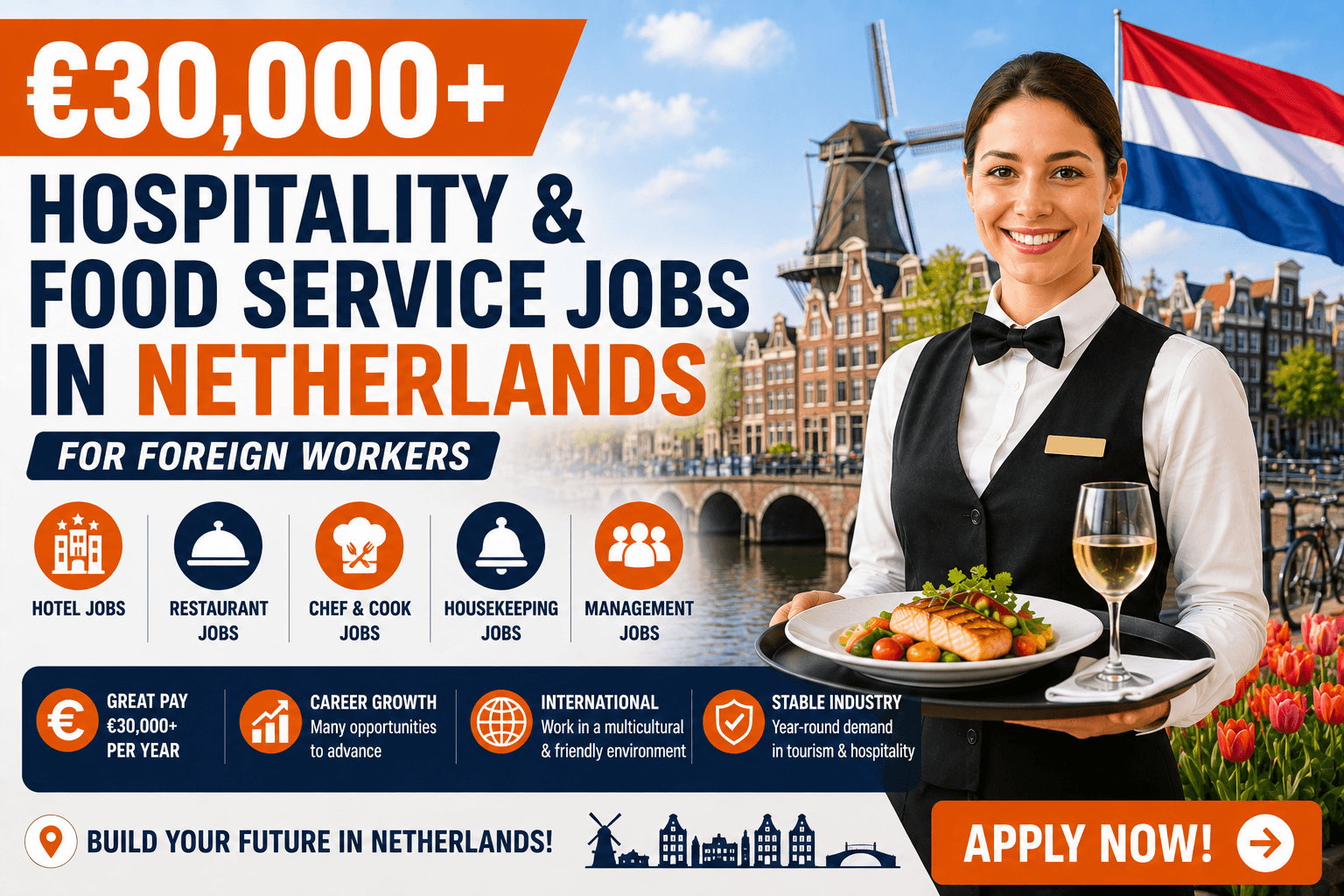
The Netherlands has a large hospitality and food-service industry supported by international tourism, business travel, restaurants, hotels, cafés, events and one of Europe’s most internationally connected economies.
Foreign workers can find hospitality opportunities across:
- Hotels
- Restaurants
- Cafés
- Resorts
- Commercial Kitchens
- Catering
- Food Service
- Housekeeping
- Guest Services
- Hospitality Management
Common positions include:
- Chef
- Cook
- Restaurant Worker
- Hotel Worker
- Waiter and Waitress
- Kitchen Assistant
- Housekeeper
- Hotel Receptionist
- Food and Beverage Worker
- Restaurant Manager
- Hotel Manager
Qualified full-time hospitality professionals can potentially earn €30,000+ per year, while experienced chefs and managers can earn considerably more.
However, foreign applicants should understand two separate questions:
Is there a hospitality job available?
and:
Can this particular job support my right to work in the Netherlands?
They are not necessarily the same thing.
Why the Netherlands Has Hospitality Jobs
The Netherlands receives substantial numbers of international tourists and business travellers.
Amsterdam is one of Europe’s most visited cities.
Hospitality demand also exists around:
- Rotterdam
- The Hague
- Utrecht
- Eindhoven
- Maastricht
- Groningen
The country hosts:
- International conferences
- Festivals
- Sporting events
- Trade fairs
- Business meetings
throughout the year.
These activities support hotels, restaurants and catering businesses.
Hospitality Salaries in Netherlands
Hospitality salaries depend on:
- Occupation
- Experience
- Employer
- Working hours
- Location
- Collective labour agreements
- Shift arrangements
Entry-level hospitality workers generally earn less than experienced chefs and managers.
For qualified workers, €30,000+ annually can be a reasonable target.
Chef Salary in Netherlands
Professional chefs can potentially earn around:
€30,000–€42,000+ annually
depending on experience and responsibility.
Senior positions can include:
- Sous Chef
- Head Chef
- Executive Chef
- Pastry Chef
- Hotel Chef
Experienced professionals at large hotels and high-end restaurants can earn more.
Cook Jobs
Cooks work in:
- Restaurants
- Hotels
- Cafés
- Catering companies
- Institutional kitchens
Experience in a commercial kitchen can significantly improve employment opportunities.
Workers should clearly document:
- Cuisine
- Experience
- Qualifications
- Food safety
- Kitchen responsibilities
when applying.
Restaurant Manager Salary
Restaurant managers can potentially earn approximately:
€35,000–€50,000+ annually
depending on establishment and experience.
Responsibilities can include:
- Staffing
- Scheduling
- Customer service
- Inventory
- Budgets
- Food safety
- Daily operations
Larger restaurant groups can offer additional management opportunities.
Hotel Manager Salary
Hotel managers can potentially earn:
€40,000–€60,000+
depending on property size and responsibility.
Senior managers at large international hotels can potentially earn more.
Monthly Salary Examples
At:
€30,000/year
gross monthly income averages:
€2,500.
At:
€35,000/year
it is approximately:
€2,917.
At:
€40,000/year
it is approximately:
€3,333.
At:
€45,000/year
it is:
€3,750.
At:
€50,000/year
it is approximately:
€4,167.
These are gross figures before Dutch income tax and applicable social contributions.
Enter an hourly wage, choose a country, and estimate monthly gross pay, tax and take-home income.
Planning estimate only. The preset uses a simplified flat percentage. Actual tax and payroll deductions can differ based on income level, province/state/region, allowances, social contributions, marital status and local tax rules.
Use the salary calculator for planning only. Actual take-home pay depends on taxable income, tax credits, individual circumstances and applicable Dutch rules.
Hotel Jobs in Netherlands
Hotels employ workers across:
- Reception
- Housekeeping
- Restaurants
- Kitchens
- Guest services
- Events
- Management
International hotel groups operate throughout the Netherlands.
English can be particularly useful in hotels serving international guests.
Restaurant Jobs
Dutch cities have restaurants serving cuisine from around the world.
Positions include:
- Chef
- Cook
- Waiter
- Kitchen Assistant
- Dishwasher
- Supervisor
- Restaurant Manager
International culinary experience can sometimes be valuable.
Café Jobs
The Netherlands has a large café culture.
Workers can find positions in:
- Coffee shops
- Bakeries
- Casual restaurants
- Lunch cafés
- Hotel cafés
Roles can include:
- Barista
- Server
- Cook
- Kitchen Worker
- Café Manager
Catering Jobs
Catering companies provide services to:
- Offices
- Conferences
- Universities
- Hospitals
- Events
- Airports
Positions can include:
- Cook
- Catering Worker
- Food Service Worker
- Supervisor
- Manager
Housekeeping Jobs
Hotel housekeepers:
- Clean guest rooms
- Replace bedding
- Restock supplies
- Clean bathrooms
- Prepare rooms
These positions can be physically demanding.
The fact that housekeeping vacancies exist does not mean they automatically provide an immigration route for applicants outside Europe.
Hotel Receptionist Jobs
Reception workers handle:
- Check-in
- Check-out
- Reservations
- Payments
- Guest questions
- Complaints
English is commonly useful.
Dutch language ability can significantly improve employment opportunities.
Waiter and Waitress Jobs
Waiting staff provide customer service in:
- Restaurants
- Hotels
- Cafés
- Events
Workers can need to:
- Take orders
- Serve meals
- Process payments
- Explain menus
English can be sufficient in some highly international workplaces, but Dutch expands the number of jobs available.
Hospitality Jobs in Amsterdam
Amsterdam has the country’s largest international hospitality market.
Opportunities exist across:
- Hotels
- Restaurants
- Tourism
- Events
- Business travel
However, Amsterdam also has expensive housing.
Applicants should compare salary against rent before relocating.
Hospitality Jobs in Rotterdam
Rotterdam is an international port and business city.
Its:
- Port
- Business sector
- Tourism
- Events
support substantial hospitality activity.
Hospitality Jobs in The Hague
The Hague hosts:
- International organisations
- Embassies
- Businesses
- Tourists
This creates demand for hotels and international restaurants.
Hospitality Jobs in Eindhoven
Eindhoven has a strong technology and international business community.
Business travel creates demand for:
- Hotels
- Restaurants
- Catering
- Events
English is widely used in many international workplaces.
Hospitality Jobs in Utrecht
Utrecht’s central location makes it important for:
- Conferences
- Tourism
- Restaurants
- Hotels
- Events
It can provide an alternative to Amsterdam.
Dutch Language
The Netherlands has very high English proficiency.
This can make it easier for foreign workers to initially communicate.
Some hospitality employers serving international customers use English extensively.
However:
English-speaking country ≠ Dutch is unnecessary.
Learning Dutch can improve opportunities for:
- Supervisory roles
- Management
- Customer service
- Long-term career progression
Can EU/EEA Citizens Work in Netherlands?
EU/EEA and Swiss citizens generally have much easier access to the Dutch labour market.
They normally do not need the same employment authorisation as third-country nationals.
This creates an important difference between European and non-European applicants.
Can Non-EU Foreigners Work in Dutch Hospitality?
Potentially.
However, applicants from outside the EU/EEA generally need appropriate immigration and employment authorisation.
Depending on the circumstances, this can involve:
- Work permit
- Combined residence and work permit
- Another qualifying residence status
The exact process depends on the worker and employment arrangement.
GVVA
The Netherlands uses the:
GVVA — Single Permit
for many non-EU workers staying and working for longer periods.
It combines residence and employment authorisation.
The employer generally plays an important role in the process.
Labour Market Test
For ordinary employment routes, an employer can face requirements concerning the availability of workers in:
- Netherlands
- EU
- EEA
This can make overseas recruitment for ordinary entry-level hospitality jobs more difficult.
An employer may need to demonstrate that suitable workers could not reasonably be found within the European labour market.
Therefore, someone applying from outside Europe should not assume that a hotel vacancy automatically means the employer can easily recruit them.
Highly Skilled Migrant Route
The Netherlands also has a Highly Skilled Migrant programme.
However, ordinary:
- Waiter
- Housekeeper
- Kitchen Assistant
- Restaurant Worker
jobs should not be marketed as Highly Skilled Migrant positions.
The route has specific:
- Employer
- Salary
- Immigration
requirements.
Typical entry-level hospitality employment does not fit the programme simply because the employer wants a foreign worker.
Recognised Sponsor
Some Dutch employers are recognised sponsors.
This can facilitate certain immigration processes.
However:
recognised sponsor ≠ every job qualifies for Highly Skilled Migrant status.
The specific employee and salary must satisfy the applicable requirements.
Chef Jobs for Non-EU Workers
Professional chefs can sometimes present a stronger case than entry-level hospitality workers because employers may need:
- Specialist culinary experience
- Specific cuisine
- Advanced kitchen skills
However, there is no automatic:
“Netherlands Chef Visa.”
The employer and worker must still qualify under an appropriate immigration route.
Asian and International Cuisine
The Netherlands has a diverse restaurant market.
Professional chefs with genuine experience in:
- Asian cuisine
- Middle Eastern cuisine
- African cuisine
- Mediterranean cuisine
- Other international cuisines
can potentially find specialist opportunities.
Applicants should be able to document their experience.
Entry-Level Hospitality Jobs
Positions such as:
- Dishwasher
- Kitchen Assistant
- Housekeeper
- Basic Food Service Worker
can be widely available.
However, they can be significantly easier to obtain for workers who already possess Dutch work rights.
For a non-EU applicant living overseas:
job availability ≠ immigration eligibility.
Student Workers
International students can work subject to the conditions attached to their residence permits.
Hospitality can be a common source of part-time employment.
However, a student residence permit should be used genuinely for study rather than treated as a shortcut into full-time hospitality employment.
Orientation Year
Certain international graduates can qualify for the Dutch orientation-year residence permit.
This can provide greater labour-market flexibility while they search for employment.
It is particularly relevant to qualifying graduates rather than being a general hospitality-worker programme.
Housing in Netherlands
Housing is one of the biggest challenges for foreign workers.
Accommodation can be expensive and difficult to find in:
- Amsterdam
- Utrecht
- Rotterdam
- The Hague
- Eindhoven
Applicants should avoid evaluating an offer purely by salary.
Compare:
salary − tax − rent − transport − food
before relocating.
Staff Accommodation
Some hotels and seasonal employers can provide accommodation.
Ask:
- Is housing included?
- Is it shared?
- What is the monthly rent?
- Are utilities included?
- Is rent deducted from salary?
- How far is it from work?
Never assume that the words:
“accommodation available”
mean free housing.
Working Hours
Hospitality often requires:
- Evenings
- Weekends
- Public holidays
- Early mornings
Applicants should understand their:
- Contract
- Hours
- Overtime
- Holiday entitlement
before accepting employment.
Employment Contract
A legitimate contract should clearly show:
- Employer
- Job
- Salary
- Working hours
- Location
- Contract duration
- Holiday arrangements
Non-EU workers should ensure the employment conditions match the immigration application.
Health Insurance
People living or working in the Netherlands can be required to obtain Dutch health insurance depending on their circumstances.
Workers should budget for health-insurance costs when estimating disposable income.
How Long Does the Process Take?
Someone who already has unrestricted Dutch work rights can have a relatively simple process:
- Prepare a CV.
- Search for vacancies.
- Apply.
- Interview.
- Sign a contract.
- Begin work.
A non-EU worker requiring employer-supported immigration can face a longer process:
- Identify suitable hospitality positions.
- Find a genuine Dutch employer.
- Confirm whether the employer can recruit a third-country national.
- Determine the required work/residence route.
- Employer completes applicable procedures.
- Submit the residence/work application.
- Provide supporting documents.
- Wait for the immigration decision.
- Travel after receiving the required approval.
- Complete Dutch registration.
- Arrange health insurance where required.
- Begin employment according to the permit conditions.
Choose your destination and preferred entry route, then tell us how far you have progressed.
Timeline results are planning estimates only and are not a guarantee of visa approval or travel date.
The wait-time calculator provides a planning estimate only.
It does not guarantee employer recruitment, labour-market approval, GVVA processing, residence approval, visa issuance, entry to the Netherlands or any decision by Dutch authorities.
Can Family Members Come?
Family options depend on the worker’s Dutch residence status.
Qualifying residents can potentially bring eligible:
- Spouses
- Partners
- Children
subject to applicable requirements.
Family members’ work rights can also depend on the sponsor’s residence category.
Check the current IND rules before making relocation plans.
Can Hospitality Workers Get Permanent Residence?
Potentially, after meeting applicable residence requirements.
Long-term residence can depend on factors including:
- Length of lawful residence
- Residence type
- Income
- Integration
- Immigration history
However:
Dutch hospitality job ≠ automatic permanent residence.
Hospitality Job Scams
Be cautious of claims such as:
“Guaranteed Netherlands hotel visa.”
“€6,000 restaurant sponsorship.”
“No documents required.”
“Guaranteed PR through housekeeping.”
“Recognised sponsor means automatic visa.”
Verify the employer and immigration pathway before paying anyone.
Building a Dutch Hospitality CV
A strong CV should highlight:
- Hospitality experience
- Job title
- Languages
- Customer service
- Food safety
- Culinary experience
- Management
English and Dutch ability should be clearly listed.
Chef CV
Chefs should highlight:
- Cuisine
- Qualifications
- Commercial kitchen experience
- Years of experience
- Menu development
- Staff supervision
- Food safety
Specialist culinary experience should be supported by genuine employment history.
Restaurant Manager CV
Managers should highlight:
- Team size
- Scheduling
- Revenue
- Customer service
- Inventory
- Training
- Budget responsibility
Leadership achievements should be measurable where possible.
Documents to Prepare
Useful documents can include:
- Passport
- CV
- Employment references
- Culinary certificates
- Hospitality qualifications
- Education records
- Employment contract
- Immigration documents
Additional documents depend on the residence pathway.
How to Find Hospitality Jobs
Useful searches include:
- Hospitality jobs Netherlands
- Hotel jobs Netherlands
- Chef jobs Netherlands
- Cook jobs Netherlands
- Restaurant jobs Amsterdam
- Hotel jobs Rotterdam
- Hospitality jobs The Hague
- Chef jobs Eindhoven
- English speaking hospitality jobs Netherlands
- Hotel jobs with accommodation Netherlands
- Hospitality jobs Netherlands foreign workers
Search both English and Dutch job titles where possible.
Frequently Asked Questions
Can foreigners work in Dutch hospitality?
Yes, provided they have appropriate work rights.
Can hospitality workers earn €30,000+?
Yes. Qualified full-time chefs and experienced hospitality workers can potentially exceed €30,000. Entry-level positions can earn less.
Can I work using only English?
Some international hotels and restaurants operate extensively in English, particularly in major cities. Dutch still expands employment opportunities.
Can chefs get work permits?
Potentially, where the employer and worker satisfy an appropriate Dutch employment and immigration pathway.
Can kitchen assistants get sponsored?
Applicants outside the EU/EEA should not assume ordinary kitchen-assistant vacancies provide straightforward immigration sponsorship.
What is GVVA?
The GVVA is a combined residence and work permit used for many third-country nationals working in the Netherlands.
Does a recognised sponsor mean any hotel job can be sponsored?
No.
Can hospitality workers get permanent residence?
Potentially after satisfying the applicable long-term residence requirements, but the job itself does not guarantee permanent residence.
Final Thoughts
The Netherlands can provide attractive hospitality opportunities for international workers.
Its:
tourism + international business + hotels + restaurants + events
support a substantial hospitality industry.
Qualified workers can potentially earn:
€30,000+ annually
while experienced:
Chefs
Restaurant Managers
and:
Hotel Managers
can earn considerably more.
English is widely spoken, which can make the Netherlands appealing to international applicants.
However, applicants from outside the EU/EEA face a more complicated employment situation than European workers.
Therefore:
hospitality vacancy ≠ work permit
recognised sponsor ≠ every vacancy qualifies
English-speaking workplace ≠ automatic immigration eligibility
and:
Dutch hospitality job ≠ guaranteed permanent residence.
A stronger strategy is:
build professional hospitality experience → target skilled positions → learn some Dutch → identify employers genuinely able to recruit non-EU workers → verify the correct residence/work route → compare salary with housing costs → relocate only after receiving the required authorization.
MimBlog is an independent information website and is not a recruitment agency, employer, immigration authority or government agency. Salaries are estimates and may vary by employer, experience and location. Job availability and immigration requirements can change. Always verify vacancies, eligibility and visa requirements through employers and official government sources.