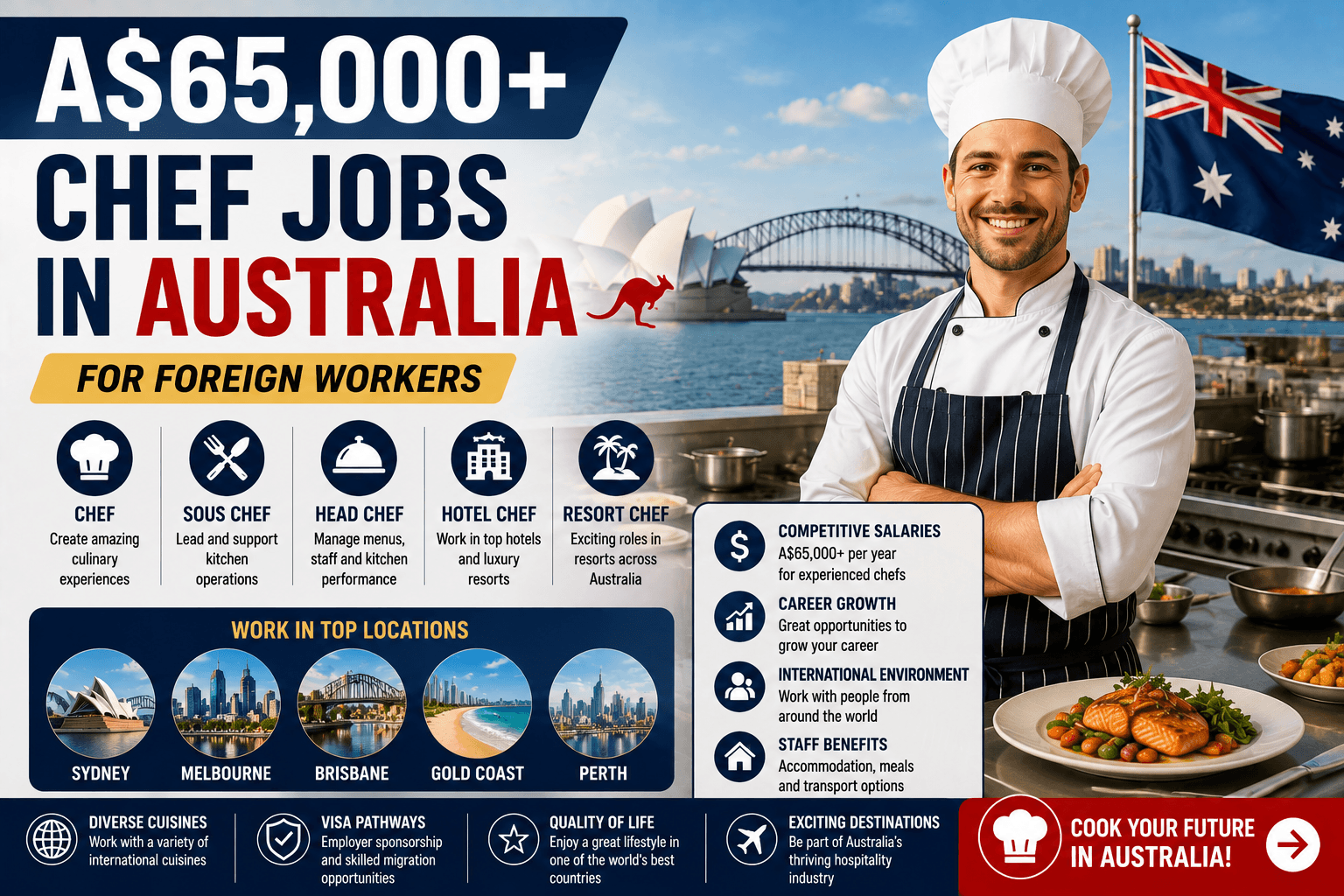
Australia has a large hospitality industry supported by restaurants, hotels, resorts, cafés, tourism and major events.
Professional chefs are employed throughout the country in:
- Restaurants
- Hotels
- Resorts
- Commercial kitchens
- Catering companies
- Private clubs
- Tourism businesses
For foreign workers with professional culinary experience, Australia can provide attractive opportunities.
Full-time chefs can potentially earn A$65,000+ per year, while experienced sous chefs, head chefs and executive chefs can earn considerably more.
Australia also has employer-sponsored and skilled-migration pathways that can be relevant to qualifying chefs.
However:
Chef job ≠ automatic Australian visa.
The worker, occupation, employer and immigration pathway must satisfy the applicable requirements.
How Much Do Chefs Earn in Australia?
Chef salaries vary according to:
- Experience
- Location
- Employer
- Qualifications
- Restaurant type
- Responsibility
- Working hours
For experienced full-time chefs, salaries around:
A$65,000–A$85,000+ annually
can be realistic.
Senior culinary professionals can earn more.
Monthly Chef Salary
At:
A$65,000/year
gross monthly income averages approximately:
A$5,417.
At:
A$70,000/year
it is approximately:
A$5,833.
At:
A$75,000/year
it is:
A$6,250.
At:
A$80,000/year
it is approximately:
A$6,667.
At:
A$90,000/year
it is:
A$7,500.
At:
A$100,000/year
it is approximately:
A$8,333.
These figures are before applicable Australian income tax and other deductions.
Enter an hourly wage, choose a country, and estimate monthly gross pay, tax and take-home income.
Planning estimate only. The preset uses a simplified flat percentage. Actual tax and payroll deductions can differ based on income level, province/state/region, allowances, social contributions, marital status and local tax rules.
Use the salary calculator for planning only. Actual Australian take-home income depends on taxable income, residency for tax purposes, applicable tax rates and individual circumstances.
Types of Chef Jobs in Australia
Professional kitchen roles include:
- Chef
- Chef de Partie
- Sous Chef
- Head Chef
- Executive Chef
- Pastry Chef
- Banquet Chef
- Resort Chef
The experience required increases significantly for senior positions.
Chef de Partie Jobs
A Chef de Partie is normally responsible for a particular section of a commercial kitchen.
Sections can include:
- Grill
- Sauce
- Fish
- Pastry
- Vegetables
The position can provide a progression route toward sous-chef roles.
Sous Chef Jobs
Sous chefs are senior kitchen professionals.
Responsibilities can include:
- Supervising kitchen workers
- Preparing food
- Maintaining quality
- Training staff
- Managing stock
- Supporting menu development
Experienced sous chefs can potentially earn above the general chef salary range.
Head Chef Jobs
Head chefs can manage:
- Kitchen teams
- Menus
- Food purchasing
- Food costs
- Scheduling
- Hygiene
- Quality control
Management responsibility generally leads to higher earning potential.
Executive Chef Jobs
Executive chefs can oversee large food operations.
Employers can include:
- Luxury hotels
- Resorts
- Casinos
- Restaurant groups
- Large catering businesses
These are senior positions requiring substantial professional experience.
Pastry Chef Jobs
Pastry chefs specialise in:
- Cakes
- Desserts
- Pastries
- Bread
- Chocolate
Employment opportunities can exist in:
- Hotels
- Restaurants
- Bakeries
- Resorts
Specialist experience can improve employability.
Restaurant Chef Jobs
Restaurants are among the largest employers of chefs in Australia.
Opportunities exist across:
- Fine dining
- Casual dining
- International cuisine
- Pubs
- Hotel restaurants
- Restaurant chains
Commercial kitchen experience is usually important.
Hotel Chef Jobs
Australian hotels employ chefs for:
- Restaurants
- Banquets
- Breakfast
- Events
- Room service
International hotel experience can strengthen applications.
Resort Chef Jobs
Australia has resorts throughout:
- Queensland
- New South Wales
- Victoria
- Western Australia
- Tasmania
- Northern Territory
Some remote and tourism employers can provide staff accommodation.
This can be particularly valuable in expensive or isolated locations.
Chef Jobs in Sydney
Sydney has one of Australia’s largest restaurant and hospitality industries.
Chefs can find opportunities in:
- Hotels
- Restaurants
- Catering
- Clubs
- Event venues
However, housing costs are high.
Workers should compare salary against accommodation expenses.
Chef Jobs in Melbourne
Melbourne is internationally known for its:
- Restaurants
- Cafés
- Food culture
The city has substantial demand for professional kitchen workers across a wide range of cuisines.
Chef Jobs in Brisbane
Brisbane’s growing population and tourism industry support:
- Restaurants
- Hotels
- Events
- Catering
Queensland’s broader tourism industry also creates opportunities outside Brisbane.
Chef Jobs on the Gold Coast
The Gold Coast has substantial tourism demand.
Hotels, restaurants and resorts can recruit:
- Chefs
- Sous Chefs
- Pastry Chefs
- Kitchen Supervisors
Tourism seasons can influence recruitment.
Chef Jobs in Perth
Perth has a large hospitality market.
Western Australia’s remote tourism and resource communities can also create opportunities for experienced cooks and chefs.
Remote Chef Jobs
One distinctive part of Australia’s food-service market is remote-site employment.
Chefs can work at:
- Mining camps
- Remote accommodation sites
- Tourism operations
These positions can involve roster arrangements such as fly-in/fly-out employment.
Remote work can pay more than ordinary restaurant employment, but conditions can be demanding.
Chef Jobs in Adelaide
Adelaide has a strong food and wine culture.
Opportunities exist across:
- Restaurants
- Hotels
- Wineries
- Tourism businesses
South Australia’s wine regions can also create hospitality employment.
Chef Jobs in Tasmania
Tasmania’s tourism and food industries support chef employment in:
- Hobart
- Launceston
- Resorts
- Regional tourism businesses
Some regional employers can experience recruitment difficulties.
International Cuisine
Australia’s multicultural population supports restaurants serving cuisines from around the world.
Experienced chefs can specialise in:
- Indian cuisine
- Chinese cuisine
- Japanese cuisine
- Korean cuisine
- Thai cuisine
- Vietnamese cuisine
- Middle Eastern cuisine
- African cuisine
- Mediterranean cuisine
- European cuisine
Specialist experience should be clearly documented.
Qualifications for Chef Jobs
Employers can look for:
- Commercial cookery qualifications
- Professional experience
- Food-safety knowledge
- Kitchen management
- Specialist culinary skills
Qualifications can also matter for immigration and skills-assessment purposes.
Commercial Cookery Qualifications
Australian chefs commonly have vocational qualifications in commercial cookery.
Foreign qualifications do not automatically become Australian qualifications simply because they cover similar material.
For immigration purposes, a formal skills assessment can be required depending on the visa pathway.
Chef Skills Assessment
Some skilled migration and employer-sponsored pathways require applicants to demonstrate that their skills satisfy Australian standards.
This can involve assessment of:
- Qualifications
- Employment history
- Practical skills
The applicable assessing authority and process depend on the occupation and visa route.
English Language
English is important for professional kitchen work.
Chefs need to communicate with:
- Kitchen employees
- Managers
- Suppliers
- Front-of-house workers
Certain Australian immigration pathways also impose formal English-language requirements.
Can Foreign Chefs Work in Australia?
Yes.
Foreign chefs can work in Australia if they hold appropriate work rights.
Potential pathways can include:
- Employer-sponsored visas
- Skilled migration
- Working Holiday arrangements for eligible applicants
- Other qualifying visas
Eligibility depends on the individual.
Employer Sponsorship
Australia has employer-sponsored immigration pathways for qualifying workers.
An employer cannot simply issue an Australian work visa.
The employer and worker must satisfy the requirements of the relevant programme.
Professional chef positions can potentially be relevant to employer sponsorship where current occupation and immigration requirements are met.
Skills in Demand Visa
Australia’s Skills in Demand visa provides an employer-sponsored route for qualifying workers.
Eligibility can depend on factors including:
- Occupation
- Sponsoring employer
- Salary
- Work experience
- English
- Other immigration requirements
Applicants should verify the current occupation eligibility before relying on a job offer.
Sponsorship Is Not Guaranteed
A restaurant advertising:
Chef Wanted
does not necessarily mean:
Visa Sponsorship Available.
Similarly:
Visa Sponsorship Available
does not mean the applicant is automatically eligible.
The employer and applicant must both meet the applicable requirements.
Skilled Migration
Chefs can potentially be relevant to Australia’s skilled-migration system when the occupation is eligible under the applicable programme.
Possible skilled pathways can involve:
- Points
- Age
- English
- Skills assessment
- Work experience
- State nomination
depending on the visa.
State Nomination
Australian states and territories can operate nomination programmes for skilled workers.
Occupation availability and requirements can change.
A chef eligible in one jurisdiction is not automatically eligible in another.
Applicants should check current state or territory requirements.
Regional Australia
Regional employment can be particularly interesting for chefs.
Hotels, restaurants and tourism businesses outside the largest cities can have difficulty recruiting experienced workers.
Regional migration programmes can also have different occupation and immigration arrangements.
Potential destinations include communities across:
- Queensland
- South Australia
- Tasmania
- Western Australia
- Northern Territory
and eligible regional areas elsewhere.
Working Holiday Visa
Eligible young people from participating countries can use Australia’s Working Holiday arrangements.
Hospitality is a common source of employment.
Eligibility depends on:
- Passport
- Age
- Visa subclass
- Other requirements
Not every nationality qualifies.
Working Holiday visas should not be confused with permanent employer sponsorship.
Food Safety
Professional kitchens must comply with applicable Australian food-safety requirements.
Chefs should understand:
- Hygiene
- Food storage
- Temperature control
- Allergens
- Cross-contamination
Food-safety certification requirements can vary by jurisdiction and role.
Working Hours
Chef work can involve:
- Evenings
- Weekends
- Public holidays
- Early mornings
- Split shifts
Workers should understand the applicable:
- Award
- Enterprise agreement
- Employment contract
before accepting a position.
Penalty Rates
Australian hospitality employees can potentially receive higher rates for certain:
- Weekend
- Public holiday
- Late-night
- Overtime
work depending on the applicable award or agreement.
Therefore, actual earnings can differ from base salary.
Superannuation
Eligible Australian employees generally receive compulsory employer superannuation contributions under Australian rules.
This is separate from ordinary take-home salary.
Workers comparing international job offers should consider superannuation as part of the broader compensation structure.
Staff Accommodation
Some:
- Resorts
- Regional hotels
- Remote employers
provide or arrange accommodation.
Ask:
- Is accommodation included?
- What does it cost?
- Is it shared?
- Are meals included?
- Is transport provided?
How Long Does the Process Take?
Someone already holding Australian work rights can have a relatively simple recruitment process:
- Prepare an Australian-style CV.
- Search for chef vacancies.
- Apply.
- Interview.
- Receive an offer.
- Begin work according to existing visa conditions.
An overseas chef requiring employer sponsorship can face a longer process:
- Prepare a professional chef CV.
- Gather culinary qualifications.
- Gather employment references.
- Determine whether a skills assessment is required.
- Complete the applicable assessment where necessary.
- Search for genuine Australian employers.
- Apply for chef vacancies.
- Complete interviews.
- Receive a qualifying employment offer.
- Employer completes applicable sponsorship or nomination requirements.
- Prepare the visa application.
- Provide English evidence where required.
- Complete health and character requirements.
- Wait for the immigration decision.
- Travel after approval.
- Begin employment according to visa conditions.
Choose your destination and preferred entry route, then tell us how far you have progressed.
Timeline results are planning estimates only and are not a guarantee of visa approval or travel date.
The wait-time calculator provides a planning estimate only.
It does not guarantee skills-assessment completion, employer sponsorship, nomination, visa processing time, visa approval, entry to Australia or any decision by the Australian government.
Can Family Members Come?
Many Australian skilled and employer-sponsored visa categories can allow qualifying family members to be included or accompany the main applicant.
Requirements depend on the visa and individual circumstances.
Applicants should verify current rules before making relocation plans.
Can Chef Jobs Lead to Permanent Residence?
Potentially.
Some chefs can eventually qualify for permanent residence through an appropriate skilled or employer-sponsored pathway.
Eligibility can depend on:
- Age
- English
- Occupation
- Skills assessment
- Experience
- Employer
- State nomination
- Visa history
However:
Australian chef job ≠ automatic permanent residence.
Cost of Living
Australian salaries can be attractive, but housing costs can be high in:
- Sydney
- Melbourne
- Brisbane
Regional locations can sometimes provide a different balance between salary and housing.
Workers should compare:
salary − tax − rent − transport − food
before accepting an offer.
Chef Job Scams
Foreign applicants should be cautious about advertisements claiming:
“Guaranteed Australia chef visa.”
“Pay A$15,000 for sponsorship.”
“No experience required — chef sponsorship.”
“Guaranteed PR after one year.”
No recruiter can guarantee a government visa decision.
Building an Australian Chef CV
A strong chef CV should highlight:
- Culinary qualifications
- Years of experience
- Cuisine
- Commercial kitchen experience
- Food safety
- Staff supervision
- Menu development
Use measurable experience.
For example:
Sous Chef — supervised a 10-person commercial kitchen producing approximately 300 covers per day.
Use only information that is accurate.
Documents to Prepare
Useful documents can include:
- Passport
- CV
- Culinary qualifications
- Employment references
- Food-safety certificates
- English-language evidence
- Skills-assessment documents
- Employment contract
Additional documents depend on the visa pathway.
How to Find Chef Jobs in Australia
Useful searches include:
- Chef jobs Australia
- Chef jobs Australia foreign workers
- Chef sponsorship jobs Australia
- Sous Chef jobs Australia
- Head Chef jobs Australia
- Hotel Chef jobs Australia
- Chef jobs Sydney
- Chef jobs Melbourne
- Chef jobs Queensland
- Regional Chef jobs Australia
- Chef jobs with accommodation Australia
Applicants requiring sponsorship should focus on legitimate employers and verify immigration eligibility independently.
Frequently Asked Questions
Can chefs earn A$65,000+ in Australia?
Yes. Many experienced full-time chefs can potentially earn A$65,000+ annually, with senior chefs earning more.
Does Australia hire foreign chefs?
Yes. Foreign chefs can work in Australia when they hold an appropriate visa or work authorization.
Can chefs get employer sponsorship?
Potentially, when the occupation, employer and applicant satisfy the requirements of an eligible employer-sponsored pathway.
Do chefs need a skills assessment?
Some immigration pathways require a positive skills assessment. The requirement depends on the visa and occupation circumstances.
Are regional chef jobs available?
Yes. Restaurants, hotels and resorts across regional Australia can recruit chefs, and regional immigration pathways can sometimes be relevant.
Can chef employment lead to permanent residence?
Potentially through a qualifying migration pathway, but employment alone does not guarantee PR.
Final Thoughts
Australia can provide attractive opportunities for professional foreign chefs.
Experienced full-time chefs can potentially earn:
A$65,000+ annually
while:
Sous Chefs
Head Chefs
and:
Executive Chefs
can earn considerably more.
Opportunities exist across:
restaurants + hotels + resorts + catering + regional tourism + remote operations.
Australia can also offer employer-sponsored and skilled-migration pathways to qualifying chefs.
However:
chef vacancy ≠ sponsorship
sponsorship ≠ guaranteed visa
A$65,000 salary ≠ automatic immigration eligibility
and:
Australian chef employment ≠ automatic permanent residence.
Foreign chefs should build strong commercial kitchen experience, maintain clear qualification and employment records, verify skills-assessment requirements and target legitimate employers offering genuine professional chef positions.
MimBlog is an independent information website and is not a recruitment agency, employer, immigration authority or government agency. Salaries are estimates and may vary by employer, experience and location. Job availability and immigration requirements can change. Always verify vacancies, eligibility and visa requirements through employers and official government sources.