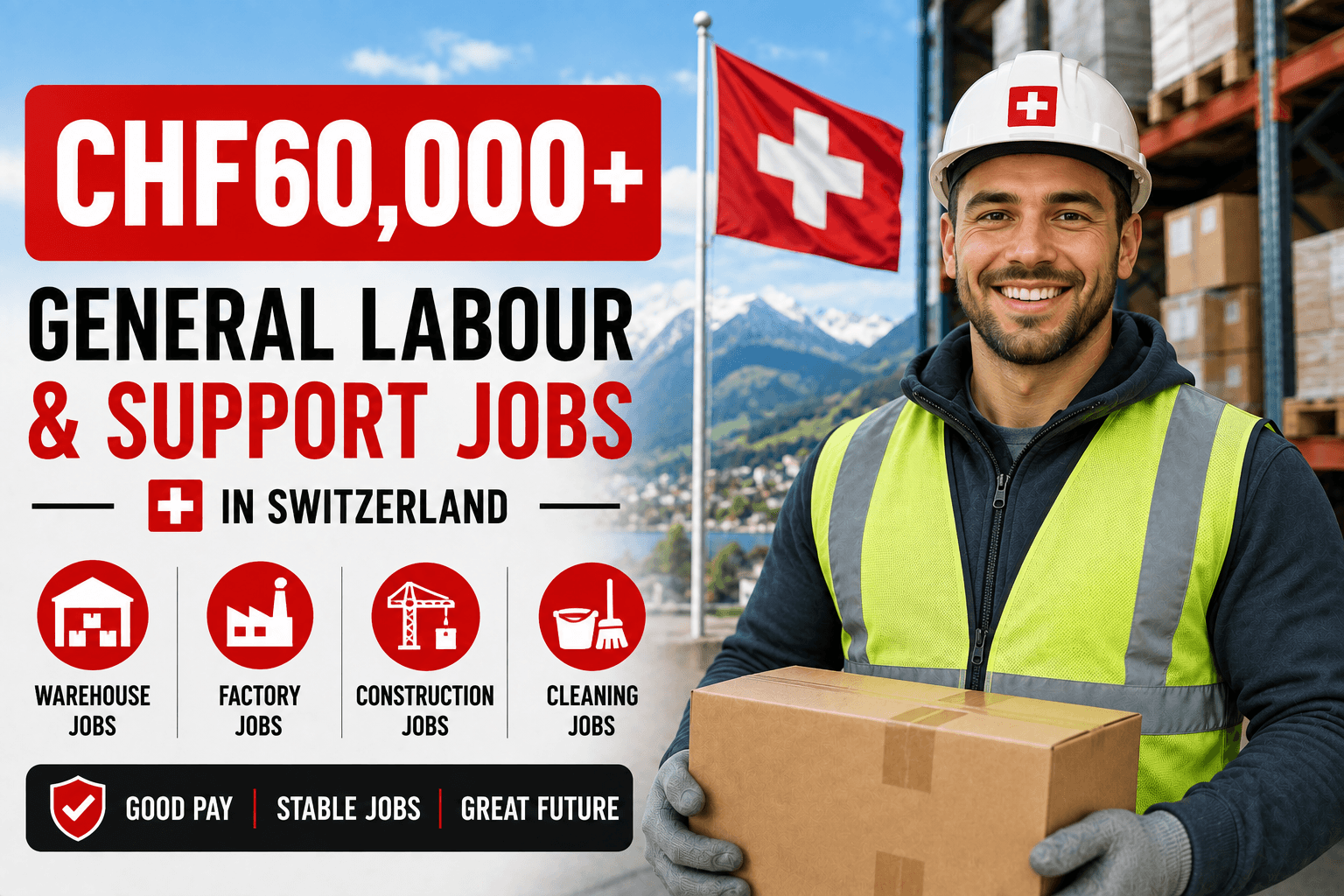
Switzerland has one of the highest-wage economies in Europe, supported by advanced manufacturing, pharmaceuticals, logistics, construction, food production, hospitality and specialised industrial businesses. Although Switzerland is widely associated with banking, pharmaceuticals and highly skilled professional employment, thousands of workers are also employed in practical General Labour & Support roles that keep warehouses, factories, construction projects, hotels and production facilities operating.
For foreign workers, Switzerland can appear particularly attractive because wages are considerably higher than in many European countries. A full-time worker in a stronger-paying labour position can potentially earn CHF60,000+ annually, although salaries vary substantially by occupation, canton, experience and employer.
For example, a worker earning CHF5,000 gross per month would receive approximately CHF60,000 annually before deductions. At CHF5,500 per month, gross annual earnings would be approximately CHF66,000, while CHF6,000 per month would equal CHF72,000.
However, Switzerland also has a high cost of living and one of Europe’s more restrictive labour-immigration systems for workers from outside the EU/EFTA.
This distinction is critical.
Swiss job vacancy ≠ automatic Swiss work permit.
How Much Do General Labour Workers Earn in Switzerland?
General labour wages vary according to canton, industry, collective agreements, qualifications and experience.
Switzerland does not operate around one simple nationwide salary level for every General Labour occupation.
Basic cleaning, hospitality-support and entry-level packing positions can earn less than CHF60,000 annually.
Workers in construction, manufacturing, logistics and specialised industrial operations can earn considerably more.
For illustration:
CHF4,000 per month = CHF48,000 annually.
CHF4,500 per month = CHF54,000 annually.
CHF5,000 per month = CHF60,000 annually.
CHF5,500 per month = CHF66,000 annually.
CHF6,000 per month = CHF72,000 annually.
Workers should also check whether an advertised salary is calculated across 12 or 13 salary payments because a 13th-month salary is common in parts of the Swiss labour market.
Enter an hourly wage, choose a country, and estimate monthly gross pay, tax and take-home income.
Planning estimate only. The preset uses a simplified flat percentage. Actual tax and payroll deductions can differ based on income level, province/state/region, allowances, social contributions, marital status and local tax rules.
The salary calculator provides a planning estimate only. Actual Swiss take-home income depends on canton, municipality, social-security deductions, pension contributions, accident insurance, withholding tax where applicable and individual circumstances.
What Are General Labour & Support Jobs?
General labour covers practical occupations supporting business operations.
Workers can move products, prepare orders, clean workplaces, operate production lines and assist skilled employees.
Common jobs include General Labourer, Warehouse Worker, Logistics Worker, Production Worker, Factory Worker, Construction Labourer, Packaging Worker, Cleaner, Forklift Driver, Kitchen Assistant and Maintenance Helper.
Switzerland has several major language regions.
Job titles can therefore appear in German, French or Italian.
Understanding the local terminology can substantially improve job-search results.
Warehouse Worker Jobs
Warehouses support Switzerland’s retail, manufacturing, pharmaceutical and logistics industries.
Warehouse Workers receive products, organise inventory and prepare outgoing shipments.
Employers can require experience with scanners, inventory systems and material-handling equipment.
Because Switzerland has several official languages, language expectations depend heavily on location.
German is particularly valuable in the country’s largest employment region.
Lagermitarbeiter Jobs
In German-speaking Switzerland, Lagermitarbeiter is a common term for Warehouse Worker.
Employees can receive deliveries, organise goods and prepare shipments.
Jobs can be available around Zurich, Basel, Bern, Lucerne and other German-speaking areas.
Employers can expect applicants to understand workplace instructions in German.
Lagerist Jobs
Lagerist is another term applicants can encounter in German-speaking Switzerland.
The role generally involves warehouse and inventory responsibilities.
Experienced workers can handle receiving, stock control and dispatch.
Equipment experience can improve employability.
Logistics Worker Jobs
Switzerland has sophisticated logistics networks connecting it with Germany, France, Italy, Austria and the rest of Europe.
Logistics employees support distribution centres, manufacturers and freight businesses.
The Basel region is particularly important because of its location near both Germany and France.
Zurich also provides substantial logistics employment.
Logistiker Jobs
The German term Logistiker can refer to trained logistics professionals.
Applicants should pay attention to qualification requirements because some Swiss logistics occupations involve recognised vocational training.
These positions can offer stronger salaries than basic warehouse-helper jobs.
Forklift Driver Jobs
Forklift Drivers move pallets and goods around warehouses and industrial facilities.
Relevant equipment experience can increase earning potential.
Employers can require recognised training.
Forklift workers employed in large industrial facilities can have stronger salary prospects than basic warehouse employees.
Factory Worker Jobs
Switzerland has advanced manufacturing across pharmaceuticals, chemicals, machinery, precision engineering, medical technology and food production.
Factory employees can support production processes, prepare materials and inspect finished products.
Swiss industrial employment can provide attractive wages.
However, employers frequently expect workers to have relevant experience.
Production Worker Jobs
Production Workers operate around manufacturing lines and industrial equipment.
Responsibilities can include preparing materials, monitoring production and checking quality.
Switzerland’s pharmaceutical and medical-device sectors also employ production personnel.
Regulated manufacturing environments can require strict documentation and hygiene procedures.
Produktionsmitarbeiter Jobs
Produktionsmitarbeiter is a useful German-language search term.
These workers support manufacturing operations.
Jobs can exist in pharmaceuticals, food production, engineering and other industrial businesses.
Shift work is common in facilities operating continuously.
Night and weekend schedules can provide additional compensation depending on the employment agreement.
Machine Operator Jobs
Machine Operators generally have more specialised responsibilities.
Employees operate production equipment and monitor manufacturing processes.
Technical experience can significantly increase earnings.
Workers who begin in basic production can potentially progress toward machine operation through training and experience.
Pharmaceutical Production Jobs
Switzerland has one of the world’s strongest pharmaceutical industries.
Basel is particularly important.
Production facilities require employees for manufacturing, packaging, quality-related support and logistics.
However, pharmaceutical manufacturing can have higher entry requirements than ordinary factory work.
Employers can require previous experience in regulated production environments.
Food Production Jobs
Food factories employ Production Workers, Packers and Machine Operators.
Employees can prepare ingredients, operate production equipment and package finished products.
Strict hygiene requirements apply.
Some food-production jobs involve cold environments.
Workers can also have early morning or night schedules.
Packaging Worker Jobs
Packaging Workers prepare products for distribution.
Jobs exist across food production, pharmaceuticals, manufacturing and logistics.
Employees can package products, label goods and inspect finished items.
Basic packaging jobs can pay below CHF60,000 annually.
Workers with machinery or regulated-industry experience can potentially earn more.
Construction Labourer Jobs
Construction provides strong earning potential for practical workers.
Switzerland has residential, commercial and infrastructure construction projects throughout the country.
Construction Labourers prepare sites, move materials and assist tradespeople.
Physical fitness and workplace safety are essential.
Workers with specialised construction experience can command higher wages.
Bauarbeiter Jobs
Bauarbeiter is a useful German term for Construction Worker.
Employees can work on buildings, roads and infrastructure projects.
Experience in concrete, groundworks and other specialised areas can improve employment prospects.
Swiss construction employers can expect workers to communicate in the regional language.
Bauhelfer Jobs
Bauhelfer generally refers to a Construction Helper.
Workers support experienced construction employees.
Responsibilities can include carrying materials, preparing equipment and maintaining worksites.
Basic positions can provide entry into construction.
However, progression toward skilled work can significantly improve earnings.
Road Construction Jobs
Infrastructure projects require workers for road building and maintenance.
Employees can prepare surfaces and assist equipment operators.
Outdoor work continues under changing weather conditions.
Relevant construction experience can improve access to these jobs.
Cleaning Jobs
Cleaners work across offices, hospitals, hotels, schools, airports and industrial facilities.
In German-speaking Switzerland, Reinigungskraft is a common search term.
In French-speaking regions, applicants can encounter terms such as agent de nettoyage.
Basic cleaning positions can pay below CHF60,000.
Industrial and specialised cleaning can offer higher earnings.
Industrial Cleaner Jobs
Industrial Cleaners work around factories, production facilities and warehouses.
Workers can clean specialised environments and equipment areas.
Safety training and protective equipment can be required.
Industrial cleaning can provide stronger wages than basic domestic cleaning.
Hospital Support Jobs
Hospitals require cleaners, kitchen workers, logistics employees and other support staff.
Switzerland has high standards for healthcare facilities.
Employees can need appropriate language ability and workplace training.
Support positions should not be confused with regulated healthcare professions, which can have separate qualification requirements.
Hotel Support Jobs
Switzerland’s tourism industry provides substantial hospitality employment.
Hotels and resorts employ Housekeeping Workers, Kitchen Assistants, Cleaners and Maintenance Workers.
Zurich, Geneva and major tourism regions provide opportunities.
Mountain resorts can also recruit seasonal employees.
Accommodation can sometimes be included or subsidised by hospitality employers, particularly in resort areas.
Kitchen Assistant Jobs
Kitchen Assistants support restaurants, hotels and institutional kitchens.
Employees clean equipment and help organise food-preparation areas.
Formal education requirements can be limited.
Language skills are still useful.
Hospitality employees in tourism areas can interact with international teams.
Maintenance Helper Jobs
Maintenance Helpers support building and equipment maintenance.
Workers can assist technicians and perform basic repairs.
Mechanical knowledge is valuable.
Workers who develop technical qualifications can progress toward higher-paying maintenance positions.
Moving Jobs
Moving companies require employees to transport furniture and other belongings.
Physical fitness is important.
Workers with appropriate driving qualifications can potentially progress into vehicle-driving roles.
Language ability can also be important because employees interact directly with customers.
General Labour Jobs in Zurich
Zurich has Switzerland’s largest metropolitan economy.
Warehousing, construction, manufacturing, airport operations, cleaning and hospitality create practical employment.
Wages can be high.
However, Zurich is also one of Europe’s most expensive cities.
Housing costs can consume a substantial part of a General Labourer’s income.
Workers should compare net salary with rent before relocating.
General Labour Jobs in Geneva
Geneva has employment across hospitality, construction, logistics, cleaning and international services.
French is the dominant local language.
English can be useful in international environments.
However, French substantially improves access to practical employment.
Housing costs are extremely high.
Some workers live outside central Geneva or commute from neighbouring areas.
General Labour Jobs in Basel
Basel is particularly important for pharmaceuticals, chemicals, manufacturing and logistics.
Its location near Germany and France makes it a major cross-border employment region.
German is important for many jobs.
Large industrial employers can provide strong wages.
Competition can nevertheless be significant.
General Labour Jobs in Bern
Bern provides construction, logistics, manufacturing and public-service employment.
German is important for most practical positions.
Workers can also encounter Swiss German in everyday workplace communication.
Housing costs can be lower than central Zurich or Geneva but remain high compared with many other countries.
General Labour Jobs in Lausanne
Lausanne provides employment across hospitality, construction, logistics and services.
French is the dominant language.
Workers seeking General Labour employment should therefore consider learning practical workplace French.
The wider Lake Geneva region has a strong economy but high housing costs.
General Labour Jobs in Lucerne
Lucerne has tourism, hospitality, construction and service employment.
Hotels can recruit Housekeeping Workers and Kitchen Assistants.
German is particularly valuable.
Tourism can create seasonal fluctuations in labour demand.
Do General Labour Jobs Require a Degree?
Many do not.
Basic warehouse, cleaning, packaging and construction-support positions can focus primarily on practical ability.
Employers can value previous experience more than university education.
However, vocational qualifications are important in Switzerland.
Workers with recognised apprenticeships or technical training can access better-paid skilled occupations.
Foreign applicants must also understand:
no degree required for job ≠ no Swiss immigration requirements.
This is particularly important for non-EU/EFTA applicants.
Language Requirements
Switzerland has four national languages: German, French, Italian and Romansh.
The most useful language depends on location.
German is dominant across much of the country.
French is particularly important in Geneva, Lausanne and western Switzerland.
Italian is important in Ticino.
English can be useful in multinational businesses.
However, English-only General Labour opportunities are considerably more limited than English-language professional jobs.
Workers should therefore learn the language of their target region.
Can Foreigners Work in General Labour Jobs in Switzerland?
Yes, but nationality matters enormously.
EU/EFTA citizens have substantially easier access to Swiss employment.
Third-country nationals face much stricter requirements.
This makes Switzerland very different from countries where ordinary labour jobs can sometimes support large temporary foreign-worker programs.
EU/EFTA Workers
Citizens of EU/EFTA countries benefit from Switzerland’s arrangements governing freedom of movement, subject to applicable rules.
They therefore have much broader access to Swiss employment.
An EU/EFTA citizen can realistically apply for many warehouse, factory, construction and hospitality positions.
Registration and residence requirements can still apply depending on employment duration and circumstances.
Cross-Border Workers
Switzerland has many employees who live in neighbouring countries and commute into Switzerland.
This is particularly common around Geneva, Basel and Ticino.
Cross-border employment can allow workers to earn Swiss salaries while living in France, Germany or Italy.
Specific permit, tax and social-security rules apply.
Applicants should not assume cross-border status is available regardless of nationality and residence.
Non-EU/EFTA Workers
Applicants from countries outside the EU/EFTA face much more restrictive admission requirements.
Swiss immigration policy generally prioritises highly qualified workers from third countries.
Employers seeking to recruit third-country nationals can face requirements relating to qualifications, labour-market priority and quotas.
This creates a major limitation for overseas applicants seeking ordinary General Labour employment.
An entry-level Warehouse Helper can be a perfectly legitimate Swiss job but still be unsuitable as a direct immigration pathway for a non-EU/EFTA applicant.
Highly Qualified Third-Country Workers
Third-country nationals generally have stronger prospects when they possess significant professional qualifications.
Managers, specialists and other highly qualified professionals are more likely to fit Switzerland’s employment-permit framework.
This means an experienced industrial engineer can have very different immigration prospects from a basic Factory Helper.
Applicants should evaluate immigration eligibility before spending money on relocation plans.
Employer Sponsorship
The term “visa sponsorship” can be misleading in Switzerland.
An employer wanting to hire a third-country national generally needs to participate in the permit process and demonstrate that the employment satisfies applicable requirements.
The employer cannot simply guarantee approval.
Cantonal and federal authorities can be involved.
Therefore:
Swiss employer offer ≠ guaranteed work permit.
Labour Market Priority
For many third-country employment applications, employers can need to demonstrate that a suitable worker could not be recruited from Switzerland or the EU/EFTA labour market.
This makes ordinary entry-level jobs particularly difficult to use for overseas recruitment.
Switzerland already has access to a very large European labour pool.
Foreign applicants from outside Europe should take this seriously when evaluating job advertisements.
Work Permit Quotas
Swiss permits for third-country workers are subject to quantitative limits.
These quotas are another reason overseas applicants should not assume every employment offer can result in a permit.
Permit availability, worker qualifications and employer requirements all matter.
L Permit
The L permit is generally associated with short-term residence.
Its applicability depends on nationality, employment and duration.
Workers should not assume receiving an employment contract automatically creates entitlement to an L permit.
Authorities determine eligibility.
B Permit
The B permit is a residence permit that can apply in qualifying circumstances.
Requirements differ according to nationality and employment.
EU/EFTA and third-country workers are subject to different frameworks.
Applicants should avoid recruiters claiming that a basic labour job automatically provides a B permit.
Does General Labour Lead to Swiss Permanent Residence?
Not automatically.
Swiss permanent residence is commonly associated with the C permit.
Eligibility depends on nationality, residence history, integration and other requirements.
A warehouse or construction job itself does not automatically create permanent residence.
Therefore:
General Labour job ≠ automatic Swiss C permit.
Overtime
Overtime can increase annual earnings.
Construction, warehouses and factories can require additional work during busy periods.
Workers should check employment contracts and collective agreements to understand compensation.
Overtime should not be treated as guaranteed income.
Shift Work
Industrial businesses can operate around the clock.
Night, weekend and holiday work can provide additional compensation depending on applicable arrangements.
Shift work can help employees reach higher annual earnings.
However, it can also affect transportation and lifestyle.
13th-Month Salary
Some Swiss employment contracts include a 13th-month salary.
This means annual compensation is divided across 13 payments rather than 12.
Applicants should examine salary offers carefully.
For example, an advertisement showing CHF5,000 per month can mean something different depending on whether compensation is paid 12 or 13 times annually.
Always compare total annual gross salary.
Social Insurance
Swiss employees generally make payroll contributions toward social-security programs.
Other deductions can include unemployment insurance and occupational pension contributions.
The exact amount depends on the worker and employment.
Foreign applicants should therefore avoid assuming gross salary equals disposable income.
Health Insurance
Health insurance is a major consideration.
Unlike systems where standard employee healthcare contributions are entirely handled through payroll, residents generally need to arrange compulsory Swiss health insurance under applicable rules.
Monthly premiums can be significant.
Workers should include health insurance in their cost-of-living calculations.
Cost of Living
Switzerland’s high salaries come with high expenses.
Zurich and Geneva are among Europe’s most expensive cities.
Rent, groceries, restaurants and services can cost substantially more than in neighbouring countries.
Workers should calculate:
net salary − rent − health insurance − transportation − food − utilities − phone/internet − personal expenses.
A CHF60,000 salary can sound enormous when converted into another currency.
However, Swiss purchasing power should be evaluated using Swiss living costs.
Housing
Finding affordable housing can be challenging.
Shared accommodation can substantially reduce costs for single workers.
Some hospitality employers in mountain regions can provide staff accommodation.
Applicants should confirm whether housing deductions apply.
Never send large rental deposits without verifying the property and agreement.
Transportation
Switzerland has an extensive public-transportation network.
Trains, trams and buses connect cities and many smaller communities.
This can reduce the need to own a car.
However, industrial facilities and night-shift workplaces can still present transportation challenges.
Workers should investigate commuting options before accepting employment.
How Long Does the Process Take?
EU/EFTA workers generally face a different process from third-country nationals.
Workers already possessing unrestricted Swiss employment rights can apply directly for vacancies.
Third-country applicants requiring employer-supported authorization face a more complex process.
The employer can need to demonstrate compliance with labour-market requirements and submit documentation to the relevant authorities.
Cantonal and federal review can be required.
Choose your destination and preferred entry route, then tell us how far you have progressed.
Timeline results are planning estimates only and are not a guarantee of visa approval or travel date.
The wait-time calculator provides a planning estimate only. It does not guarantee recruitment, cantonal authorization, federal approval, visa issuance, entry into Switzerland, residence-permit issuance or permanent residence.
Can Family Members Come?
Family-reunification options depend on nationality and residence status.
EU/EFTA workers and third-country nationals can face different rules.
Eligible spouses and children can potentially join qualifying residents under applicable conditions.
Applicants should verify requirements for their specific permit.
An employment offer alone does not automatically create family immigration rights.
General Labour Job Scams
Foreign applicants should be particularly cautious about Swiss job scams.
High Swiss salaries make the country attractive to fraudulent recruiters.
Warning signs include:
“Guaranteed Switzerland warehouse visa.”
“Pay CHF5,000 for B permit.”
“No qualifications required — Switzerland sponsorship guaranteed.”
“Factory job automatically gives permanent residence.”
“Pay recruiter before employer interview.”
Swiss authorities, not private recruiters, make immigration decisions.
Third-country workers should be particularly suspicious of advertisements offering guaranteed permits for ordinary entry-level jobs.
Building a Swiss General Labour CV
A strong CV should clearly describe practical experience.
Useful skills include warehouse operations, production, construction, forklift operation, packaging and industrial cleaning.
Instead of:
“Worked in warehouse.”
write:
“Received deliveries, organised inventory, picked customer orders, prepared shipments and maintained safe warehouse work areas.”
Language ability should be clearly listed.
For example:
German — B1
French — A2
English — B2
Applicants should state genuine proficiency levels.
Documents to Prepare
Applicants can need a passport or identity document, professional CV, employment references and relevant qualifications.
Equipment operators should prepare evidence of training.
Third-country applicants can need substantial additional documentation for the employment-permit process.
Sensitive documents should only be provided to legitimate employers and official authorities.
How to Find General Labour Jobs in Switzerland
Applicants should search in the language of the region.
Useful German searches include:
Lagermitarbeiter Schweiz
Produktionsmitarbeiter Schweiz
Bauarbeiter Schweiz
Bauhelfer Schweiz
Reinigungskraft Schweiz
Logistik Mitarbeiter Schweiz
and:
Staplerfahrer Schweiz.
Useful French searches include:
ouvrier Suisse
employé logistique Suisse
agent de production Suisse
agent de nettoyage Suisse
and:
manutentionnaire Suisse.
Applicants should add locations such as Zurich, Basel, Bern, Geneva or Lausanne.
Third-country nationals should separately evaluate whether their occupation realistically satisfies Swiss work-permit requirements.
Frequently Asked Questions
Can General Labourers earn CHF60,000+ in Switzerland?
Yes. Workers earning approximately CHF5,000 gross monthly reach CHF60,000 annually. Construction, industrial, technical and equipment-related jobs can potentially pay more.
Do General Labour jobs require a university degree?
Many basic positions do not. However, immigration requirements for third-country nationals strongly favour highly qualified workers.
Can foreigners work in Swiss warehouses?
Yes, provided they possess appropriate Swiss work authorization.
Can non-EU workers get Swiss General Labour jobs?
It can be difficult. Switzerland generally applies stricter admission requirements to third-country workers, making ordinary entry-level jobs much less straightforward as immigration pathways.
Is German required?
Not everywhere, but German is extremely valuable across much of Switzerland. French is particularly important in western Switzerland, while Italian is important in Ticino.
Does a Swiss employer guarantee a work permit?
No.
Can a General Labour job lead to permanent residence?
Not automatically. Long-term residence depends on immigration status, residence history and other applicable requirements.
Why are Swiss salaries so high?
Switzerland has high productivity and wages, but living costs, housing and compulsory health insurance are also expensive.
Final Thoughts
Switzerland provides attractive General Labour & Support employment across construction, manufacturing, pharmaceuticals, logistics, food production, cleaning and hospitality.
Common jobs include Lagermitarbeiter, Produktionsmitarbeiter, Bauarbeiter, Bauhelfer, Reinigungskraft, Forklift Driver, Packaging Worker and Logistics Worker.
Workers in stronger-paying positions can potentially earn CHF60,000+ annually, with experienced construction, industrial and technical employees earning more.
However, Switzerland is significantly easier to access for workers who already have Swiss work rights or are EU/EFTA nationals.
Third-country applicants face a much more restrictive employment-permit system.
Remember:
Swiss vacancy ≠ work permit
high salary ≠ immigration eligibility
employer offer ≠ guaranteed permit
no degree required for the job ≠ no immigration requirements
and:
General Labour employment ≠ automatic permanent residence.
Foreign workers should therefore evaluate salary, language, cost of living and immigration eligibility together. For non-EU/EFTA applicants in particular, developing specialised industrial, construction or technical skills can provide considerably stronger prospects than relying exclusively on entry-level General Labour vacancies.
MimBlog is an independent information website and is not a recruitment agency, employer, immigration authority or government agency. Salaries are estimates and may vary by employer, experience and location. Job availability and immigration requirements can change. Always verify vacancies, eligibility and visa requirements through employers and official government sources.