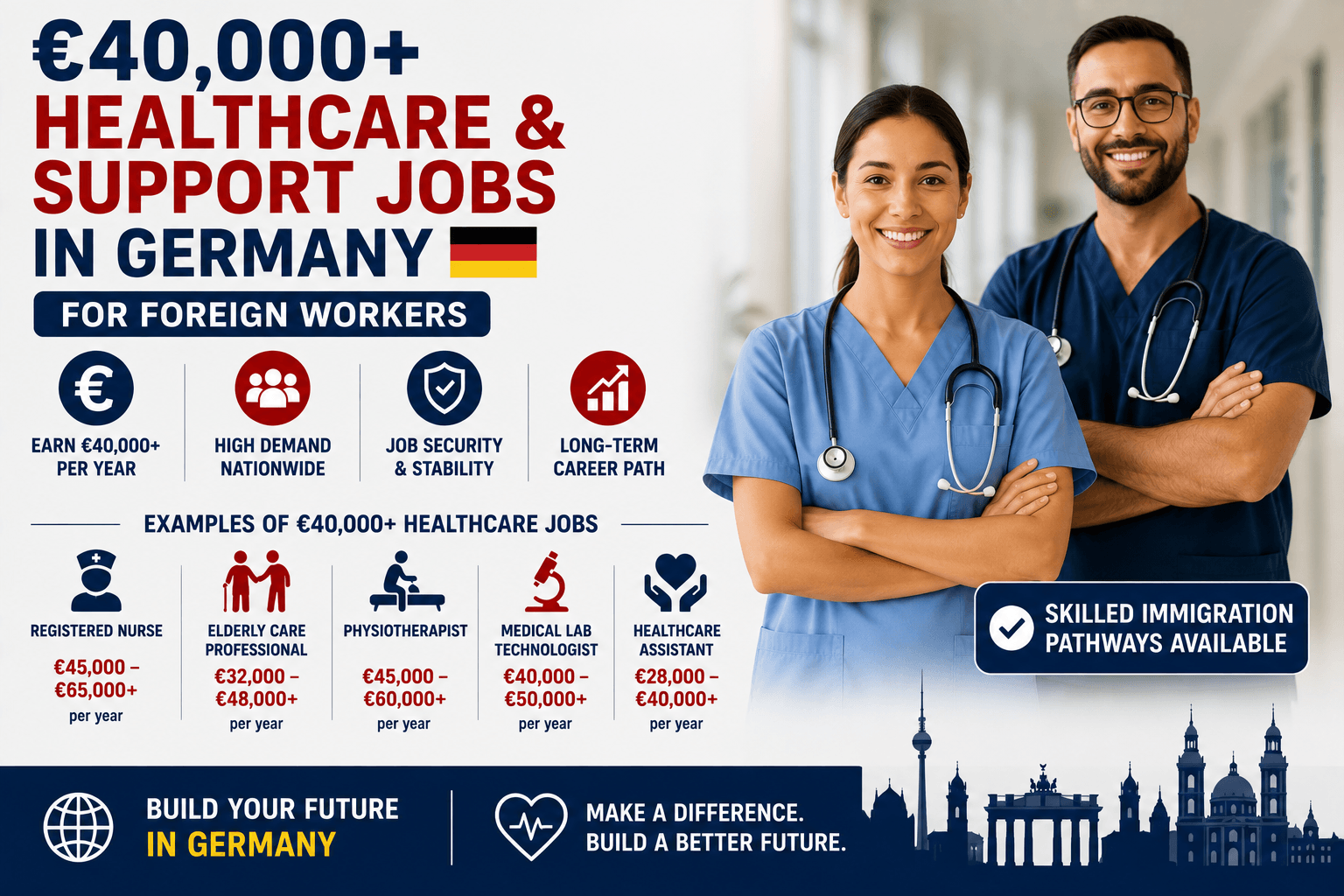
Germany has one of Europe’s largest healthcare systems and employs millions of people across hospitals, nursing facilities, elderly care, rehabilitation, medical technology and community health services.
For foreign workers, Germany is particularly interesting because its healthcare workforce includes both:
regulated professional careers
and:
care and support occupations.
Potential opportunities include:
- Nurses
- Elderly care professionals
- Nursing assistants
- Healthcare assistants
- Physiotherapists
- Occupational therapists
- Medical laboratory professionals
- Radiology professionals
- Emergency medical workers
- Other healthcare specialists
Some qualified healthcare workers can earn more than:
€40,000 per year.
However, salary is only part of the story.
Germany regulates many healthcare professions.
A foreign qualification that allows you to work as a nurse, physiotherapist or another healthcare professional in your home country does not necessarily allow you to immediately practise under the equivalent professional title in Germany.
Qualification recognition and German-language ability can be critical.
This guide explains €40,000+ healthcare and support jobs in Germany for foreign workers, including salaries, nursing, elderly care, qualification recognition, work visas and the country’s Skilled Immigration Act.
Can Healthcare Workers Earn €40,000+ in Germany?
Yes.
An annual gross salary of €40,000 equals approximately:
€3,333 gross per month.
Weekly equivalent:
approximately €769.
At 40 hours per week, the simple hourly equivalent is approximately:
€19.23/hour.
For comparison:
€20/hour = €41,600/year
€22/hour = €45,760/year
€25/hour = €52,000/year
€30/hour = €62,400/year
€35/hour = €72,800/year
Professional healthcare occupations can exceed the €40,000 threshold.
Entry-level and assistant positions may fall below it.
Enter an hourly wage, choose a country, and estimate monthly gross pay, tax and take-home income.
Planning estimate only. The preset uses a simplified flat percentage. Actual tax and payroll deductions can differ based on income level, province/state/region, allowances, social contributions, marital status and local tax rules.
Use this calculator for planning. Actual German income depends on working hours, employment agreement, taxes, social-security contributions and other deductions.
Healthcare Jobs in Germany for Foreign Workers
Germany’s healthcare labour market includes occupations across:
Professional Healthcare
- Registered/general nurses
- Specialist nurses
- Physiotherapists
- Occupational therapists
- Pharmacists
- Medical technologists
- Radiology professionals
Care & Support
- Elderly care workers
- Nursing assistants
- Healthcare assistants
- Care assistants
- Disability support
- Residential care
The immigration and professional-recognition requirements can differ considerably between these groups.
Nursing Jobs in Germany
Nursing is one of the most important healthcare careers for foreign professionals considering Germany.
Nurses work in:
- Hospitals
- Specialist clinics
- Nursing homes
- Elderly-care facilities
- Rehabilitation centres
- Outpatient services
- Home-care services
Germany’s official international recruitment information identifies nursing as a profession with strong employment prospects.
But nursing is also a:
regulated profession.
That makes recognition extremely important.
Is Nursing Regulated in Germany?
Yes.
Germany’s official recognition portal states that nursing is regulated.
To work permanently under the protected professional title, foreign nurses generally need official recognition of their professional qualification.
The responsible authority examines whether the foreign qualification is equivalent to the corresponding German professional qualification.
Recognition of Foreign Nursing Qualifications
The recognition process can examine:
- Your nursing qualification
- Training content
- Duration of training
- Professional experience
- Other qualifications
- Personal suitability
- Health suitability
- German-language ability
If substantial differences exist between your qualification and the German reference qualification, additional measures can be required.
These can include an adaptation period or knowledge examination depending on the case.
German Language Requirement for Nurses
Language ability is particularly important.
Germany’s official nursing information indicates that nurses generally need German at approximately:
B2 level
under the Common European Framework of Reference for Languages.
Exact evidence and procedures can depend on the competent authority.
This means an applicant should not assume English alone is enough for ordinary nursing employment in Germany.
Why German Matters in Healthcare
Healthcare workers communicate with:
- Patients
- Families
- Doctors
- Nurses
- Pharmacists
- Emergency workers
- Government authorities
A misunderstanding involving medication or patient care can have serious consequences.
German-language skills are therefore both an employment and patient-safety issue.
Nurse Salary in Germany
Nursing salaries depend on:
- Experience
- Employer
- Region
- Specialisation
- Collective agreements
- Shift pattern
- Night work
- Weekend work
Qualified nurses can reach and exceed our €40,000 annual benchmark.
Specialist and experienced nurses can earn more.
Rather than treating one nationwide salary as guaranteed, applicants should compare actual German employment contracts.
€40,000 Salary Per Month
A €40,000 annual gross salary equals approximately:
€3,333/month.
For comparison:
| Annual Gross | Monthly Gross |
|---|---|
| €40,000 | €3,333 |
| €45,000 | €3,750 |
| €50,000 | €4,167 |
| €55,000 | €4,583 |
| €60,000 | €5,000 |
| €70,000 | €5,833 |
| €80,000 | €6,667 |
These amounts are before German deductions.
German Take-Home Pay
Germany has significant payroll deductions.
Depending on the worker, deductions can include:
- Income tax
- Pension insurance
- Health insurance
- Unemployment insurance
- Long-term-care insurance
- Other applicable deductions
Therefore:
€3,500 gross per month is not €3,500 take-home pay.
Applicants should compare net income when planning relocation.
Elderly Care Jobs in Germany
Germany’s ageing population makes elderly care an important component of the country’s healthcare and social-care system.
Foreign applicants often search for:
- Elderly caregiver jobs Germany
- Altenpflege jobs
- Care worker jobs Germany
- Nursing home jobs Germany
- Healthcare assistant Germany
The exact German occupation matters.
Some positions involve regulated professional nursing.
Others involve assistant or support duties.
What Do Elderly Care Workers Do?
Depending on qualifications and role, duties can include:
- Personal care
- Mobility assistance
- Meal assistance
- Medication-related support within authorised scope
- Monitoring patients
- Documentation
- Companionship
- Supporting everyday activities
- Communicating with families
Workers must remain within the professional scope of their position.
Caregiver Jobs in Germany
“Caregiver” is a broad English term and may not correspond neatly to one German occupation.
Foreign applicants should determine whether a vacancy is for:
- Qualified nursing professional
- Nursing assistant
- Elderly-care assistant
- Home-care worker
- Disability-support worker
- Another support occupation
The qualification and immigration requirements can differ.
Nursing Assistant Jobs
Nursing-assistant positions can provide support to professional nursing teams.
Duties can include:
- Patient hygiene
- Mobility support
- Meal assistance
- Basic patient support
- Maintaining patient comfort
- Supporting qualified nursing professionals
Germany has also made changes to immigration rules affecting foreign workers with recognised vocational qualifications.
However, recognition and employment requirements should always be checked for the specific occupation.
Healthcare Assistant Jobs
Healthcare-assistant roles can exist in:
- Hospitals
- Nursing homes
- Residential care
- Rehabilitation
- Community care
Foreign applicants should not rely exclusively on the English title.
Check the corresponding German occupation and qualification requirements.
Physiotherapist Jobs in Germany
Physiotherapy is another healthcare profession relevant to foreign workers.
Physiotherapists help patients:
- Restore movement
- Recover from injury
- Manage physical limitations
- Improve mobility
- Rehabilitate after illness or surgery
Physiotherapy is a regulated profession in Germany.
Foreign professionals generally need recognition before using the professional title.
Occupational Therapist Jobs
Occupational therapists help patients improve their ability to perform everyday activities.
They can work in:
- Hospitals
- Rehabilitation
- Elderly care
- Disability services
- Mental healthcare
- Community services
Professional recognition requirements apply.
Medical Laboratory Jobs
Germany’s healthcare system also employs laboratory professionals who support:
- Diagnostics
- Pathology
- Medical testing
- Clinical services
Technical healthcare professions can have qualification-recognition requirements.
Applicants should identify the exact German occupation before beginning the immigration process.
Radiology Jobs
Medical imaging and radiology professionals work with diagnostic and therapeutic imaging technologies.
These can include:
- X-ray
- CT
- MRI
- Other medical imaging
Again, professional recognition can be required.
Healthcare Jobs Without a Medical Degree
You do not necessarily need to be a doctor to work in German healthcare.
Potential careers include:
- Nursing
- Nursing assistance
- Elderly care
- Healthcare support
- Laboratory work
- Therapy
- Medical technology
Some require university education.
Others use vocational qualifications.
Germany’s Vocational Training System
Germany has a strong vocational education system.
Many occupations are entered through structured vocational training rather than university degrees.
This is particularly relevant for young foreign workers who do not yet have a professional healthcare qualification.
Instead of applying as an already-qualified worker, some applicants may investigate:
Ausbildung
or vocational training opportunities.
Nursing Ausbildung
Germany offers vocational nursing training.
This can be attractive to applicants who want to build a healthcare career in Germany rather than transfer an existing qualification.
However, vocational training has separate:
- Admission requirements
- Language requirements
- Visa requirements
- Training conditions
It should not be confused with recognition for an already-qualified foreign nurse.
Can Foreigners Work in German Healthcare?
Yes.
Foreign nationals can work in Germany when they satisfy:
- Employment requirements.
- Professional-recognition requirements where applicable.
- Immigration requirements.
- Language requirements where applicable.
The correct route depends on the worker’s qualifications and employment offer.
Germany Skilled Worker Visa
Germany provides immigration routes for qualified workers.
A foreign worker with a recognised vocational or academic qualification can potentially qualify for residence for skilled employment when the relevant requirements are met.
The employment must generally be qualified employment.
Regulated professions can additionally require permission to practise.
Skilled Immigration Act
Germany expanded its skilled-worker immigration framework through reforms to the Skilled Immigration Act.
The reforms created and expanded routes involving:
- Recognised skilled workers
- Foreign professional qualifications
- Recognition partnerships
- Opportunity Card
- Vocational training
- Experienced workers
The correct route depends on the applicant.
Recognition Partnership
Germany’s recognition partnership can allow certain foreign skilled workers to enter Germany and complete professional recognition after arrival while working under applicable conditions.
This can reduce one barrier for applicants whose qualification has not yet received full German recognition.
However, the arrangement has eligibility requirements.
For regulated healthcare professions, workers still need to satisfy the conditions for professional practice.
Opportunity Card
Germany’s Opportunity Card allows eligible foreign nationals to enter Germany to look for qualified employment.
It is not a guaranteed healthcare job.
Applicants must satisfy the applicable eligibility framework.
The Opportunity Card can be useful for some skilled workers who want to search for employment inside Germany.
Can a Nurse Use the Opportunity Card?
Potentially, depending on eligibility.
However, entering Germany to search for work does not remove nursing recognition requirements.
A nurse cannot simply use the Opportunity Card to bypass professional licensing.
EU Blue Card
Some highly qualified healthcare-related workers can potentially qualify for an EU Blue Card when they satisfy:
- Qualification requirements
- Employment requirements
- Applicable salary threshold
However, the Blue Card is not the normal immigration route for every healthcare worker.
Nurses and care assistants should not automatically assume they qualify.
Work Visa vs Professional Recognition
This distinction is essential.
Immigration permission allows you to live/work under specified conditions.
Professional recognition allows you to practise a regulated profession.
A person can satisfy immigration requirements while still needing professional recognition.
Similarly, recognition of a qualification does not automatically provide immigration permission.
Healthcare Jobs With Visa Sponsorship
Foreign applicants often search:
healthcare jobs in Germany with visa sponsorship.
Germany does not use the term “sponsorship” in exactly the same way as some other countries.
Usually, the important components are:
- Genuine German employment
- Qualification
- Recognition where necessary
- Federal Employment Agency involvement where applicable
- Appropriate residence title
Do not assume every employer advertising a vacancy will manage the entire immigration process for you.
German Employer Job Offer
A genuine employment contract can be central to a skilled-worker immigration application.
The contract should clearly explain:
- Employer
- Position
- Salary
- Working hours
- Start date
- Employment conditions
Applicants should verify employers before submitting personal documents.
Fast-Track Procedure for Skilled Workers
Germany has a fast-track procedure that an employer can initiate for a qualified foreign worker.
It can coordinate parts of:
- Qualification recognition
- Federal Employment Agency approval
- Visa process
The employer applies through the competent foreigners authority.
The procedure involves a fee.
It can accelerate parts of the administrative process but:
does not guarantee visa approval.
How Long Does Recognition Take?
Germany’s official recognition information generally states that once the competent authority has received the complete documents, the recognition procedure commonly takes:
around three to four months.
Some cases can take longer.
Applicants also need to account for:
- Document gathering
- Translation
- Language learning
- Employer recruitment
- Visa appointment
- Visa processing
- Travel preparation
Choose your destination and preferred entry route, then tell us how far you have progressed.
Timeline results are planning estimates only and are not a guarantee of visa approval or travel date.
Use the calculator for planning only. Recognition and immigration timelines vary by applicant and authority.
Documents for Healthcare Jobs
Foreign healthcare applicants can need:
- Passport
- CV
- Qualification certificates
- Academic or vocational transcripts
- Professional licence
- Employment references
- Proof of work experience
- German-language certificate
- Police or good-standing documents
- Medical suitability documents
- Recognition decision
- Employment contract
Requirements depend on profession.
Translation of Documents
German authorities may require documents to be translated into German.
Translations may need to be completed by appropriately authorised translators.
Do not translate official certificates yourself unless the authority explicitly permits it.
Healthcare Jobs in Berlin
Berlin has a large healthcare labour market.
Employment exists across:
- Hospitals
- Clinics
- Nursing homes
- Rehabilitation
- Community services
- Medical technology
However, housing has become increasingly competitive.
Healthcare Jobs in Munich
Munich provides healthcare employment across major hospitals and specialist facilities.
Salaries can be attractive.
But Munich is also one of Germany’s more expensive housing markets.
Healthcare Jobs in Hamburg
Hamburg has substantial hospital, elderly-care and medical-service employment.
Applicants should compare:
- Salary
- Rent
- Transport
- Working hours
rather than salary alone.
Healthcare Jobs in Frankfurt
Frankfurt and the surrounding Rhine-Main region provide healthcare opportunities across hospitals, private clinics and care facilities.
The region also has a large international population.
Healthcare Jobs in Rural Germany
Smaller German cities and rural communities should not be ignored.
Some employers outside major metropolitan centres can face greater recruitment challenges.
Foreign workers willing to consider smaller communities may broaden their opportunities.
German-language ability can become even more important in areas with fewer English-speaking residents.
How to Find Healthcare Jobs in Germany
Useful searches include:
- Pflegefachkraft Deutschland
- Nurse jobs Germany
- Altenpflege Germany
- Pflegehelfer Germany
- Nursing assistant Germany
- Physiotherapist Germany
- Healthcare jobs Germany international
- Anerkennung Pflege Germany
Learning the German occupation name can substantially improve your job search.
Apply Directly to Employers
Potential employers include:
- Hospitals
- University hospitals
- Nursing homes
- Rehabilitation clinics
- Home-care organisations
- Healthcare groups
Visit official employer career pages whenever possible.
Make It in Germany
Germany’s official Make it in Germany portal is an important government resource for international skilled workers.
It provides information about:
- Working in Germany
- Recognition
- Visas
- Job search
- Nursing
- Skilled-worker immigration
Foreign applicants should use official sources to verify immigration claims made by recruiters.
Recognition in Germany
The official Recognition in Germany portal helps foreign professionals identify:
- Whether their profession is regulated
- Which authority handles recognition
- Required documents
- Recognition procedures
- Counselling resources
This should be one of the first resources used by foreign healthcare professionals.
Avoid German Healthcare Job Scams
Be cautious of advertisements promising:
- Guaranteed German nursing visa
- Guaranteed €5,000 monthly salary
- No German required for regulated patient-care jobs
- Guaranteed recognition
- Guaranteed Opportunity Card
- Paid job contracts
- Immediate permanent residence
No legitimate recruiter can guarantee a government decision.
Never Buy a Job Contract
A genuine German employment contract represents a real employer-worker relationship.
Do not pay an unknown person simply to generate a contract for immigration purposes.
Authorities can verify employment.
Fraudulent documentation can cause:
- Visa refusal
- Immigration consequences
- Financial loss
- Future application problems
Germany vs UK Healthcare Jobs
Germany and the UK both have large healthcare systems.
However, the immigration landscape differs.
The UK ended new overseas recruitment through its care worker and senior care worker Health and Care Worker route in July 2025.
Germany continues to recruit international skilled workers, including healthcare professionals, but German language and qualification recognition are particularly important.
Germany vs Australia Healthcare Jobs
Australia currently offers high salaries across professional nursing and several care/support occupations.
Germany can offer a strong European career pathway but typically places greater emphasis on German-language ability.
Foreign workers should compare:
- Salary
- Taxes
- Language
- Recognition
- Immigration
- Cost of living
- Long-term career opportunities
Germany vs Canada Healthcare Jobs
Canada provides opportunities across nursing, home support, nurse aide and other healthcare-support occupations.
Germany has its own regulated-profession and vocational-training system.
A qualification recognised in Canada does not automatically become recognised in Germany.
Frequently Asked Questions
Can foreigners work in healthcare in Germany?
Yes, when they meet the applicable employment, immigration, qualification-recognition and language requirements.
Can healthcare workers earn €40,000?
Yes. Qualified healthcare professionals can reach and exceed €40,000 annually, although salaries vary by occupation and experience.
Can foreigners work as nurses in Germany?
Yes, but nursing is regulated. Foreign nurses generally need professional recognition and must satisfy language and other requirements.
What German level do nurses need?
Official German nursing guidance generally identifies approximately B2 German as the required level for professional recognition.
Can caregivers work in Germany?
Care and support employment exists, but applicants need to identify the exact German occupation because “caregiver” is a broad English term.
Can I work in Germany without a university degree?
Yes. Germany has many vocational occupations. Healthcare includes both academic and vocational careers.
Can I move to Germany before my qualification is fully recognised?
Some applicants may qualify for mechanisms such as a recognition partnership, subject to eligibility. Regulated professions still require the necessary permission for professional practice.
Can healthcare workers use the Opportunity Card?
Eligible applicants may use the Opportunity Card to search for qualified employment, but it does not remove professional-recognition requirements.
Does a German job offer guarantee a visa?
No.
How long can professional recognition take?
Once complete documentation has been submitted, official guidance commonly indicates approximately three to four months, although individual cases vary.
Final Thoughts
Germany provides an important European destination for foreign healthcare professionals and support workers.
Potential careers span:
Nursing → elderly care → nursing assistance → physiotherapy → occupational therapy → medical technology → healthcare support.
Qualified workers in many professional occupations can reach or exceed:
€40,000 per year.
But foreign applicants should focus on more than salary.
Three questions are particularly important:
Is my profession regulated?
Will Germany recognise my qualification?
What German-language level do I need?
For nurses and many other regulated healthcare professionals, qualification recognition is a central part of the process.
Germany’s Skilled Immigration Act, recognition pathways and international recruitment mechanisms can create opportunities, but they do not remove professional requirements.
Foreign applicants should verify their profession through official German recognition resources before paying recruiters or making relocation plans.
For other destinations, compare $50,000+ Healthcare & Support Jobs in USA for Foreign Workers, £30,000+ Healthcare & Support Jobs in UK for Foreign Workers, A$60,000+ Healthcare & Support Jobs in Australia for Foreign Workers, and $50,000+ Healthcare & Support Jobs in Canada for Foreign Workers.
Our next Germany articles will explore Nursing Jobs in Germany for Foreign Workers, Caregiver & Elderly Care Jobs in Germany, and Healthcare Assistant Jobs in Germany.
MimBlog is an independent information website and is not a recruitment agency, employer, immigration authority or government agency. Salaries are estimates and may vary by employer, experience and location. Job availability and immigration requirements can change. Always verify vacancies, eligibility and visa requirements through employers and official government sources.
1 thought on “€40,000+ Healthcare & Support Jobs in Germany for Foreign Workers”