
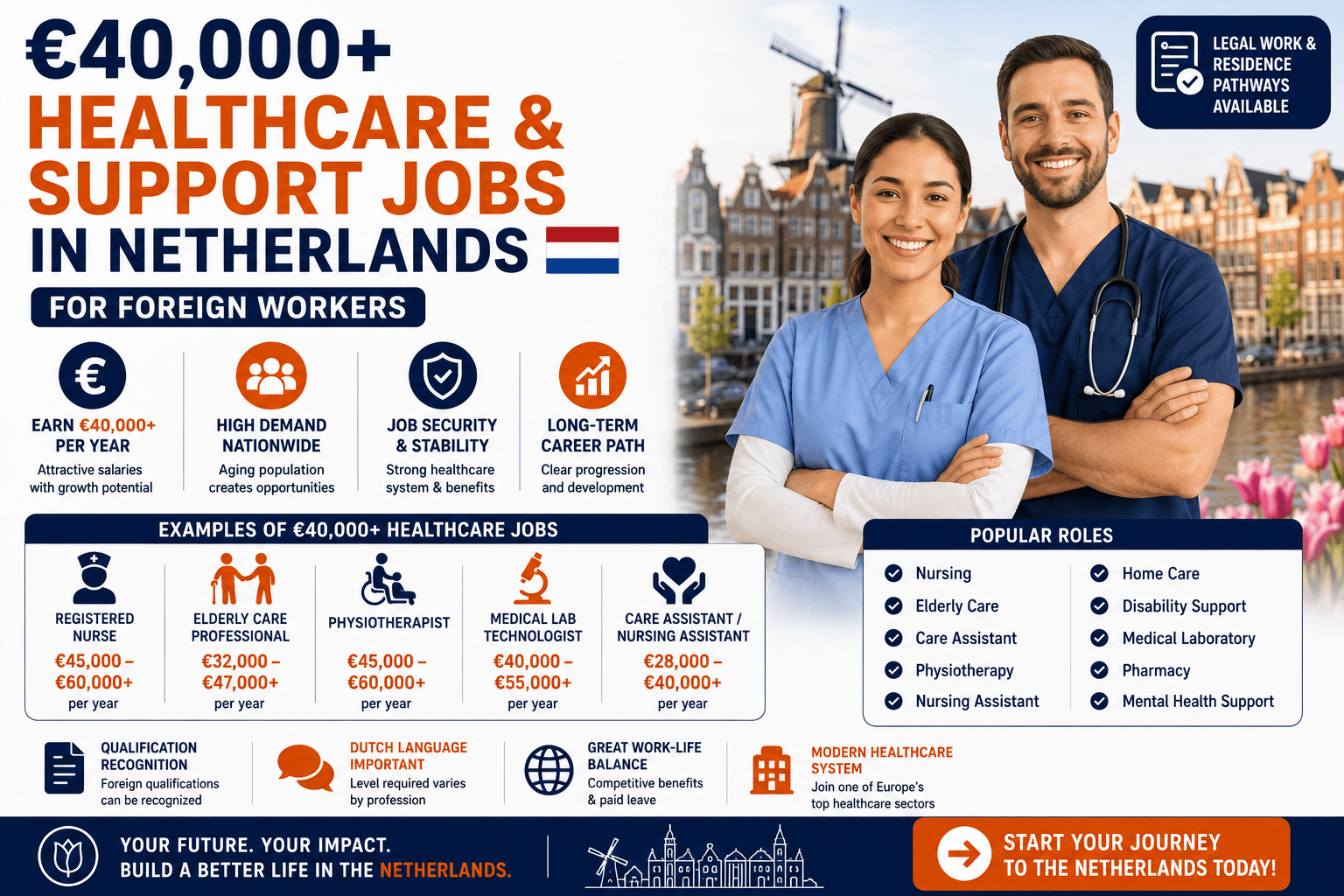
The Netherlands has a highly developed healthcare system with employment across hospitals, elderly care, home care, disability services, mental healthcare, rehabilitation and community support.
For foreign workers, opportunities can range from professional healthcare careers to practical care and support occupations.


Potential careers include:
- Registered nurses
- Elderly care workers
- Care assistants
- Nursing assistants
- Home-care workers
- Disability support workers
- Physiotherapists
- Pharmacists
- Medical laboratory professionals
- Mental-health professionals
- Social and community-care workers
Qualified workers in several Dutch healthcare occupations can earn €40,000 or more per year.
However, foreign applicants need to understand something important before applying:
Healthcare qualification recognition can be just as important as immigration permission in the Netherlands.
For regulated professions such as nursing and physiotherapy, a foreign qualification may need to be recognised and the professional may need registration in the Dutch BIG register before independently practising.
Dutch-language proficiency can also be required.
Therefore, a foreign worker should consider three separate questions:
Can I qualify for the job?
Can I legally practise the profession?
Can I obtain the appropriate Dutch work and residence permission?
This guide explains €40,000+ healthcare and support jobs in the Netherlands for foreign workers, including salaries, nursing, elderly care, qualification recognition, BIG registration and immigration options.
Can Healthcare Workers Earn €40,000+ in the Netherlands?
Yes.
An annual gross income of:
€40,000
equals approximately:
€3,333 gross per month.
At 40 hours per week, the simple hourly equivalent is approximately:
€19.23/hour.
For comparison:
€20/hour = €41,600/year
€22/hour = €45,760/year
€25/hour = €52,000/year
€30/hour = €62,400/year
€35/hour = €72,800/year
These calculations assume 40 hours weekly for 52 weeks.
Actual Dutch employment contracts can use different working hours.
Enter an hourly wage, choose a country, and estimate monthly gross pay, tax and take-home income.
Planning estimate only. The preset uses a simplified flat percentage. Actual tax and payroll deductions can differ based on income level, province/state/region, allowances, social contributions, marital status and local tax rules.
Use this calculator for general planning. Dutch taxes, social contributions, working hours, holiday arrangements and employment conditions affect actual take-home income.
Healthcare Jobs in the Netherlands
The Dutch healthcare sector includes professional, technical and support occupations.
Professional Healthcare Careers
These can include:
- Nurses
- Doctors
- Physiotherapists
- Pharmacists
- Midwives
- Psychologists
- Other regulated healthcare professionals
Healthcare Support Careers
Support occupations can include:
- Elderly care
- Home care
- Nursing support
- Personal care
- Disability support
- Residential care
- Community support
The qualification requirements differ considerably.
Someone who does not have a university medical degree should therefore not assume that the Dutch healthcare sector is closed to them.
Nursing Jobs in the Netherlands
Nursing is one of the most important healthcare careers for international applicants.
Dutch nurses can work in:
- Hospitals
- Nursing homes
- Elderly-care facilities
- Mental-health organisations
- Rehabilitation centres
- Home healthcare
- Community healthcare
- Disability-care organisations
However, nursing is a regulated profession.
That means foreign nurses cannot simply arrive with an overseas nursing certificate and automatically practise as Dutch registered nurses.
BIG Registration for Nurses
The Netherlands maintains the:
BIG register
for regulated individual healthcare professions.
Nurses are among the professions for which BIG registration is mandatory when practising under the protected professional title.
Foreign-trained nurses generally need their professional qualifications recognised before completing the appropriate registration process.
Which Healthcare Professionals Need BIG Registration?
The BIG system covers 11 professional groups.
These include:
- Pharmacists
- Doctors
- Physiotherapists
- Health psychologists
- Clinical technologists
- General educational psychologists
- Physician assistants
- Psychotherapists
- Dentists
- Midwives
- Nurses
Foreign applicants in these professions should investigate BIG requirements early.
Foreign Healthcare Professionals Already Work in the Netherlands
International qualifications are not unusual within the Dutch system.
As of August 2026, BIG-register statistics show thousands of professionals registered on the basis of foreign qualifications.
For example, approximately:
3,501 nurses
in the BIG register were registered on the basis of a foreign diploma.
Foreign-qualified professionals were also represented among:
- Doctors
- Dentists
- Midwives
- Physiotherapists
- Pharmacists
- Psychologists
This demonstrates that recognition of foreign healthcare qualifications is possible.
However, it does not mean recognition is automatic.
Dutch Language Requirements
Language ability is a major issue for foreign healthcare professionals.
The BIG registration process requires applicants with relevant foreign qualifications to demonstrate the required language proficiency.
This makes sense because healthcare professionals need to communicate accurately with:
- Patients
- Families
- Doctors
- Nurses
- Pharmacists
- Other healthcare workers
Foreign applicants should therefore consider learning Dutch as part of their career plan rather than treating it as something to worry about after receiving a job offer.
Can You Work in Dutch Healthcare With Only English?
Some healthcare-related positions may operate partly in English, particularly in international organisations, research or specialist environments.
However, patient-facing healthcare is different.
For regulated professions, official language requirements can apply.
Even when a particular support occupation does not require BIG registration, employers can still expect strong Dutch communication skills because workers interact directly with clients.
Therefore:
English-speaking country ≠ English-only healthcare career.
Nurse Salary in the Netherlands
Nursing salaries depend on factors including:
- Experience
- Employer
- Collective labour agreement
- Specialisation
- Working hours
- Night shifts
- Weekend work
- Hospital or care environment
Qualified and experienced nursing professionals can reach the €40,000 annual level and beyond.
However, foreign applicants should compare actual vacancies rather than relying on one universal salary figure.
€40,000 Salary Per Month
A gross annual salary of €40,000 equals:
approximately €3,333 per month.
For comparison:
| Annual Gross Salary | Monthly Gross Equivalent |
|---|---|
| €40,000 | €3,333 |
| €45,000 | €3,750 |
| €50,000 | €4,167 |
| €55,000 | €4,583 |
| €60,000 | €5,000 |
| €70,000 | €5,833 |
| €80,000 | €6,667 |
These are gross amounts before applicable Dutch deductions.
Take-Home Pay in the Netherlands
Gross salary should never be confused with disposable income.
Depending on your circumstances, deductions and costs can include:
- Income tax
- Social insurance
- Health insurance
- Pension contributions where applicable
- Other employment deductions
Workers also need to budget for:
- Rent
- Food
- Transportation
- Utilities
- Health insurance
- Personal expenses
Housing is particularly important because accommodation can be expensive and difficult to find in several Dutch cities.
Elderly Care Jobs in the Netherlands
Elderly care is an important part of the Dutch healthcare and social-care system.
Workers can support older people in:
- Nursing homes
- Residential facilities
- Private homes
- Community settings
- Home-care organisations
Potential duties can include:
- Personal care
- Mobility assistance
- Meal support
- Companionship
- Daily living assistance
- Household support
- Helping clients remain independent
The exact professional title matters.
Caregiver Jobs in the Netherlands
International job seekers frequently search for:
caregiver jobs in Netherlands
but “caregiver” is a broad English term.
Dutch employers may use different occupational titles.
One particularly important occupation is:
Verzorgende IG
which represents a trained care occupation within the Dutch healthcare system.
Other jobs can fall into home care, nursing assistance, disability support or personal support.
Foreign workers should search using both English and Dutch occupational terminology.
Does a Caregiver Need BIG Registration?
Not every healthcare occupation is included in the BIG register.
For example, the Dutch BIG-register itself identifies occupations such as:
Verzorgende IG
as healthcare professions that do not fall under mandatory BIG registration.
However, this does not mean that anyone can automatically use every professional title or perform every healthcare duty.
Qualification requirements can still apply.
This distinction is extremely important:
No BIG registration required does not mean no qualifications required.
Healthcare Assistant Jobs
Healthcare assistants can work across:
- Elderly care
- Residential care
- Hospitals
- Disability services
- Home care
- Community healthcare
The precise duties determine the qualifications and professional rules.
Foreign applicants should identify the Dutch occupation corresponding to the vacancy.
Home Care Jobs
The Netherlands has an extensive home-care system.
Home-care workers can support people who want to continue living independently.
Duties can include:
- Personal support
- Household assistance
- Mobility
- Daily activities
- Social support
- Personal care
Some positions can require workers to travel between multiple clients.
Disability Support Worker Jobs
The Dutch care sector also employs workers supporting people with:
- Physical disabilities
- Intellectual disabilities
- Developmental needs
- Complex support needs
Employment can exist in:
- Residential facilities
- Supported living
- Community programmes
- Day services
- Home environments
Dutch-language ability can be especially important because communication forms a central part of support work.
Physiotherapist Jobs
Physiotherapy is another regulated healthcare profession in the Netherlands.
Foreign physiotherapists need to investigate:
- Recognition of qualifications
- BIG registration
- Dutch-language requirements
- Employment requirements
A foreign physiotherapy licence does not automatically provide Dutch professional authorisation.
Pharmacist Jobs
Pharmacists are also among the professions requiring BIG registration.
International pharmacists should investigate professional recognition before planning relocation.
Their immigration route and professional-recognition route are separate processes.
Medical Laboratory Jobs
Laboratory and diagnostic careers provide another route into Dutch healthcare.
The professional rules depend on the exact occupation.
Foreign applicants should determine:
- Whether the profession is regulated
- Whether qualification recognition is necessary
- Whether BIG registration applies
- What language ability the employer requires
Do this before accepting recruitment claims.
Healthcare Jobs Without a Medical Degree
Healthcare employment in the Netherlands is not limited to doctors.
Depending on qualifications, workers can investigate careers in:
- Elderly care
- Personal care
- Home care
- Nursing support
- Disability support
- Community support
Some roles use vocational education rather than university medical education.
Dutch Vocational Healthcare Qualifications
The Netherlands has an extensive vocational education system.
Healthcare qualifications can exist at different educational levels.
This means foreign workers should compare their existing education against the Dutch qualification required for a particular occupation.
An overseas “caregiver certificate” is not automatically equivalent to a Dutch healthcare qualification.
Recognition of Foreign Qualifications
For regulated healthcare professionals, qualification recognition can be mandatory.
The procedure depends partly on:
- Profession
- Country where the qualification was obtained
- Qualification level
- Professional history
Applicants educated outside the European Economic Area can face a different recognition procedure from some European-trained professionals.
Why Recognition Matters
Imagine that someone has worked as a registered nurse for five years outside Europe.
Their experience can be valuable.
But the Netherlands still needs to determine whether their education and professional competence satisfy Dutch requirements.
The recognition process protects both:
- Patients
- Healthcare professionals
It also prevents someone from using a protected professional title without meeting the required standards.
Can Non-EU Foreigners Work in the Netherlands?
Yes, provided they satisfy the relevant immigration requirements.
The immigration process depends on:
- Nationality
- Occupation
- Employer
- Salary
- Qualifications
- Type of employment
Workers from outside the EU/EEA generally face additional immigration requirements compared with people who already have EU free-movement rights.
Highly Skilled Migrant Permit
The Netherlands has a:
Highly Skilled Migrant
residence-permit route.
To use this route, the foreign worker generally needs an employment contract with an employer recognised by the Dutch Immigration and Naturalisation Service, or IND, as a recognised sponsor.
The salary must also satisfy the applicable income requirements and be market-conforming.
Recognised Sponsor
This is an important term.
Not every Dutch employer can simply use the highly skilled migrant procedure.
For this route, the employer generally needs to be recognised by the IND.
The IND maintains a public register of recognised sponsors.
Foreign applicants should verify the employer rather than trusting a recruiter who merely claims:
“We are visa sponsors.”
Healthcare Professionals and Highly Skilled Migration
There is an additional requirement for certain healthcare professionals.
If the job involves individual healthcare and the profession is subject to the relevant BIG Act registration requirements, the highly skilled migrant process requires the healthcare professional to have the appropriate BIG registration.
This shows again why immigration and professional recognition must be planned together.
Highly Skilled Migrant Salary Requirements
The Netherlands applies income requirements to highly skilled migrant applications.
These thresholds can change.
They can also depend on factors such as age and applicant circumstances.
Therefore, a €40,000 healthcare salary does not automatically mean someone qualifies for the highly skilled migrant route.
Always check the current IND salary threshold applicable to your situation.
Can Caregivers Use the Highly Skilled Migrant Route?
This should not be assumed.
Many ordinary care/support positions do not pay salaries associated with the highly skilled migrant thresholds.
The employer must also be a recognised sponsor for that route.
Therefore, a foreign caregiver outside the EU should not assume:
caregiver vacancy = highly skilled migrant sponsorship.
Other immigration mechanisms can apply depending on circumstances.
GVVA — Single Permit
The Netherlands also has employment routes involving the combined residence and work permit commonly known as:
GVVA
for certain foreign workers.
Different rules apply depending on:
- Occupation
- Employer
- Length of employment
- Applicant circumstances
The employer may need to demonstrate that applicable labour-market requirements have been satisfied.
Work Permit — TWV
In some circumstances, an employer can need a:
TWV
or Dutch work permit.
Again, the correct process depends on the foreign worker’s residence status and employment situation.
There is no single “Netherlands healthcare visa” covering everyone.
EU Blue Card
Highly qualified foreign professionals can also investigate the:
EU Blue Card
where they satisfy the applicable requirements.
This route has its own:
- Qualification requirements
- Salary requirements
- Employment conditions
It is not the correct pathway for every healthcare or care worker.
Employer Sponsorship
International applicants often search:
healthcare jobs in Netherlands with visa sponsorship.
It is more accurate to ask:
Which immigration route can this employer use for this specific job?
Possible answers can differ according to occupation.
Avoid treating “visa sponsorship” as one universal Dutch immigration programme.
How Long Does Moving to the Netherlands Take?
There is no single timeline.
A regulated healthcare professional can need time for:
- Diploma recognition
- Dutch-language learning
- BIG registration
- Job search
- Employer recruitment
- Immigration application
- Document preparation
- Travel preparation
A support worker who does not require BIG registration can have a different process.
Choose your destination and preferred entry route, then tell us how far you have progressed.
Timeline results are planning estimates only and are not a guarantee of visa approval or travel date.
Use the result for planning only. Qualification recognition and immigration processing times vary and are not guaranteed.
Documents Foreign Healthcare Workers May Need
Depending on occupation and immigration route, documents can include:
- Passport
- Diploma
- Academic transcript
- Professional licence
- Employment references
- CV
- Language certificate
- Qualification-recognition decision
- BIG registration
- Employment contract
- Criminal-record or professional-standing documents where applicable
The exact list depends on your profession.
Healthcare Jobs in Amsterdam
Amsterdam has a large healthcare employment market.
Opportunities can exist across:
- Hospitals
- Mental healthcare
- Elderly care
- Home care
- Specialist healthcare
- Community services
However, Amsterdam is also known for expensive housing.
Foreign workers should compare salary with accommodation costs.
Healthcare Jobs in Rotterdam
Rotterdam has:
- Major hospitals
- Community healthcare
- Elderly-care organisations
- Disability services
- Home-care providers
Housing costs can still be significant but differ from Amsterdam.
Healthcare Jobs in The Hague
The Hague provides healthcare and support employment alongside its large international community.
Potential employers include:
- Hospitals
- Care facilities
- Home-care organisations
- Mental-health providers
Dutch-language ability can still be important even in an internationally oriented city.
Healthcare Jobs in Utrecht
Utrecht is centrally located and has a substantial healthcare and academic-medical sector.
The city can be attractive for healthcare professionals but also has a competitive housing market.
Healthcare Jobs Outside Major Cities
Do not restrict your search to Amsterdam.
Healthcare services operate throughout the country.
Smaller cities and communities can provide opportunities across:
- Elderly care
- Nursing
- Home healthcare
- Disability services
- Hospitals
Broadening your location search can increase the number of potential employers.
How to Search for Dutch Healthcare Jobs
Useful search terms include:
- Verpleegkundige vacatures
- Zorg vacatures
- Verzorgende IG vacatures
- Thuiszorg vacatures
- Healthcare Netherlands
- Nurse Netherlands
- Ouderenzorg vacatures
- Gehandicaptenzorg vacatures
Using Dutch job titles can dramatically expand your search results.
Build a Netherlands-Ready CV
Your CV should clearly state:
- Professional title
- Qualifications
- Years of experience
- Languages
- Professional registration
- Recognition status
- Specialist skills
For regulated professionals, consider making your recognition/BIG status immediately visible.
For example:
Registered Nurse — Foreign Qualification Recognition in Progress
is more useful to an employer than simply writing:
Healthcare Worker.
Learning Dutch Before Applying
Foreign healthcare workers can improve their chances by beginning Dutch before relocation.
This can help with:
- Recognition
- Employment interviews
- Patient communication
- Integration
- Everyday life
Do not wait until an employer tells you that Dutch is required.
Job Scams
Be cautious of advertisements promising:
- Guaranteed Netherlands healthcare visa
- Guaranteed BIG registration
- Guaranteed €5,000 salary
- Caregiver visa with no qualifications
- No Dutch required for every patient-facing role
- Permanent residence immediately
- Job contracts for sale
Government authorities—not recruiters—decide immigration and professional registration.
Never Buy BIG Registration
BIG registration cannot legitimately be purchased from a recruiter.
It is a professional registration process.
Anyone offering:
“Guaranteed BIG certificate for €2,000”
should be treated as a serious red flag.
Verify the Employer
For highly skilled migrant recruitment, check whether the employer appears in the IND’s recognised-sponsor register when that route is being proposed.
Also verify:
- Official company website
- Careers page
- Address
- Email domain
- Vacancy
- Employment contract
Do not send money because someone sends you a Dutch-looking PDF.
Netherlands vs Germany Healthcare Jobs
Both Germany and the Netherlands provide significant European healthcare opportunities.
Germany places strong emphasis on:
- Qualification recognition
- German-language ability
- Skilled-worker immigration
The Netherlands similarly uses:
- Professional recognition
- Dutch-language requirements
- BIG registration for regulated professions
- Specific immigration routes
For an English-speaking foreign worker, neither country should be treated as an English-only healthcare destination.
Netherlands vs UK Healthcare Jobs
The UK continues to provide the Health and Care Worker visa for many eligible professional healthcare occupations.
However, new overseas recruitment through care worker and senior care worker occupations ended in July 2025.
The Netherlands uses a different immigration framework entirely.
Support workers should therefore investigate the actual Dutch occupation and immigration route rather than assuming the UK care-worker model applies.
Netherlands vs Australia Healthcare Jobs
Australia currently provides strong opportunities across:
- Nursing
- Aged care
- Disability support
- Personal care
It also has employer-sponsored mechanisms relevant to certain care occupations.
The Netherlands can be attractive to workers seeking a European career, but Dutch language and professional recognition can create additional barriers.
Netherlands vs Canada Healthcare Jobs
Canada has healthcare-support occupations such as:
- Home support worker
- Personal support worker
- Nurse aide
- Caregiver
The Dutch system uses different professional titles, qualification structures and immigration rules.
Do not assume Canadian and Dutch caregiver occupations are interchangeable.
Frequently Asked Questions
Can foreigners work in healthcare in the Netherlands?
Yes, provided they satisfy the employment, professional and immigration requirements applicable to their occupation.
Can healthcare workers earn €40,000?
Yes. Qualified workers in several professional healthcare occupations can reach and exceed €40,000 annually.
Do nurses need BIG registration?
Yes. Nursing is one of the professions for which BIG registration is required for professional practice under the protected title.
Can foreign nurses register?
Yes. BIG-register statistics show thousands of nurses registered on the basis of foreign qualifications. Recognition and other requirements still apply.
Do caregivers need BIG registration?
Not every care occupation does. For example, Verzorgende IG is not one of the professions entered in the BIG register. Qualification requirements can still apply.
Do I need Dutch?
For regulated foreign healthcare professionals, language proficiency is part of the professional-registration process. Employers can also require Dutch for other patient-facing positions.
Is there a Netherlands healthcare visa?
No single immigration route applies to every healthcare worker.
Can healthcare workers use the highly skilled migrant route?
Some can, provided they meet the requirements and work for an IND-recognised sponsor. Regulated healthcare professionals must also satisfy applicable BIG-registration requirements.
Can caregivers get highly skilled migrant sponsorship?
Do not assume so. Salary thresholds and recognised-sponsor requirements can make this route unsuitable for many ordinary support-care positions.
Does a Dutch job guarantee a residence permit?
No.
Final Thoughts
The Netherlands offers opportunities across both professional healthcare and practical support services.
Foreign workers can investigate careers spanning:
Nursing → elderly care → home care → disability support → physiotherapy → pharmacy → laboratory work → community care.
Qualified workers in several healthcare occupations can reach:
€40,000+ per year.
But salary alone should not determine your plan.
For international applicants, three issues are particularly important:
qualification recognition
Dutch-language ability
and:
immigration eligibility.
Foreign nurses, physiotherapists and several other regulated healthcare professionals may need BIG registration before practising.
Other support occupations can operate outside the BIG register but can still have qualification and language requirements.
Therefore, start by identifying your exact Dutch occupation rather than simply searching for “healthcare jobs with sponsorship.”
For other international opportunities, compare €40,000+ Healthcare & Support Jobs in Germany for Foreign Workers, $50,000+ Healthcare & Support Jobs in USA for Foreign Workers, £30,000+ Healthcare & Support Jobs in UK for Foreign Workers, A$60,000+ Healthcare & Support Jobs in Australia for Foreign Workers, and $50,000+ Healthcare & Support Jobs in Canada for Foreign Workers.
From here, our Netherlands cluster can expand into Nursing Jobs in Netherlands for Foreign Workers, Caregiver & Elderly Care Jobs in Netherlands, and Healthcare Assistant Jobs in Netherlands.