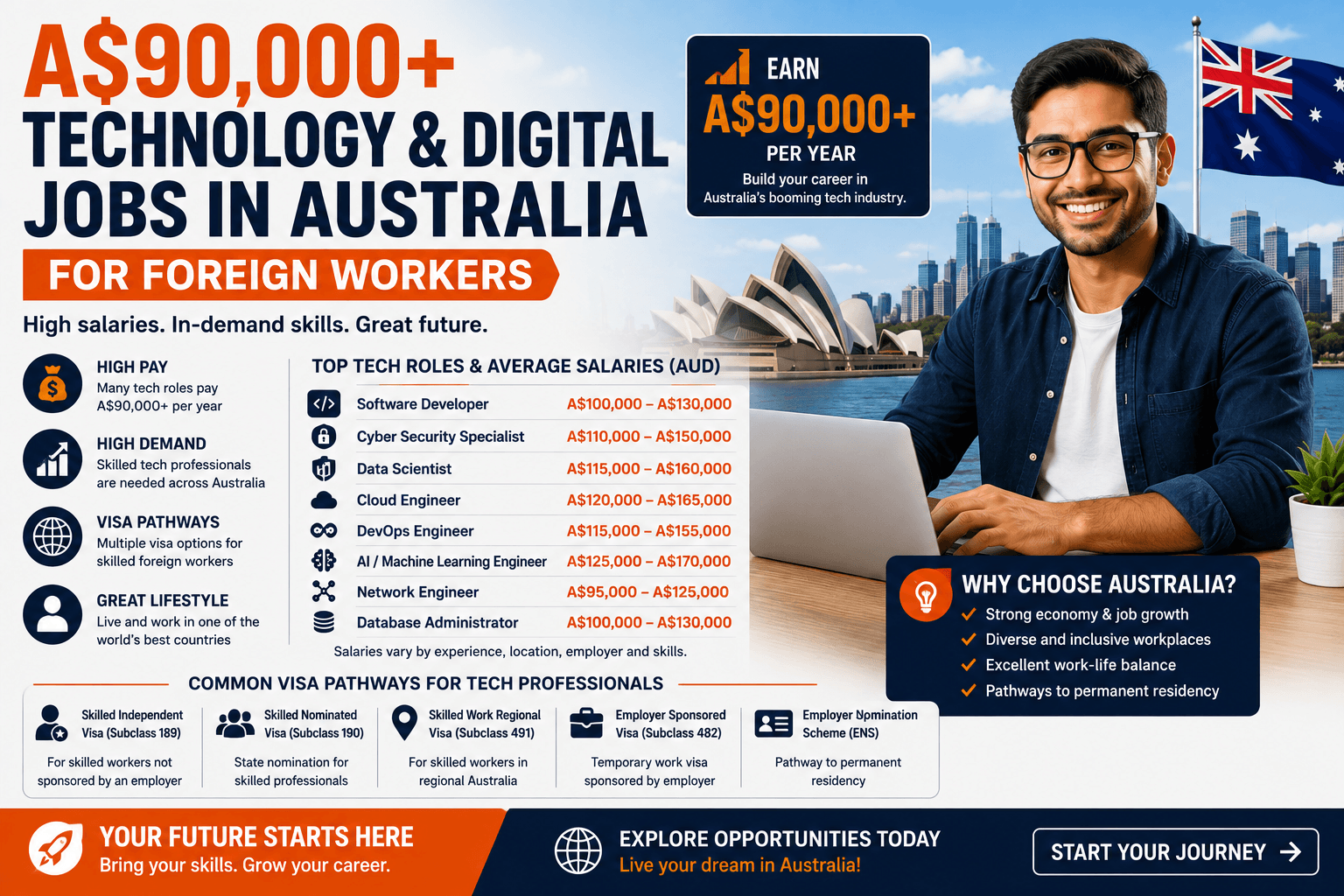
Australia offers strong career opportunities for skilled technology professionals across software development, cybersecurity, data science, cloud computing, artificial intelligence, networking and digital services.
For experienced workers, salaries above:
A$90,000 per year
are achievable across many technology occupations.
Australia’s technology workforce is not limited to dedicated software companies.
Tech professionals work throughout:
- Banking
- Mining
- Healthcare
- Telecommunications
- Government
- Consulting
- Retail
- Energy
- Education
- Defence
- Logistics
- Startups
This creates opportunities in major cities such as:
- Sydney
- Melbourne
- Brisbane
- Perth
- Adelaide
- Canberra
Foreign technology professionals can also have access to skilled and employer-sponsored immigration pathways where they meet the relevant requirements.
However:
a technology job does not automatically provide an Australian visa.
Occupation, qualifications, work experience, employer, salary and immigration pathway all matter.
This guide explains A$90,000+ technology and digital jobs in Australia for foreign workers, including salaries, occupations, skills assessments and visa options.
Why Work in Technology in Australia?
Technology has become essential across the Australian economy.
Businesses increasingly need professionals who can:
- Develop software
- Protect networks
- Manage cloud infrastructure
- Analyse data
- Automate business processes
- Build AI systems
- Maintain digital platforms
This creates opportunities well beyond traditional technology companies.
For example, a software engineer can work for a:
- Bank
- Mining company
- Hospital group
- Retail company
- Government contractor
Likewise, cybersecurity specialists are needed anywhere valuable information and systems must be protected.
What Does A$90,000 Per Year Mean?
A$90,000 gross annually equals approximately:
A$7,500 per month.
Weekly gross equivalent:
approximately A$1,731.
At 40 hours per week, the simple hourly equivalent is approximately:
A$43.27.
Technology Salary Examples
| Annual Gross | Approx. Monthly Gross |
|---|---|
| A$70,000 | A$5,833 |
| A$80,000 | A$6,667 |
| A$90,000 | A$7,500 |
| A$100,000 | A$8,333 |
| A$120,000 | A$10,000 |
| A$150,000 | A$12,500 |
| A$180,000 | A$15,000 |
These figures are simple gross calculations rather than guaranteed salaries.
Enter an hourly wage, choose a country, and estimate monthly gross pay, tax and take-home income.
Planning estimate only. The preset uses a simplified flat percentage. Actual tax and payroll deductions can differ based on income level, province/state/region, allowances, social contributions, marital status and local tax rules.
Use the salary calculator for planning only. Australian income tax, Medicare-related obligations, superannuation arrangements and other deductions depend on individual circumstances.
Software Developer Jobs in Australia
Software development is one of Australia’s major technology career areas.
Potential job titles include:
- Software Developer
- Software Engineer
- Full-Stack Developer
- Backend Developer
- Frontend Developer
- Application Developer
- Mobile Developer
Software developers build and maintain systems used throughout the economy.
Software Development Skills
Common technical skills include:
- JavaScript
- TypeScript
- Python
- Java
- C#
- C++
- React
- Node.js
- .NET
- SQL
Employers can also value:
- Cloud computing
- APIs
- Automated testing
- CI/CD
- Containers
The exact technology stack depends on the position.
Software Engineer Jobs
Software engineers can work on:
- Enterprise applications
- Banking platforms
- Cloud systems
- E-commerce
- Government applications
- Mining technology
- Telecommunications
- Artificial intelligence
Experienced engineers can earn considerably more than A$90,000 annually.
However, salary varies by:
- Experience
- Location
- Employer
- Technical speciality
- Management responsibility
Cybersecurity Jobs
Cybersecurity has become increasingly important as Australian organisations depend more heavily on digital infrastructure.
Potential positions include:
- Cyber Security Analyst
- Security Engineer
- SOC Analyst
- Security Consultant
- Penetration Tester
- Cloud Security Engineer
- Security Architect
- Incident Response Specialist
Cybersecurity Responsibilities
Professionals can help organisations defend against:
- Malware
- Ransomware
- Account compromise
- Data breaches
- Network attacks
- Insider threats
- Vulnerabilities
Government, banking, telecommunications and consulting are major areas for cybersecurity employment.
Cybersecurity Skills
Useful skills can include:
- SIEM
- Network security
- Cloud security
- Incident response
- Vulnerability management
- Identity management
- Threat detection
- Penetration testing
Certifications can include:
- Security+
- CISSP
- CISM
- CCSP
Certifications strengthen some applications but do not replace practical experience.
Data Scientist Jobs
Australian organisations increasingly use data to improve decisions.
Data Scientists can work in:
- Banking
- Insurance
- Healthcare
- Mining
- Retail
- Government
- Technology
- Consulting
Responsibilities can include:
- Predictive modelling
- Statistical analysis
- Machine learning
- Data visualisation
- Experimentation
Data Science Skills
Employers can seek:
- Python
- R
- SQL
- Statistics
- Machine learning
- Power BI
- Tableau
- Cloud data platforms
Strong mathematical knowledge can be important for advanced positions.
Data Analyst Jobs
Data Analyst is another common digital career.
Data analysts help organisations understand:
- Sales
- Customers
- Operations
- Marketing
- Financial performance
Common tools include:
- SQL
- Excel
- Power BI
- Tableau
- Python
Entry-level data-analysis salaries can be below A$90,000, while experienced analysts and specialised professionals can earn above that level.
Artificial Intelligence Jobs
Artificial intelligence is creating new roles across Australia.
Potential positions include:
- AI Engineer
- Machine Learning Engineer
- Applied Scientist
- NLP Engineer
- Computer Vision Engineer
- Generative AI Engineer
AI roles can involve:
- Machine learning
- Large language models
- Data pipelines
- Model deployment
- Software engineering
- Cloud infrastructure
Research-heavy positions can prefer postgraduate qualifications.
Cloud Engineer Jobs
Australian companies increasingly use:
- Amazon Web Services
- Microsoft Azure
- Google Cloud
This creates opportunities for:
- Cloud Engineers
- Cloud Architects
- Platform Engineers
- Infrastructure Engineers
- Cloud Security Engineers
Cloud Skills
Useful technologies include:
- AWS
- Azure
- Google Cloud
- Terraform
- Docker
- Kubernetes
- Linux
- Networking
Experienced cloud professionals can command strong salaries.
DevOps Engineer Jobs
DevOps professionals help companies build, deploy and operate software efficiently.
Common skills include:
- Git
- CI/CD
- Docker
- Kubernetes
- Terraform
- Linux
- Cloud computing
- Monitoring
DevOps can overlap with:
- Cloud Engineering
- Platform Engineering
- Site Reliability Engineering
Site Reliability Engineer Jobs
Site Reliability Engineers help maintain:
- Uptime
- Performance
- Reliability
- Scalability
They often combine:
software development + infrastructure engineering.
Experienced SRE professionals can command high salaries.
Network Engineer Jobs
Network engineers design and maintain:
- Corporate networks
- Data-centre networks
- Cloud connectivity
- VPNs
- Firewalls
- Telecommunications infrastructure
Skills can include:
- Cisco
- Routing
- Switching
- Network security
- SD-WAN
- Cloud networking
Database Jobs
Database careers include:
- Database Administrator
- Database Developer
- Database Architect
- Data Engineer
Relevant technologies can include:
- SQL Server
- PostgreSQL
- Oracle
- MySQL
- Cloud databases
Data engineering can be particularly valuable as businesses expand their analytics and AI systems.
IT Support Jobs
Not every technology job starts at A$90,000.
IT support positions can include:
- Help Desk Technician
- Service Desk Analyst
- Desktop Support Technician
- Technical Support Specialist
These jobs can provide a starting point for progression into:
- Networking
- Systems administration
- Cybersecurity
- Cloud computing
UX/UI Jobs
Digital technology careers also include design.
Potential positions include:
- UX Designer
- UI Designer
- Product Designer
- UX Researcher
- Digital Designer
Skills can include:
- Figma
- Prototyping
- User research
- Accessibility
- Design systems
Experienced product designers can earn strong salaries.
IT Project Manager Jobs
Experienced technology professionals can progress into:
- IT Project Manager
- Technical Project Manager
- Programme Manager
- Product Manager
These roles can require:
- Leadership
- Budget management
- Planning
- Technical understanding
- Stakeholder communication
Technology Jobs in Sydney
Sydney has one of Australia’s largest technology markets.
Major sectors include:
- Banking
- Fintech
- Software
- Cybersecurity
- Consulting
- Cloud computing
Salaries can be high.
Housing costs can also be substantial.
Applicants should compare:
salary vs cost of living.
Technology Jobs in Melbourne
Melbourne has opportunities across:
- Software
- Financial services
- Consulting
- E-commerce
- Health technology
- Education technology
- Gaming
It is another major destination for foreign technology professionals.
Technology Jobs in Brisbane
Brisbane has been developing a larger digital economy.
Technology employment can be found across:
- Mining
- Energy
- Government
- Software
- Consulting
Queensland can therefore be worth considering instead of restricting a search to Sydney and Melbourne.
Technology Jobs in Perth
Perth has significant demand for technology supporting:
- Mining
- Energy
- Engineering
- Resources
This can create opportunities for:
- Data professionals
- Software engineers
- Cybersecurity specialists
- Cloud professionals
Technology Jobs in Adelaide
Adelaide has opportunities connected with:
- Defence
- Space
- Engineering
- Cybersecurity
- Government technology
However, some defence positions can require Australian citizenship or security clearance.
Foreign applicants should check eligibility before applying.
Technology Jobs in Canberra
Canberra has substantial government-related technology employment.
Roles can include:
- Cybersecurity
- Cloud
- Software development
- Data
- IT consulting
But many government and defence positions can impose:
- Citizenship
- Security-clearance
requirements.
Foreign workers should read advertisements carefully.
Do Foreign Workers Need a Degree?
Requirements vary by occupation.
Technology workers can have qualifications in:
- Computer Science
- Software Engineering
- Information Technology
- Cybersecurity
- Data Science
- Mathematics
- Engineering
Some employers also hire self-taught professionals with extensive practical experience.
However, immigration and skills-assessment requirements are separate from employer hiring preferences.
Skills Assessment
Australia’s skilled migration system can require a formal skills assessment.
For many ICT occupations, the relevant assessing authority is:
Australian Computer Society — ACS.
The skills-assessment process can examine factors such as:
- Qualification
- Field of study
- Employment experience
- Occupation
The assessment needed depends on the immigration pathway and occupation.
ACS Assessment Is Not a Visa
This distinction is important.
A successful skills assessment does not automatically give someone an Australian visa.
Likewise:
job offer ≠ visa
and:
occupation on a list ≠ visa approval.
Each stage has separate requirements.
Can Experience Replace a Degree?
In some ACS-related assessment circumstances, professional experience can play an important role where an applicant does not have a closely related ICT qualification.
The exact requirements depend on the assessment pathway.
Applicants should use the current ACS rules rather than assuming several years of coding experience automatically creates a positive assessment.
Technology Certifications
Certifications can strengthen a technology profile.
Cloud
- AWS
- Microsoft Azure
- Google Cloud
Cybersecurity
- Security+
- CISSP
- CISM
- CCSP
Networking
- Cisco certifications
But immigration authorities and skills-assessment bodies can evaluate qualifications differently from employers.
Visa Options for Tech Workers
Potential Australian immigration pathways can include:
- Skills in Demand visa — subclass 482
- Employer Nomination Scheme — subclass 186
- Skilled Independent visa — subclass 189
- Skilled Nominated visa — subclass 190
- Skilled Work Regional visa — subclass 491
- Skilled Employer Sponsored Regional visa — subclass 494
Eligibility depends on the worker, occupation and visa.
Skills in Demand Visa — Subclass 482
The Skills in Demand visa allows qualifying employers to sponsor skilled foreign workers for eligible employment.
The worker needs:
- An eligible employer
- Appropriate occupation
- Required skills
- Applicable work experience
- Required English ability
- Other immigration requirements
Salary and employment conditions also matter.
Employer Nomination Scheme — Subclass 186
Subclass 186 can provide permanent residence for qualifying employer-nominated workers.
It has different streams and eligibility rules.
A temporary sponsored technology worker may potentially later qualify for employer nomination where the requirements are satisfied.
However:
subclass 482 does not automatically become permanent residence.
Skilled Independent Visa — Subclass 189
Subclass 189 is a points-tested permanent visa.
It does not require employer sponsorship.
Applicants can need:
- Eligible occupation
- Positive skills assessment
- Required English
- Sufficient points
- Invitation to apply
Meeting the minimum points threshold does not guarantee an invitation.
Skilled Nominated Visa — Subclass 190
Subclass 190 is also points-tested but requires nomination by an Australian state or territory.
Each jurisdiction can establish its own:
- Occupation priorities
- Eligibility rules
- Nomination requirements
Technology workers should investigate the state where their occupation is in demand.
Skilled Work Regional Visa — Subclass 491
Subclass 491 is designed for eligible skilled workers willing to live and work in regional Australia.
It can involve:
- State or territory nomination
- Eligible family sponsorship
depending on the pathway.
Regional Australia can create opportunities beyond the largest cities.
Employer Sponsored Regional Visa — Subclass 494
Employers in regional Australia can use subclass 494 to sponsor qualifying skilled workers.
This can be relevant to technology professionals willing to consider locations outside Sydney, Melbourne and Brisbane.
Permanent Residence
Australia has several routes that can potentially lead directly or indirectly to permanent residence.
But there is no universal rule that says:
“Work in Australian tech for two years and automatically receive PR.”
Visa category and eligibility determine the outcome.
Occupation Lists
Australia uses occupation lists for various skilled and employer-sponsored migration purposes.
Technology occupations can include roles such as:
- Software Engineer
- Developer Programmer
- Analyst Programmer
- ICT Business Analyst
- Systems Analyst
- Cyber Security Engineer
depending on the applicable current instrument and visa.
Applicants should verify the current occupation classification rather than relying on old blogs.
Core Skills Occupation List
Australia’s employer-sponsored system uses the:
Core Skills Occupation List — CSOL
for relevant Skills in Demand Core Skills applications.
Numerous ICT occupations can appear on the list.
However, being on the list alone does not guarantee sponsorship.
The applicant still needs a genuine employer and must meet the applicable visa requirements.
English Requirement
Australian skilled visas can require English-language ability.
Evidence can involve approved tests depending on the visa.
Points-tested applicants can also receive additional points for higher levels of English.
Check the current Home Affairs requirements before booking an examination.
Age
Age can be particularly important for points-tested skilled migration.
Some permanent skilled visas generally require applicants to be below the applicable age threshold when invited.
Employer-sponsored routes can have different rules and exemptions.
Therefore, applicants should choose immigration pathways based on their actual circumstances.
Points Test
Points-tested visas can award points for factors such as:
- Age
- English
- Skilled employment
- Education
- Australian study
- Partner qualifications
- State nomination
The minimum eligibility threshold does not guarantee selection.
Invitation levels depend on government priorities and competition.
How Long Does Australian Tech Immigration Take?
There is no universal processing period.
Your journey can include:
- Skills assessment
- English examination
- Expression of Interest
- State nomination
- Invitation
- Employer recruitment
- Visa application
- Health examination
- Character checks
Employer-sponsored workers can have a different process from points-tested applicants.
Choose your destination and preferred entry route, then tell us how far you have progressed.
Timeline results are planning estimates only and are not a guarantee of visa approval or travel date.
Use this calculator only as a planning estimate. It does not guarantee Australian visa processing time, state nomination, invitation, employer sponsorship or permanent residence.
Remote Australian Tech Jobs
Foreign technology professionals can potentially work remotely for Australian companies while remaining overseas.
This can happen through:
- Contracting
- Foreign subsidiaries
- Employer-of-record arrangements
However:
remote Australian work ≠ Australian visa.
You need appropriate immigration permission to physically relocate and work in Australia.
Building a Strong Tech Resume
Australian technology employers value evidence of impact.
Instead of:
“Responsible for developing applications.”
Use:
“Built an automated reporting system that reduced manual processing time by 60%.”
Where accurate, quantify:
- Users
- Revenue
- Performance
- Cost savings
- Automation
- Security improvements
GitHub
Developers can demonstrate practical ability through:
- Applications
- APIs
- Tests
- Documentation
- Open-source work
A clean portfolio can help international applicants prove their skills before an interview.
Your professional profile should clearly communicate:
- Occupation
- Technology stack
- Years of experience
- Projects
- Certifications
- Education
- Achievements
Avoid vague titles such as:
“IT Expert.”
A title such as:
“Senior Backend Engineer | Java | AWS | Kubernetes”
provides recruiters with much more information.
How to Search for Jobs
Useful searches include:
- Software Engineer Australia visa sponsorship
- Developer Programmer Australia sponsorship
- Cybersecurity jobs Australia foreign workers
- Data Scientist Australia sponsorship
- Cloud Engineer Australia subclass 482
- ICT jobs Australia visa sponsorship
- Tech jobs Australia international applicants
Employer Sponsorship
Do not assume every Australian employer sponsors visas.
Some advertisements specifically require:
full Australian working rights.
Others can consider sponsorship.
Targeting employers with a history of international recruitment can make a job search more efficient.
Tech Job Scams
Watch for claims such as:
“Guaranteed Australian PR.”
“Buy subclass 482 sponsorship.”
“Pay A$20,000 for software job.”
“Guaranteed 189 invitation.”
“No skills assessment required for everyone.”
Immigration decisions cannot legitimately be guaranteed by recruiters.
Australia vs USA Tech Jobs
The United States can offer higher top-end salaries.
Australia provides a different combination of:
- Employer sponsorship
- Points-tested migration
- State nomination
- Regional migration
The better destination depends on the individual.
Australia vs Canada Tech Jobs
Both countries have skilled immigration systems.
Canada uses pathways such as:
- Express Entry
- Provincial Nominee Programs
- Employer-supported work permits
Australia uses:
- Points-tested skilled visas
- State nomination
- Employer sponsorship
Applicants should compare their eligibility under both systems.
Australia vs Germany Tech Jobs
Germany can offer the EU Blue Card and other skilled-worker routes where requirements are met.
Australia has a more extensive points-tested migration structure.
English-speaking foreign technology professionals can find Australia’s language environment attractive.
Frequently Asked Questions
Can foreigners get technology jobs in Australia?
Yes. Foreign technology professionals can work in Australia when they have suitable employment and valid work rights.
Can tech workers earn A$90,000?
Yes. Many experienced software, cybersecurity, cloud, data and other technology professionals can earn above A$90,000.
Does Australia sponsor software engineers?
Australian employers can sponsor eligible foreign technology workers where the employer, occupation and applicant meet the applicable requirements.
What is the 482 visa?
Subclass 482 is Australia’s Skills in Demand employer-sponsored temporary work visa.
Can technology workers get permanent residence?
Potentially. Australia has employer-sponsored, points-tested, state-nominated and regional permanent-residence pathways.
Do I need ACS?
Many ICT professionals pursuing skilled migration need a skills assessment from the Australian Computer Society, depending on occupation and visa pathway.
Is an ACS assessment a visa?
No.
Do I need a degree?
Not every employer requires the same education, but immigration skills assessments can have their own qualification and experience rules.
Can I get PR without an employer?
Potentially, through qualifying points-tested pathways such as subclasses 189 or 190. Eligibility does not guarantee an invitation.
Is visa sponsorship guaranteed?
No.
Final Thoughts
Australia provides strong career opportunities for international technology professionals.
Foreign workers can pursue jobs across:
- Software engineering
- Cybersecurity
- Data science
- Artificial intelligence
- Cloud computing
- DevOps
- Networking
- Digital products
For experienced professionals, annual earnings above:
A$90,000
can be realistic.
However, technology skills alone do not create immigration status.
Applicants need to understand:
occupation classification
skills assessment
employer requirements
and:
visa eligibility.
Potential routes can include:
Skills in Demand subclass 482
Employer Nomination Scheme subclass 186
Skilled Independent subclass 189
Skilled Nominated subclass 190
Skilled Work Regional subclass 491
and:
Skilled Employer Sponsored Regional subclass 494.
The strongest strategy is:
build specialised skills → gain documented experience → identify the correct occupation → complete any required skills assessment → target genuine employers or skilled migration programmes → verify current visa requirements.
For more Technology & Digital Jobs guides, continue with £40,000+ Technology & Digital Jobs in UK for Foreign Workers, followed by dedicated guides for Software Engineers, Cybersecurity Specialists, Data Scientists and Cloud Engineers.
MimBlog is an independent information website and is not a recruitment agency, employer, immigration authority or government agency. Salaries are estimates and may vary by employer, experience and location. Job availability and immigration requirements can change. Always verify vacancies, eligibility and visa requirements through employers and official government sources.