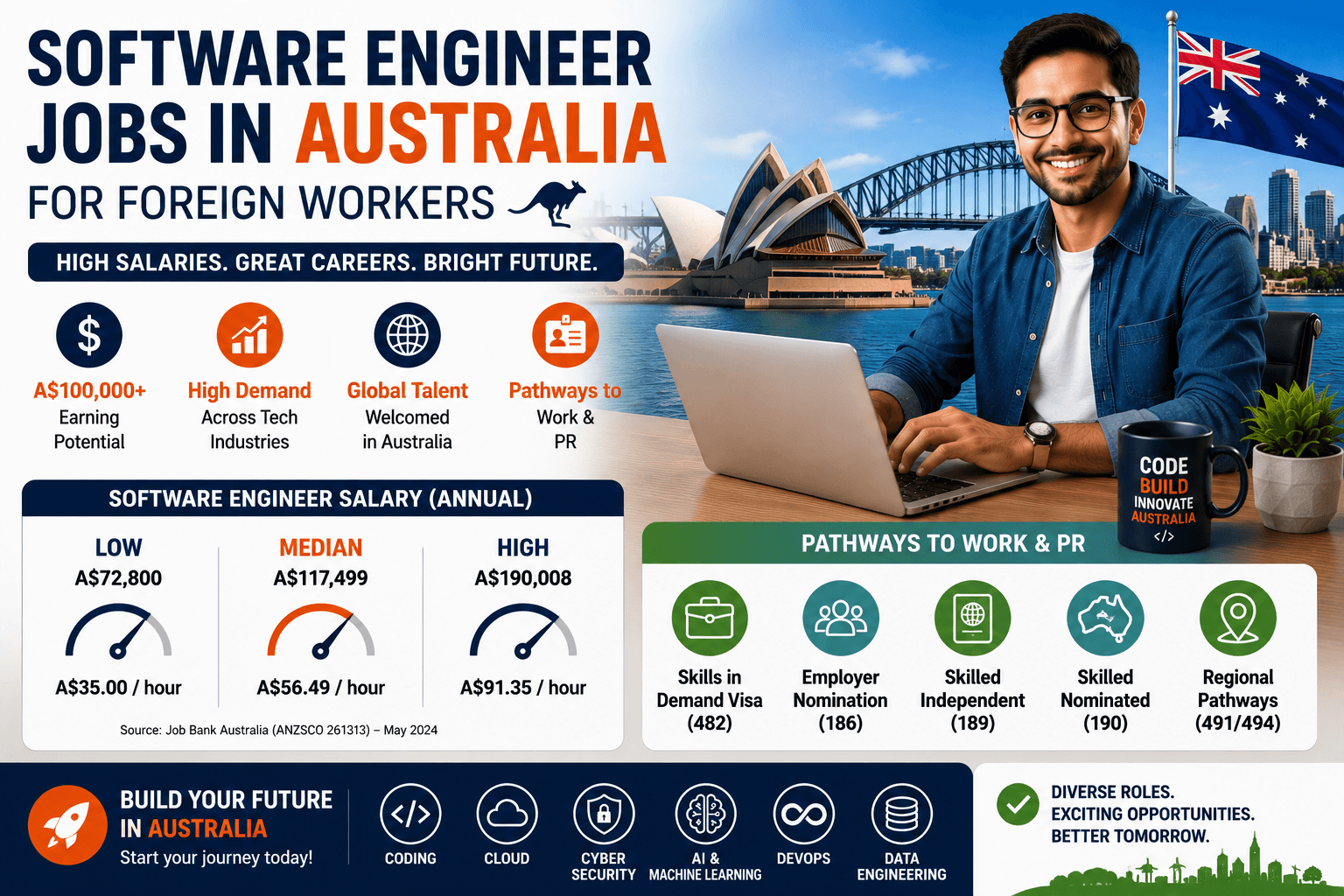
Australia offers strong opportunities for foreign software engineers and developers across technology, banking, telecommunications, consulting, government, mining technology, healthcare, fintech and other industries.
Software engineering is also one of Australia’s better-paid professional technology careers.
Experienced software professionals can earn:
A$100,000+ per year
while senior engineers, technical leads and software architects can earn considerably more depending on experience, employer and location.
Foreign software engineers can potentially access several Australian immigration pathways, including:
- Skills in Demand visa — subclass 482
- Employer Nomination Scheme — subclass 186
- Skilled Independent visa — subclass 189
- Skilled Nominated visa — subclass 190
- Skilled Work Regional visa — subclass 491
- Skilled Employer Sponsored Regional visa — subclass 494
However:
a software engineering job does not automatically provide an Australian visa or permanent residence.
Occupation eligibility, skills assessment, qualifications, experience, English ability, salary and the chosen visa pathway can all matter.
This guide explains software engineer jobs in Australia for foreign workers, including salaries, skills, ACS assessment, employer sponsorship and skilled migration options.
Software Engineering in Australia
Software engineers design, develop and maintain software systems.
Their work can involve:
- Application development
- System architecture
- Backend services
- Cloud applications
- APIs
- Databases
- Mobile applications
- Enterprise software
- Automated testing
- Security
- System integration
Software professionals are employed throughout the Australian economy rather than only by dedicated technology companies.
Potential sectors include:
- Banking
- Insurance
- Telecommunications
- Mining
- Healthcare
- Consulting
- Government
- Retail
- E-commerce
- Defence technology
- Education technology
Software Engineer vs Software Developer
Australian employers use several related titles.
These can include:
- Software Engineer
- Software Developer
- Developer Programmer
- Analyst Programmer
- Full-Stack Developer
- Backend Developer
- Frontend Developer
For immigration purposes, the exact occupation classification can become important.
Applicants should select the occupation that matches their actual:
education + employment history + professional duties
rather than simply choosing whichever occupation appears to have better immigration prospects.
Can Software Engineers Earn A$100,000+?
Yes.
Australia’s technology market supports six-figure salaries for many experienced software professionals.
However, salary varies substantially according to:
- Experience
- Location
- Technical speciality
- Employer
- Industry
- Seniority
Junior developers can earn below A$100,000.
Experienced engineers can move above it.
Senior engineers and architects can earn considerably more.
Example Software Salary Levels
A software professional might encounter salaries around:
| Annual Gross Salary | Approx. Monthly Gross |
|---|---|
| A$80,000 | A$6,667 |
| A$90,000 | A$7,500 |
| A$100,000 | A$8,333 |
| A$110,000 | A$9,167 |
| A$120,000 | A$10,000 |
| A$140,000 | A$11,667 |
| A$160,000 | A$13,333 |
| A$180,000 | A$15,000 |
These are simple salary examples, not guaranteed market rates.
Enter an hourly wage, choose a country, and estimate monthly gross pay, tax and take-home income.
Planning estimate only. The preset uses a simplified flat percentage. Actual tax and payroll deductions can differ based on income level, province/state/region, allowances, social contributions, marital status and local tax rules.
Use the salary calculator for planning only. Actual Australian take-home income depends on income tax, Medicare-related circumstances, superannuation treatment and individual circumstances.
Software Engineer Jobs in Sydney
Sydney is one of Australia’s largest technology employment centres.
Software professionals can work across:
- Banking
- Fintech
- Software
- Telecommunications
- Consulting
- E-commerce
- Cloud computing
Sydney can offer strong salaries, but housing costs can also be high.
Foreign applicants should therefore compare:
salary + rent + transportation + tax + lifestyle costs
rather than focusing only on gross salary.
Software Engineer Jobs in Melbourne
Melbourne has another large technology ecosystem.
Opportunities exist across:
- Software
- Financial services
- Consulting
- Healthcare technology
- E-commerce
- Gaming
- Digital services
Melbourne is an important destination for both Australian and international developers.
Software Engineer Jobs in Brisbane
Brisbane has opportunities across:
- Software
- Mining technology
- Energy
- Consulting
- Government
- Digital services
Queensland’s technology market can provide an alternative to Sydney and Melbourne.
Software Engineer Jobs in Perth
Perth has specialised technology opportunities connected with:
- Mining
- Resources
- Energy
- Automation
- Industrial technology
Developers with experience in:
- Data
- Cloud
- Automation
- Industrial systems
can find opportunities connected with Western Australia’s resource economy.
Software Engineer Jobs in Adelaide
Adelaide offers careers across:
- Defence technology
- Engineering
- Software
- Cybersecurity
- Space-related industries
Some defence positions can have citizenship or security-clearance restrictions.
Foreign workers should check individual job requirements carefully.
Software Engineer Jobs in Canberra
Canberra has a large concentration of government and government-contractor technology jobs.
Potential areas include:
- Software development
- Cybersecurity
- Cloud computing
- Data
- Systems engineering
However, many sensitive government positions can require:
- Australian citizenship
- Security clearance
Therefore, not every Canberra technology vacancy is suitable for a newly arriving foreign worker.
Software Engineering Skills
Frequently requested programming languages can include:
- JavaScript
- TypeScript
- Python
- Java
- C#
- C++
- Go
- PHP
- SQL
Frameworks can include:
- React
- Angular
- Vue
- Node.js
- Spring
- .NET
- Django
- Laravel
Cloud Skills
Cloud knowledge can significantly strengthen a software engineering profile.
Common platforms include:
- AWS
- Microsoft Azure
- Google Cloud
Useful technologies include:
- Docker
- Kubernetes
- Terraform
- CI/CD
- Linux
Backend Developer Jobs
Backend developers build systems responsible for:
- APIs
- Authentication
- Databases
- Business logic
- Integrations
- Server-side processing
Useful technologies can include:
- Java
- Python
- Node.js
- C#
- Go
- PHP
Frontend Developer Jobs
Frontend professionals build user-facing applications.
Common skills include:
- HTML
- CSS
- JavaScript
- TypeScript
- React
- Angular
- Vue
Employers can also value experience with:
- Accessibility
- Responsive design
- Automated testing
- Performance optimisation
Full-Stack Developer Jobs
Full-stack developers work across both frontend and backend systems.
Example stacks include:
React + Node.js + PostgreSQL + AWS
or:
Angular + .NET + SQL Server + Azure.
Full-stack developers can be particularly useful to:
- Startups
- SaaS businesses
- Agencies
- Smaller technology teams
Mobile Developer Jobs
Mobile-development positions include:
- Android Developer
- iOS Developer
- React Native Developer
- Flutter Developer
Useful technologies include:
- Kotlin
- Swift
- Java
- Dart
- React Native
DevOps Knowledge
Software engineers with infrastructure experience can also move toward:
- DevOps Engineer
- Platform Engineer
- Site Reliability Engineer
Useful skills include:
- Docker
- Kubernetes
- Terraform
- Git
- Linux
- CI/CD
Artificial Intelligence Skills
Software engineers increasingly work with:
- Machine learning
- Generative AI
- Large language models
- AI APIs
- Vector databases
- Model deployment
Strong software engineering fundamentals remain important even for AI-focused development.
Do You Need a Degree?
Australian employers can hire software engineers with different educational backgrounds.
Common qualifications include:
- Computer Science
- Software Engineering
- Information Technology
- Computer Engineering
However, immigration pathways can have separate skills-assessment and qualification requirements.
This means:
employer accepts you ≠ migration skills assessment automatically accepts you.
Australian Computer Society
The Australian Computer Society — ACS — performs migration skills assessments for many ICT occupations.
For migration purposes, foreign software professionals may need an ACS skills assessment depending on their chosen visa pathway and occupation.
ACS examines factors such as:
- Qualification
- ICT content
- Professional experience
- Occupation
- Employment evidence
Skills Assessment Is Not a Job Application
This distinction is important.
An ACS migration skills assessment helps determine whether your professional background meets requirements for a nominated ICT occupation for relevant migration purposes.
It does not:
- Find you a job
- Guarantee sponsorship
- Guarantee a visa
- Guarantee permanent residence
Employers conduct their own hiring assessments.
Work Experience Evidence
Foreign applicants should keep detailed evidence of employment.
This can include:
- Employer references
- Employment contracts
- Payslips
- Tax records
- Bank evidence where applicable
Documents should accurately demonstrate:
- Job title
- Dates
- Hours
- Duties
Immigration authorities and skills-assessment bodies can scrutinise employment claims.
Skills in Demand Visa — Subclass 482
Australia’s employer-sponsored temporary skilled visa is the:
Skills in Demand visa — subclass 482.
It replaced the previous Temporary Skill Shortage visa framework.
A qualifying Australian employer can potentially sponsor an eligible foreign software professional where the applicable requirements are satisfied.
Core Skills Stream
Many professional occupations can potentially use the:
Core Skills stream
where the occupation and employment meet current requirements.
The job normally needs to satisfy:
- Eligible occupation requirements
- Salary requirements
- Sponsorship requirements
- Worker eligibility requirements
Software professionals should verify their exact occupation against the current applicable occupation list.
Core Skills Occupation List
Australia uses the:
Core Skills Occupation List — CSOL
for relevant employer-sponsored visa arrangements.
Technology occupations appear on the list, but applicants should never assume:
“I work in IT, therefore I qualify.”
The exact occupation matters.
Employer Sponsorship
For a subclass 482 application, the Australian business normally needs to satisfy the relevant sponsorship and nomination requirements.
The worker then needs to satisfy the visa requirements.
Therefore:
job offer ≠ visa
and:
sponsorship ≠ guaranteed visa approval.
Employer Nomination Scheme — Subclass 186
The Employer Nomination Scheme can provide permanent residence for qualifying employer-nominated workers.
Software professionals can potentially use subclass 186 where:
- Employer requirements are satisfied
- Occupation requirements are satisfied
- Worker requirements are satisfied
Different streams can have different conditions.
Temporary Residence Transition
Some workers who first enter Australia under employer sponsorship can later potentially move toward permanent residence through an applicable Employer Nomination Scheme pathway.
However:
482 visa ≠ automatic subclass 186 approval.
The worker and employer must still satisfy the requirements in force at the time.
Skilled Independent Visa — Subclass 189
Software professionals can potentially pursue:
Skilled Independent visa — subclass 189
where their occupation and profile qualify.
This is a points-tested permanent visa.
Applicants generally need to:
- Have an eligible occupation
- Obtain a suitable skills assessment
- Meet English requirements
- Meet age requirements
- Submit an Expression of Interest
- Receive an invitation
- Meet the points requirements
Meeting the minimum points threshold does not guarantee an invitation.
Skilled Nominated Visa — Subclass 190
The:
Skilled Nominated visa — subclass 190
is another points-tested permanent residence route.
It requires nomination by an Australian state or territory.
Each jurisdiction can establish:
- Occupation priorities
- Additional requirements
- Selection criteria
A software engineer who qualifies in one state is not automatically guaranteed nomination by another.
Skilled Work Regional Visa — Subclass 491
The subclass 491 visa supports skilled migration to designated regional Australia.
Applicants can potentially qualify through:
- State or territory nomination
- Eligible family sponsorship
where requirements are satisfied.
It is a provisional visa with a potential later pathway to permanent residence.
Regional Software Jobs
Regional Australia is not limited to agriculture or manual employment.
Technology jobs can exist in:
- Adelaide
- Canberra
- Hobart
- Regional Queensland
- Regional New South Wales
- Regional Western Australia
depending on how immigration rules define designated regional areas.
Subclass 494
The:
Skilled Employer Sponsored Regional visa — subclass 494
allows qualifying regional employers to sponsor skilled foreign workers.
This can provide another option for software professionals willing to work outside Australia’s largest metropolitan areas.
Points-Tested Migration
Points can be awarded for factors such as:
- Age
- English
- Skilled employment
- Education
- Australian study
- Partner factors
- State nomination
A strong points score can improve competitiveness.
However:
high points ≠ guaranteed invitation.
English Requirements
Foreign software engineers may need to demonstrate English proficiency for certain visa pathways.
Accepted tests and score requirements depend on the visa.
Applicants should verify current Department of Home Affairs requirements rather than relying on old IELTS tables found online.
How Long Does Australian Immigration Take?
The timeline depends heavily on the pathway.
A software engineer could go through:
- Skills assessment.
- English test where required.
- Employer search or Expression of Interest.
- Sponsorship or invitation.
- Visa application.
- Health examination.
- Character checks.
- Government processing.
- Decision.
Employer-sponsored and points-tested pathways can therefore have very different timelines.
Choose your destination and preferred entry route, then tell us how far you have progressed.
Timeline results are planning estimates only and are not a guarantee of visa approval or travel date.
Use the wait-time calculator only as a planning estimate. It does not guarantee ACS assessment time, invitation timing, employer sponsorship, Department of Home Affairs processing time, visa approval or permanent residence.
Can Software Engineers Get Australian PR?
Potentially.
Relevant permanent residence routes can include:
- Subclass 186
- Subclass 189
- Subclass 190
Provisional regional routes can also potentially lead toward permanent residence where the later requirements are satisfied.
However:
software engineer occupation ≠ automatic PR.
Remote Australian Software Jobs
Foreign developers can potentially work remotely for Australian companies while living abroad.
Possible arrangements include:
- Contracting
- Overseas subsidiary
- Employer of record
However:
remote Australian employment ≠ Australian work visa.
Physical relocation requires appropriate immigration permission.
How to Find Australian Software Jobs
Useful searches include:
- Software Engineer Australia visa sponsorship
- Software Developer Australia subclass 482
- Backend Developer Australia sponsorship
- Full-Stack Developer Australia foreign workers
- Software Engineer Australia international applicants
- Software Developer Australia employer sponsorship
Focus on vacancies that specifically mention:
- Sponsorship
- International candidates
- Relocation
rather than assuming every Australian technology vacancy will sponsor an overseas applicant.
Build a Strong Australian Tech Resume
Show measurable achievements.
Instead of:
“Developed backend systems.”
write:
“Built backend services processing 2 million monthly transactions and reduced API response time by 42%.”
when accurate.
Useful metrics include:
- Users
- Revenue
- Cost savings
- Performance
- Reliability
- Security
- Automation
GitHub
Developers can demonstrate their ability through:
- Production applications
- APIs
- Automated tests
- Documentation
- Open-source projects
A portfolio is particularly useful when applying internationally.
Use a precise professional headline.
For example:
Senior Software Engineer | Java | AWS | Kubernetes
is stronger than:
Software/IT Professional.
Australian Job Scams
Foreign applicants should be cautious of claims such as:
“Guaranteed Australian software job.”
“Pay A$20,000 for sponsorship.”
“Guaranteed subclass 482.”
“Guaranteed Australian PR.”
“No skills assessment required for everyone.”
Government visa decisions cannot legitimately be guaranteed by recruiters.
Australia vs Canada Software Jobs
Both countries offer strong software careers.
Canada provides pathways involving:
- Employer-supported work permits
- Express Entry
- Provincial Nominee Programs
Australia provides:
- Skills in Demand 482
- Employer Nomination Scheme 186
- Skilled Independent 189
- Skilled Nominated 190
- Regional pathways
The better destination depends on the worker’s professional and immigration profile.
Australia vs UK Software Jobs
The UK commonly uses the:
Skilled Worker visa
for employer-sponsored technology professionals.
Australia offers both:
employer-sponsored
and:
points-tested
migration pathways.
Australia vs Germany Software Jobs
Germany offers options including:
- EU Blue Card
- Skilled-worker visa
- Routes for experienced IT professionals
Australia uses a more formal occupation and skills-assessment system for many skilled migration pathways.
Frequently Asked Questions
Can foreigners get software engineering jobs in Australia?
Yes. Australian employers can recruit foreign software professionals where the employment and immigration requirements are satisfied.
Can software engineers earn A$100,000?
Yes. Experienced software professionals can earn above A$100,000 annually, although actual salary depends on location, experience and employer.
Do software engineers need ACS?
For many ICT migration pathways, a suitable ACS migration skills assessment can be required. The exact requirement depends on the occupation and visa.
What is the subclass 482 visa?
The Skills in Demand visa is an employer-sponsored temporary skilled-work visa.
Can a subclass 482 lead to PR?
Potentially through an applicable permanent pathway such as subclass 186, but permanent residence is not automatic.
Can software engineers apply for subclass 189?
Potentially, where the occupation and applicant meet the current eligibility requirements and the worker receives an invitation.
What is subclass 190?
It is a points-tested permanent visa requiring nomination from an Australian state or territory.
Can I work regionally?
Potentially. Subclasses 491 and 494 can provide regional skilled-migration options where requirements are satisfied.
Does a job offer guarantee a visa?
No.
Is Australian PR guaranteed for software engineers?
No.
Final Thoughts
Australia offers excellent opportunities for skilled foreign software engineers and developers.
Experienced professionals can earn:
A$100,000+ per year
with higher compensation possible for:
- Senior Software Engineers
- Cloud Engineers
- Software Architects
- Technical Leads
- Platform Engineers
- Engineering Managers
Foreign software professionals can potentially access pathways including:
Skills in Demand visa — subclass 482
Employer Nomination Scheme — subclass 186
Skilled Independent — subclass 189
Skilled Nominated — subclass 190
Skilled Work Regional — subclass 491
and:
Skilled Employer Sponsored Regional — subclass 494.
For migration, the Australian Computer Society can also play an important role in assessing qualifications and professional experience for relevant ICT occupations.
However:
software job ≠ guaranteed sponsorship
sponsorship ≠ guaranteed visa
and:
software engineering occupation ≠ automatic Australian permanent residence.
The strongest approach is:
develop strong software skills → gain documented professional experience → identify the correct ICT occupation → obtain a skills assessment where required → target genuine Australian employers or skilled-migration programmes → apply through the pathway that matches your profile.
MimBlog is an independent information website and is not a recruitment agency, employer, immigration authority or government agency. Salaries are estimates and may vary by employer, experience and location. Job availability and immigration requirements can change. Always verify vacancies, eligibility and visa requirements through employers and official government sources.