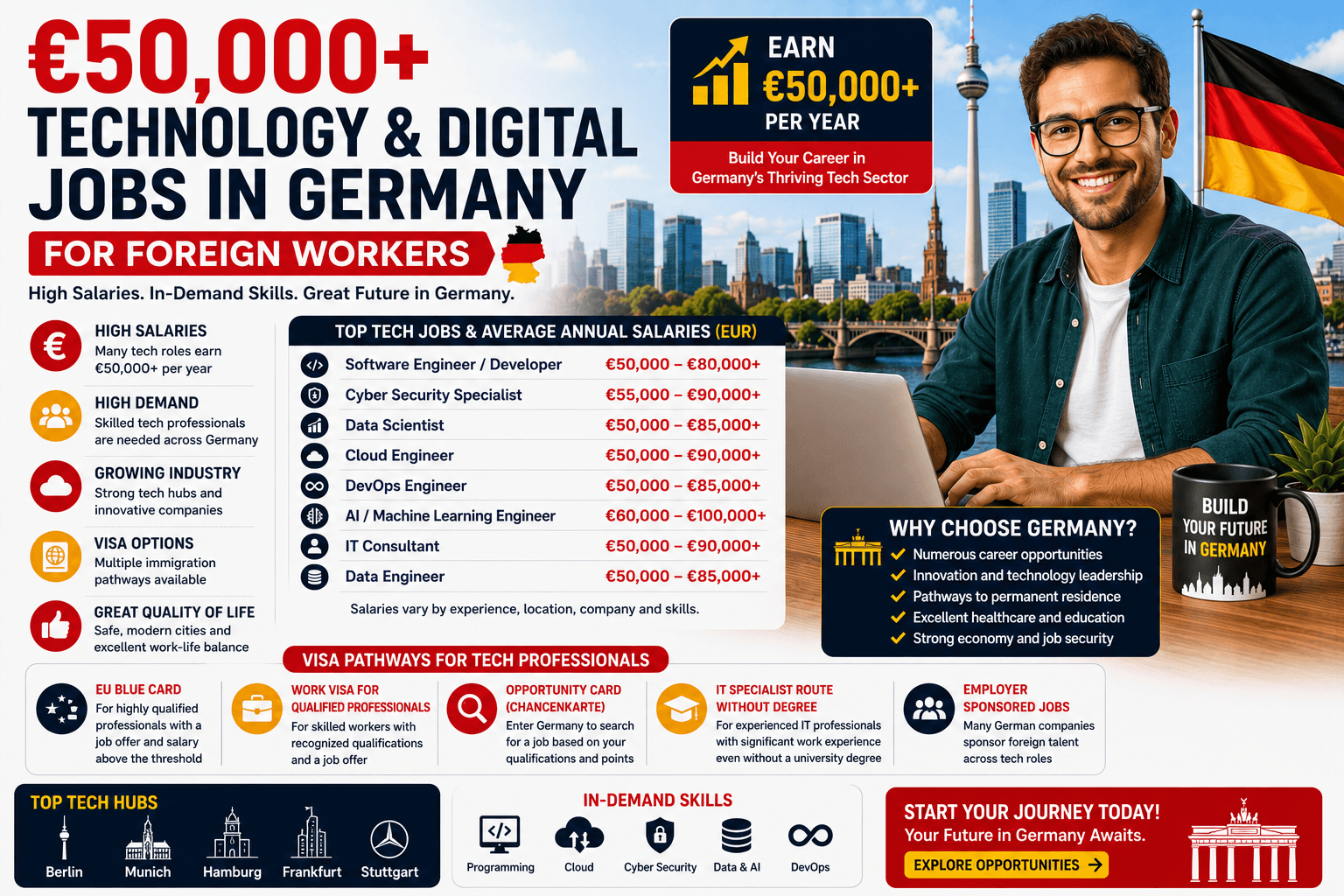
Germany is one of Europe’s largest economies and offers technology career opportunities across software engineering, cybersecurity, artificial intelligence, data science, cloud computing, automation and other digital fields.
For experienced technology professionals, salaries of:
€50,000+ per year
are achievable across many occupations.
Higher salaries can be available to senior workers in areas such as:
- Software Engineering
- Cybersecurity
- Cloud Computing
- DevOps
- Artificial Intelligence
- Data Science
- IT Architecture
- Technology Management
Germany is particularly interesting for foreign technology workers because several immigration routes can support qualified professionals.
Depending on the worker and job, these can include:
- EU Blue Card
- Work visa for qualified professionals
- Opportunity Card
- Other skilled-worker pathways
Germany has also created special provisions that can make immigration possible for certain experienced IT professionals even without a traditional university degree.
However:
IT job ≠ automatic German visa.
Salary, qualifications, professional experience and the selected immigration pathway still matter.
This guide explains €50,000+ technology and digital jobs in Germany for foreign workers, including salaries, occupations, language requirements and immigration options.
Why Work in Technology in Germany?
Germany’s economy combines advanced manufacturing with a rapidly evolving digital sector.
Technology professionals work throughout:
- Automotive
- Manufacturing
- Banking
- Insurance
- Logistics
- Telecommunications
- Healthcare
- Energy
- E-commerce
- Software
- Consulting
- Research
Germany’s major industrial companies also employ large internal technology teams.
This means a foreign developer should not search only for:
German software companies.
Technology opportunities can exist at:
- Car manufacturers
- Banks
- Engineering companies
- Logistics companies
- Pharmaceutical businesses
and many other employers.
Technology Jobs for Foreign Workers
Popular technology occupations include:
- Software Developer
- Software Engineer
- Backend Developer
- Frontend Developer
- Full-Stack Developer
- Cybersecurity Specialist
- Data Scientist
- Data Engineer
- Cloud Engineer
- DevOps Engineer
- Machine Learning Engineer
- Network Engineer
- IT Consultant
- Systems Administrator
- IT Project Manager
What Does €50,000 Per Year Mean?
A €50,000 gross annual salary equals approximately:
€4,167 gross per month.
At 40 hours weekly, the simple hourly equivalent is approximately:
€24.04.
Salary Examples
| Annual Gross | Approx. Monthly Gross |
|---|---|
| €40,000 | €3,333 |
| €45,000 | €3,750 |
| €50,000 | €4,167 |
| €60,000 | €5,000 |
| €70,000 | €5,833 |
| €80,000 | €6,667 |
| €100,000 | €8,333 |
| €120,000 | €10,000 |
These are simple gross calculations rather than guaranteed German technology salaries.
Enter an hourly wage, choose a country, and estimate monthly gross pay, tax and take-home income.
Planning estimate only. The preset uses a simplified flat percentage. Actual tax and payroll deductions can differ based on income level, province/state/region, allowances, social contributions, marital status and local tax rules.
Use the calculator for planning only. Actual German take-home pay depends on taxes, social-security contributions, health insurance, individual circumstances and other deductions.
Software Developer Jobs in Germany
Software development is one of the most accessible German technology careers for international professionals.
Potential titles include:
- Softwareentwickler
- Software Engineer
- Backend Developer
- Frontend Developer
- Full-Stack Developer
- Application Developer
Developers can work across almost every major German industry.
Software Development Skills
Common skills include:
- Java
- JavaScript
- TypeScript
- Python
- C#
- C++
- React
- Angular
- Node.js
- .NET
- SQL
German industrial employers can also value experience with:
- Embedded systems
- Automotive software
- Industrial automation
- IoT
Software Engineer Salary
Software-engineering salaries vary according to:
- Experience
- City
- Employer
- Industry
- Technical speciality
Experienced developers can earn:
€50,000–€80,000+
annually.
Senior engineers and specialists can earn more.
These are broad market examples rather than guaranteed salary ranges.
Automotive Software Jobs
Germany’s automotive industry creates specialised technology opportunities.
Potential careers include:
- Embedded Software Engineer
- Automotive Software Developer
- Autonomous Systems Engineer
- Computer Vision Engineer
- Vehicle Cybersecurity Specialist
Relevant skills can include:
- C
- C++
- Embedded Linux
- AUTOSAR
- Computer vision
- Machine learning
Cybersecurity Jobs
Cybersecurity is increasingly important as German businesses digitalise.
Potential roles include:
- Cybersecurity Analyst
- Security Engineer
- SOC Analyst
- Penetration Tester
- Security Consultant
- Cloud Security Engineer
- Information Security Manager
Cybersecurity Skills
Relevant skills can include:
- SIEM
- Network security
- Incident response
- Cloud security
- Vulnerability management
- Identity management
- Penetration testing
Certifications can include:
- Security+
- CISSP
- CISM
- CCSP
Practical experience remains important.
Data Scientist Jobs
Data Scientists help German organisations use data to:
- Predict outcomes
- Automate decisions
- Improve products
- Optimise manufacturing
- Understand customers
Industries employing data professionals include:
- Automotive
- Finance
- Insurance
- E-commerce
- Manufacturing
- Healthcare
Data Science Skills
Common skills include:
- Python
- R
- SQL
- Statistics
- Machine learning
- Data visualisation
Experience with cloud platforms can also strengthen applications.
Data Engineer Jobs
Data Engineers build infrastructure used to:
- Collect data
- Transform data
- Store data
- Supply analytics systems
Skills can include:
- Python
- SQL
- Spark
- Kafka
- Cloud platforms
- Data warehouses
The growth of AI has increased the importance of strong data infrastructure.
Artificial Intelligence Jobs
Germany has significant activity across:
- AI research
- Industrial AI
- Autonomous systems
- Robotics
- Machine learning
- Computer vision
Potential jobs include:
- AI Engineer
- Machine Learning Engineer
- Applied Scientist
- NLP Engineer
- Computer Vision Engineer
AI in Manufacturing
Germany’s industrial economy makes AI particularly relevant to:
- Robotics
- Quality control
- Predictive maintenance
- Factory automation
- Supply-chain optimisation
Technology professionals with both software and engineering experience can have valuable profiles.
Cloud Engineer Jobs
German companies increasingly rely on:
- AWS
- Microsoft Azure
- Google Cloud
Potential careers include:
- Cloud Engineer
- Cloud Architect
- Platform Engineer
- Cloud Security Engineer
DevOps Jobs
DevOps professionals can work with:
- Docker
- Kubernetes
- Terraform
- Jenkins
- GitHub Actions
- Linux
- AWS
- Azure
Experienced DevOps and platform engineers can command salaries well above €50,000.
Network Engineer Jobs
Network professionals manage:
- Corporate networks
- Data centres
- Cloud connectivity
- Firewalls
- VPNs
Potential titles include:
- Network Engineer
- Network Administrator
- Infrastructure Engineer
- Network Architect
IT Consultant Jobs
Germany has a substantial technology-consulting industry.
IT consultants help organisations:
- Implement software
- Modernise systems
- Move to cloud platforms
- Improve cybersecurity
- Deploy enterprise technology
German-language ability can be particularly valuable because consulting often involves direct client communication.
SAP Jobs
Germany is a particularly important market for SAP professionals.
Potential careers include:
- SAP Consultant
- SAP Developer
- SAP Basis Administrator
- SAP Security Consultant
- SAP S/4HANA Specialist
Experienced SAP professionals can command strong salaries.
IT Project Manager Jobs
Experienced technology workers can progress into:
- IT Project Manager
- Technical Project Manager
- Programme Manager
- Product Manager
German-language ability can become more important as a professional moves into management.
Technology Jobs in Berlin
Berlin has one of Germany’s largest startup ecosystems.
Technology opportunities exist across:
- Software
- Fintech
- E-commerce
- AI
- SaaS
Berlin is also one of the easier German cities for finding some English-speaking technology environments.
However, English-only jobs remain competitive.
Technology Jobs in Munich
Munich has major employers across:
- Automotive
- Software
- Insurance
- Engineering
- Electronics
Salaries can be high.
Housing costs are also among the highest in Germany.
Technology Jobs in Frankfurt
Frankfurt is a major financial centre.
Technology opportunities include:
- Banking technology
- Cybersecurity
- Cloud
- Fintech
- Data
Technology Jobs in Hamburg
Hamburg has technology opportunities across:
- Logistics
- Media
- E-commerce
- Aviation
- Software
Technology Jobs in Stuttgart
Stuttgart is particularly strong in:
- Automotive technology
- Manufacturing
- Engineering
- Embedded software
- Industrial automation
Technology Jobs in Cologne
Cologne has opportunities across:
- Media
- Telecommunications
- Insurance
- Software
- Consulting
Technology Jobs in Düsseldorf
Düsseldorf provides technology employment across:
- Telecommunications
- Consulting
- Corporate IT
- Financial services
Do You Need German?
Not every German technology job requires fluent German.
Some international technology companies operate largely in English.
This is especially common in:
- Berlin startups
- Multinational technology businesses
- Research
- Some software-engineering teams
However:
German dramatically expands your job market.
Why Learn German?
German can help with:
- Interviews
- Workplace communication
- Client-facing jobs
- Management positions
- Government procedures
- Daily life
Even where an employer uses English internally, learning German can improve long-term career and settlement prospects.
Can You Get a Tech Job With Only English?
Yes, particularly in specialised technology occupations.
But applicants should not assume every employer works in English.
Search terms such as:
English speaking software jobs Germany
can help.
Do You Need a University Degree?
Not necessarily.
This is one of the most interesting aspects of German IT immigration.
Germany has special immigration provisions for certain IT professionals with substantial professional experience.
Depending on the immigration route and circumstances, an IT professional can potentially qualify without holding a traditional university degree.
IT Specialists Without a Degree
Germany’s official skilled-immigration framework includes provisions for experienced IT specialists.
This can be particularly useful for:
- Self-taught developers
- System administrators
- Cybersecurity professionals
- IT consultants
- Other experienced technology workers
However, applicants still need to satisfy the applicable professional-experience, employment and salary requirements.
Do not interpret this as:
“Anyone who can code can get a German visa without qualifications.”
EU Blue Card
The EU Blue Card is one of Germany’s major immigration pathways for highly qualified workers.
Technology professionals can qualify where they satisfy requirements involving:
- Eligible employment
- Qualification or applicable professional basis
- Salary threshold
- Other immigration conditions
Lower Blue Card Threshold
Germany applies a lower EU Blue Card salary threshold to certain:
shortage occupations
and eligible new entrants to the labour market.
Information and communications technology service managers and certain academic STEM occupations can fall within relevant shortage-occupation provisions.
The exact annual salary threshold is adjusted over time.
Applicants should verify the current figure before accepting an employment offer.
IT Specialists and EU Blue Card
Germany also permits certain experienced IT specialists to qualify for an EU Blue Card without a university degree when the applicable conditions are satisfied.
This is particularly important for experienced foreign technology professionals.
Professional experience needs to satisfy the required standard.
The employment must also meet the applicable Blue Card conditions.
Blue Card Is Not Automatic
A €50,000 technology job does not automatically guarantee an EU Blue Card.
The required salary depends on:
- Applicable threshold
- Occupation
- Individual circumstances
- Current year’s rules
Always verify the threshold for the year of application.
Work Visa for Qualified Professionals
Foreign technology professionals can also use Germany’s work visa for qualified professionals where they meet the requirements.
This can involve:
- Recognised or comparable qualification
- Qualified employment
- Other immigration conditions
The employment does not always have to match the qualification in the narrow way older German immigration rules once required, although regulated professions remain different.
Opportunity Card
Germany’s:
Opportunity Card — Chancenkarte
provides another route for certain foreign skilled workers seeking employment.
It can allow eligible applicants to enter Germany to look for qualifying work.
There are different eligibility routes.
Applicants can qualify through recognised qualifications or a points-based system where the requirements are satisfied.
Opportunity Card Is Not Guaranteed Employment
The Opportunity Card gives eligible applicants an immigration route for job searching.
It does not guarantee:
- Employment
- €50,000 salary
- EU Blue Card
- Permanent residence
Workers still need to secure suitable employment.
Job Search Strategy
International technology workers should search for positions using both English and German job titles.
Examples include:
- Software Engineer Germany
- Softwareentwickler
- IT Spezialist
- Cyber Security Specialist
- Data Scientist
- Cloud Engineer
- DevOps Engineer
- IT Consultant
- Machine Learning Engineer
Recognition of Qualifications
For many non-regulated technology occupations, professional recognition works differently from regulated careers such as nursing.
However, recognition or proof of qualification can still matter for immigration.
The requirements depend on the selected visa route.
Foreign University Degrees
Applicants with foreign university degrees may need to establish that their qualification is recognised or comparable where the immigration route requires it.
Germany’s official systems can be used to verify foreign qualifications and institutions.
Employment Contract
A genuine employment offer should clearly explain:
- Employer
- Job title
- Salary
- Working hours
- Location
- Start date
- Employment conditions
Review the contract carefully before beginning an immigration application.
Gross vs Net Salary
German salaries are normally discussed as:
gross — brutto
rather than take-home pay.
Your net income can be considerably lower after:
- Income tax
- Pension insurance
- Health insurance
- Unemployment insurance
- Long-term-care insurance
Therefore:
€60,000 gross ≠ €5,000 monthly take-home.
Health Insurance
Health insurance is mandatory in Germany.
Employees normally participate in the German health-insurance system according to the applicable rules.
Factor this into relocation planning.
Remote German Tech Jobs
A German company can potentially work with a technology professional who remains overseas.
This can happen through:
- Contracting
- Foreign subsidiaries
- Employer-of-record structures
However:
remote German employment ≠ German residence permission.
You need the appropriate immigration status to relocate and work physically in Germany.
How Long Does the Process Take?
A foreign technology professional can need time for:
- Qualification verification
- Job search
- Interviews
- Employment contract
- Visa preparation
- Embassy appointment
- Immigration processing
- Relocation
The exact process depends on the immigration route and applicant.
Choose your destination and preferred entry route, then tell us how far you have progressed.
Timeline results are planning estimates only and are not a guarantee of visa approval or travel date.
Use this calculator only as a planning estimate. It does not guarantee German visa processing time, employment, EU Blue Card eligibility or immigration approval.
Building a German Tech CV
German employers generally expect a structured professional application.
Your CV should clearly show:
- Technical skills
- Work history
- Education
- Certifications
- Projects
- Languages
Technology workers should emphasise measurable achievements.
Instead of:
“Worked as backend developer.”
Use:
“Built APIs serving 500,000 monthly requests and reduced average response time by 35%.”
when accurate.
GitHub Portfolio
Developers can demonstrate practical skills through:
- Applications
- APIs
- Documentation
- Testing
- Deployment
- Open-source contributions
This is particularly useful for applicants without traditional computer-science backgrounds.
Your professional profile should clearly describe your specialisation.
For example:
Cloud Engineer | AWS | Kubernetes | Terraform
is more useful than:
IT Expert.
Technology Job Scams
Foreign applicants should be cautious of advertisements claiming:
“Guaranteed German work visa.”
“Pay €10,000 for EU Blue Card.”
“Guaranteed IT job.”
“No experience needed for €80,000 software job.”
“Guaranteed permanent residence.”
No recruiter can guarantee a government immigration decision.
Germany vs USA Tech Jobs
The United States can offer considerably higher top-end technology salaries.
Germany provides a different immigration environment, including:
- EU Blue Card
- Qualified professional routes
- Opportunity Card
For some workers, Germany can provide a more predictable immigration option than relying on a cap-subject U.S. H-1B process.
Germany vs Canada Tech Jobs
Canada offers:
- Express Entry
- Provincial Nominee Programs
- Work permits
Germany offers:
- EU Blue Card
- Qualified professional visa
- Opportunity Card
- Special provisions for experienced IT workers
English-speaking workers may find Canada easier linguistically, while Germany can offer attractive European career opportunities.
Germany vs UK Tech Jobs
The UK Skilled Worker route is primarily employer-sponsored.
Germany offers both employer-connected skilled-worker routes and the Opportunity Card for eligible job seekers.
German-language ability is more important for the wider German labour market.
Frequently Asked Questions
Can foreigners get technology jobs in Germany?
Yes. German employers recruit foreign technology professionals across software, cybersecurity, data, cloud, AI and other digital careers.
Can tech workers earn €50,000?
Yes. Experienced technology professionals can earn €50,000 or more depending on occupation, city and employer.
Do I need German?
Not for every technology position. Some companies use English, but German substantially increases available opportunities.
Can IT professionals immigrate without a degree?
Certain experienced IT professionals can potentially qualify under special German immigration provisions without a traditional university degree when they meet the applicable requirements.
Can IT workers get an EU Blue Card without a degree?
Certain experienced IT specialists can qualify where they satisfy the applicable professional-experience and other Blue Card requirements.
Is €50,000 enough for a Blue Card?
It can be sufficient in some circumstances, but applicants must check the current salary threshold applicable to their occupation and situation.
What is the Opportunity Card?
The Chancenkarte is a German immigration route allowing eligible foreign applicants to enter Germany to search for qualifying employment.
Does an Opportunity Card guarantee a job?
No.
Can software engineers get permanent residence?
Potentially. Skilled workers and EU Blue Card holders can eventually qualify for settlement where they satisfy the applicable residence, employment, language and other requirements.
Is visa sponsorship guaranteed?
No.
Final Thoughts
Germany provides attractive opportunities for skilled international technology professionals.
Foreign workers can pursue careers across:
- Software Engineering
- Cybersecurity
- Data Science
- Artificial Intelligence
- Cloud Computing
- DevOps
- SAP
- Industrial Technology
- Automotive Software
Experienced professionals can earn:
€50,000+ per year
and senior specialists can earn substantially more.
Germany also stands out because its immigration system provides options for some experienced IT professionals who do not have a traditional university degree.
Potential immigration pathways include:
EU Blue Card
work visa for qualified professionals
and:
Opportunity Card.
But there is no automatic:
“Germany IT visa.”
Applicants need to match their:
experience + qualifications + job + salary
with the correct immigration route.
The strongest strategy is:
build specialised technology skills → document professional experience → improve German where possible → target genuine employers → identify the correct immigration pathway → verify current salary and visa requirements before applying.
For more Technology & Digital Jobs guides, continue with €50,000+ Technology & Digital Jobs in Netherlands for Foreign Workers, followed by occupation guides covering Software Developer Jobs, Cybersecurity Jobs, Data Scientist Jobs, Cloud Engineer Jobs and AI Jobs.
MimBlog is an independent information website and is not a recruitment agency, employer, immigration authority or government agency. Salaries are estimates and may vary by employer, experience and location. Job availability and immigration requirements can change. Always verify vacancies, eligibility and visa requirements through employers and official government sources.