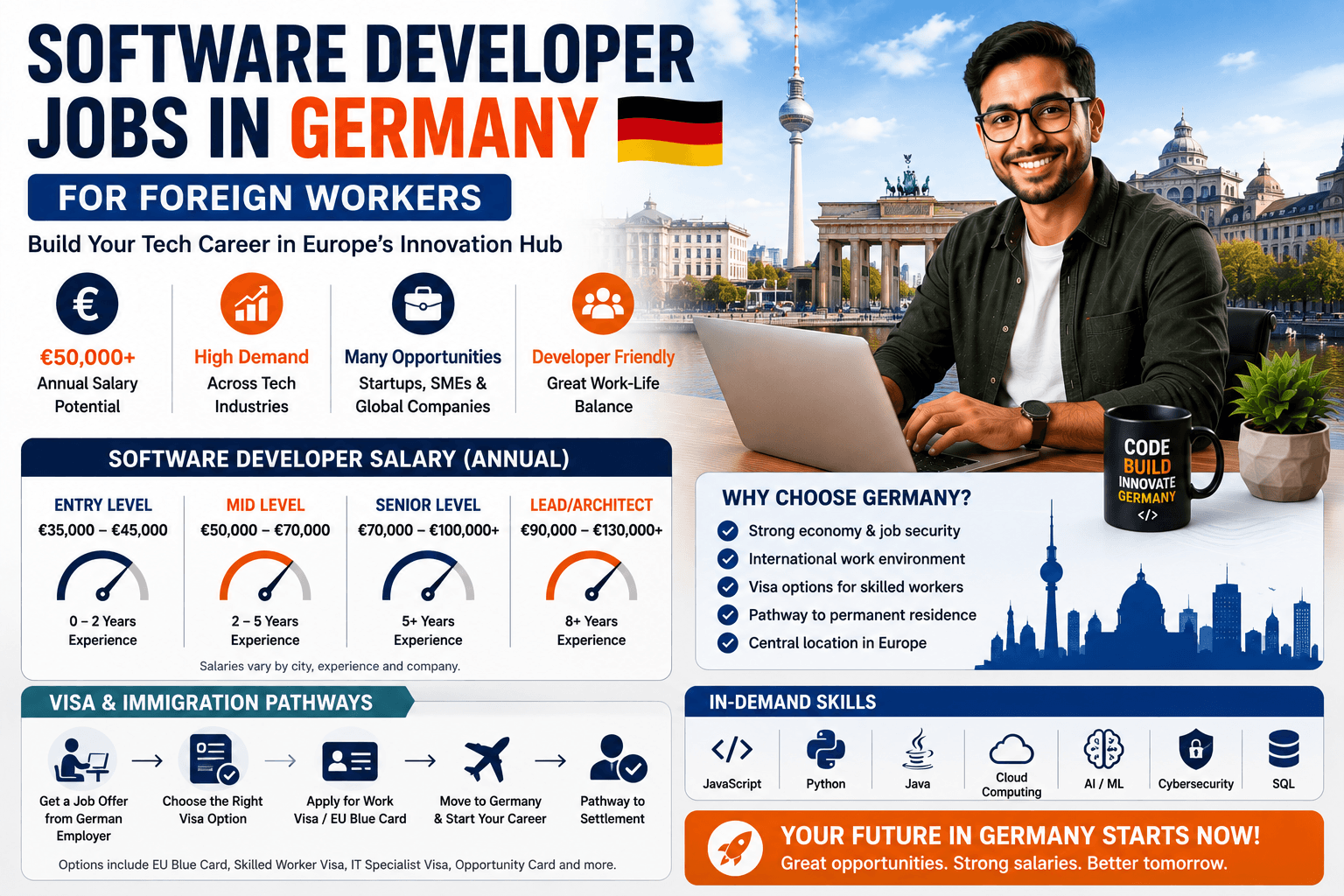
Germany is one of Europe’s largest technology economies and an attractive destination for foreign software developers, programmers and IT specialists.
Opportunities exist across:
- Software development
- Automotive technology
- Artificial intelligence
- Fintech
- Cloud computing
- Cybersecurity
- E-commerce
- Industrial automation
- Enterprise software
- Telecommunications
For experienced software professionals, salaries of:
€50,000+ per year
are achievable, while senior engineers, architects, technical leads and specialised developers can earn substantially more.
Germany is particularly interesting for international technology workers because several immigration routes can apply, including the:
- EU Blue Card
- Work visa for qualified professionals
- Special provisions for experienced IT professionals
- Opportunity Card
However:
a software developer job does not automatically guarantee a German work visa or residence permit.
Salary, qualifications, professional experience, the employment offer and the selected immigration route all matter.
This guide explains software developer jobs in Germany for foreign workers, including salaries, skills, EU Blue Card options and other routes available to IT professionals.
Software Development in Germany
Germany has a large and diverse technology economy.
Software developers can work for:
- Technology companies
- Automotive manufacturers
- Banks
- Insurance companies
- Industrial manufacturers
- Consulting firms
- E-commerce companies
- Startups
- Telecommunications companies
- Research organisations
Germany’s strong manufacturing economy also creates technology careers that do not exist at the same scale in some other countries.
For example, software engineers can work on:
- Autonomous vehicles
- Industrial robotics
- Embedded systems
- Factory automation
- Internet of Things
- Automotive software
Can Software Developers Earn €50,000+?
Yes.
Experienced software developers in Germany can earn above:
€50,000 per year.
Compensation varies according to:
- Experience
- City
- Employer
- Industry
- Technical speciality
- Seniority
A simple monthly equivalent of €50,000 is approximately:
€4,167 gross per month.
At €60,000:
€5,000 gross per month.
At €80,000:
approximately €6,667 gross per month.
At €100,000:
approximately €8,333 gross per month.
These figures are gross salary before deductions.
Example Software Developer Salary Levels
| Annual Gross Salary | Approx. Monthly Gross |
|---|---|
| €45,000 | €3,750 |
| €50,000 | €4,167 |
| €60,000 | €5,000 |
| €70,000 | €5,833 |
| €80,000 | €6,667 |
| €90,000 | €7,500 |
| €100,000 | €8,333 |
| €120,000 | €10,000 |
These are simple salary examples rather than guaranteed market rates.
Enter an hourly wage, choose a country, and estimate monthly gross pay, tax and take-home income.
Planning estimate only. The preset uses a simplified flat percentage. Actual tax and payroll deductions can differ based on income level, province/state/region, allowances, social contributions, marital status and local tax rules.
Use the salary calculator for planning only. Actual German take-home income depends on income tax, social insurance, health insurance, tax class, family circumstances and other deductions.
Software Developer Jobs in Berlin
Berlin has one of Germany’s most internationally oriented technology markets.
Opportunities exist across:
- Software
- Fintech
- E-commerce
- Artificial intelligence
- SaaS
- Gaming
- Digital services
English-speaking technology jobs are relatively common compared with many other German employment sectors.
However, German language ability can still expand the number of employers available to you.
Software Developer Jobs in Munich
Munich has a strong technology and engineering economy.
Software professionals can work across:
- Automotive technology
- Enterprise software
- Artificial intelligence
- Insurance technology
- Cloud computing
- Engineering
Munich can offer high salaries, but it is also one of Germany’s more expensive housing markets.
Software Developer Jobs in Frankfurt
Frankfurt is Germany’s major financial centre.
Technology opportunities exist across:
- Banking
- Fintech
- Cybersecurity
- Cloud infrastructure
- Enterprise software
- Data
Developers with financial-services experience can find specialised opportunities.
Software Developer Jobs in Hamburg
Hamburg provides careers across:
- E-commerce
- Logistics technology
- Media
- Software
- Gaming
- Digital services
Software Developer Jobs in Stuttgart
Stuttgart is particularly important for:
- Automotive technology
- Engineering
- Embedded software
- Industrial automation
- Manufacturing technology
Developers with C++, embedded systems or automotive experience can find specialised opportunities.
Software Developer Jobs in Cologne and Düsseldorf
Both cities have technology employment across:
- Telecommunications
- Consulting
- Enterprise IT
- Media
- E-commerce
- Digital services
Foreign workers should therefore avoid restricting their job search to Berlin.
Programming Languages in Demand
German employers recruit developers with skills including:
- Java
- JavaScript
- TypeScript
- Python
- C#
- C++
- Go
- PHP
- SQL
Frameworks can include:
- React
- Angular
- Vue
- Spring
- Node.js
- .NET
- Django
- Laravel
Java Developer Jobs
Java remains important across:
- Banking
- Insurance
- Enterprise applications
- Automotive systems
- Large corporate platforms
Java developers with Spring and cloud experience can target enterprise software roles.
Python Developer Jobs
Python is widely used for:
- Backend development
- Artificial intelligence
- Data science
- Automation
- Machine learning
Python developers can strengthen their profiles with:
- Django
- FastAPI
- Flask
- SQL
- AWS
- Azure
C++ Developer Jobs
Germany’s automotive and engineering sectors create opportunities for C++ developers.
Potential applications include:
- Automotive software
- Robotics
- Embedded systems
- Industrial equipment
- Simulation
Frontend Developer Jobs
Common frontend skills include:
- HTML
- CSS
- JavaScript
- TypeScript
- React
- Angular
- Vue
Employers can also value:
- Accessibility
- Testing
- Performance optimisation
- Responsive design
Full-Stack Developer Jobs
Full-stack developers work across frontend and backend technologies.
Typical stacks can include:
React + Node.js + PostgreSQL + AWS
or:
Angular + Java + Spring + PostgreSQL.
Cloud Engineering Skills
Cloud computing experience can significantly strengthen a software engineering profile.
Important platforms include:
- AWS
- Microsoft Azure
- Google Cloud
Related technologies include:
- Docker
- Kubernetes
- Terraform
- Linux
- CI/CD
DevOps Skills
Developers can also move into:
- DevOps Engineering
- Platform Engineering
- Site Reliability Engineering
These careers combine:
- Development
- Infrastructure
- Automation
- Cloud computing
Artificial Intelligence Jobs
Germany has opportunities across:
- Machine learning
- Generative AI
- Computer vision
- Robotics
- Autonomous vehicles
- Industrial AI
Developers with strong Python, mathematics and machine-learning experience can target specialised positions.
Do You Need German?
Not necessarily for every software job.
Many international technology companies operate partly or entirely in English.
This is particularly common in cities such as:
- Berlin
- Munich
- Frankfurt
However, German language skills can substantially increase employment options.
A foreign developer who speaks German can potentially access:
- More employers
- Client-facing positions
- Management roles
- Smaller German companies
German can also make everyday life easier.
Do You Need a Degree?
Not necessarily for every German IT immigration route.
Germany provides several pathways for technology professionals.
A recognised academic qualification can be particularly useful for routes such as the:
EU Blue Card.
However, Germany also provides possibilities for experienced IT specialists who do not hold a traditional university degree, provided the relevant immigration requirements are satisfied.
This makes Germany particularly interesting for experienced self-taught developers.
EU Blue Card
The EU Blue Card is one of Germany’s important immigration routes for highly qualified foreign professionals.
A software developer can potentially qualify where the requirements are satisfied.
These can include:
- Qualifying employment
- Required salary
- Appropriate qualification or qualifying professional experience
- Other immigration requirements
Germany applies a lower Blue Card salary threshold to certain shortage occupations and qualifying situations.
Technology professionals can potentially benefit where their exact circumstances satisfy the rules.
IT Specialists and EU Blue Card
Germany provides a particularly important provision for IT professionals.
Under qualifying circumstances, an IT specialist can potentially obtain an EU Blue Card based on professional experience even without a university degree.
The applicant must satisfy the applicable requirements, including sufficient relevant professional experience and the required employment salary.
This can be valuable for experienced:
- Software Developers
- Software Engineers
- Cloud Engineers
- DevOps Engineers
- Cybersecurity Specialists
who built their careers through professional experience rather than university education.
Work Visa for Qualified Professionals
Foreign software professionals can also potentially use Germany’s work visa for qualified professionals.
The route can apply where:
- The worker has a recognised or comparable qualification where required
- There is qualifying employment
- Immigration conditions are satisfied
The exact route depends on the applicant’s background.
Experienced IT Professionals
Germany also has immigration provisions designed for experienced IT specialists.
This is important because the technology industry contains many professionals who have:
- Strong commercial experience
- No computer science degree
- Non-traditional education
Under the appropriate rules, professional experience can play a significant role.
However:
being self-taught does not automatically qualify someone for a German residence permit.
Applicants must satisfy the requirements of the route they use.
Opportunity Card
Germany’s:
Opportunity Card — Chancenkarte
can allow qualifying foreign workers to enter Germany to search for suitable employment.
Eligibility can depend on the applicant’s:
- Qualification
- Language ability
- Professional background
- Points where applicable
- Financial means
The Opportunity Card should not be confused with:
a guaranteed job
or:
automatic permanent residence.
Opportunity Card vs Job Offer
A worker who already has qualifying employment may be better suited to a direct employment residence route.
The Opportunity Card is particularly relevant to eligible applicants who want to conduct their job search in Germany.
Applicants should compare the pathways rather than automatically choosing the Opportunity Card.
Recognition of Qualifications
Whether formal recognition is required depends on:
- Profession
- Immigration route
- Qualification
Software development itself is generally not a regulated profession in the same way as occupations such as nursing.
However, qualification comparability can still matter for certain immigration routes.
Applicants should check the requirements applying to their exact pathway.
Job Offer Requirements
A genuine German employment offer should clearly identify:
- Employer
- Job title
- Salary
- Working hours
- Employment conditions
For immigration purposes, authorities can assess whether the employment meets the requirements of the selected residence route.
Federal Employment Agency
Germany’s Federal Employment Agency can be involved in approval of employment conditions for certain immigration processes.
Not every case follows an identical procedure.
Applicants should therefore use the rules applying to their specific residence category.
Age 45+ Rule
Foreign professionals applying for certain German employment residence permits for the first time at age 45 or older can face an additional salary or adequate pension-provision requirement.
The salary threshold is adjusted over time.
Applicants affected by this rule should verify the current annual amount before applying.
How Long Does German Immigration Take?
The overall process can include:
- Job search.
- Employment contract.
- Qualification or professional-experience verification where applicable.
- Visa application where required.
- Authority processing.
- Entry to Germany.
- Local registration.
- Residence-permit procedures where applicable.
Processing times can vary by:
- German mission
- Applicant’s country
- Immigration route
- Local foreigners authority
- Document completeness
Choose your destination and preferred entry route, then tell us how far you have progressed.
Timeline results are planning estimates only and are not a guarantee of visa approval or travel date.
Use the wait-time calculator only as a planning estimate. It does not guarantee embassy appointment availability, visa-processing time, Federal Employment Agency approval, EU Blue Card approval or residence-permit issuance.
Can Software Developers Get Permanent Residence?
Potentially.
Foreign software developers who live and work legally in Germany can potentially progress toward:
permanent settlement permission
when they satisfy the applicable requirements.
EU Blue Card holders can have particularly favourable settlement rules.
The required period can depend partly on factors such as:
- Residence status
- Employment
- German language ability
- Pension contributions
- Other legal requirements
Therefore:
German work visa ≠ automatic permanent residence.
Can Software Developers Bring Family?
Foreign workers holding qualifying German residence permits can potentially bring eligible family members under family reunification rules.
Requirements depend on:
- Residence status
- Family relationship
- Individual circumstances
EU Blue Card holders can benefit from favourable family provisions.
Remote German Software Jobs
Foreign developers can potentially work remotely for German companies while living abroad.
Possible arrangements include:
- Contracting
- Overseas subsidiary
- Employer of record
However:
remote German job ≠ German residence permission.
A worker who wants to relocate physically to Germany needs the appropriate immigration status.
Building a German Tech CV
Software applicants should emphasise measurable achievements.
Instead of:
“Developed web applications.”
write:
“Built a customer platform serving 400,000 monthly users and reduced average page load time by 45%.”
when accurate.
Useful metrics include:
- Users
- Revenue
- Performance
- Cost reduction
- Automation
- Reliability
- Security
GitHub Portfolio
Foreign applicants can demonstrate ability through:
- Production applications
- APIs
- Open-source contributions
- Automated testing
- Documentation
- Cloud deployments
Quality matters more than simply having many repositories.
Use a clear professional headline.
For example:
Senior Backend Developer | Java | Spring Boot | AWS
is more useful than:
IT Expert.
How to Find German Software Jobs
Useful searches include:
- Software Developer Germany English jobs
- Software Engineer Germany foreign workers
- Software Developer Germany EU Blue Card
- Backend Developer Berlin English
- Software Engineer Munich international
- IT jobs Germany visa sponsorship
German employers do not normally use the phrase:
“visa sponsorship”
in exactly the same way as UK or US employers.
Search for:
- Relocation support
- International applicants
- English-speaking jobs
- EU Blue Card eligible jobs
as well.
Job Scams
Foreign applicants should be cautious of advertisements claiming:
“Guaranteed German software job.”
“Pay €10,000 for EU Blue Card.”
“Guaranteed German permanent residence.”
“No qualifications or experience required for €100,000 job.”
A legitimate employer cannot guarantee the immigration authority’s decision.
Germany vs Canada Software Jobs
Canada offers:
- Express Entry
- Provincial Nominee Programs
- Employer-supported work permits
Germany offers:
- EU Blue Card
- Skilled-worker residence
- Experienced IT professional provisions
- Opportunity Card
Germany can be particularly attractive to experienced developers interested in the European labour market.
Germany vs UK Software Jobs
The UK Skilled Worker route depends heavily on:
- Approved sponsor
- Certificate of Sponsorship
- Salary requirements
Germany provides several employment-residence pathways and special flexibility for qualifying IT specialists.
Germany vs Australia Software Jobs
Australia uses a structured occupation and skills-assessment framework for many skilled migration programmes.
Germany can provide a more direct employer-to-residence pathway for qualifying technology workers.
The best option depends on the worker’s profile.
Frequently Asked Questions
Can foreigners get software developer jobs in Germany?
Yes. Foreign software professionals can work in Germany when they secure qualifying employment and appropriate immigration permission.
Can software developers earn €50,000+?
Yes. Experienced software developers can earn above €50,000 annually, while senior and specialised professionals can earn considerably more.
Do I need German?
Not for every technology job. English-speaking software jobs exist, particularly at international companies, although German can substantially expand your opportunities.
Do I need a computer science degree?
Not necessarily. Some German IT immigration routes allow qualifying experienced professionals to rely substantially on professional experience.
Can an IT professional get an EU Blue Card without a degree?
Potentially, under special provisions for qualifying IT professionals with sufficient relevant professional experience and an eligible job.
What is the Opportunity Card?
It is a German residence route that can allow qualifying foreign workers to enter Germany to search for suitable employment.
Does an Opportunity Card guarantee employment?
No.
Can a software developer eventually obtain permanent residence?
Potentially, after satisfying the applicable residence, employment and other legal requirements.
Does a German job guarantee a visa?
No.
Can I work remotely for a German company?
Potentially while living abroad, but remote employment does not itself provide German residence permission.
Final Thoughts
Germany offers excellent opportunities for foreign software developers.
Technology professionals can build careers across:
- Berlin
- Munich
- Frankfurt
- Hamburg
- Stuttgart
- Cologne
- Düsseldorf
and work across industries including:
- Software
- Automotive technology
- Banking
- Artificial intelligence
- Cloud computing
- Industrial automation
- E-commerce
Experienced developers can earn:
€50,000+ annually
while senior specialists can earn substantially more.
Germany also provides several immigration possibilities, including:
EU Blue Card
work visa for qualified professionals
special provisions for experienced IT specialists
and:
Opportunity Card.
One of Germany’s strongest advantages for the technology industry is that some qualifying IT professionals can access immigration pathways based heavily on professional experience even without a traditional university degree.
However:
software job ≠ guaranteed visa
EU Blue Card ≠ automatic permanent residence
and:
Opportunity Card ≠ guaranteed employment.
The strongest strategy is:
develop specialised software skills → document your professional experience → target German employers recruiting internationally → determine the immigration route matching your qualifications and experience → verify current salary and visa requirements → apply with complete documentation.
MimBlog is an independent information website and is not a recruitment agency, employer, immigration authority or government agency. Salaries are estimates and may vary by employer, experience and location. Job availability and immigration requirements can change. Always verify vacancies, eligibility and visa requirements through employers and official government sources.