

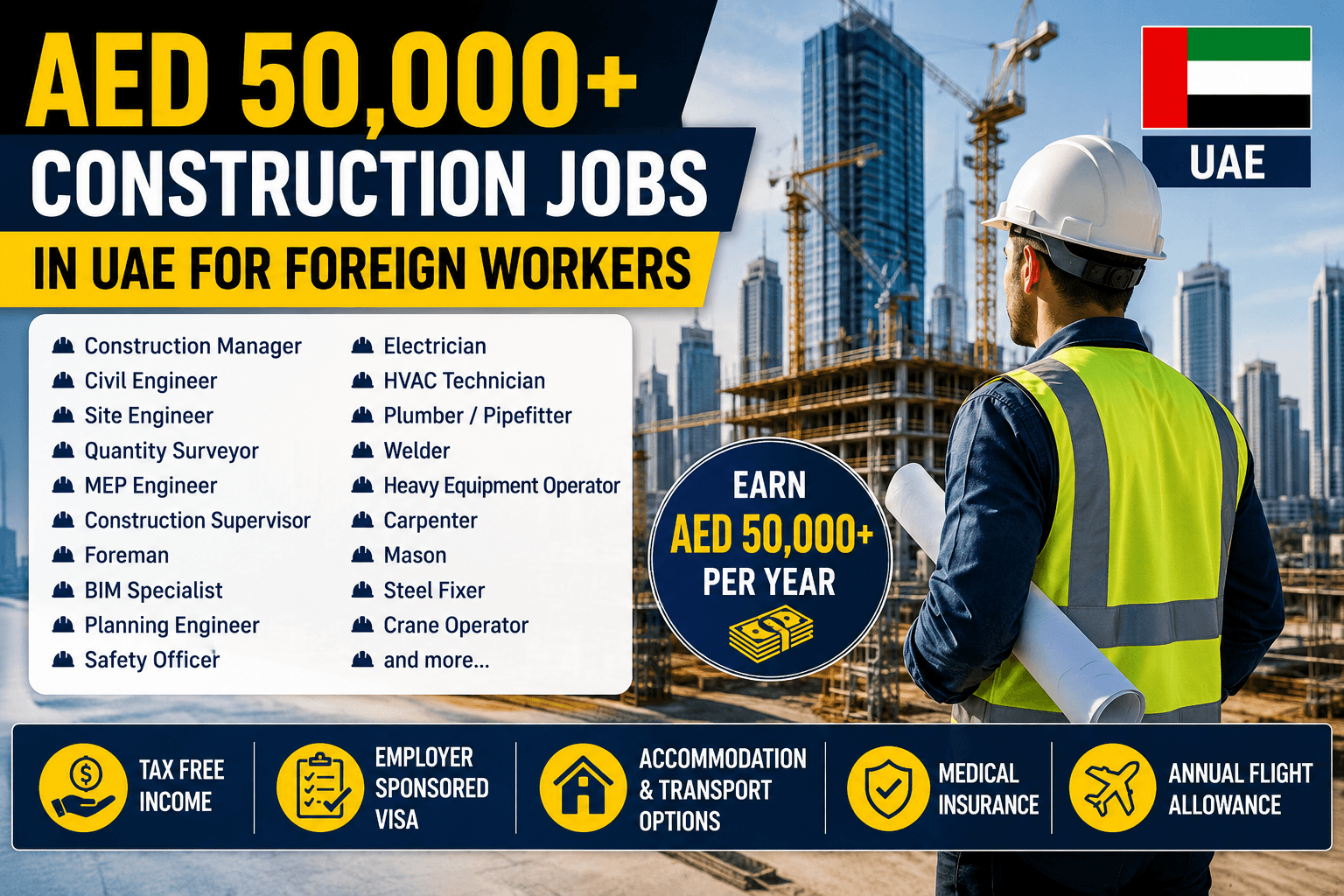
The United Arab Emirates remains one of the most recognisable construction markets in the Middle East. Dubai, Abu Dhabi, Sharjah and other emirates continue to support residential, commercial, infrastructure, hospitality and industrial projects that require workers across different levels of the construction industry.
For foreign workers, this creates opportunities ranging from skilled trades to engineering, supervision and construction management.


However, there is an important point to understand before applying:
Not every construction job in the UAE pays AED 50,000 or more per year.
Some general labour and entry-level trade positions pay considerably less. On the other hand, experienced tradespeople, supervisors, engineers, quantity surveyors and construction managers can move well beyond the AED 50,000 annual level.
For example, current UAE salary data from Indeed places the average base salary of a construction manager at approximately AED 16,805 per month, which annualises to more than AED 200,000 before considering other compensation.
This guide explains construction jobs in the UAE for foreign workers, realistic salary expectations, occupations worth considering, employment requirements and how the UAE work-permit process generally works in 2026.
Why Foreign Workers Consider Construction Jobs in the UAE
The UAE has developed a construction industry that serves a wide range of projects.
These include:
- Residential developments
- Commercial buildings
- Hotels and resorts
- Roads and transportation infrastructure
- Industrial facilities
- Warehouses and logistics developments
- High-rise buildings
- Mechanical and electrical projects
- Energy infrastructure
- Renovation and maintenance projects
Dubai and Abu Dhabi are particularly important employment centres, although construction opportunities also exist in Sharjah, Ajman, Ras Al Khaimah and other parts of the country.
Another major attraction is taxation.
The UAE government states that the country does not levy income tax on individuals.
For an employee earning a salary from employment, this can make the UAE particularly interesting when comparing headline salaries with countries that impose substantial personal income tax.
This does not mean living in the UAE is tax-free in every sense. The country has VAT and other taxes and charges. Workers also have living expenses such as accommodation, transportation, food and insurance to consider.
Nevertheless, the absence of individual income tax is an important factor when comparing UAE employment with opportunities elsewhere.
Construction Salaries in the UAE
Construction salaries vary enormously.
A general construction worker and a senior construction manager should not be placed in the same salary category.
Experience, occupation, employer, emirate, qualifications and the complexity of the project can significantly affect compensation.
The following ranges can be used as broad planning estimates rather than guaranteed salaries.
| Construction Occupation | Approximate Monthly Salary | Approximate Annual Salary |
|---|---|---|
| Senior Construction Manager | AED 20,000–35,000+ | AED 240,000–420,000+ |
| Construction Manager | AED 12,000–25,000+ | AED 144,000–300,000+ |
| Project Manager | AED 15,000–30,000+ | AED 180,000–360,000+ |
| Civil Engineer | AED 6,000–15,000+ | AED 72,000–180,000+ |
| Quantity Surveyor | AED 6,000–15,000+ | AED 72,000–180,000+ |
| Site Engineer | AED 5,000–12,000+ | AED 60,000–144,000+ |
| MEP Engineer | AED 6,000–15,000+ | AED 72,000–180,000+ |
| Construction Supervisor | AED 5,000–10,000+ | AED 60,000–120,000+ |
| Foreman | AED 4,000–8,000+ | AED 48,000–96,000+ |
| Experienced Electrician | AED 3,000–6,000+ | AED 36,000–72,000+ |
| Experienced Plumber | AED 3,000–6,000+ | AED 36,000–72,000+ |
| Experienced Welder | AED 3,000–7,000+ | AED 36,000–84,000+ |
| HVAC Technician | AED 3,000–7,000+ | AED 36,000–84,000+ |
| Heavy Equipment Operator | AED 3,000–7,000+ | AED 36,000–84,000+ |
| Carpenter | AED 2,000–5,000+ | AED 24,000–60,000+ |
| Mason | AED 2,000–5,000+ | AED 24,000–60,000+ |
| General Construction Labourer | AED 1,200–3,000+ | AED 14,400–36,000+ |
These are broad market estimates. Actual offers can fall below or above these ranges.
Can You Really Earn AED 50,000+ in UAE Construction?
Yes.
AED 50,000 per year is approximately:
AED 4,167 per month.
That level is realistic for many experienced construction professionals and some skilled tradespeople, but it is not a realistic minimum for every construction occupation.
Workers most likely to exceed AED 50,000 annually include:
- Construction managers
- Project managers
- Site engineers
- Civil engineers
- Quantity surveyors
- MEP engineers
- Experienced foremen
- Construction supervisors
- BIM professionals
- Senior HVAC technicians
- Specialised welders
- Experienced heavy-equipment operators
- Certain highly experienced electricians and plumbers
General labourers, helpers and some entry-level tradespeople can earn substantially less.
Therefore, foreign applicants targeting AED 50,000+ should focus on developing a specialised skill, recognised qualification, supervisory experience or technical expertise.
Enter an hourly wage, choose a country, and estimate monthly gross pay, tax and take-home income.
Planning estimate only. The preset uses a simplified flat percentage. Actual tax and payroll deductions can differ based on income level, province/state/region, allowances, social contributions, marital status and local tax rules.
1. Construction Manager
Construction management is one of the strongest-paying areas of the UAE construction industry.
Construction managers can coordinate:
- Contractors
- Workers
- Project schedules
- Materials
- Safety
- Budgets
- Quality control
- Project milestones
Current UAE salary data from Indeed reports an average construction-manager base salary of approximately AED 16,805 per month, based on reported salaries as of August 2026.
That is approximately AED 201,660 annually if the monthly figure is maintained for 12 months.
Indeed also reports considerable variation by employer, experience and location.
Senior construction managers working on major developments can earn substantially more than junior managers.
Typical Requirements
Employers may look for:
- Degree in civil engineering, construction management or related field
- Several years of construction experience
- Project-management experience
- UAE or Gulf-region experience for some positions
- Leadership ability
- Knowledge of construction safety
- Strong English communication skills
- Familiarity with project-management software
Professional certifications can also strengthen an application.
2. Construction Project Manager
Project managers coordinate major parts of construction projects from planning through completion.
Their responsibilities can include budgets, contractors, deadlines, client communication and project delivery.
Experienced project managers can command some of the highest salaries in the industry.
Large infrastructure, hospitality, residential and commercial developments can offer particularly attractive opportunities.
3. Civil Engineer
Civil engineers are central to the UAE construction sector.
They may work on:
- Buildings
- Roads
- Bridges
- Infrastructure
- Drainage
- Utilities
- Industrial developments
Foreign-trained engineers should carefully check whether their qualifications require attestation, recognition or professional registration for the specific position.
Previous experience on large projects can significantly improve employability.
4. Site Engineer
Site engineers work closer to day-to-day construction operations.
Responsibilities may include:
- Monitoring work
- Checking drawings
- Coordinating subcontractors
- Inspecting materials
- Reporting progress
- Resolving site issues
- Supporting quality control
Site-engineering experience can also create a path toward project management or construction management.
5. Quantity Surveyor
Quantity surveyors help control the financial side of construction.
Their work can involve:
- Cost estimation
- Tendering
- Contracts
- Material quantities
- Budget monitoring
- Valuations
- Claims
- Final accounts
Experienced quantity surveyors can earn considerably above AED 50,000 per year.
Knowledge of UAE contracts and regional construction practices can be particularly valuable.
6. MEP Engineer
MEP stands for mechanical, electrical and plumbing.
Modern UAE developments depend heavily on complex building systems, creating opportunities for engineers and technicians specialising in MEP work.
MEP engineers may work with:
- Air conditioning
- Ventilation
- Electrical distribution
- Plumbing
- Fire protection
- Building services
Large commercial developments can require substantial MEP teams.
7. BIM Specialist
Building Information Modelling has become increasingly important for major construction projects.
BIM professionals work with digital building models to improve design coordination, construction planning and collaboration.
Useful skills may include experience with software such as:
- Revit
- Navisworks
- AutoCAD
- Civil 3D
- Other BIM platforms
Experienced BIM coordinators and managers can command substantially higher salaries than basic drafting positions.
8. Construction Supervisor
Construction supervisors oversee workers and specific areas of site operations.
They may be responsible for:
- Productivity
- Safety
- Work quality
- Daily assignments
- Materials
- Reporting
Experienced supervisors can cross the AED 50,000 annual level, particularly on larger projects.
9. Construction Foreman
Foremen provide direct supervision for construction crews.
Employers often value practical experience heavily for these positions.
A strong foreman may have extensive experience in areas such as:
- Concrete
- Carpentry
- Steel fixing
- MEP
- Civil works
- Finishing
- Road construction
Some employers prefer applicants who already understand Gulf construction practices.
10. Electrician
Electricians are needed across construction, maintenance and facilities operations.
However, salary levels vary dramatically.
Current Indeed data indicates that the overall average base salary for an electrician in the UAE is approximately AED 2,073 per month as of August 2026.
This is below AED 50,000 annually.
Therefore, an article claiming that ordinary electrician jobs automatically pay AED 50,000+ would be misleading.
Higher earnings are more realistic for:
- Master electricians
- Senior electricians
- Industrial electricians
- Electrical supervisors
- Workers with specialist systems knowledge
- Experienced technicians working on complex projects
Indeed’s current data, for example, places the reported average for master electricians considerably above the general electrician average.
Specialisation matters.
11. HVAC Technician
Air conditioning is particularly important in the UAE because of the country’s climate.
HVAC technicians can work on:
- Air-conditioning systems
- Chillers
- Ventilation
- Building cooling
- Maintenance
- Commercial HVAC installations
Experienced technicians with knowledge of large commercial systems may have stronger earning potential.
12. Plumber and Pipefitter
Plumbing and pipefitting skills are needed across residential, commercial and industrial projects.
Workers with experience in complex piping systems, industrial installations or supervisory positions may earn considerably more than entry-level plumbers.
13. Welder
Welding salaries depend heavily on specialisation.
A basic welder and a highly qualified specialist welder can have very different earning potential.
Skills in areas such as:
- TIG welding
- MIG welding
- Pipe welding
- Structural welding
- Stainless steel
- Industrial welding
can improve employment prospects.
Relevant certifications can also be important.
14. Heavy Equipment Operator
Construction projects require workers capable of operating equipment such as:
- Excavators
- Bulldozers
- Loaders
- Graders
- Cranes
- Backhoes
Licensing and certification requirements can depend on the equipment and location.
Experienced operators working on major infrastructure projects may earn more than general equipment operators.
15. Carpenter
Carpenters can find work in:
- Formwork
- Fit-outs
- Interior construction
- Doors
- Furniture installation
- Structural carpentry
Entry-level salaries can be relatively low, while experienced specialists and supervisors can earn more.
16. Mason
Masons may work with:
- Blocks
- Bricks
- Concrete
- Tiles
- Finishing materials
General mason salaries can fall below AED 50,000 annually, making experience and specialisation important for workers targeting higher earnings.
17. Steel Fixer
Steel fixers install reinforcing steel used in concrete construction.
The occupation is important on major building and infrastructure projects.
However, basic steel-fixer positions should generally be considered a trade opportunity rather than automatically a high-salary occupation.
18. Crane Operator
Crane operation is a specialised area where training, licensing, equipment type and experience can significantly influence compensation.
Operators working with larger or more specialised cranes may have stronger earning potential.
19. Safety Officer
Construction companies require workers responsible for occupational health and safety.
Safety officers may monitor:
- PPE compliance
- Site hazards
- Safety procedures
- Incident reporting
- Worker training
- Risk assessments
Qualifications such as NEBOSH, IOSH or other recognised health-and-safety credentials can be valuable depending on the employer.
20. Planning Engineer
Planning engineers help manage project schedules and monitor progress.
They may use software such as Primavera P6 to coordinate project timelines.
Experienced planning engineers working on large developments can earn well above AED 50,000 annually.
Where Are Construction Jobs Located?
Dubai
Dubai remains a major construction employment centre.
Projects can include:
- Residential towers
- Luxury developments
- Hotels
- Commercial properties
- Infrastructure
- Warehouses
- Renovations
- Fit-out projects
Competition can be significant because Dubai attracts workers from around the world.
Abu Dhabi
Abu Dhabi also provides substantial opportunities in:
- Infrastructure
- Residential developments
- Government-related projects
- Energy
- Industrial construction
- Commercial developments
Senior construction professionals may find particularly strong opportunities in Abu Dhabi.
Sharjah
Sharjah can provide opportunities in residential, industrial and commercial construction.
Living costs may also differ from central Dubai, although commuting and transportation need to be considered.
Ras Al Khaimah
Ras Al Khaimah has construction activity connected with residential, hospitality, tourism and industrial development.
Foreign workers should therefore search beyond Dubai when exploring the UAE employment market.
Can Foreign Workers Get Construction Jobs in the UAE?
Yes.
Foreign nationals make up a major part of the UAE workforce.
However, a foreign worker generally needs the appropriate legal authorisation to work.
UAE labour law states that work cannot be undertaken without the required work permit.
For the standard employment route, the process normally involves an employer.
The UAE’s official government platform describes the standard work visa as the route for employees in the private and government sectors.
How the UAE Work-Permit Process Works
The exact process depends on the worker, employer, occupation and emirate.
For private-sector employment covered by the Ministry of Human Resources and Emiratisation, a common process begins with an employment offer.
The employer then handles the appropriate work-permit procedures.
UAE regulations specifically provide for a work permit that allows an establishment registered with the Ministry to recruit a worker from outside the UAE.
The process can involve:
- Receiving a genuine job offer.
- Employer applying for the appropriate work permit.
- Completing applicable entry and immigration procedures.
- Entering the UAE where necessary.
- Completing required medical fitness procedures.
- Completing Emirates ID and residency formalities where applicable.
- Beginning employment according to the authorised arrangements.
The exact sequence and requirements can vary.
Applicants should follow instructions from the employer and relevant UAE authorities.
The Employer Should Handle Recruitment Costs
This is particularly important for foreign job seekers.
UAE labour legislation prohibits employers from charging workers the fees and costs of recruitment and employment, directly or indirectly.
That is one reason applicants should be cautious when someone claiming to represent an employer demands large payments for a supposed guaranteed construction job.
Never assume that paying a recruiter guarantees a UAE work visa.
Documents You May Need
Depending on the occupation and employer, applicants may need documents such as:
- Valid passport
- Passport photographs
- Employment offer
- Educational certificates
- Trade certificates
- Professional qualifications
- Experience letters
- Previous employment records
- Medical documentation where required
- Professional licences for regulated occupations
Certain qualifications may require authentication or attestation.
Requirements can differ by profession.
Do You Need a Degree?
Not for every construction job.
A degree is more likely to be required for occupations such as:
- Civil engineer
- Construction engineer
- Project manager
- Quantity surveyor
- MEP engineer
- Planning engineer
Trades may place greater emphasis on vocational qualifications, certifications and practical experience.
For positions such as labourer or helper, formal education requirements may be lower.
However, lower qualification requirements often correspond with lower salaries.
Is UAE Experience Required?
Not always.
Many foreign workers enter the UAE without previous UAE employment.
However, job advertisements frequently prefer candidates with:
- UAE experience
- GCC experience
- Knowledge of local construction practices
- Familiarity with UAE regulations
- Existing professional networks
This creates a common challenge: obtaining the first UAE position can sometimes be harder than changing jobs after gaining local experience.
Applicants coming directly from overseas should highlight transferable experience from substantial construction projects.
Is English Required?
English is widely used across the UAE’s international construction workforce.
The required level depends on the occupation.
A labourer may require basic workplace communication, while an engineer or project manager may need strong professional English for:
- Meetings
- Reports
- Contracts
- Drawings
- Client communication
- Safety documentation
Arabic can be useful but is not necessarily required for every construction position.
UAE Construction Salary Packages
When evaluating a UAE job offer, do not look only at the headline salary.
Compensation packages may include different components.
Ask whether the offer includes:
- Basic salary
- Housing or accommodation
- Housing allowance
- Transportation
- Transportation allowance
- Medical insurance
- Annual flight allowance
- Overtime
- Bonuses
- Paid leave
- End-of-service benefits
An AED 5,000 monthly offer with accommodation and transportation can have a very different practical value from AED 5,000 where the employee must pay all living expenses independently.
Read the employment contract carefully.
UAE Income Tax on Salaries
One of the biggest financial differences between the UAE and many Western employment destinations is personal income tax.
The UAE government’s official information states that the country does not levy income tax on individuals.
Therefore, workers generally do not face a conventional federal personal income tax deduction from employment salaries.
However, workers still need to budget for living expenses and other charges.
The UAE also imposes VAT on many goods and services.
Your own country may also have tax-residency rules that could matter depending on your circumstances.
How to Find Construction Jobs in the UAE
Foreign workers can search through:
- Employer career websites
- Major online job platforms
- Professional networking websites
- Engineering recruitment agencies
- Construction recruitment companies
- Direct company applications
- Professional contacts
For senior roles, LinkedIn and specialist recruitment companies can be particularly useful.
For skilled trades, large contractors, subcontractors and facilities-management companies may recruit directly.
Companies to Research
Rather than sending applications randomly, identify companies operating in your particular construction field.
Research:
- Main contractors
- Civil engineering companies
- MEP contractors
- Infrastructure companies
- Fit-out companies
- Facilities-management companies
- Property developers
- Engineering consultancies
Visit the official careers page of the company whenever possible.
How to Improve Your Chances
Build a UAE-Appropriate CV
Keep your CV focused on measurable construction experience.
Instead of simply writing:
“Worked as site engineer.”
Explain the scale of your work.
For example:
“Supervised structural and finishing activities on a 12-storey residential development and coordinated subcontractors across multiple work packages.”
Numbers provide context.
Highlight Major Projects
Include information such as:
- Project value
- Building size
- Number of floors
- Type of project
- Team size
- Equipment operated
- Safety record
- Responsibilities
- Software used
Include Relevant Certifications
Depending on your occupation, useful certifications may include:
- NEBOSH
- IOSH
- PMP
- Trade qualifications
- Welding certifications
- Equipment licences
- BIM certifications
- Engineering credentials
Only list certifications you actually hold.
Learn Relevant Software
For technical professionals, software skills can significantly strengthen a CV.
Examples include:
- AutoCAD
- Revit
- Navisworks
- Primavera P6
- MS Project
- Civil 3D
- Cost-estimation software
Avoid UAE Job Scams
Foreign workers should be cautious when searching online.
Warning signs can include:
- Guaranteed visa promises
- Guaranteed employment
- Requests for large recruitment payments
- Interviews conducted only through suspicious messaging accounts
- Recruiters using free email addresses while claiming to represent major companies
- Extremely high salaries for basic positions
- Requests for banking passwords
- Requests for payment before providing a legitimate employment contract
The UAE government provides guidance warning job seekers about labour and visa fraud.
Verify the company independently.
Is AED 50,000 a Good Construction Salary in the UAE?
It depends on the worker’s circumstances.
AED 50,000 per year equals approximately AED 4,167 per month.
For a single worker receiving employer-provided accommodation and transportation, this can have a very different value from someone paying market-rate housing independently in central Dubai.
Senior professionals should generally target significantly more than AED 50,000 annually.
Construction managers, engineers, quantity surveyors and experienced project professionals may earn multiples of that figure.
Therefore, AED 50,000 should be viewed as a useful article threshold for certain skilled positions—not as a definition of a high UAE professional salary.
Can UAE Construction Jobs Lead to Long-Term Residence?
A standard employment residence arrangement should not automatically be described as permanent immigration.
The UAE also offers other residence categories, including Green and Golden visa routes, but they have separate eligibility requirements.
The UAE government describes the Green visa as a self-sponsored route available to qualifying skilled employees, while the standard work visa applies to employees in the government and private sectors.
Eligibility should be checked separately against current official requirements.
A construction job alone does not automatically give someone permanent residence.
How Long Could the Process Take?
There is no single timeline that applies to every foreign construction worker.
The total period can depend on:
- Employer recruitment
- Work-permit processing
- Document preparation
- Entry procedures
- Medical fitness
- Emirates ID processing
- Residence procedures
- Individual circumstances
Applicants should avoid making irreversible travel or employment decisions based solely on an estimated timeline.
Choose your destination and preferred entry route, then tell us how far you have progressed.
Timeline results are planning estimates only and are not a guarantee of visa approval or travel date.
Frequently Asked Questions
Can foreigners work in construction in the UAE?
Yes. Foreign nationals can work in UAE construction when they have the appropriate employment and work authorisation.
Do construction jobs in Dubai pay AED 50,000 per year?
Some do, but not all. AED 50,000 equals about AED 4,167 monthly. Many professional, supervisory and specialised positions exceed this level, while general labour and some entry-level trades can pay less.
Do UAE employers sponsor foreign construction workers?
Employers can recruit workers from outside the UAE and apply for the appropriate work permit. However, this should not be interpreted as a guarantee that every construction employer will recruit or sponsor every foreign applicant.
Does the UAE charge income tax on construction workers’ salaries?
The UAE government’s official platform states that the UAE does not levy income tax on individuals. Other costs, taxes on consumption and personal financial obligations may still apply.
Can I work in Dubai on a tourist visa?
Having permission to visit the UAE is not the same as having permission to work. Workers must have the appropriate employment authorisation before undertaking work.
Can I get a construction job without a degree?
Yes. Many trade and operational construction occupations do not necessarily require university degrees. Engineers and certain professional positions normally require appropriate academic qualifications.
Which construction jobs pay the most in the UAE?
Senior construction management, project management, specialised engineering, quantity surveying, commercial management, MEP management and other senior technical positions generally have stronger earning potential.
Is accommodation included with UAE construction jobs?
Sometimes. It depends on the employer and contract. Some companies provide accommodation or an allowance, while others expect employees to arrange housing themselves.
Should I pay someone for a UAE job offer?
Be extremely cautious. UAE labour legislation prohibits employers from charging workers recruitment and employment fees and costs. Verify recruiters and employers before making any payment.
Final Thoughts
The UAE can offer attractive opportunities for foreign construction workers, but salary expectations need to be realistic.
AED 50,000+ per year is achievable, particularly for experienced skilled workers, supervisors, engineers, quantity surveyors, technical specialists and managers.
At the same time, general labourers and entry-level tradespeople can earn significantly less.
The strongest approach is to build a specialised skill, document your experience, obtain relevant qualifications and target legitimate employers whose projects match your background.
Foreign workers should also understand that getting a job offer and obtaining legal permission to work are separate parts of the process.
A genuine employer will follow the appropriate UAE employment and work-permit procedures.
Before accepting an offer, verify the employer, understand the complete compensation package, read the contract carefully and confirm current work-permit requirements through official UAE government sources.
With the right experience and a carefully targeted job search, the UAE remains an important market to consider for an international construction career.