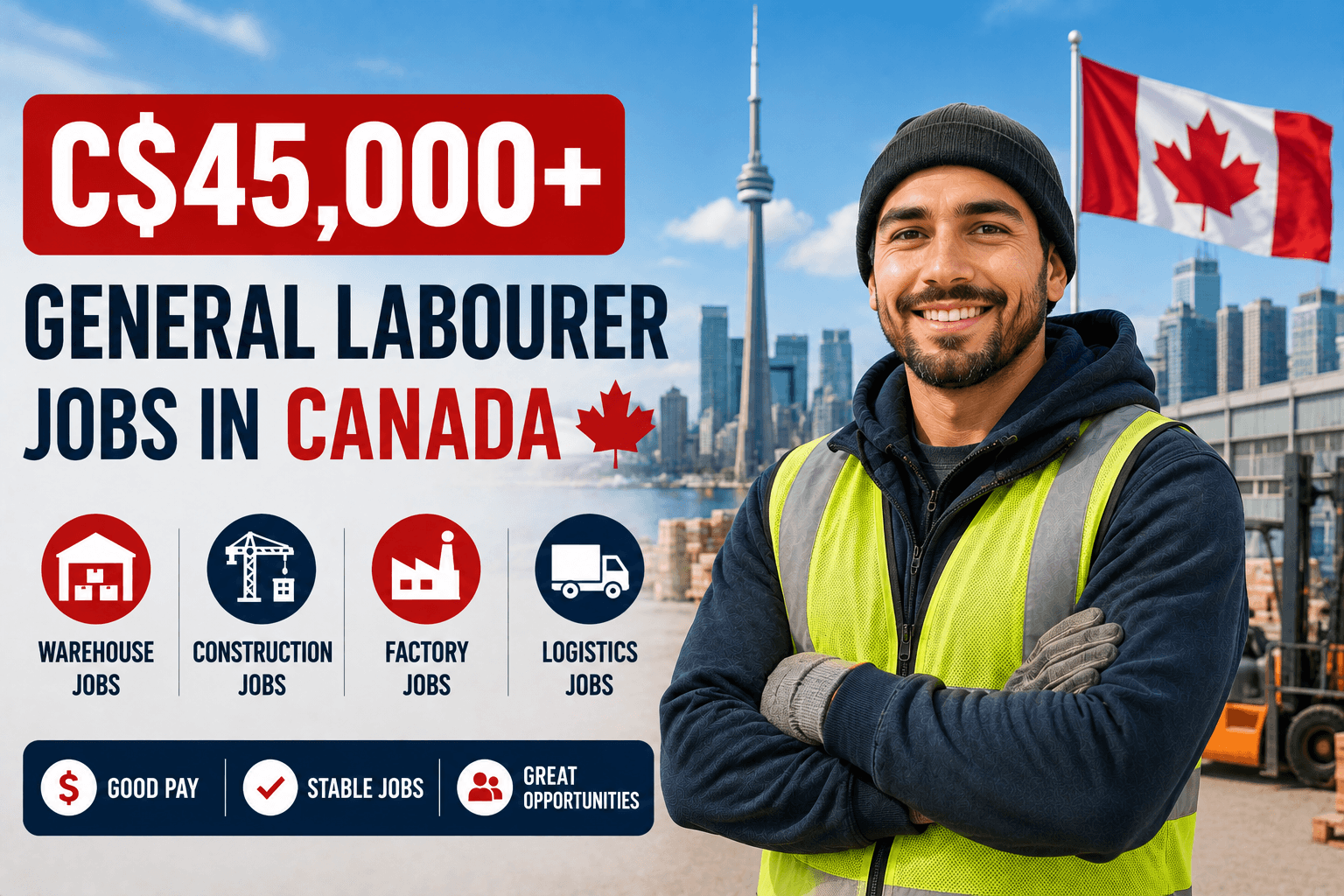
Canada’s construction sites, warehouses, factories, distribution centres, moving companies and industrial businesses depend on General Labourers to perform the practical work required to keep operations running. These jobs can be attractive to foreign workers because many entry-level positions do not require university education, while workers who gain equipment, construction or industrial experience can move into considerably higher-paying positions.
Current Government of Canada Job Bank data shows why C$45,000+ is a reasonable benchmark for this occupation cluster. General labourers working in material handling have a national median wage of approximately C$22 per hour, while general construction labourers have a national median of approximately C$25 per hour.
At C$22 per hour for 40 hours each week, gross annual earnings are approximately C$45,760.
At C$25 per hour, the same schedule produces approximately C$52,000 annually.
Experienced construction labourers can earn considerably more. Job Bank currently reports a national wage range of approximately C$18.25 to C$40 per hour for general construction labourers.
Foreign applicants, however, need to distinguish between finding a Canadian job and qualifying to work legally in Canada.
A vacancy does not automatically mean an employer will hire from overseas.
Canadian General Labourer job ≠ automatic work permit.
How Much Do General Labourers Earn in Canada?
General Labourer salaries depend heavily on the industry, province, experience and responsibilities.
For material-handling General Labourers, Canada’s Job Bank currently reports a national low wage of approximately C$16.55 per hour, a median of C$22 and a high of C$30.29.
For construction labourers, the national figures are stronger: approximately C$18.25 at the low end, C$25 at the median and C$40 at the high end.
That produces very different annual earnings.
C$18 per hour × 40 hours = approximately C$37,440 annually.
C$20 per hour × 40 hours = approximately C$41,600 annually.
C$22 per hour × 40 hours = approximately C$45,760 annually.
C$25 per hour × 40 hours = approximately C$52,000 annually.
C$30 per hour × 40 hours = approximately C$62,400 annually.
C$35 per hour × 40 hours = approximately C$72,800 annually.
C$40 per hour × 40 hours = approximately C$83,200 annually.
These figures represent gross earnings before deductions and assume consistent 40-hour workweeks.
Enter an hourly wage, choose a country, and estimate monthly gross pay, tax and take-home income.
Planning estimate only. The preset uses a simplified flat percentage. Actual tax and payroll deductions can differ based on income level, province/state/region, allowances, social contributions, marital status and local tax rules.
Use the salary calculator to estimate monthly and annual income. Actual Canadian take-home pay depends on federal and provincial income taxes, Canada Pension Plan or Quebec Pension Plan contributions, Employment Insurance and other applicable deductions.
What Does a General Labourer Do in Canada?
General Labourer is a broad job description.
The actual work depends on the industry.
A Warehouse Labourer can load shipments and move inventory.
A Construction Labourer can prepare worksites and assist tradespeople.
A Factory Labourer can move materials and support production.
A Moving Labourer can load furniture.
An Industrial Labourer can support equipment and maintenance teams.
Canada’s Job Bank describes material handlers as workers who handle, move, load and unload materials manually or with material-handling equipment. They can work for transportation, storage, moving, manufacturing, processing, retail and wholesale businesses.
Warehouse General Labourer Jobs
Warehouses are among the most accessible places to find practical employment.
Canadian warehouses require employees to receive goods, prepare customer orders, organise inventory and load vehicles.
Large distribution operations are concentrated around major population centres.
The Greater Toronto Area has enormous warehouse activity in Mississauga, Brampton, Vaughan, Milton and surrounding communities.
Calgary and Edmonton have major logistics sectors.
Metro Vancouver also has substantial warehousing and port-related distribution.
Material Handler Jobs
Material Handler is an important job title for applicants to search.
According to Job Bank, the occupation generally requires short-term work experience and no formal education, with on-the-job training being common. The national median wage is currently C$22 per hour.
Workers move materials manually or with equipment.
Responsibilities can include loading trucks, unloading shipments, supplying production areas and organising warehouse products.
Equipment experience can improve earning potential.
Warehouse Associate Jobs
Warehouse Associate is another common title.
Workers can pick orders, pack products and receive inventory.
Modern warehouses increasingly use barcode scanners and warehouse-management systems.
Computer familiarity can therefore help even in practical occupations.
Large facilities can operate around the clock, creating evening and night-shift opportunities.
Order Picker Jobs
Order Pickers locate products and prepare orders.
Workers can walk significant distances during each shift.
Some facilities use powered equipment.
Accuracy is important because picking errors can affect customers and inventory records.
Experienced workers can progress into inventory, equipment-operation or supervisory roles.
Picker Packer Jobs
Picker Packers combine order selection with packaging.
These positions are particularly common in e-commerce and retail distribution.
Entry-level wages can be lower than C$45,000 annually.
Overtime, shift premiums and progression into equipment roles can increase income.
Loader and Unloader Jobs
Loaders and Unloaders move goods into and out of trucks and containers.
Physical strength is important.
Workers need to follow safe lifting procedures.
Experience can provide a route toward Forklift Operator or other equipment positions.
Forklift Operator Jobs
Forklift operation can provide better earnings than basic manual labour.
Workers operate powered equipment to move pallets and inventory.
Employers can require training and demonstrated competence.
Experience with reach trucks, counterbalance forklifts and other warehouse equipment can improve job prospects.
Construction General Labourer Jobs
Construction is particularly attractive for workers seeking stronger wages.
Government Job Bank data currently places the national median wage for General Construction Labourers at C$25 per hour, equivalent to approximately C$52,000 annually at 40 hours weekly.
Construction labourers assist skilled tradespeople and perform labouring activities at construction sites. Job Bank indicates that the occupation generally involves on-the-job training and usually does not require formal education.
Workers can prepare sites, carry materials, remove debris and support construction crews.
Construction Helper Jobs
Construction Helpers assist carpenters, electricians, plumbers and other tradespeople.
This can be one of the strongest starting points for workers who eventually want to enter a skilled trade.
A worker can begin by preparing materials and tools before developing specialised skills.
Canadian skilled trades can offer considerably higher earning potential than entry-level labour.
Concrete Labourer Jobs
Concrete Labourers support foundation, structural and infrastructure projects.
Employees can prepare forms, move materials and assist concrete workers.
Physical strength and outdoor work tolerance are important.
Experience with concrete finishing can lead to better-paying positions.
Road Construction Labourer Jobs
Road Labourers work on highways, streets and infrastructure.
Employees can assist equipment operators and prepare construction areas.
Some road projects involve overnight work.
Remote infrastructure jobs can also require workers to stay away from home for periods.
Demolition Labourer Jobs
Demolition workers remove building materials and prepare sites for redevelopment.
Safety training is critical.
Workers can encounter heavy debris and hazardous environments.
Employers should provide appropriate protective equipment and training.
Factory General Labourer Jobs
Canada has manufacturing employment across food production, automotive manufacturing, metal fabrication, plastics, wood products and consumer goods.
General Labourers support production operations.
Workers can supply materials, package products and maintain organised work areas.
Ontario has Canada’s largest manufacturing economy.
Quebec also has substantial industrial activity.
Alberta, Manitoba and other provinces provide additional opportunities.
Production Labourer Jobs
Production Labourers work directly around manufacturing processes.
Employees can prepare materials and inspect finished goods.
Experience can lead to Machine Operator positions.
This progression is valuable because equipment operators can earn more than entry-level production helpers.
Food Production Labourer Jobs
Canada has a substantial food-processing industry.
Workers are employed in meat processing, bakeries, beverage production, dairy processing and packaged-food manufacturing.
Food Production Labourers can prepare ingredients, package products and clean production equipment.
Workers can encounter refrigerated environments.
Strict food-safety rules apply.
Packaging Worker Jobs
Packaging Workers prepare finished goods for sale and distribution.
Employees can operate basic packaging equipment, apply labels and inspect products.
Entry requirements can be relatively accessible.
However, basic packaging wages can be below the C$45,000 benchmark.
Workers should compare hourly pay carefully.
Moving Labourer Jobs
Moving companies employ workers to load household and commercial goods.
Workers carry furniture and prepare items for transportation.
The job is physically demanding.
Customer-service ability is useful because employees frequently interact directly with clients.
Workers with appropriate driving qualifications can progress toward moving-truck driving.
Industrial Labourer Jobs
Industrial Labourers support factories, plants and heavy industrial operations.
Workers can move materials and maintain work areas.
These environments can provide higher wages than basic warehouse employment.
Safety requirements are also more demanding.
Workers with equipment and industrial experience can have stronger prospects.
General Labourer Jobs in Ontario
Ontario has Canada’s largest provincial labour market.
The Greater Toronto Area provides extensive warehousing, construction, manufacturing and logistics employment.
Important locations include Toronto, Mississauga, Brampton, Vaughan, Milton and Hamilton.
Kitchener-Waterloo, Cambridge, London and Windsor also have manufacturing and distribution industries.
Housing is a major consideration.
Toronto and many surrounding communities have expensive rents.
Workers should compare salary with accommodation costs.
General Labourer Jobs in Alberta
Alberta has opportunities across construction, warehousing, manufacturing, logistics and industrial operations.
Calgary and Edmonton are the major employment centres.
Job Bank currently reports a C$22 median hourly wage for material-handling General Labourers in Alberta. Construction labourers have a median around C$25 per hour.
Industrial and construction experience can be particularly valuable.
Alberta also has no provincial sales tax, although federal and provincial income taxes still apply.
General Labourer Jobs in British Columbia
British Columbia has construction, logistics, warehousing and manufacturing employment.
Vancouver, Surrey, Richmond and Burnaby have major logistics operations.
The Port of Vancouver supports substantial goods movement.
Job Bank currently reports approximately C$25 per hour as the median wage for construction labourers in British Columbia.
Housing costs, particularly around Vancouver, can be extremely high.
General Labourer Jobs in Manitoba
Winnipeg is an important transportation and manufacturing centre.
Warehouses, food-processing companies and manufacturers employ General Labourers.
Housing can be more affordable than Toronto or Vancouver.
Job Bank currently reports a median construction-labourer wage of approximately C$22 per hour in Manitoba.
General Labourer Jobs in Saskatchewan
Saskatchewan has employment across construction, agriculture-related processing, warehousing and industrial operations.
Regina and Saskatoon are the largest employment centres.
Current Job Bank data puts the median material-handling wage at approximately C$20 per hour and construction labour around C$23 per hour.
General Labourer Jobs in Quebec
Quebec has substantial construction and manufacturing industries.
Montreal is a major logistics and distribution centre.
French ability is extremely valuable and can be required for many workplaces.
Construction wages can be particularly attractive. Current Job Bank figures put the Quebec median for general construction labourers at approximately C$29.85 per hour.
Workers should also remember that Quebec has its own immigration and labour-market processes in several areas.
Do General Labourer Jobs Require a Degree?
Many do not.
Job Bank currently says material handling usually requires short-term work experience, no formal education and on-the-job training.
Construction labourers similarly commonly receive on-the-job training and usually do not require formal education.
This can make General Labour attractive to people without university qualifications.
However:
no formal education required ≠ no immigration requirements.
Foreign nationals still need legal authorization to work in Canada.
Can Foreigners Work as General Labourers in Canada?
Yes.
Foreign nationals can legally work as General Labourers when they hold appropriate Canadian work authorization.
The challenge for applicants outside Canada is finding an employer willing and able to recruit them under an appropriate immigration or temporary-worker pathway.
Canada currently has two broad work-permit categories: employer-specific work permits and open work permits. An employer-specific permit limits employment according to conditions stated on the permit, while open work permits are available only in qualifying situations.
Employer-Specific Work Permit
An employer-specific work permit allows a foreign worker to work according to the employer, occupation, location and other conditions printed on the permit.
A job offer is required.
IRCC states that the employer may also need to obtain a Labour Market Impact Assessment before the worker applies.
This is one of the most important routes for foreign workers researching Canadian General Labour opportunities.
What Is an LMIA?
LMIA means Labour Market Impact Assessment.
IRCC describes a positive LMIA as confirmation that there is a need for a foreign worker to fill the position and that no Canadian citizen or permanent resident is available to do the job.
Many employer-specific work permits require an LMIA, although exemptions exist.
The employer—not the foreign worker independently—handles the LMIA application when one is required.
Therefore:
LMIA ≠ work permit.
A positive LMIA can support a qualifying work-permit application, but the worker still needs to meet immigration requirements.
Temporary Foreign Worker Program
When an employer needs an LMIA to hire a foreign worker, recruitment generally falls under the Temporary Foreign Worker Program rather than the LMIA-exempt International Mobility Program.
General Labour positions can potentially be recruited through the TFWP when the employer and position satisfy current requirements.
However, Canadian rules for low-wage temporary foreign workers have changed repeatedly.
Employers can face caps and location or sector-related restrictions.
Foreign applicants should therefore avoid assuming that every low-wage General Labour job can receive an LMIA.
LMIA-Exempt Jobs
Not every employer-specific work permit requires an LMIA.
Canada’s International Mobility Program covers qualifying LMIA-exempt situations, including certain free-trade-agreement workers, Francophone Mobility workers and some International Experience Canada participants.
Eligibility depends on the worker and program.
A General Labour job itself does not automatically create an LMIA exemption.
Open Work Permits
An open work permit can allow a qualifying foreign national to work for many Canadian employers without obtaining a separate employer-specific permit for each position.
However, open work permits are only available in specific situations.
IRCC currently lists categories that can include some post-graduation work permit holders, qualifying family members and other designated groups.
Someone outside Canada cannot simply request an open work permit because they want to work as a General Labourer.
International Experience Canada
International Experience Canada can provide work opportunities for eligible young people from participating countries.
Categories include Working Holiday, Young Professionals and International Co-op.
IRCC notes that IEC generally applies to eligible youth between 18 and 35, although exact eligibility depends on nationality and category.
Working Holiday participants can have considerably more flexibility when searching for General Labour employment.
However, not every nationality participates.
Does a General Labourer Job Lead to Permanent Residence?
Not automatically.
Temporary employment and permanent residence are different immigration processes.
Canadian work experience can sometimes help workers qualify for permanent immigration pathways, depending on occupation, skill classification, province and program requirements.
Provincial Nominee Programs can also provide pathways for workers who satisfy provincial criteria.
However:
General Labourer job ≠ automatic PR.
Applicants should never accept claims that an LMIA automatically guarantees Canadian permanent residence.
Provincial Nominee Programs
Canadian provinces operate immigration streams based on their economic and labour-market priorities.
Some streams target workers with employer support.
Eligibility varies substantially by province and can change.
The occupation’s NOC classification, wage, employer, work experience and language ability can all matter.
Foreign workers should check the specific provincial program instead of assuming that all General Labour positions qualify.
Rural Employment Opportunities
Smaller Canadian communities can provide opportunities in manufacturing, food processing, warehousing and construction.
Competition can sometimes differ from Toronto and Vancouver.
Housing can also be cheaper.
However, workers need to consider transportation because smaller communities can have limited public transit.
Canada has also introduced temporary TFWP measures in 2026 for certain participating rural areas and employers, with the details differing by province and sector.
Workers should verify current rules before relying on a rural job as an immigration pathway.
Overtime
Overtime can increase General Labour earnings considerably.
The rules differ by province and industry.
Construction, warehouses and factories can require extra hours during busy periods.
Workers should understand provincial employment standards and their contracts.
Overtime should not be treated as guaranteed income.
Night Shift Jobs
Warehouses and factories frequently operate evenings and nights.
Some employers provide shift premiums.
Night shifts can therefore increase income.
However, transportation can become more difficult when public transit operates less frequently.
Benefits
Non-wage benefits can significantly improve a compensation package.
Job Bank reports that approximately 81.6% of workers in material handling nationally receive at least one type of non-wage benefit. Benefits can include employer pension plans, dental, medical or life insurance, and leave entitlements.
For construction trades helpers and labourers, Job Bank reports approximately 72.1% receive at least one non-wage benefit.
Applicants should therefore compare total compensation rather than hourly wage alone.
Cost of Living
Canada’s living costs vary enormously.
Toronto and Vancouver are expensive.
Calgary has also experienced housing-cost increases.
Winnipeg, Edmonton, Regina and some smaller communities can provide more affordable options.
A worker earning C$50,000 in a smaller city can sometimes have more disposable income than someone earning C$55,000 in an extremely expensive area.
Calculate:
take-home pay − rent − food − transportation − phone/internet − utilities − personal expenses.
Transportation
Many warehouses and construction sites are located in industrial areas.
Public transit can be limited.
Having a vehicle can increase the number of jobs a worker can realistically accept.
However, vehicle ownership introduces fuel, insurance, registration, maintenance and financing costs.
Workers should investigate commuting options before choosing accommodation.
Canadian Winters
Foreign workers should prepare for Canadian weather.
Construction Labourers can work outdoors during cold conditions.
Warehouse employees can work around loading docks.
Appropriate winter clothing is essential.
Workers arriving from warm climates should budget for insulated jackets, boots, gloves and other winter equipment.
Workplace Safety
General Labourers can work around vehicles, machinery and construction materials.
Workers should follow occupational health and safety procedures.
Required protective equipment can include hard hats, steel-toe boots, high-visibility clothing, gloves and safety glasses.
Workers should also receive appropriate training before operating specialised equipment.
How Long Does the Canadian Work-Permit Process Take?
There is no single timeline that applies to every General Labourer.
Workers who already have open work authorization can apply directly for jobs.
Someone recruited overseas for an employer-specific work permit can face additional steps.
The employer first determines whether an LMIA is required.
If it is, the employer completes the applicable LMIA process.
After receiving the required employer documents, the foreign worker applies for the work permit.
IRCC says most foreign nationals need a work permit to work in Canada, and applicants applying from outside Canada may need to submit forms, supporting employment documents, fees and biometrics before a decision.
Choose your destination and preferred entry route, then tell us how far you have progressed.
Timeline results are planning estimates only and are not a guarantee of visa approval or travel date.
The wait-time calculator provides a planning estimate only. It does not guarantee an LMIA decision, work-permit approval, visa issuance, biometrics completion, entry to Canada, employment duration, permanent residence or citizenship.
Can Family Members Come to Canada?
Family work and study rights depend on the principal worker’s status and current Canadian immigration rules.
Spouses do not automatically qualify for an open work permit simply because their partner has a Canadian job.
Eligibility depends on the worker’s circumstances and applicable family-member work-permit rules.
Applicants should verify the current requirements before making family relocation plans.
General Labourer Job Scams in Canada
Canadian job scams frequently target overseas applicants.
Warning signs include:
“Guaranteed Canada LMIA for C$5,000.”
“Pay employer to issue job offer.”
“General Labour job guarantees PR.”
“No interview, visa guaranteed.”
“Pay before seeing employment contract.”
“LMIA means your work permit is already approved.”
A positive LMIA does not itself give a worker legal permission to work.
IRCC explains that the worker uses employer documents, including the applicable LMIA information when required, to support a work-permit application.
Applicants should be particularly suspicious of anyone selling guaranteed approvals.
Building a Canadian General Labourer Resume
A strong resume should focus on practical abilities.
Instead of writing:
“Worked as General Labourer.”
write:
“Loaded and unloaded deliveries, organised warehouse materials, prepared customer orders and maintained safe work areas.”
For construction:
“Prepared construction sites, transported building materials, assisted skilled tradespeople and maintained tools and work areas.”
Useful skills include material handling, warehouse operations, construction, production, forklift operation, inventory management, workplace safety and equipment operation.
Certifications That Can Improve Earnings
Practical training can significantly improve employability.
Forklift training can help Warehouse Labourers move into equipment operation.
Construction workers can benefit from safety training.
Workers interested in transportation can pursue appropriate commercial driving qualifications.
Construction Helpers can begin apprenticeships and eventually qualify in skilled trades.
The objective should be progression.
A worker earning C$20 per hour in basic labour can potentially move toward occupations paying C$25, C$30 or considerably more.
How to Find General Labourer Jobs in Canada
Useful searches include:
General Labourer jobs Canada
General Labourer material handling Canada
Construction Labourer Canada
Warehouse General Labourer Canada
Factory Labourer Canada
Production Labourer Canada
Material Handler Canada
General Labourer LMIA Canada
Temporary Foreign Worker General Labour Canada
and:
General Labourer foreign workers Canada.
Foreign applicants should pay attention to whether the employer is actually recruiting temporary foreign workers.
Canada’s Job Bank also provides information and job-search resources for temporary foreign workers. IRCC specifically directs applicants without a job offer toward Job Bank’s temporary-foreign-worker listings.
Frequently Asked Questions
Can General Labourers earn C$45,000+ in Canada?
Yes. Canada’s current Job Bank median for material-handling General Labourers is approximately C$22 per hour, which equals about C$45,760 annually at 40 hours per week.
How much do Construction Labourers earn?
The national median is currently approximately C$25 per hour, with Job Bank reporting a national range from about C$18.25 to C$40 per hour.
Do General Labourer jobs require university education?
Many do not. Job Bank says material handling usually requires short-term work experience and no formal education, while construction labourers also commonly receive on-the-job training.
Can foreigners work as General Labourers in Canada?
Yes, if they have appropriate authorization to work.
Does every employer need an LMIA?
No. Many employer-specific work permits require an LMIA, while qualifying LMIA-exempt situations exist under programs such as the International Mobility Program.
Does an LMIA guarantee a work permit?
No. The LMIA is an employer-side labour-market document. The foreign worker still needs to apply for and qualify for the appropriate work permit.
Does a General Labourer job guarantee permanent residence?
No.
Which provinces have General Labourer jobs?
Ontario, Alberta, British Columbia, Manitoba, Saskatchewan, Quebec and other provinces have employment across warehousing, construction, manufacturing and logistics.
Final Thoughts
Canada provides extensive General Labourer employment across construction, warehousing, manufacturing, logistics, food processing, moving and industrial operations.
Current Government of Canada Job Bank figures put the national median wage for material-handling General Labourers at approximately C$22 per hour, while construction labourers have a median around C$25 per hour.
That means full-time gross earnings of C$45,000+ are realistic in many General Labour occupations, while experienced construction and industrial workers can potentially earn substantially more.
For foreign applicants, however, job availability and immigration eligibility must be considered separately.
Remember:
Canadian vacancy ≠ LMIA
LMIA ≠ work permit
job offer ≠ guaranteed entry to Canada
General Labourer job ≠ automatic permanent residence
and:
no degree required ≠ no immigration requirements.
The strongest long-term strategy is to combine practical General Labour experience with additional skills. Forklift operation, industrial equipment, construction trades, machinery and logistics experience can turn an entry-level Canadian labour job into a considerably stronger career.
MimBlog is an independent information website and is not a recruitment agency, employer, immigration authority or government agency. Salaries are estimates and may vary by employer, experience and location. Job availability and immigration requirements can change. Always verify vacancies, eligibility and visa requirements through employers and official government sources.