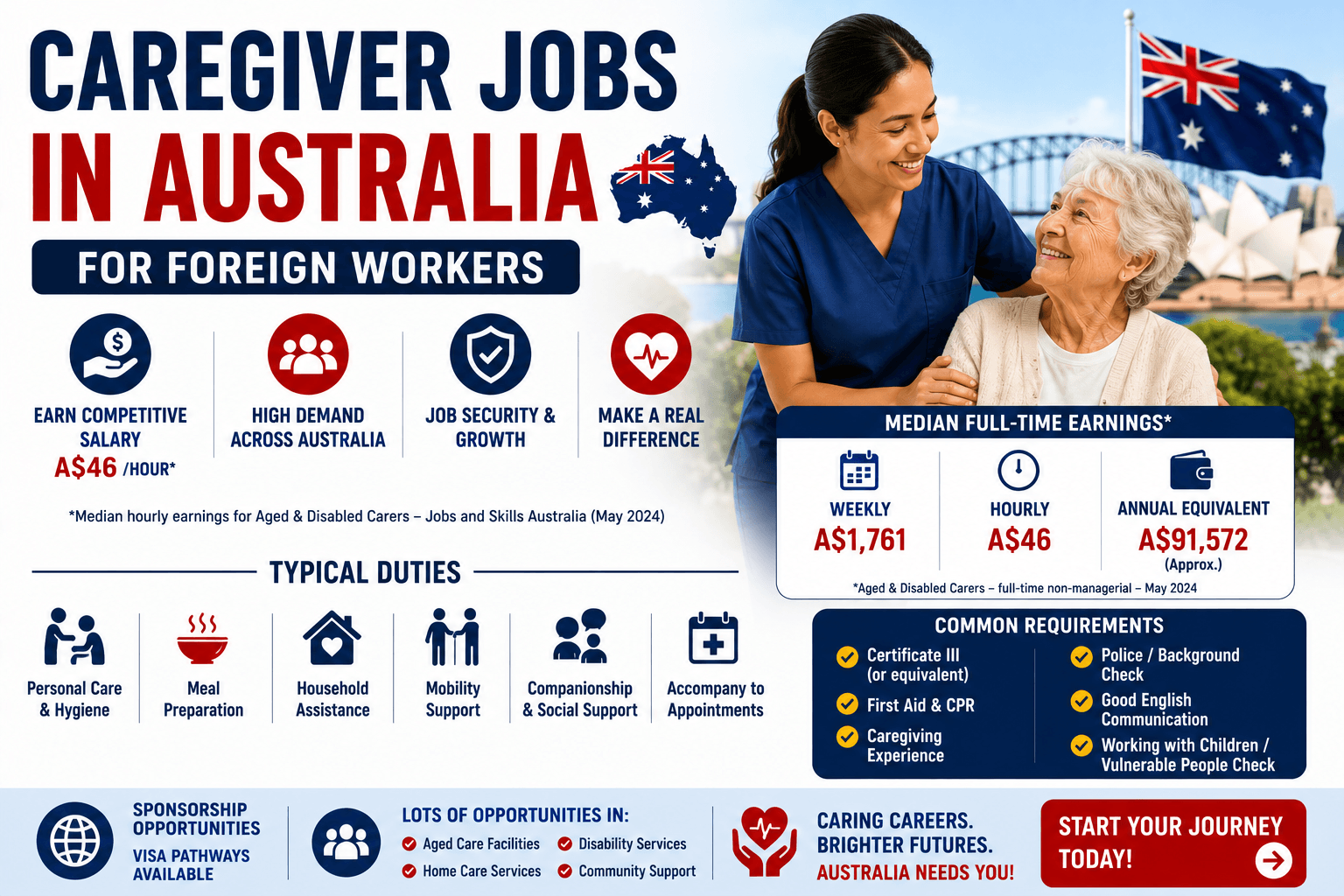
Caregiver jobs in Australia can offer foreign workers opportunities in aged care, disability support, personal care and community services.
While “caregiver” is a popular international search term, Australia commonly uses occupational titles such as:
- Aged care worker
- Aged and disabled carer
- Personal care assistant
- Disability support worker
- Residential care worker
- Home care worker
- Community support worker
This distinction matters.
You should not search only for “caregiver jobs” when looking for Australian employment. Employers may advertise suitable positions under different occupational titles.
Current Jobs and Skills Australia data reports approximately 376,300 Aged and Disabled Carers working across Australia.
For full-time non-managerial workers in this occupation, current median earnings are approximately:
A$1,761 per week
with median hourly earnings of approximately:
A$46 per hour.
If A$1,761 were earned every week for 52 weeks, the simple annual equivalent would be approximately:
A$91,572 per year.
However, there is an extremely important qualification:
Only about 40% of workers in this occupation currently work full-time hours.
Therefore, it would be misleading to claim that every Australian caregiver earns A$90,000+.
Working hours, employment status, occupation, location and employer can make a substantial difference.
This guide explains caregiver jobs in Australia for foreign workers, including salaries, aged care, disability support, qualifications and employer-sponsored visa considerations.
Are There Caregiver Jobs in Australia?
Yes.
Australia has a large care and support workforce.
Jobs and Skills Australia classifies Aged and Disabled Carers under occupation code 423111.
Workers in this occupation provide care, supervision and support to aged people and people with disabilities in different settings.
Employment can exist in:
- Private homes
- Residential aged-care facilities
- Community organisations
- Disability services
- Supported accommodation
- Home-care organisations
This occupation is a major component of Australia’s broader Health Care and Social Assistance industry.
What Does a Caregiver Do in Australia?
Actual responsibilities depend on the client and employer.
Jobs and Skills Australia describes tasks that can include:
- Assisting with mobility
- Helping with personal hygiene
- Assisting with dressing
- Providing companionship
- Supporting social activities
- Preparing food
- Performing household duties
- Shopping
- Running errands
- Accompanying clients
- Providing emotional support
Some workers specialise in elderly care.
Others primarily support people with disabilities.
Caregiver Salary in Australia
There is no universal Australian “caregiver salary.”
However, Aged and Disabled Carers provide a useful benchmark.
Current Jobs and Skills Australia figures are approximately:
| Measure | Current Figure |
|---|---|
| Median full-time weekly earnings | A$1,761 |
| Median hourly earnings | A$46 |
| Full-time workers | 40% |
| Average full-time hours | 43 hours/week |
Annualising the full-time weekly median:
A$1,761 × 52 = approximately A$91,572
Monthly equivalent:
approximately A$7,631
Again, these figures describe full-time earnings.
They do not mean every care worker receives this annual salary.
How Much Is A$46 Per Hour?
At different weekly schedules:
A$46 × 20 hours = A$920/week
A$46 × 30 hours = A$1,380/week
A$46 × 38 hours = A$1,748/week
A$46 × 40 hours = A$1,840/week
At 38 hours weekly for 52 weeks:
approximately A$90,896/year
This demonstrates why guaranteed hours are as important as the advertised hourly rate.
Enter an hourly wage, choose a country, and estimate monthly gross pay, tax and take-home income.
Planning estimate only. The preset uses a simplified flat percentage. Actual tax and payroll deductions can differ based on income level, province/state/region, allowances, social contributions, marital status and local tax rules.
Use the calculator for planning. Actual earnings depend on the employment arrangement.
Can Caregivers Earn A$60,000 in Australia?
Yes, some can.
At 38 hours per week, the approximate hourly wage required to gross A$60,000 annually is:
A$30.36/hour.
For example:
A$32/hour = A$63,232/year
A$35/hour = A$69,160/year
A$40/hour = A$79,040/year
A$46/hour = A$90,896/year
However, part-time work can result in substantially lower annual earnings even when the hourly wage is relatively strong.
This is why our broader A$60,000+ Healthcare & Support Jobs in Australia for Foreign Workers guide compares occupations and employment structures.
Aged Care Jobs in Australia
Aged care is one of the most important areas for international applicants researching caregiver employment.
Australia’s aged-care workforce supports older people who require assistance with everyday living.
Workers can provide:
- Personal care
- Mobility assistance
- Meal support
- Companionship
- Household assistance
- Social support
- Daily living assistance
Employment can occur in residential facilities or through home-care services.
Residential Aged Care Jobs
Residential aged-care facilities provide accommodation and care to older Australians who need ongoing assistance.
Potential roles can include:
- Personal care worker
- Aged care worker
- Care assistant
- Nursing support worker
- Enrolled nurse
- Registered nurse
Professional nursing positions should not be confused with personal-care occupations.
Nurses have separate professional registration requirements.
Home Care Jobs
Some older Australians receive support while remaining in their own homes.
Home-care workers may travel between clients.
Depending on the job, a worker may need:
- Driver’s licence
- Reliable transport
- Ability to travel locally
Always consider travel time and expenses when comparing home-care positions.
Disability Support Worker Jobs
Disability support is another major component of Australia’s care sector.
Disability support workers assist people with disabilities to live as independently as possible.
Duties can include:
- Personal care
- Mobility support
- Community participation
- Household activities
- Transportation
- Social support
- Daily routines
- Skill development
Our dedicated Disability Support Worker Jobs in Australia for Foreign Workers article will explore this occupation separately.
Personal Care Assistant Jobs
Personal care assistants provide direct support with everyday activities.
The job can involve:
- Bathing
- Dressing
- Grooming
- Mobility
- Meal assistance
- Companionship
- Personal hygiene
Personal-care positions can exist in aged care, disability support and residential services.
Caregiver vs Aged Care Worker
“Caregiver” is a broad international term.
“Aged care worker” is more specific.
An aged-care worker primarily supports older people.
A caregiver could theoretically describe someone supporting:
- An elderly person
- Someone with a disability
- Someone requiring home assistance
When applying in Australia, use the employer’s actual job title.
Caregiver vs Disability Support Worker
A disability support worker focuses on supporting people with disabilities.
The role can include personal care but may also involve:
- Community participation
- Independent-living skills
- Social activities
- Transport
- Employment support
- Daily routines
Do not assume every disability-support job is simply elderly caregiving.
Caregiver vs Registered Nurse
These careers are significantly different.
Registered nursing is a regulated healthcare profession.
Jobs and Skills Australia currently reports registered-nurse median full-time earnings around:
A$2,192/week
compared with:
A$1,761/week
for full-time Aged and Disabled Carers.
Registered nurses also require professional nursing registration.
A care worker cannot simply perform RN duties because an employer uses a broad “caregiver” title.
Do You Need a Nursing Degree?
Not necessarily.
Caregiver, aged-care and disability-support positions are different from registered nursing.
Current Jobs and Skills Australia education data for Aged and Disabled Carers shows Certificate III/IV as the largest qualification category, representing approximately 36.6% of workers.
Other workers have:
- Diplomas
- Bachelor’s degrees
- Year 12
- Other qualifications
The exact qualification required depends on the position.
Certificate III for Aged Care
International applicants researching Australian care jobs frequently encounter qualifications such as Certificate III.
Relevant Australian vocational qualifications can prepare workers for support roles.
However, someone outside Australia should not assume they can purchase an online certificate from an unknown provider and automatically qualify for employment or a visa.
Verify Australian qualifications through legitimate education and training channels.
Common Caregiver Requirements
Employers can request:
- Relevant care qualification
- Previous experience
- First aid
- CPR
- Police checks
- Working-with-vulnerable-people screening
- Disability-sector screening where applicable
- Driver’s licence
- English communication skills
- References
Requirements vary by state, occupation and employer.
Communication Skills
Care workers need to communicate with:
- Clients
- Families
- Nurses
- Supervisors
- Healthcare professionals
- Community organisations
Clear communication is particularly important when supporting vulnerable clients.
Physical Requirements
Care work can be physically demanding.
Workers may need to:
- Stand for long periods
- Assist with mobility
- Help clients transfer safely
- Perform household duties
- Travel between clients
Proper manual-handling training can be important.
Can Foreigners Work as Caregivers in Australia?
Potentially, yes.
Foreign nationals need a visa providing appropriate work rights.
The visa route depends on:
- Occupation
- Employer
- Qualifications
- Experience
- Location
- Salary
- Applicant circumstances
Employer sponsorship is one possibility for eligible positions.
Skills in Demand Visa — Subclass 482
Australia’s Skills in Demand visa (subclass 482) is an employer-sponsored temporary visa.
The Department of Home Affairs states that it allows employers to sponsor suitably skilled workers to fill positions when appropriately skilled Australian workers cannot be sourced.
The visa includes different streams.
Occupation and salary requirements apply.
Work Experience for Subclass 482
Current Home Affairs information indicates applicants need the skills required for the nominated occupation.
The government’s sponsored-skilled-visa comparison states that applicants generally need:
12 months of work experience in the occupation or a related field.
Additional requirements apply.
Finding a caregiver vacancy therefore does not automatically make someone eligible for subclass 482.
Employer Nomination Scheme — Subclass 186
The Employer Nomination Scheme, or:
subclass 186
is a permanent employer-sponsored visa.
Different streams have different requirements.
Depending on the pathway, applicants can need:
- Employer nomination
- Appropriate occupation
- Skills assessment
- Work experience
- English ability
- Professional licensing where applicable
- Other requirements
Regional Sponsorship — Subclass 494
The Skilled Employer Sponsored Regional (Provisional) visa — subclass 494 is designed for eligible employer-sponsored skilled positions in designated regional areas.
It can be relevant when foreign workers are willing to work outside Australia’s largest metropolitan areas.
The visa can provide up to five years of residence and work under its conditions.
Caregiver Jobs With Visa Sponsorship
Searches such as:
caregiver jobs in Australia with visa sponsorship
are extremely popular.
Employer-sponsored care employment does exist.
But applicants need to identify the actual occupation.
A vacancy advertised as:
Personal Care Assistant
may have different immigration implications from:
Aged or Disabled Carer
or:
Nursing Support Worker.
Always determine the correct occupation code before assuming sponsorship is possible.
Aged Care Industry Labour Agreement
Australia has also used an Aged Care Industry Labour Agreement to help eligible aged-care employers recruit overseas workers for specified occupations.
This is particularly relevant to our Healthcare & Support category.
Eligible occupations under the arrangement have included roles such as:
- Aged or Disabled Carer
- Nursing Support Worker
- Personal Care Assistant
The agreement can provide concessions under specified circumstances.
However, a foreign worker cannot simply apply independently for an “aged care labour agreement visa.”
The employer must participate in the applicable labour-agreement process.
Why the Labour Agreement Matters
This arrangement demonstrates that Australia’s international healthcare recruitment is not restricted to registered nurses and doctors.
Support-care occupations can also appear within employer-sponsored migration arrangements.
That is important for foreign workers without professional nursing qualifications.
However, eligibility is still not automatic.
Does Every Aged Care Employer Sponsor Foreign Workers?
No.
An aged-care organisation can employ hundreds of workers without necessarily sponsoring overseas candidates for every vacancy.
Applicants should look specifically for employers indicating that they:
- Consider international candidates
- Offer sponsorship for eligible positions
- Participate in applicable labour agreements
Then verify the employer independently.
Can Caregiver Jobs Lead to Permanent Residence?
Potentially, depending on the immigration pathway.
For example, subclass 186 is itself a permanent employer-sponsored visa.
Other temporary or regional routes can interact with longer-term migration pathways.
However:
A caregiver job does not automatically provide Australian permanent residence.
The worker must meet the requirements of the relevant visa pathway.
Regional Caregiver Jobs
Foreign applicants should consider regional Australia.
Care and healthcare services operate throughout:
- Regional New South Wales
- Regional Victoria
- Regional Queensland
- Western Australia
- South Australia
- Tasmania
- Northern Territory
Some regional employers may participate in skilled migration or employer-sponsored programs.
Caregiver Jobs in Sydney
Sydney provides a large employment market for:
- Aged care
- Disability services
- Home care
- Personal support
However, housing expenses can be substantial.
Compare wages with living costs before relocating.
Caregiver Jobs in Melbourne
Melbourne has extensive:
- Residential aged care
- Home care
- Disability support
- Community services
Foreign applicants should search employers directly rather than relying exclusively on recruitment agents.
Caregiver Jobs in Brisbane
Brisbane and surrounding Queensland communities also provide care-sector employment.
Applicants willing to consider regional Queensland can broaden their search further.
Caregiver Jobs in Perth
Perth and other Western Australian communities employ workers across aged care and disability support.
Regional Western Australia can involve very different living conditions from Perth, so research the location carefully.
Full-Time vs Part-Time Care Work
This is one of the most important salary considerations.
Jobs and Skills Australia reports that only around:
40% of Aged and Disabled Carers work full-time.
That means a large share work part-time.
A job paying A$46/hour for 20 hours per week produces:
A$47,840/year
before considering unpaid periods.
The same hourly rate at 38 hours weekly produces:
A$90,896/year.
Always ask about guaranteed hours.
Casual Caregiver Jobs
Casual work is also common in parts of the care sector.
Casual employees can receive higher hourly rates partly because their employment conditions differ from permanent employees.
Compare:
- Hourly wage
- Guaranteed hours
- Annual leave
- Sick leave
- Shift availability
- Weekend work
- Public-holiday work
- Job stability
The highest hourly number is not automatically the best offer.
Penalty Rates
Australian workers can receive additional pay under applicable awards or agreements for certain working arrangements.
Depending on the job, higher rates may apply to:
- Weekends
- Public holidays
- Nights
- Overtime
Do not build your entire budget around penalty rates unless those shifts are genuinely guaranteed.
Caregiver Take-Home Pay
Gross salary differs from take-home pay.
Australian income tax and other deductions can affect the amount received.
Foreign workers should compare net income with:
- Rent
- Food
- Transportation
- Utilities
- Insurance
- Personal expenses
Sydney and regional Australia can have very different budgets.
How Long Does It Take to Move to Australia?
There is no single caregiver processing time.
Your journey can involve:
- Qualification assessment
- Employer search
- Interviews
- Skills assessment where required
- Employer nomination
- Visa preparation
- Health examinations
- Character requirements
- Visa processing
- Travel preparation
Choose your destination and preferred entry route, then tell us how far you have progressed.
Timeline results are planning estimates only and are not a guarantee of visa approval or travel date.
Use the calculator as a planning tool rather than a guaranteed visa timeline.
How to Find Caregiver Jobs in Australia
Use Australian terminology.
Search for:
- Aged care worker Australia
- Aged and disabled carer
- Personal care assistant
- Disability support worker
- Nursing support worker
- Home care worker
- Community support worker
Then add:
sponsorship
when specifically researching international recruitment.
Search Employer Websites
Potential employers include:
- Residential aged-care providers
- Disability-service organisations
- Home-care providers
- Community organisations
- Healthcare groups
When you find an employer, visit its official careers page.
Build a Strong Caregiver CV
Your CV should immediately show your relevant experience.
Instead of:
Caregiver — 3 years
consider:
Aged Care Worker — 3 Years’ Personal & Elderly Care Experience
or:
Disability Support Worker — Personal Care & Community Support
Highlight genuine experience such as:
- Elderly care
- Disability support
- Personal hygiene
- Mobility assistance
- Meal preparation
- Community participation
- First aid
- CPR
Do not claim nursing responsibilities you were not qualified to perform.
Avoid Caregiver Job Scams
Be cautious of:
- Guaranteed subclass 482 visas
- Guaranteed Australian PR
- Paid job offers
- Fake sponsorship letters
- Fake aged-care employers
- Recruiters demanding large upfront payments
- “No experience, no qualifications, guaranteed visa” advertisements
Verify employers and visa information independently.
Frequently Asked Questions
Can foreigners work as caregivers in Australia?
Potentially, yes. Applicants need appropriate work rights and must satisfy the requirements of the occupation and visa pathway.
How much do caregivers earn?
Jobs and Skills Australia reports median full-time weekly earnings around A$1,761 for Aged and Disabled Carers, with median hourly earnings around A$46.
Does every caregiver earn A$91,000?
No. The A$91,572 figure is a simple annualisation of the full-time weekly median. Only around 40% of workers in the occupation currently work full-time.
Can caregivers earn A$60,000?
Yes. At 38 hours weekly, approximately A$30.36/hour is enough to gross A$60,000 annually.
Do I need a nursing degree?
Not necessarily. Care and support occupations are different from registered nursing.
Can aged-care workers get visa sponsorship?
Employer-sponsored pathways can apply to eligible occupations and employers. Australia’s Aged Care Industry Labour Agreement has also covered specified care occupations.
Is there an Australian caregiver visa?
There is no universal visa simply issued because someone calls themselves a caregiver. Applicants use applicable Australian visa pathways based on occupation and circumstances.
Can disability support workers be foreign workers?
Potentially, subject to the occupation, employer, visa and applicant meeting the relevant requirements.
Does sponsorship guarantee PR?
No. Different visas have different temporary or permanent outcomes and eligibility rules.
Is aged care part of healthcare?
Yes. Aged care sits naturally within Australia’s broader Health Care and Social Assistance sector and within our Healthcare & Support category.
Final Thoughts
Caregiver opportunities make Australia’s Healthcare & Support sector relevant to far more people than professional nurses alone.
Current Jobs and Skills Australia data shows approximately:
376,300 Aged and Disabled Carers
working across the country.
For full-time workers, current median earnings are around:
A$1,761 per week
with median hourly earnings around:
A$46.
The annualised full-time figure is approximately:
A$91,572.
However, only around 40% of workers in the occupation currently work full-time.
That makes hours, employment status and job conditions extremely important.
Foreign workers should search using Australian job titles such as:
Aged Care Worker → Aged or Disabled Carer → Personal Care Assistant → Disability Support Worker → Nursing Support Worker.
For the broader sector, read A$60,000+ Healthcare & Support Jobs in Australia for Foreign Workers.
Next, compare Aged Care Jobs in Australia for Foreign Workers and Disability Support Worker Jobs in Australia for Foreign Workers.
If you have professional nursing qualifications instead, our Registered Nurse Jobs in Australia for Foreign Workers guide will cover that pathway separately.
MimBlog is an independent information website and is not a recruitment agency, employer, immigration authority or government agency. Salaries are estimates and may vary by employer, experience and location. Job availability and immigration requirements can change. Always verify vacancies, eligibility and visa requirements through employers and official government sources.