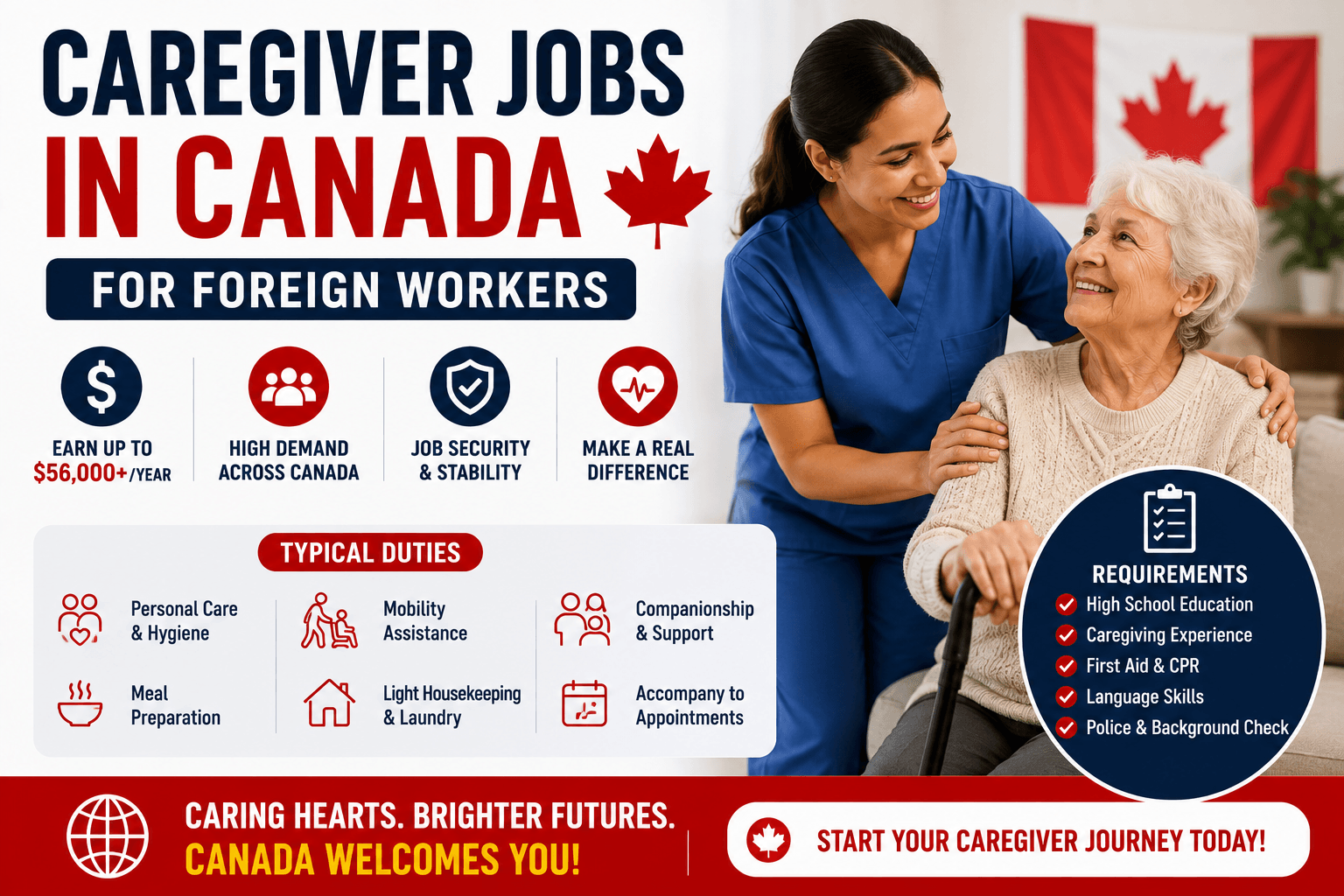
Caregiver jobs are among the most searched healthcare and support opportunities in Canada by foreign workers.
Unlike careers such as registered nursing, caregiving does not necessarily require a university nursing degree.
Caregivers and home support workers can help seniors, people with disabilities, individuals recovering from illness and other people who need assistance with everyday activities.
However, foreign workers should understand an important point:
“Caregiver” is a broad job description, not one universal Canadian occupation or immigration program.
The actual occupation, duties, employer and NOC code matter.
Government of Canada Job Bank currently reports national home support worker wages of approximately:
Low: $16.00 per hour
Median: $20.50 per hour
High: $27.00 per hour
At the current national median, someone working 40 hours per week would have a simple gross annual equivalent of approximately:
$42,640 per year.
At $25 per hour:
$52,000 per year
At $27 per hour:
$56,160 per year
Some positions and regions can therefore cross the $50,000 level, although foreign workers should not assume every caregiver job pays this amount.
This guide explains caregiver jobs in Canada for foreign workers, including salaries, requirements, duties, work permits and important immigration considerations.
What Is a Caregiver in Canada?
A caregiver provides assistance to someone who needs support with everyday life.
The person receiving care might be:
- An elderly person
- Someone with a disability
- Someone recovering from illness
- A person requiring home support
- A child
- Someone requiring companionship or personal assistance
Depending on the occupation, caregivers can work:
- In private homes
- For home-care organisations
- In community settings
- In residential environments
- Through support-service providers
The exact duties determine how the job should be classified.
Caregiver vs Home Support Worker
The terms are frequently used interchangeably online.
However, foreign applicants should pay attention to the actual Canadian occupation.
Home support workers, caregivers and related occupations providing personal care are commonly associated with:
NOC 44101 — Home support workers, caregivers and related occupations
The occupational classification is more useful for immigration research than simply searching for “caregiver visa.”
What Do Caregivers Do?
Responsibilities vary according to the client and employer.
Common duties can include:
- Providing companionship
- Helping with personal hygiene
- Assisting with dressing
- Helping with mobility
- Preparing meals
- Assisting with feeding
- Performing routine household duties
- Accompanying clients to appointments
- Supporting elderly clients
- Assisting people with disabilities
- Providing personal care
- Reporting changes in a client’s condition
Caregivers should perform only duties that fall within their role, training and authorised scope.
Caregiver Salary in Canada
Using current Job Bank home-support-worker wage information:
| Wage Level | Hourly Wage | Approx. Annual Equivalent |
|---|---|---|
| Low | $16.00 | $33,280 |
| Median | $20.50 | $42,640 |
| High | $27.00 | $56,160 |
Annual figures assume 40 hours per week for 52 weeks.
Actual schedules can differ considerably.
How Much Do Caregivers Make Per Month?
At $20.50/hour:
Weekly gross: $820
Monthly gross equivalent: approximately $3,553
Annual gross: approximately $42,640
At $25/hour:
Monthly gross equivalent: approximately $4,333
Annual gross: approximately $52,000
At $27/hour:
Monthly gross equivalent: approximately $4,680
Annual gross: approximately $56,160
Enter an hourly wage, choose a country, and estimate monthly gross pay, tax and take-home income.
Planning estimate only. The preset uses a simplified flat percentage. Actual tax and payroll deductions can differ based on income level, province/state/region, allowances, social contributions, marital status and local tax rules.
These are gross estimates before Canadian taxes and payroll deductions.
Can Caregivers Earn $50,000 in Canada?
Yes, some can.
To gross $50,000 annually at 40 hours per week, the required wage is approximately:
$24.04/hour.
Therefore:
$24/hour = $49,920/year
$25/hour = $52,000/year
$27/hour = $56,160/year
Canada’s current national home-support-worker median of $20.50 is below the $50,000 threshold.
This means it would be misleading to advertise all Canadian caregiver jobs as “$50,000 caregiver jobs.”
Higher-paying positions can reach that level, but many do not.
Caregiver Salary in Ontario
Ontario is one of the largest markets for care and support employment.
Current Job Bank data places the provincial home-support-worker median at approximately:
$22/hour.
At 40 hours weekly:
$22 × 40 × 52 = $45,760/year.
At $25/hour:
$52,000/year.
Caregiver opportunities can exist throughout:
- Toronto
- Ottawa
- Hamilton
- London
- Mississauga
- Brampton
- Windsor
- Other Ontario communities
Applicants should compare individual vacancies rather than assuming Toronto always offers the highest wage.
Caregiver Salary in British Columbia
British Columbia has a significant home-care and support sector.
Caregivers can work throughout:
- Vancouver
- Surrey
- Burnaby
- Victoria
- Kelowna
- Nanaimo
- Smaller communities
Compensation should be compared against local housing costs, particularly in Metro Vancouver.
Foreign workers should check current Job Bank wage data for the specific region before accepting an offer.
Caregiver Salary in Alberta
Caregiver and home-support employment can also be found in:
- Calgary
- Edmonton
- Red Deer
- Smaller Alberta communities
Wages vary according to employer and region.
Applicants should compare:
- Hourly wage
- Guaranteed hours
- Overtime
- Accommodation arrangements
- Transportation
- Employment benefits
Do not evaluate a caregiver offer based on hourly wage alone.
Caregiver Jobs in Nova Scotia
Current Job Bank information reports a home-support-worker median around:
$22/hour
in Nova Scotia.
At 40 hours weekly:
approximately $45,760/year.
Atlantic Canada should therefore be included when foreign workers compare support-care opportunities.
Elderly Caregiver Jobs in Canada
Canada’s ageing population means elderly care forms an important part of the country’s care sector.
Elderly caregivers can help clients with:
- Mobility
- Meal preparation
- Personal hygiene
- Companionship
- Dressing
- Household activities
- Appointments
- Everyday routines
Some clients require relatively light companionship.
Others have significantly more complex care requirements.
Always read the job description carefully.
Live-In Caregiver Jobs
Some job seekers specifically search for:
live-in caregiver jobs in Canada.
A live-in arrangement means accommodation forms part of the working arrangement.
However, living in the client’s home does not mean normal employment standards disappear.
Foreign workers should understand:
- Working hours
- Private accommodation arrangements
- Wage deductions where legally applicable
- Rest periods
- Duties
- Employment contract
- Provincial employment standards
Be suspicious of employers who expect unlimited availability because accommodation is provided.
Home Support Worker Jobs
Home support work overlaps significantly with caregiving.
Home support workers can provide personal care and companionship for seniors, people with disabilities and other clients.
Our dedicated Home Support Worker Jobs in Canada for Foreign Workers article will provide a deeper breakdown of this occupation.
Personal Support Worker Jobs
Personal support worker, or PSW, is another important Canadian care occupation, especially in Ontario.
PSWs can work in:
- Long-term-care homes
- Retirement residences
- Home care
- Hospitals
- Community environments
The relationship between PSW, caregiver and home-support roles can be confusing to international applicants.
Our Personal Support Worker Jobs in Canada for Foreign Workers guide will compare these positions.
Healthcare Assistant Jobs
Healthcare assistants generally work in patient or personal-support environments.
Depending on the province and employer, the title can overlap with:
- Care aide
- Health care aide
- Patient care aide
- Support worker
Applicants should compare duties rather than assuming job titles mean exactly the same thing across Canada.
See Healthcare Assistant Jobs in Canada for Foreign Workers.
Caregiver vs Nurse Aide
Caregivers and nurse aides are not necessarily the same occupation.
Nurse aides, orderlies and patient service associates commonly work in healthcare institutions such as:
- Hospitals
- Nursing homes
- Assisted-care facilities
Current national nurse-aide median compensation is approximately:
$24/hour
compared with:
$20.50/hour
for home support workers.
That means nurse-aide work currently has a higher national median.
Our Nurse Aide Jobs in Canada for Foreign Workers guide will examine the difference.
Caregiver vs Registered Nurse
The difference is much larger.
Registered nursing is a regulated professional occupation.
Current national RN median:
$43.27/hour
Current home-support-worker median:
$20.50/hour
The occupations have very different:
- Education
- Responsibilities
- Scope of practice
- Professional requirements
- Salaries
Being a caregiver does not make someone a registered nurse.
Likewise, an overseas nursing qualification should not automatically be presented as Canadian RN registration.
Read Registered Nurse Jobs in Canada for International Nurses if you are professionally trained as a nurse.
Do You Need a Nursing Degree to Become a Caregiver?
Not necessarily.
Caregiving and home support are different from registered nursing.
Job Bank indicates that home support occupations generally require secondary school and may require home-support courses, first-aid certification and related training depending on the position.
Specific employers can impose additional requirements.
This makes caregiving relevant to our broader Healthcare Jobs in Canada Without a Medical Degree guide.
Common Caregiver Requirements
Depending on the employer, requirements can include:
- Secondary-school education
- Caregiving experience
- Home-support training
- First-aid certification
- CPR
- Background checks
- References
- Language ability
- Driver’s licence for some jobs
Never assume every employer uses identical requirements.
Caregiver Skills
Strong caregivers generally need:
- Patience
- Communication
- Reliability
- Compassion
- Time management
- Personal-care skills
- Observation
- Respect for privacy
- Physical stamina
Caregiving involves substantial responsibility for another person’s wellbeing.
Do Caregivers Need a Canadian Work Permit?
Foreign nationals generally need appropriate authorisation to work in Canada unless an exemption applies.
The immigration route depends on the applicant and employment situation.
An employer-specific work permit is one possibility.
Where required, an employer may need an LMIA.
Other situations can involve LMIA-exempt work permits.
Caregiver Jobs With LMIA
Foreign applicants often search for:
caregiver jobs in Canada with LMIA.
An LMIA is a Labour Market Impact Assessment.
Where required, it is generally the Canadian employer—not the worker—who applies for the LMIA.
A positive LMIA can then form part of an eligible foreign worker’s employer-specific work-permit process.
An LMIA itself is not a work permit or permanent-residence approval.
Caregiver Jobs With Visa Sponsorship
Another popular search is:
caregiver jobs in Canada with visa sponsorship.
Applicants should be cautious with this phrase.
Canada does not operate every foreign-worker process through a generic “visa sponsorship” system.
An employer might:
- Obtain an LMIA where required
- Recruit under an applicable LMIA exemption
- Hire someone who already holds Canadian work authorisation
- Participate in another applicable program
Always determine the actual immigration process.
Canada’s Caregiver Immigration Programs
Caregiver immigration is an area where outdated online information can cause serious confusion.
Canada has changed its caregiver programs multiple times.
Older articles may discuss:
- Live-in Caregiver Program
- Caring for Children Program
- Caring for People with High Medical Needs
- Home Child Care Provider Pilot
- Home Support Worker Pilot
Applicants should not assume these older pathways remain open under their previous rules.
IRCC subsequently introduced the Home Care Worker Immigration Pilots as new caregiver-focused permanent-residence pathways.
Because caregiver program intake can change, always check the current IRCC status before preparing an application.
Home Care Worker Immigration Pilots
The Home Care Worker Immigration Pilots were designed around home-care occupations and permanent residence.
However, program availability and intake limits matter.
A program existing on the IRCC website does not necessarily mean applications are currently being accepted.
This distinction is extremely important.
Before paying anyone to prepare a caregiver immigration application, verify:
- Whether the relevant stream is open.
- Whether you meet the current eligibility requirements.
- Whether applications are being accepted.
- Whether the job offer meets the program’s requirements.
- Whether you are applying through an official process.
Caregiver PR Claims
Avoid advertisements saying:
“Get automatic PR as a caregiver.”
No legitimate Canadian immigration program should be reduced to that statement.
Eligibility requirements still apply.
An employment offer alone does not automatically guarantee permanent residence.
Can Caregiver Experience Qualify for Healthcare Express Entry Draws?
Do not assume so.
Canada’s Healthcare and Social Services Express Entry category contains a specific list of eligible NOC occupations.
Some healthcare-support occupations are included, such as nurse aides and certain social-service occupations.
But simply being described as a “caregiver” does not automatically make an occupation eligible.
Always check the exact NOC.
Caregiver Work Experience
Maintain good employment records.
Useful documents include:
- Employment contracts
- Employer references
- Payslips
- Tax or payroll records where applicable
- Job descriptions
- Employment dates
- Hours worked
References should accurately explain the care duties you performed.
How to Write a Caregiver CV
Your CV should clearly explain your experience.
Instead of:
Caregiver — 3 years
consider:
Elderly Caregiver — 3 Years of Home & Personal Support Experience
Then highlight genuine skills such as:
- Elderly care
- Personal hygiene assistance
- Mobility support
- Meal preparation
- Companionship
- Disability support
- First aid
- CPR
Never claim clinical nursing responsibilities you were not qualified to perform.
Sample Caregiver Profile
A professional summary could focus on:
Experienced home support caregiver with three years of elderly-care experience, including personal-care assistance, mobility support, meal preparation and companionship.
Keep the description accurate and specific.
How to Find Caregiver Jobs in Canada
Start with reliable job sources.
The Government of Canada’s Job Bank allows applicants to research:
- Home support worker jobs
- Caregiver jobs
- Regional wages
- Job requirements
- Employment outlook
Useful searches include:
- Home support worker Canada
- Caregiver Canada
- Elderly caregiver Canada
- Personal support worker Canada
- Home care aide Canada
- Disability support worker Canada
Search by Province
Instead of only searching Canada-wide, try:
- Caregiver jobs Ontario
- Home support worker Alberta
- Caregiver jobs British Columbia
- Home support worker Nova Scotia
- Personal support worker Ontario
This helps you compare salaries and employers.
Can You Apply From Outside Canada?
Foreign workers can search for Canadian employment from abroad.
However, Job Bank warns international candidates that not every advertised position is open to people without Canadian work authorisation.
Pay attention to whether an employer is recruiting international candidates.
Never Pay for a Job Offer
A major warning for caregiver applicants:
Be extremely cautious if someone asks you to buy a Canadian job offer.
Red flags include:
- “Pay for LMIA”
- “Guaranteed caregiver visa”
- “Guaranteed caregiver PR”
- “Guaranteed employer”
- “No interview required”
- “100% visa approval”
- Requests to send money to a personal account
Verify employers independently.
Check the Employer
Before sending sensitive information:
- Search the organisation
- Visit its official website
- Verify its address
- Check its contact information
- Confirm the vacancy
- Verify the recruiter’s email
- Research the employment conditions
Fraudulent recruiters frequently impersonate legitimate Canadian organisations.
How Long Does the Caregiver Process Take?
There is no single caregiver processing time.
Your journey can include:
- Job search
- Employer recruitment
- LMIA processing where applicable
- Document preparation
- Work-permit processing
- Medical examination
- Immigration processing
- Travel preparation
A permanent-residence caregiver pathway can have a different timeline from a temporary work-permit process.
Choose your destination and preferred entry route, then tell us how far you have progressed.
Timeline results are planning estimates only and are not a guarantee of visa approval or travel date.
Use the result for planning only. Immigration processing times can change and no calculator can guarantee an approval date.
Cost of Moving to Canada as a Caregiver
Foreign applicants should budget for possible expenses including:
- Passport
- Immigration fees
- Medical examination
- Police certificates
- Language testing where applicable
- Document preparation
- Flight
- Temporary accommodation
- Initial transportation
- Food
- Emergency savings
Never spend all your savings on a recruiter.
Is Caregiving a Good Career in Canada?
It can be suitable for people who genuinely enjoy support work.
The job can provide:
- Canadian work experience
- Healthcare-sector exposure
- Stable employment opportunities
- Career progression possibilities
- Meaningful personal work
However, caregiving can also be physically and emotionally demanding.
Workers can spend long periods:
- Standing
- Helping clients move
- Providing personal care
- Working irregular schedules
- Supporting people with significant needs
Understand the actual job before accepting an offer.
Can Caregivers Progress to Other Healthcare Jobs?
Potentially.
A caregiver might later pursue education or training for careers such as:
- Personal support worker
- Nurse aide
- Licensed practical nurse
- Registered nurse
- Community support worker
However, work experience alone does not automatically grant these professional qualifications.
Additional education or registration can be required.
Frequently Asked Questions
Can foreigners work as caregivers in Canada?
Yes, provided they meet the job requirements and have appropriate Canadian work authorisation.
How much do caregivers earn in Canada?
Current Job Bank data for home support workers reports approximately $16/hour low, $20.50 median and $27 high nationally.
Can caregivers earn $50,000?
Some positions can. Approximately $24.04/hour is required to gross $50,000 annually at 40 hours per week.
Do I need a nursing degree?
Not necessarily. Caregiver and home-support occupations are different from registered nursing.
Can I get PR as a caregiver?
Canada has caregiver-focused immigration pathways, but program availability and eligibility requirements apply. A caregiver job does not automatically provide PR.
Is there a caregiver visa?
Be careful with this phrase. Canada uses specific immigration programs and work permits rather than one generic visa available to anyone who calls themselves a caregiver.
Do I need an LMIA?
It depends on the work-permit route. Some employer-specific foreign-worker situations require an LMIA while others can be exempt.
Can I apply from Africa or Asia?
Foreign nationals from many countries can pursue Canadian opportunities if they meet the applicable employment and immigration requirements.
Are caregiver jobs the same as PSW jobs?
Not always. Titles and responsibilities can overlap, but PSW and home-support positions should be evaluated according to their actual duties and occupational classification.
Are caregiver jobs healthcare jobs?
They fit naturally within the broader Healthcare & Support sector because they provide personal and home-care services, although they should not be confused with regulated professional healthcare careers.
Final Thoughts
Caregiver jobs significantly expand the range of opportunities within Canada’s Healthcare & Support sector.
You do not necessarily need to be a doctor or registered nurse to work in care.
Home support workers and caregivers currently have a national median wage around:
$20.50 per hour
or approximately:
$42,640 per year
under a simple full-time calculation.
Higher-paying positions can exceed:
$50,000 per year.
But salary should be considered alongside duties, hours, employer conditions and immigration requirements.
Foreign workers should also be particularly careful with caregiver immigration information because Canadian programs have changed repeatedly.
Always verify current program status directly before paying fees or making major decisions.
For the wider sector, read $50,000+ Healthcare & Support Jobs in Canada for Foreign Workers and Healthcare Jobs in Canada for Foreign Workers.
Next, compare caregiving with Healthcare Assistant Jobs in Canada for Foreign Workers, Personal Support Worker Jobs in Canada, Nurse Aide Jobs in Canada and Home Support Worker Jobs in Canada.
If you have professional nursing qualifications instead, start with Nursing Jobs in Canada for Foreign Workers.
MimBlog is an independent information website and is not a recruitment agency, employer, immigration authority or government agency. Salaries are estimates and may vary by employer, experience and location. Job availability and immigration requirements can change. Always verify vacancies, eligibility and visa requirements through employers and official government sources.
1 thought on “Caregiver Jobs in Canada for Foreign Workers: Salary & Requirements”