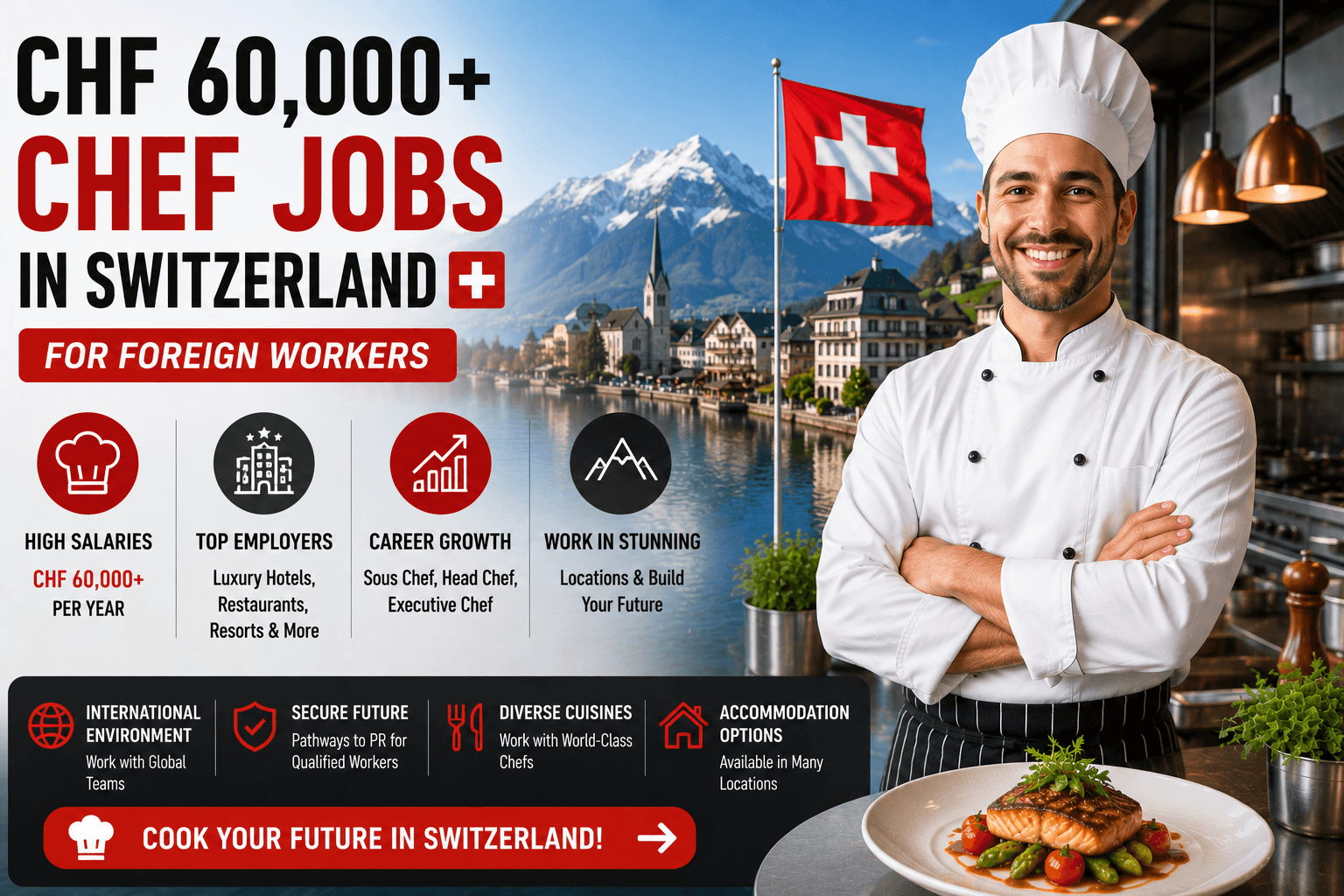
Switzerland has one of Europe’s highest-paying hospitality markets, supported by luxury hotels, Michelin-level restaurants, mountain resorts and a large international tourism industry.
For experienced foreign chefs, opportunities can exist in:
- Luxury hotels
- Restaurants
- Ski resorts
- Alpine hotels
- Catering companies
- International hotel groups
- Fine-dining establishments
Experienced professional chefs can potentially earn CHF 60,000+ per year, while sous chefs, head chefs and executive chefs can earn considerably more.
However, Switzerland has much stricter immigration rules for workers from outside the EU and EFTA than many other European destinations.
Therefore:
A Swiss chef vacancy does not automatically mean a foreign worker can obtain a work permit.
Nationality, qualifications, experience and employer requirements are extremely important.
How Much Do Chefs Earn in Switzerland?
Chef salaries depend on:
- Experience
- Position
- Canton
- Employer
- Hotel category
- Restaurant category
- Working hours
- Management responsibility
Experienced professional chefs can potentially earn approximately:
CHF 60,000–CHF 80,000+ annually.
Senior culinary professionals can earn considerably more.
Monthly Chef Salary
At:
CHF 60,000/year
gross monthly income averages:
CHF 5,000.
At:
CHF 65,000/year
it is approximately:
CHF 5,417.
At:
CHF 70,000/year
it is approximately:
CHF 5,833.
At:
CHF 75,000/year
it is:
CHF 6,250.
At:
CHF 80,000/year
it is approximately:
CHF 6,667.
At:
CHF 90,000/year
it is:
CHF 7,500.
At:
CHF 100,000/year
it is approximately:
CHF 8,333.
These figures represent gross earnings before applicable taxes, insurance and other deductions.
Enter an hourly wage, choose a country, and estimate monthly gross pay, tax and take-home income.
Planning estimate only. The preset uses a simplified flat percentage. Actual tax and payroll deductions can differ based on income level, province/state/region, allowances, social contributions, marital status and local tax rules.
The salary calculator provides a planning estimate only. Actual Swiss take-home income depends on canton, tax status, insurance, deductions and individual circumstances.
Types of Chef Jobs in Switzerland
Professional kitchen positions include:
- Chef
- Chef de Partie
- Sous Chef
- Head Chef
- Executive Chef
- Pastry Chef
- Hotel Chef
- Resort Chef
- Banquet Chef
- Specialist Cuisine Chef
Senior positions generally require extensive professional experience.
Chef de Partie Jobs
A Chef de Partie normally manages a specific section of a professional kitchen.
Examples include:
- Grill
- Sauce
- Fish
- Pastry
- Vegetables
Luxury hotels and restaurants can employ several Chefs de Partie within one kitchen.
Sous Chef Jobs
Sous chefs are senior culinary professionals.
Responsibilities can include:
- Supervising kitchen employees
- Preparing food
- Training workers
- Managing stock
- Maintaining food standards
- Supporting menu development
Experienced sous chefs can potentially earn substantially above general chef salaries.
Head Chef Jobs
Head chefs can manage:
- Kitchen teams
- Menus
- Purchasing
- Scheduling
- Food costs
- Hygiene
- Quality control
Strong leadership and high-end hospitality experience can improve earning potential.
Executive Chef Jobs
Executive chefs are among the highest-level culinary professionals.
Large:
- Five-star hotels
- Luxury resorts
- Restaurant groups
- International hotel companies
can employ executive chefs.
These positions can involve responsibility for:
- Multiple kitchens
- Large teams
- Budgets
- Menus
- Purchasing
- Quality standards
Extensive professional experience is normally expected.
Pastry Chef Jobs
Switzerland has a strong:
- Chocolate
- Bakery
- Pastry
- Luxury dessert
industry.
Professional pastry chefs can work in:
- Hotels
- Restaurants
- Patisseries
- Resorts
Specialist pastry and chocolate experience can be valuable.
Luxury Hotel Chef Jobs
Luxury hospitality is one of Switzerland’s strongest employment areas for experienced chefs.
Five-star properties can employ large international kitchen teams.
Luxury-hotel experience from another country can strengthen an applicant’s CV.
Ski Resort Chef Jobs
Switzerland is famous for Alpine tourism.
Ski destinations require hospitality workers during winter tourism seasons.
Chefs can find employment in:
- Hotels
- Ski resorts
- Chalets
- Restaurants
- Luxury lodges
Some employers can provide staff accommodation.
Chef Jobs in Zurich
Zurich has a large:
- Hotel
- Restaurant
- Business hospitality
market.
Salaries can be attractive.
However, Zurich is also one of Europe’s most expensive cities.
Workers should compare salary against:
- Rent
- Health insurance
- Transport
- Food
before accepting employment.
Chef Jobs in Geneva
Geneva has a highly international population.
Its:
- International organisations
- Business sector
- Tourism
- Luxury hotels
support a substantial hospitality industry.
French is particularly valuable.
Chef Jobs in Lucerne
Lucerne is one of Switzerland’s major tourism destinations.
Hotels and restaurants serve large numbers of international visitors.
Professional chefs can find opportunities in:
- Luxury hotels
- Restaurants
- Tourism properties
Chef Jobs in Interlaken
Interlaken is strongly connected with Alpine tourism.
Hotels and restaurants can require additional hospitality workers during busy tourism periods.
Staff accommodation can be particularly valuable because local housing can be limited.
Chef Jobs in Zermatt
Zermatt is one of Switzerland’s best-known ski and mountain destinations.
The resort contains:
- Luxury hotels
- Restaurants
- Chalets
- Ski hospitality businesses
Seasonal chef opportunities can exist.
Professional hotel or resort experience can strengthen applications.
Chef Jobs in St. Moritz
St. Moritz has an internationally recognised luxury hospitality market.
High-end hotels and restaurants can recruit experienced culinary professionals.
Competition for these positions can also be substantial.
Language Requirements
Switzerland has several official languages.
The language most useful to a chef depends on the region.
German
Important in areas including:
- Zurich
- Bern
- Basel
- Lucerne
French
Important in:
- Geneva
- Lausanne
Italian
Important in:
- Ticino
English is commonly used in international luxury hospitality.
However, knowing the local language can substantially improve employment opportunities.
Qualifications for Chef Jobs
Employers can look for:
- Culinary qualifications
- Professional experience
- Luxury-hotel experience
- Fine-dining experience
- Food-safety knowledge
- Kitchen management
- Specialist cuisine
Senior positions require stronger credentials.
Can Foreign Chefs Work in Switzerland?
Yes.
However, the immigration process depends heavily on nationality.
There is a major distinction between:
EU/EFTA nationals
and:
third-country nationals.
EU/EFTA Chefs
EU/EFTA citizens generally have much easier access to the Swiss labour market under the applicable free-movement arrangements.
They still need to complete the required registration or permit procedures depending on the duration and circumstances of employment.
Non-EU/EFTA Chefs
The situation is substantially more difficult for workers from countries outside the EU/EFTA.
Switzerland generally restricts third-country employment to highly qualified workers.
The system can favour professionals such as:
- Managers
- Specialists
- Highly qualified workers
with strong professional credentials.
This means an ordinary entry-level restaurant position is generally much more difficult to use as an immigration route.
Can a Non-EU Chef Get a Swiss Work Permit?
Potentially, but the profile generally needs to be strong.
A senior professional such as an:
Executive Chef
with extensive international luxury-hotel experience can have a stronger profile than an entry-level cook.
Factors can include:
- Qualifications
- Professional experience
- Specialist expertise
- Employer need
- Salary
- Labour-market requirements
- Permit availability
Approval is not guaranteed.
Employer Requirements
For many third-country hires, the Swiss employer plays a central role in the work-permit application.
The employer can need to demonstrate that the applicable labour-market requirements have been satisfied.
This makes ordinary overseas recruitment considerably more restrictive.
Swiss Work Permit Quotas
Switzerland applies quantitative limits to certain permits for third-country nationals.
Therefore, even a genuine job offer does not automatically result in a permit.
Foreign applicants should not pay recruiters who claim they can guarantee a Swiss work permit.
L Permit
An L permit is generally associated with shorter-term residence.
The exact conditions depend on:
- Nationality
- Employment
- Contract duration
- Immigration circumstances
B Permit
A B permit is generally associated with longer residence circumstances.
The rules differ according to nationality and employment situation.
Receiving a job offer does not itself guarantee either permit.
Employment Contract
A legitimate Swiss chef offer should clearly state:
- Employer
- Position
- Salary
- Working hours
- Location
- Contract duration
- Employment conditions
Applicants should understand whether accommodation or meals are included.
Taxes
Swiss taxation varies considerably according to:
- Canton
- Municipality
- Income
- Residence status
- Family circumstances
Foreign employees can also have tax deducted at source depending on their situation.
Therefore:
CHF 70,000 gross salary is not CHF 70,000 take-home pay.
Health Insurance
Mandatory health insurance is an important expense in Switzerland.
Workers should include insurance premiums when calculating their monthly budget.
A high Swiss salary must always be considered alongside Switzerland’s high living costs.
Cost of Living
Switzerland is one of Europe’s most expensive countries.
Major expenses include:
- Housing
- Health insurance
- Food
- Transportation
Zurich and Geneva can be particularly expensive.
A salary that appears extremely high compared with another country can provide a smaller advantage after Swiss living expenses.
Staff Accommodation
Staff accommodation can be especially valuable in:
- Ski resorts
- Alpine hotels
- Rural tourism destinations
Some employers provide or arrange housing.
Ask:
- Is housing included?
- What is the monthly rent?
- Is the room shared?
- Are meals included?
- Are utilities included?
Get these details in writing.
Meals
Some hotels and restaurants provide staff meals during working shifts.
This can reduce monthly food expenses.
However, it should not be assumed unless confirmed by the employer.
Working Hours
Professional chefs can work:
- Evenings
- Weekends
- Public holidays
- Early mornings
Tourism seasons can also create particularly busy periods.
Workers should review their employment contract carefully.
How Long Does the Process Take?
An EU/EFTA worker can generally follow a more straightforward route:
- Prepare a professional CV.
- Search for chef vacancies.
- Apply.
- Interview.
- Receive an offer.
- Complete applicable permit or registration procedures.
- Begin employment.
A non-EU/EFTA chef can face a considerably more restrictive process:
- Build substantial professional culinary experience.
- Gather qualifications.
- Gather detailed employment references.
- Prepare a professional CV.
- Search for Swiss employers.
- Target qualified or specialist chef positions.
- Complete interviews.
- Receive a genuine employment offer.
- Employer completes applicable labour-market procedures.
- Employer submits the appropriate permit application.
- Authorities assess the employment and applicant.
- Permit availability and applicable quotas are considered.
- Complete entry visa procedures where required.
- Travel after receiving the necessary authorization.
- Complete local registration.
- Begin employment according to permit conditions.
Choose your destination and preferred entry route, then tell us how far you have progressed.
Timeline results are planning estimates only and are not a guarantee of visa approval or travel date.
The wait-time calculator provides a planning estimate only.
It does not guarantee employer recruitment, labour-market approval, permit availability, work-permit processing, visa issuance, entry into Switzerland or any decision by Swiss authorities.
Can Family Members Come?
Family-reunification rights depend on:
- Nationality
- Permit
- Residence status
- Family relationship
- Housing
- Other applicable requirements
EU/EFTA and third-country nationals can be subject to different rules.
Applicants should verify their individual eligibility before making relocation plans.
Can Chef Jobs Lead to Permanent Residence?
Potentially, after qualifying residence in Switzerland and meeting the applicable requirements.
The rules depend on:
- Nationality
- Permit history
- Residence duration
- Integration
- Language
However:
chef job ≠ automatic permanent residence.
Swiss Citizenship
Citizenship has separate and demanding eligibility requirements.
Working as a chef does not automatically provide Swiss citizenship.
Applicants must satisfy the applicable naturalisation requirements independently.
Chef Job Scams
Foreign applicants should be cautious about claims such as:
“Guaranteed Switzerland chef visa.”
“Pay CHF 10,000 for sponsorship.”
“Restaurant job with guaranteed Swiss residence.”
“No qualifications required.”
This is particularly important for non-EU applicants because Swiss third-country recruitment is restrictive.
Building a Swiss Chef CV
A strong chef CV should highlight:
- Culinary qualifications
- Years of experience
- Cuisine
- Luxury-hotel experience
- Fine-dining experience
- Kitchen management
- Staff supervision
- Languages
Language ability can be especially important.
For example:
German — B1
English — C1
should be listed if accurate.
Strong Experience Example
Instead of:
Chef — Hotel — seven years
write:
Sous Chef — five-star hotel — seven years
Supervised a 12-person culinary team and coordinated restaurant and banquet food production for a luxury international hotel.
Only include claims you can verify.
Documents to Prepare
Useful documents can include:
- Passport
- CV
- Culinary qualifications
- Employment references
- Language certificates
- Education documents
- Employment contract
- Work-permit documents
Additional documents depend on nationality and permit route.
How to Find Chef Jobs in Switzerland
Useful searches include:
- Chef jobs Switzerland
- Chef jobs Switzerland foreign workers
- Sous Chef jobs Switzerland
- Executive Chef jobs Switzerland
- Hotel Chef jobs Switzerland
- Chef jobs Zurich
- Chef jobs Geneva
- Chef jobs Zermatt
- Chef jobs St. Moritz
- Chef jobs with accommodation Switzerland
- Luxury Hotel Chef jobs Switzerland
Searching in German and French can uncover additional vacancies.
Frequently Asked Questions
Can chefs earn CHF 60,000+ in Switzerland?
Yes. Experienced professional chefs can potentially earn CHF 60,000+ annually, while senior culinary professionals can earn substantially more.
Can foreigners work as chefs in Switzerland?
Yes, but immigration requirements differ significantly between EU/EFTA citizens and third-country nationals.
Can non-EU chefs get Swiss work permits?
Potentially, particularly for highly qualified or specialist professionals, but third-country recruitment is restrictive and approval is not guaranteed.
Do Swiss hotels provide accommodation?
Some hotels and resorts provide or arrange staff accommodation, particularly in tourism and ski destinations.
Is Switzerland good for chefs?
It can provide high salaries and prestigious hospitality experience, but living costs are also extremely high.
Can chef employment lead to permanent residence?
Potentially after satisfying applicable residence requirements. A chef job itself does not guarantee permanent residence.
Final Thoughts
Switzerland can provide some of Europe’s most attractive chef salaries and hospitality career opportunities.
Experienced chefs can potentially earn:
CHF 60,000+ annually
while:
Sous Chefs
Head Chefs
and:
Executive Chefs
can earn considerably more.
Opportunities exist across:
luxury hotels + restaurants + ski resorts + fine dining + Alpine tourism.
However, Switzerland is considerably easier for EU/EFTA workers to access than workers from third countries.
Therefore:
chef vacancy ≠ work permit
high salary ≠ guaranteed permit
Swiss employer ≠ automatic sponsorship
and:
Swiss chef employment ≠ automatic permanent residence.
For non-EU applicants in particular, strong qualifications, specialist culinary expertise, senior-level experience and a genuine employer need can make a major difference.
MimBlog is an independent information website and is not a recruitment agency, employer, immigration authority or government agency. Salaries are estimates and may vary by employer, experience and location. Job availability and immigration requirements can change. Always verify vacancies, eligibility and visa requirements through employers and official government sources.