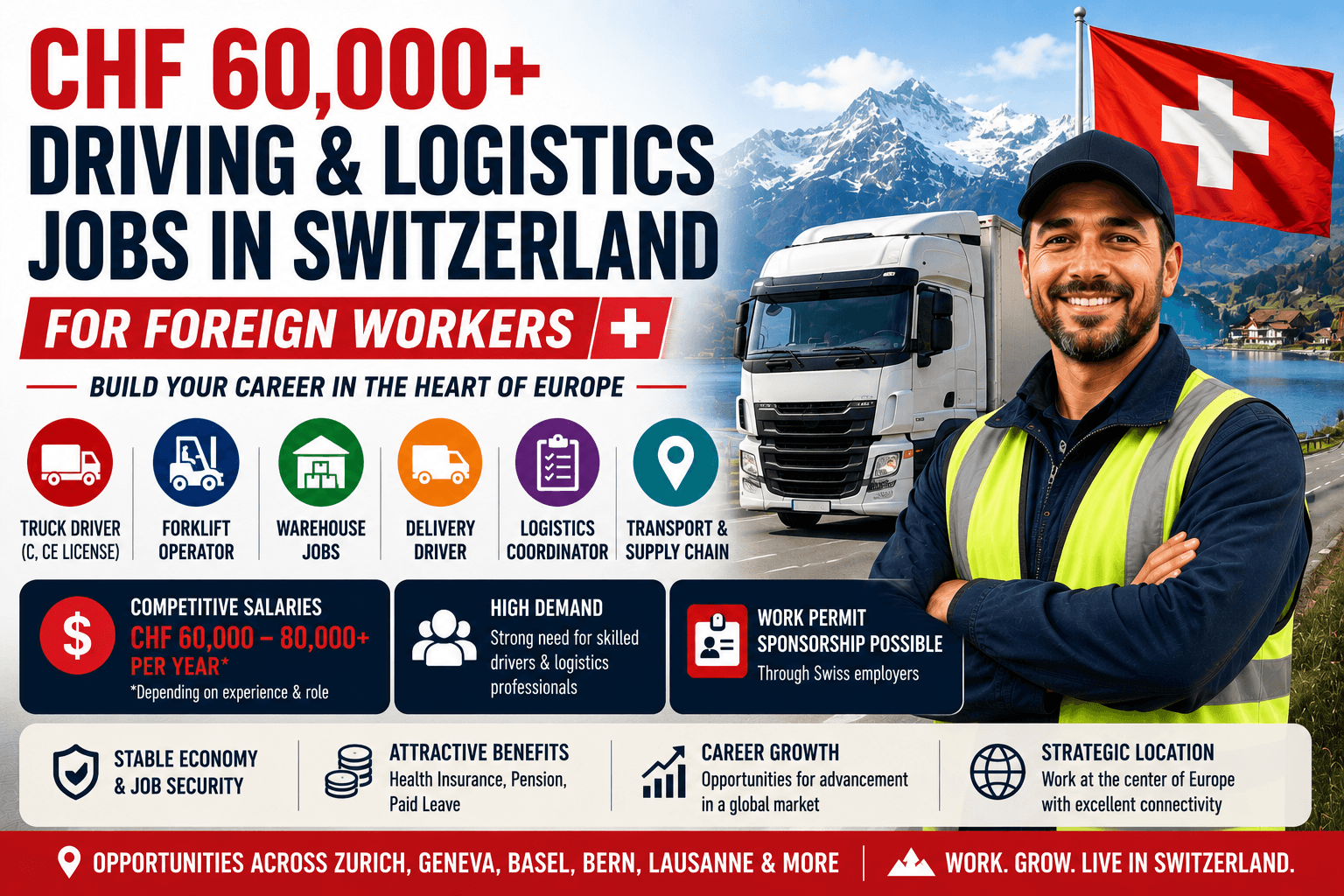
Switzerland has a highly developed transportation and logistics industry connecting some of Europe’s most important commercial markets.
Its location between Germany, France, Italy and Austria makes Switzerland important for:
- Road freight
- Warehousing
- International transportation
- Pharmaceutical logistics
- Retail distribution
- Manufacturing supply chains
- Air cargo
- Supply-chain management
Driving and logistics workers can find opportunities across:
- Truck Driving
- Delivery Driving
- Warehouse Operations
- Forklift Operation
- Freight Handling
- Transport Coordination
- Logistics Planning
- Supply Chain Management
- Warehouse Management
Depending on the occupation, location, experience and employer, experienced workers can target annual gross earnings around:
CHF 60,000–CHF 80,000+
while senior logistics and supply-chain professionals can earn substantially more.
Switzerland, however, has one of the most important distinctions foreign applicants need to understand:
finding a Swiss logistics vacancy does not automatically mean you can obtain a Swiss work permit.
For applicants from outside the EU/EFTA, immigration can be considerably more difficult than finding the actual job.
Why Switzerland Has a Strong Logistics Industry
Switzerland shares borders with:
- Germany
- France
- Italy
- Austria
- Liechtenstein
Its position places it between major European industrial and consumer markets.
Swiss businesses also operate in valuable industries including:
- Pharmaceuticals
- Chemicals
- Precision manufacturing
- Medical technology
- Food
- Retail
- Machinery
These sectors require sophisticated logistics networks.
Truck Driver Jobs in Switzerland
Professional drivers transport:
- Consumer products
- Food
- Pharmaceuticals
- Machinery
- Construction materials
- Industrial products
- Freight
Drivers can work on:
- Local routes
- Regional routes
- National routes
- Cross-border European routes
International experience can be particularly valuable.
Truck Driver Salary in Switzerland
Switzerland is a high-wage economy.
Professional-driver earnings depend on:
- Canton
- Employer
- Experience
- Vehicle
- Working hours
- Route
- Freight
- Shift patterns
Experienced drivers can potentially earn around:
CHF 60,000–CHF 75,000+ annually
in suitable positions.
Specialised jobs can potentially pay more.
These figures are broad planning ranges rather than guaranteed salaries.
The Swiss Federal Statistical Office provides its Salarium calculator for estimating wages according to characteristics such as economic sector, region and occupational group. Its current calculator uses Swiss Earnings Structure Survey 2024 data.
Monthly Salary Examples
At:
CHF 60,000/year
gross monthly salary averages:
CHF 5,000.
At:
CHF 66,000/year
it is:
CHF 5,500.
At:
CHF 72,000/year
it is:
CHF 6,000.
At:
CHF 84,000/year
it is:
CHF 7,000.
These figures are gross amounts before applicable taxes, social contributions and other deductions.
Enter an hourly wage, choose a country, and estimate monthly gross pay, tax and take-home income.
Planning estimate only. The preset uses a simplified flat percentage. Actual tax and payroll deductions can differ based on income level, province/state/region, allowances, social contributions, marital status and local tax rules.
Use the salary calculator as a planning tool. Actual Swiss take-home income depends on canton, municipality, salary, residence status, pension contributions, insurance and personal circumstances.
Long-Haul Truck Driver Jobs
Long-distance drivers can transport freight throughout Switzerland and into neighbouring European countries.
International routes can connect Switzerland with:
- Germany
- France
- Italy
- Austria
- Netherlands
- Belgium
Drivers working internationally need to understand applicable European and Swiss transportation regulations.
Local Truck Driver Jobs
Local drivers can deliver goods between:
- Distribution centres
- Retail stores
- Factories
- Construction sites
- Businesses
These jobs can provide more regular schedules than long-haul freight.
Pharmaceutical Transportation
Switzerland has one of the world’s strongest pharmaceutical industries.
Pharmaceutical logistics can require careful handling of:
- Medicines
- Medical products
- Temperature-sensitive goods
- Laboratory materials
Drivers with specialist experience can potentially find higher-value logistics opportunities.
Delivery Driver Jobs
Delivery drivers work in:
- Parcel delivery
- Retail
- Food distribution
- Business delivery
- E-commerce
However, a delivery vacancy should not be confused with an immigration opportunity.
For non-EU/EFTA applicants, ordinary delivery positions are generally unlikely to fit Switzerland’s highly qualified third-country admission model.
Warehouse Jobs
Warehouse workers perform:
- Picking
- Packing
- Loading
- Unloading
- Scanning
- Inventory
- Dispatch
Employment exists throughout Switzerland’s industrial and distribution regions.
Forklift Operator Jobs
Forklift operators work in:
- Warehouses
- Factories
- Distribution centres
- Freight terminals
Workers can operate equipment such as:
- Counterbalance forklifts
- Reach trucks
- Pallet-moving equipment
Employers can require appropriate Swiss-recognised training and workplace-safety competence.
Logistics Coordinator Jobs
Logistics coordinators help manage:
- Shipments
- Transportation
- Warehouses
- Carriers
- Documentation
- Customers
These positions can require:
- Professional logistics experience
- Computer skills
- Language ability
- International freight knowledge
Professional logistics roles can be more realistic immigration targets for highly qualified third-country applicants than basic warehouse positions.
Transport Planner Jobs
Transport planners organise:
- Routes
- Drivers
- Vehicles
- Delivery schedules
- Capacity
Experience managing international European transportation can be particularly valuable.
Supply Chain Jobs
Switzerland’s multinational companies employ professionals in:
- Supply Chain Analysis
- Procurement
- Logistics Engineering
- Demand Planning
- Transport Management
- Warehouse Management
- Supply Chain Management
For applicants from outside the EU/EFTA, these professional positions can be significantly more relevant to Swiss immigration than ordinary driver or warehouse jobs.
Logistics Jobs in Zurich
Zurich is Switzerland’s largest commercial centre.
The surrounding region has opportunities involving:
- Retail distribution
- Air cargo
- Corporate logistics
- Warehousing
- Supply chain
Zurich Airport also supports international freight activity.
Logistics Jobs in Basel
Basel is particularly important for:
- Pharmaceuticals
- Chemicals
- International trade
- Cross-border logistics
Its location near France and Germany makes it strategically valuable.
Workers with pharmaceutical logistics experience can find the region particularly interesting.
Logistics Jobs in Geneva
Geneva has:
- Airport logistics
- International trade
- Retail distribution
- Corporate supply chains
French is especially valuable in this region.
Logistics Jobs in Bern
Bern and surrounding areas require:
- Retail transportation
- Warehousing
- Distribution
- Construction logistics
German is particularly useful.
Logistics Jobs in Lausanne
Lausanne and the wider Vaud region offer opportunities in:
- Distribution
- Retail logistics
- Manufacturing
- Warehousing
French is generally important.
Language Requirements
Switzerland has several official languages.
The most relevant language depends heavily on location.
German
Useful in:
- Zurich
- Basel
- Bern
- Lucerne
French
Useful in:
- Geneva
- Lausanne
- Neuchâtel
Italian
Important in:
- Ticino
English is common in multinational professional environments.
However, drivers dealing with:
- Customers
- Dispatch
- Warehouses
- Authorities
can benefit significantly from the local language.
EU/EFTA Workers
Switzerland operates a dual labour-market access system.
EU/EFTA nationals benefit from substantially easier access under Switzerland’s free-movement arrangements.
Workers across qualification levels from EU/EFTA countries generally have easier access to Swiss employment than third-country nationals.
This distinction is extremely important for driving and warehouse applicants.
Non-EU/EFTA Workers
The situation is substantially different for people from countries outside the EU/EFTA.
Switzerland states that third-country nationals are generally admitted for employment when they are:
managers, specialists or other qualified workers.
The authorities primarily expect qualifications such as higher education plus professional experience, although special training and extensive experience can be considered in some professions.
Therefore, an applicant living outside Europe should not assume:
Swiss truck-driver shortage = Swiss truck-driver visa.
Why Truck Driver Sponsorship Is Difficult
For a third-country national, the employer generally needs to demonstrate that it could not find a suitable worker from:
- Switzerland
- EU/EFTA countries
- Other categories with labour-market priority.
The employer must document genuine recruitment efforts.
That creates a major obstacle for ordinary occupations that can potentially be filled from the large Swiss and EU/EFTA labour market.
Work Permit Quotas
Third-country work permits are also limited by annual quotas.
Switzerland maintained its third-country permit quotas for 2026.
This further reinforces the focus on highly qualified foreign workers.
Employer Applies for the Permit
For qualifying third-country employment, the future Swiss employer applies for work authorisation.
The employer generally needs to demonstrate:
- Why the foreign applicant is needed
- Why an eligible Swiss/EU/EFTA worker could not fill the position
- Appropriate salary
- Appropriate working conditions
Swiss authorities state that wages and employment conditions for foreign workers must correspond to those customary for the region, profession and sector.
B Permit
A B permit is generally associated with longer-term residence.
The exact status depends on:
- Nationality
- Employment
- Canton
- Immigration circumstances
Third-country permits remain subject to Switzerland’s admission rules.
L Permit
An L permit is generally used for shorter periods of residence.
Again, the precise rules depend on the worker and employment circumstances.
C Permit
The C permit is a settlement permit.
It should not be confused with:
- Initial work authorisation
- B permit
- L permit
A new foreign worker does not simply receive permanent Swiss settlement because they obtained a job.
Can Warehouse Workers Get Swiss Work Permits?
Workers who already possess unrestricted or appropriate Swiss employment rights can certainly work in warehouses.
The immigration question is different.
For an applicant applying directly from a non-EU/EFTA country, a basic warehouse position is generally a poor fit for Switzerland’s highly qualified third-country admission rules.
Can Truck Drivers Get Swiss Work Permits?
For EU/EFTA workers, access is substantially easier.
For third-country applicants, ordinary truck-driving positions face the same major barriers:
- Labour-market priority
- Qualification requirements
- Employer justification
- Permit quotas
Exceptional circumstances can exist, but foreign applicants should not treat ordinary truck driving as a straightforward Swiss sponsorship route.
Better Opportunities for Third-Country Applicants
Higher-skilled logistics occupations can offer a stronger profile.
Examples include:
- Supply Chain Manager
- Senior Logistics Manager
- Procurement Manager
- Logistics Engineer
- Supply Chain Analyst
- International Transport Manager
Applicants with:
- Degrees
- Specialist expertise
- Several years of experience
- Management responsibility
fit Switzerland’s third-country admission model more closely.
Swiss Driving Licence
Professional drivers must hold appropriate legal driving entitlement.
Foreign drivers moving to Switzerland should determine:
- Whether their licence is recognised
- Whether it must be exchanged
- Whether testing is required
- Which commercial-driving requirements apply
Do not assume an overseas HGV licence automatically provides unrestricted professional-driving rights in Switzerland.
Professional Driver Requirements
Commercial driving can involve additional rules concerning:
- Professional qualification
- Working time
- Rest periods
- Safety
- Vehicle operation
Employers can also require specific training or certification.
Foreign drivers should verify these requirements before accepting a position.
Cost of Living
Swiss salaries are high.
So are many living costs.
Major expenses include:
- Housing
- Health insurance
- Food
- Transportation
- Childcare
Cities such as Zurich and Geneva can be particularly expensive.
A salary should therefore be evaluated against:
net income + rent + health insurance + daily expenses.
A CHF 70,000 salary does not necessarily provide the same purchasing power as CHF 70,000 would suggest in a lower-cost country.
How Long Does the Process Take?
For a qualifying third-country professional, the process can include:
- Finding a Swiss employer.
- Receiving an employment offer.
- Employer preparing the work-permit application.
- Labour-market review.
- Cantonal review.
- Federal review where applicable.
- Work authorisation.
- Visa procedure where required.
- Travel.
- Local registration.
- Driving-licence procedures where applicable.
- Starting employment.
Swiss authorities state that third-country workers need work authorisation and that, depending on nationality, a visa can also be required. Workers must register with their local authority after arrival before beginning employment.
Choose your destination and preferred entry route, then tell us how far you have progressed.
Timeline results are planning estimates only and are not a guarantee of visa approval or travel date.
The wait-time calculator provides a planning estimate only. It does not guarantee employer recruitment, cantonal approval, federal approval, quota availability, visa issuance, licence recognition, residence permission or any Swiss government decision.
Can Family Members Come?
Family-reunification possibilities depend on:
- Nationality
- Residence permit
- Family relationship
- Housing
- Applicable cantonal and federal requirements
Applicants should check the rules associated with their exact permit.
Can Logistics Work Lead to Permanent Residence?
Potentially, where the worker remains legally resident and later satisfies Switzerland’s settlement requirements.
However:
Swiss job ≠ automatic C permit.
Permanent settlement depends on the person’s circumstances and immigration history.
Swiss Citizenship
Citizenship is another separate stage.
Employment does not automatically lead to Swiss citizenship.
Naturalisation has federal, cantonal and communal requirements.
Job Scams
Foreign applicants should be cautious of advertisements claiming:
“Switzerland truck-driver visa guaranteed.”
“Warehouse job with free Swiss work permit.”
“Pay CHF 8,000 for B permit.”
“Swiss PR guaranteed after two years.”
For non-EU/EFTA applicants, these claims are particularly suspicious because Switzerland’s official rules clearly place significant restrictions on third-country labour-market admission.
Building a Swiss Truck Driver CV
Drivers should highlight:
- Commercial licence categories
- Years of experience
- Vehicle types
- Freight
- International routes
- Safety record
- Languages
For example:
“Completed 600,000+ kilometres of commercial freight transportation across international European routes with a strong safety record.”
when accurate.
Logistics Professional CV
Professional applicants should demonstrate measurable results.
Examples include:
“Reduced international freight costs by 14% across a €20 million supply chain.”
or:
“Improved on-time delivery performance from 91% to 98% across 12 European markets.”
when accurate.
For third-country applicants, demonstrating specialist expertise is particularly important.
How to Find Driving and Logistics Jobs
Useful searches include:
- Truck driver Switzerland
- LKW Fahrer Schweiz
- Chauffeur poids lourd Suisse
- Warehouse jobs Switzerland
- Logistics coordinator Switzerland
- Transport planner Switzerland
- Supply chain Switzerland
- Logistics manager Switzerland
- International transport manager Switzerland
Search in the local language of the region whenever possible.
Frequently Asked Questions
Can foreigners work as truck drivers in Switzerland?
Yes, provided they have the legal right to work and satisfy professional-driving requirements.
How much can truck drivers earn?
Experienced drivers can potentially earn roughly CHF 60,000–CHF 75,000+ depending on employer, canton, experience and working conditions.
Can a non-EU foreigner get sponsored as a Swiss truck driver?
It is considerably more difficult. Switzerland primarily admits highly qualified third-country workers, applies labour-market priority and limits permits through quotas.
Are EU workers treated differently?
Yes. EU/EFTA workers have substantially easier labour-market access under Switzerland’s free-movement arrangements.
Can warehouse workers receive Swiss sponsorship?
People who already have Swiss work rights can work in warehouses. A basic warehouse job is generally not a strong immigration route for a new third-country applicant.
Which logistics workers have better prospects?
Highly qualified supply-chain, management and specialist professionals generally fit Switzerland’s third-country employment model more closely.
Does Switzerland have work-permit quotas?
Yes. Third-country admissions are limited, and Switzerland maintained its third-country quotas for 2026.
Does a Swiss job guarantee permanent residence?
No.
Final Thoughts
Switzerland offers some of Europe’s most attractive salaries for transportation and logistics workers.
Experienced workers can target opportunities across:
- Truck driving
- Warehousing
- Freight
- Transport planning
- Logistics coordination
- Supply chain management
Some experienced drivers can potentially earn:
CHF 60,000–CHF 75,000+ annually
while senior logistics professionals can earn considerably more.
But foreign workers need to understand that Switzerland operates two very different labour-market systems.
For:
EU/EFTA workers, access is substantially easier.
For:
non-EU/EFTA workers, Switzerland primarily admits highly qualified professionals, applies Swiss/EU/EFTA worker priority and limits third-country permits.
Therefore:
high Swiss salary ≠ easy immigration
truck-driver vacancy ≠ visa sponsorship
warehouse shortage ≠ automatic work permit
and:
Swiss work permit ≠ automatic permanent residence.
For a third-country applicant, a stronger Swiss strategy can be:
build specialist logistics expertise → obtain recognised professional qualifications → gain management or advanced supply-chain experience → learn the relevant Swiss regional language → target specialist employers → secure a qualifying offer → employer completes the Swiss work-permit procedure → relocate legally.
MimBlog is an independent information website and is not a recruitment agency, employer, immigration authority or government agency. Salaries are estimates and may vary by employer, experience and location. Job availability and immigration requirements can change. Always verify vacancies, eligibility and visa requirements through employers and official government sources.