

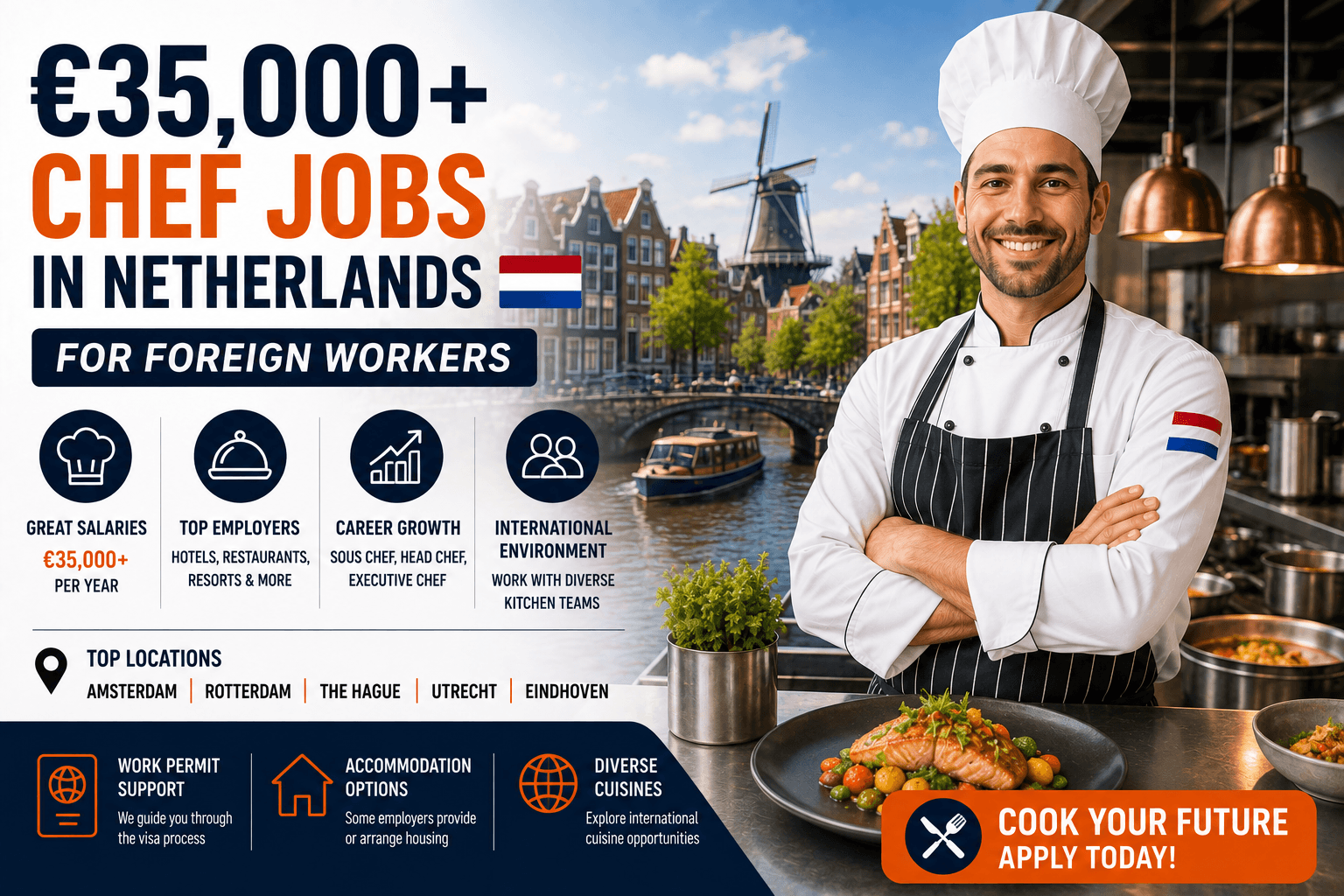
The Netherlands has a large and international hospitality industry, with restaurants, hotels, resorts, cafés and catering businesses employing professional chefs throughout the country.
Cities such as Amsterdam, Rotterdam, The Hague and Utrecht attract millions of international visitors and have restaurants serving cuisines from around the world.


For experienced foreign chefs, opportunities can exist in:
- Restaurants
- Hotels
- Resorts
- Catering companies
- Commercial kitchens
- International restaurant groups
- Tourism businesses
Experienced professional chefs can potentially earn €35,000+ per year, while sous chefs, head chefs and executive chefs can earn considerably more.
However, employment opportunities and immigration options are very different for EU/EEA workers and workers coming from outside Europe.
Therefore:
A chef job in the Netherlands does not automatically provide a Dutch work permit or residence permit.
How Much Do Chefs Earn in the Netherlands?
Chef salaries depend on:
- Experience
- Position
- Employer
- Location
- Restaurant category
- Hotel category
- Working hours
- Management responsibility
Experienced professional chefs can potentially earn approximately:
€35,000–€45,000+ annually.
Senior chefs and culinary managers can earn more.
Monthly Chef Salary
At:
€35,000/year
gross monthly salary averages approximately:
€2,917.
At:
€40,000/year
it is approximately:
€3,333.
At:
€45,000/year
it is:
€3,750.
At:
€50,000/year
it is approximately:
€4,167.
At:
€60,000/year
it is:
€5,000.
These amounts are before applicable Dutch taxes and deductions.
Enter an hourly wage, choose a country, and estimate monthly gross pay, tax and take-home income.
Planning estimate only. The preset uses a simplified flat percentage. Actual tax and payroll deductions can differ based on income level, province/state/region, allowances, social contributions, marital status and local tax rules.
Use the salary calculator for planning only. Actual take-home pay depends on taxable income, tax credits and individual circumstances.
Types of Chef Jobs in the Netherlands
Professional kitchen positions include:
- Chef
- Chef de Partie
- Sous Chef
- Head Chef
- Executive Chef
- Pastry Chef
- Hotel Chef
- Banquet Chef
- Specialist Cuisine Chef
The experience required increases significantly for senior positions.
Chef de Partie Jobs
A Chef de Partie usually manages a particular kitchen section.
Examples include:
- Grill
- Sauce
- Fish
- Pastry
- Vegetables
This can be a useful career step for chefs progressing toward sous-chef positions.
Sous Chef Jobs
Sous chefs support senior kitchen management.
Responsibilities can include:
- Supervising kitchen employees
- Food preparation
- Stock management
- Staff training
- Food safety
- Menu development
- Quality control
Experienced sous chefs can potentially earn considerably more than junior kitchen employees.
Head Chef Jobs
Head chefs can oversee:
- Kitchen teams
- Menus
- Purchasing
- Food costs
- Scheduling
- Hygiene
- Quality
Strong leadership and commercial kitchen experience are important.
Executive Chef Jobs
Executive chefs can manage large culinary operations.
Employers can include:
- Luxury hotels
- Large restaurants
- Restaurant groups
- Resorts
- Catering companies
Executive-chef positions usually require substantial professional and management experience.
Pastry Chef Jobs
Pastry chefs specialise in:
- Cakes
- Desserts
- Pastries
- Bread
- Chocolate
Opportunities exist in:
- Hotels
- Restaurants
- Bakeries
- Luxury hospitality
Specialist experience can strengthen an applicant’s CV.
Restaurant Chef Jobs
The Netherlands has a highly international restaurant industry.
Opportunities exist across:
- Fine dining
- Casual dining
- International cuisine
- Hotel restaurants
- Restaurant groups
- Independent restaurants
Amsterdam has a particularly international food market.
Hotel Chef Jobs
Hotels employ chefs for:
- Breakfast
- Restaurants
- Banquets
- Conferences
- Events
- Room service
Large hotels can employ several levels of kitchen professionals.
Catering Chef Jobs
Catering businesses provide food for:
- Offices
- Events
- Conferences
- Institutions
- Private functions
Experienced chefs can find opportunities in both hospitality and institutional catering.
Chef Jobs in Amsterdam
Amsterdam is the country’s largest international tourism destination.
The city has:
- Luxury hotels
- International restaurants
- Tourist restaurants
- Event venues
- Corporate hospitality
English is commonly used in international workplaces.
However, Amsterdam also has high housing costs.
Foreign workers should compare salary against rent before accepting employment.
Chef Jobs in Rotterdam
Rotterdam is a major commercial and international city.
Its multicultural population supports restaurants serving cuisine from around the world.
Opportunities exist in:
- Restaurants
- Hotels
- Catering
- Events
Chef Jobs in The Hague
The Hague has:
- International organisations
- Embassies
- Hotels
- Restaurants
- Business travel
Its international population supports a diverse hospitality sector.
Chef Jobs in Utrecht
Utrecht has a large restaurant and café industry supported by:
- Residents
- Students
- Tourism
- Business
Its central location also provides access to a wider Dutch employment market.
Chef Jobs Outside Major Cities
Hospitality employment is not limited to Amsterdam.
Opportunities can also exist in:
- Tourist towns
- Coastal resorts
- Holiday parks
- Regional hotels
- Conference centres
Housing can sometimes be less expensive outside the largest cities.
International Cuisine Chef Jobs
The Netherlands has restaurants specialising in cuisines including:
- Indonesian
- Surinamese
- Indian
- Chinese
- Japanese
- Turkish
- Moroccan
- Middle Eastern
- African
- Mediterranean
Specialist cuisine experience can be valuable when it genuinely matches an employer’s needs.
Do I Need Dutch?
Not always.
English is widely spoken in the Netherlands, particularly in major cities and international hospitality businesses.
Some professional kitchens operate largely in English.
However, Dutch can improve:
- Job opportunities
- Communication
- Promotion prospects
- Customer interaction
- Long-term integration
Applicants planning to remain in the country should consider learning Dutch.
Qualifications
Employers can look for:
- Culinary qualifications
- Commercial kitchen experience
- Food-safety knowledge
- Specialist cuisine
- Staff supervision
- Kitchen management
The requirements depend on the position.
Senior positions normally require stronger experience.
Can Foreign Chefs Work in the Netherlands?
Yes.
However, nationality matters substantially.
EU/EEA and Swiss Citizens
EU/EEA and Swiss nationals generally have much easier access to the Dutch labour market.
They normally do not face the same work-permit process as third-country nationals.
Non-EU Workers
Workers from outside the EU/EEA and Switzerland generally need appropriate permission to work and reside in the Netherlands.
The employer can have an important role in this process.
GVVA Single Permit
For many non-EU nationals planning to work in the Netherlands for longer periods, a combined residence and work authorization known as the:
GVVA — Single Permit
can be relevant.
The process combines residence and employment authorization.
Eligibility depends on the employment situation.
Labour-Market Requirements
For ordinary employment, employers can face requirements relating to recruitment within the Netherlands and wider European labour market before employing certain third-country nationals.
This can make overseas recruitment for ordinary restaurant positions more difficult.
Therefore, applicants should not assume:
restaurant vacancy = overseas sponsorship.
Specialist Chefs
Foreign chefs with specialist culinary expertise can sometimes have stronger employment profiles than applicants for basic kitchen positions.
Examples can include chefs with substantial experience in a particular cuisine.
However:
specialist experience does not automatically remove immigration requirements.
The employer still needs to follow the applicable process.
Highly Skilled Migrant Route
The Netherlands has a Highly Skilled Migrant programme.
It involves recognised sponsors and salary requirements.
However, ordinary:
- Chef
- Cook
- Kitchen Assistant
- Dishwasher
positions should not automatically be assumed to qualify for this programme.
A company being a recognised sponsor also does not mean every position it offers qualifies for the Highly Skilled Migrant route.
Recognised Sponsor
Recognised sponsorship is important for certain Dutch immigration routes.
Foreign applicants sometimes misunderstand this concept.
A hotel or restaurant being connected with a recognised sponsor does not automatically turn every hospitality vacancy into a qualifying sponsored job.
Always evaluate the actual position and immigration route.
Employment Contract
A genuine employment contract should explain:
- Employer
- Position
- Salary
- Working hours
- Location
- Holiday
- Contract duration
Workers should carefully review the agreement before relocating.
Taxes
Dutch employees generally pay taxes through the country’s tax system.
Actual deductions depend on:
- Income
- Tax credits
- Personal circumstances
Therefore:
€40,000 gross salary is not €40,000 take-home pay.
Workers should calculate expected net income before accepting employment.
Health Insurance
People living and working in the Netherlands can have health-insurance obligations.
Foreign workers should understand:
- Insurance requirements
- Premiums
- Employer arrangements
before calculating their monthly budget.
Working Hours
Chef employment frequently involves:
- Evenings
- Weekends
- Public holidays
- Early mornings
Shift schedules depend on the employer.
Workers should review:
- Weekly hours
- Overtime
- Holiday
- Breaks
before accepting a contract.
Housing in the Netherlands
Housing is one of the biggest challenges for foreign workers.
Amsterdam is particularly expensive.
Housing can also be difficult to find in other major cities.
Before accepting a chef position, calculate:
net salary − rent − insurance − transport − food.
A slightly lower salary in a less expensive city can sometimes provide better disposable income.
Staff Accommodation
Some:
- Hotels
- Resorts
- Holiday parks
- Regional employers
can provide or arrange employee accommodation.
Always ask:
- Is accommodation included?
- What is the monthly cost?
- Is the room shared?
- Are utilities included?
- Is rent deducted from salary?
How Long Does the Process Take?
An EU/EEA worker or someone who already has unrestricted Dutch work rights can have a relatively straightforward recruitment process:
- Prepare a professional CV.
- Search for chef vacancies.
- Apply.
- Interview.
- Receive an offer.
- Complete applicable registration requirements.
- Begin employment.
A non-EU applicant requiring employment authorization can face a longer process:
- Prepare a professional chef CV.
- Gather culinary qualifications.
- Gather employment references.
- Search for legitimate employers.
- Apply for suitable chef vacancies.
- Complete interviews.
- Receive a genuine job offer.
- Employer determines the appropriate employment-permit route.
- Employer completes applicable procedures.
- Submit required immigration documents.
- Complete applicable entry procedures.
- Wait for the decision.
- Travel after receiving the required permission.
- Complete Dutch registration and residence formalities.
- Begin employment according to the approved conditions.
Choose your destination and preferred entry route, then tell us how far you have progressed.
Timeline results are planning estimates only and are not a guarantee of visa approval or travel date.
The wait-time calculator provides a planning estimate only.
It does not guarantee employer recruitment, GVVA processing, residence-permit processing, entry authorization, visa issuance or any decision by Dutch immigration or employment authorities.
Can Family Members Come?
Qualifying residence-permit holders can potentially bring eligible family members under Dutch family migration rules.
Eligibility depends on the worker’s:
- Residence status
- Income
- Family relationship
- Immigration circumstances
Applicants should check the current requirements before making relocation plans.
Can Chef Jobs Lead to Permanent Residence?
Potentially.
A foreign worker who legally lives in the Netherlands for the required period and satisfies the applicable conditions can potentially become eligible for long-term or permanent residence.
Requirements can involve:
- Lawful residence
- Residence history
- Income
- Integration
depending on the pathway.
However:
chef job ≠ automatic permanent residence.
Dutch Citizenship
Citizenship has separate eligibility requirements.
Employment as a chef does not automatically lead to Dutch citizenship.
Applicants must independently satisfy the applicable naturalisation rules.
Chef Job Scams
Foreign applicants should be cautious about claims such as:
“Guaranteed Netherlands chef visa.”
“Pay €7,000 for sponsorship.”
“Restaurant job with automatic residence.”
“No experience required — Highly Skilled Migrant chef.”
No recruiter can legitimately guarantee an immigration decision.
Building a Dutch Chef CV
A strong CV should highlight:
- Culinary qualifications
- Years of experience
- Cuisine
- Commercial kitchen experience
- Food safety
- Staff supervision
- Languages
If you speak:
- Dutch
- English
- German
- French
include the level accurately.
Strong Experience Description
Instead of:
Chef — Restaurant — four years
write:
Chef de Partie — four years
Managed the grill section of a high-volume restaurant kitchen and maintained preparation and food-safety standards during daily service.
Only include experience you can verify.
Documents to Prepare
Useful documents can include:
- Passport
- CV
- Culinary certificates
- Employment references
- Education documents
- Employment contract
- Immigration documents
Additional documents depend on the work and residence route.
How to Find Chef Jobs in the Netherlands
Useful searches include:
- Chef jobs Netherlands
- Chef jobs Netherlands foreign workers
- Chef jobs Amsterdam
- Sous Chef jobs Netherlands
- Head Chef jobs Netherlands
- Hotel Chef jobs Netherlands
- Chef jobs Rotterdam
- Chef jobs with accommodation Netherlands
- International Chef jobs Amsterdam
- Restaurant Chef jobs Netherlands
Applicants who need work authorization should establish whether an employer is actually willing and able to complete the required process.
Frequently Asked Questions
Can chefs earn €35,000+ in the Netherlands?
Yes. Experienced professional chefs can potentially earn €35,000+ annually, while senior chefs can earn more.
Can foreigners work as chefs in the Netherlands?
Yes. EU/EEA workers generally have easier access, while non-EU workers normally require appropriate employment and residence authorization.
Is English enough?
Some international kitchens use English extensively. However, learning Dutch can significantly improve long-term opportunities.
Do restaurants sponsor foreign chefs?
Some employers can recruit workers from outside the EU when applicable requirements are satisfied. This should not be assumed for every vacancy.
Is the Highly Skilled Migrant visa available to every chef?
No. Ordinary chef and restaurant employment should not automatically be assumed to qualify for the Highly Skilled Migrant programme.
Can chef employment lead to permanent residence?
Potentially after meeting the applicable residence requirements, but employment itself does not guarantee permanent residence.
Final Thoughts
The Netherlands can provide attractive opportunities for experienced foreign chefs.
Professional chefs can potentially earn:
€35,000+ annually
while:
Sous Chefs
Head Chefs
and:
Executive Chefs
can earn considerably more.
Opportunities exist across:
restaurants + hotels + catering + tourism + international cuisine.
English is widely used, which can make the Netherlands attractive to international workers.
However, non-EU applicants face substantially more immigration restrictions than EU/EEA workers.
Therefore:
chef vacancy ≠ work permit
recognised sponsor ≠ every job qualifies
€35,000 salary ≠ automatic immigration eligibility
and:
Dutch chef employment ≠ automatic permanent residence.
Foreign chefs should target legitimate employers, document their professional culinary experience and carefully verify the appropriate Dutch work and residence pathway before relocating.


