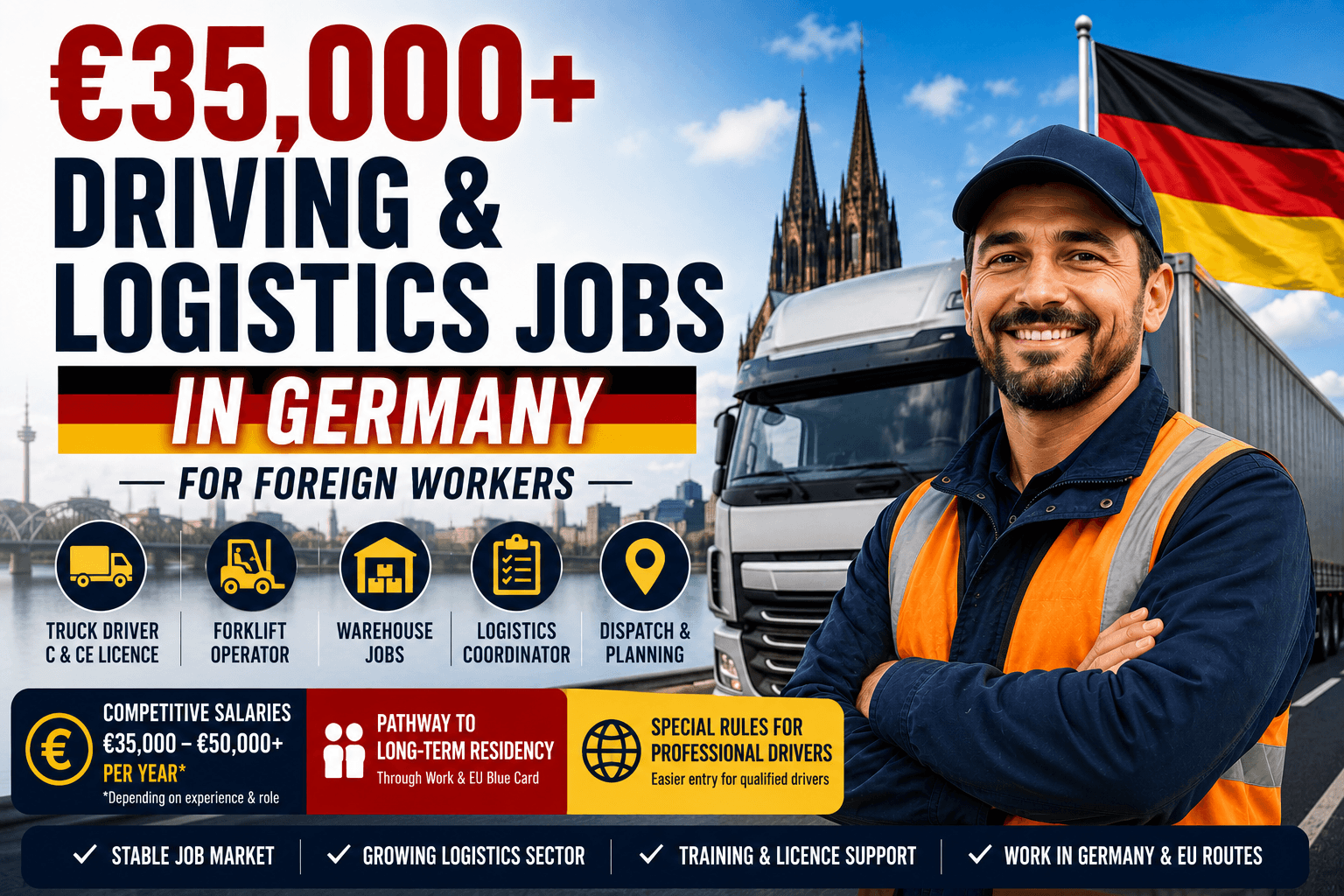
Germany has one of Europe’s largest transportation, manufacturing and logistics industries.
Its central location allows goods to move between major European markets, while Germany’s automotive, manufacturing, retail and e-commerce industries depend heavily on efficient transportation.
This creates employment across:
- Truck Driving
- Delivery Driving
- Warehouse Operations
- Forklift Operation
- Freight Handling
- Dispatch
- Logistics Coordination
- Transport Planning
- Warehouse Management
- Supply Chain Management
For experienced workers, some driving and logistics positions can provide annual earnings of:
€35,000–€50,000+
while specialised drivers, supervisors and professional logistics workers can earn more.
Germany can also offer employment pathways for certain foreign professional drivers under rules that differ from the normal skilled-worker process.
However:
German logistics vacancy ≠ automatic German work visa.
Foreign applicants still need to satisfy the immigration, employment and licensing requirements applying to their circumstances.
This guide explains driving and logistics jobs in Germany for foreign workers, including salaries, professional-driver requirements, driving licences, work visas and longer-term residence.
Why Germany Has a Large Logistics Industry
Germany sits near the centre of Europe.
It shares borders with:
- Denmark
- Poland
- Czechia
- Austria
- Switzerland
- France
- Luxembourg
- Belgium
- Netherlands
This makes Germany an important transportation corridor.
Freight can move through Germany toward markets throughout the European Union.
Germany also has major:
- Motorways
- Rail networks
- Airports
- Inland ports
- Seaports
- Distribution centres
Logistics therefore plays an important role in the national economy.
Truck Driver Jobs in Germany
Truck drivers transport:
- Consumer goods
- Machinery
- Food
- Automotive components
- Construction materials
- Industrial products
Drivers can work on:
- Local routes
- Regional routes
- National routes
- International European routes
International driving can involve crossing several European countries.
Truck Driver Salary in Germany
Truck-driver compensation varies according to:
- Employer
- Region
- Experience
- Route
- Vehicle
- Working hours
- Specialisation
Experienced drivers can target gross annual earnings around:
€35,000–€45,000+
in many employment situations.
Specialised drivers and positions involving additional responsibilities can potentially earn more.
These are broad planning ranges rather than guaranteed salaries.
Monthly Salary Examples
At:
€35,000 annually
gross monthly salary is approximately:
€2,917.
At:
€40,000 annually
it is approximately:
€3,333.
At:
€45,000 annually
it is:
€3,750.
At:
€50,000 annually
it is approximately:
€4,167.
These amounts are before taxes and social-security deductions.
Enter an hourly wage, choose a country, and estimate monthly gross pay, tax and take-home income.
Planning estimate only. The preset uses a simplified flat percentage. Actual tax and payroll deductions can differ based on income level, province/state/region, allowances, social contributions, marital status and local tax rules.
Use the salary calculator only as a planning tool. Actual German take-home income depends on tax class, social insurance, health insurance, family circumstances and other individual factors.
Long-Distance Truck Driver Jobs
Long-distance drivers can transport goods across Germany and other European countries.
The work can involve:
- Long journeys
- Overnight stops
- Strict delivery schedules
- Driving-time regulations
- Rest requirements
International routes can require additional documentation and practical knowledge of European transportation rules.
Local Truck Driver Jobs
Local drivers can work around:
- Warehouses
- Factories
- Supermarkets
- Distribution centres
- Construction sites
These jobs can allow drivers to return home more frequently.
However, they can involve:
- Frequent stops
- Loading
- Unloading
- Urban traffic
Delivery Driver Jobs
Germany has a large parcel and e-commerce industry.
Delivery workers transport packages to:
- Homes
- Businesses
- Parcel collection points
Delivery work can involve:
- Vans
- Light commercial vehicles
- Small trucks
Drivers need good:
- Navigation
- Time management
- Customer service
skills.
Warehouse Jobs
Germany’s manufacturing and retail economy requires enormous warehouse capacity.
Warehouse workers can perform:
- Picking
- Packing
- Loading
- Unloading
- Sorting
- Inventory handling
- Dispatch
Major warehouse employment exists around industrial and population centres.
Forklift Driver Jobs
Forklift operators move:
- Pallets
- Freight
- Machinery
- Inventory
inside:
- Warehouses
- Factories
- Distribution centres
Employers generally expect workers to demonstrate appropriate training and safe operation.
Foreign certificates should not automatically be assumed to satisfy German employer requirements.
Freight Handler Jobs
Freight handlers help move products through:
- Warehouses
- Airports
- Ports
- Freight terminals
The job can include:
- Loading
- Sorting
- Scanning
- Pallet handling
- Shipment preparation
Physical fitness can be important.
Logistics Coordinator Jobs
Logistics coordinators help organise shipments.
Responsibilities can include:
- Booking transportation
- Tracking deliveries
- Coordinating carriers
- Managing documentation
- Communicating with customers
These positions can require stronger:
- German
- Computer
- Administrative
skills than basic warehouse jobs.
Transport Planner Jobs
Transport planners organise:
- Routes
- Drivers
- Vehicles
- Delivery schedules
- Capacity
Professional experience with logistics software can strengthen employment prospects.
Warehouse Supervisor Jobs
Experienced warehouse workers can progress into:
- Team Leader
- Shift Supervisor
- Warehouse Supervisor
- Operations Supervisor
Responsibilities can include:
- Staff management
- Productivity
- Safety
- Inventory
- Scheduling
Supply Chain Careers
Workers with professional qualifications can target:
- Supply Chain Analyst
- Logistics Analyst
- Procurement Specialist
- Transport Manager
- Warehouse Manager
- Supply Chain Manager
These positions can provide significantly higher compensation than entry-level logistics work.
Driving Jobs in Berlin
Berlin has:
- Retail
- E-commerce
- Delivery
- Warehousing
- Technology logistics
activity.
The city’s large population creates substantial last-mile delivery demand.
Driving Jobs in Hamburg
Hamburg is particularly important because of its port.
The Port of Hamburg supports:
- Container transportation
- Warehousing
- International freight
- Trucking
- Shipping logistics
Workers with port and container experience can find relevant opportunities.
Driving Jobs in Frankfurt
Frankfurt is centrally located and has one of Europe’s major airports.
The region supports:
- Air freight
- Warehousing
- Distribution
- Road transport
Its location makes it important for national and European logistics.
Driving Jobs in Munich
Munich and Bavaria have substantial:
- Automotive
- Manufacturing
- Retail
- Distribution
activity.
Living costs can be relatively high, particularly in Munich.
Workers should compare salary with housing expenses.
Driving Jobs in Stuttgart
Stuttgart has a major automotive and manufacturing economy.
Transportation workers help move:
- Automotive components
- Machinery
- Industrial goods
through regional and international supply chains.
Driving Jobs in Cologne and Düsseldorf
The Rhine-Ruhr region is one of Europe’s largest population and industrial areas.
This creates substantial:
- Warehousing
- Trucking
- Retail distribution
- Industrial logistics
activity.
German Driving Licence
Professional truck drivers need the appropriate licence for the vehicles they operate.
European licence categories include:
C
and:
CE
for relevant heavy vehicles and combinations.
The exact licence required depends on the vehicle.
Category C
Category C generally relates to heavy motor vehicles above the applicable weight threshold.
Drivers need to satisfy the relevant legal requirements.
Category CE
Category CE generally permits qualifying heavy vehicle and trailer combinations.
This can be particularly relevant for:
- Tractor-trailers
- Long-distance freight
- International transport
Foreign Driving Licences
Whether a foreign driving licence can be used or converted depends on:
- Country of issue
- Licence category
- German residence
- Applicable recognition rules
Some applicants can need:
- Theory testing
- Practical testing
- Additional qualification
Foreign commercial drivers should investigate this before accepting employment.
Professional Driver Qualification
Professional truck and bus drivers in Germany can be subject to additional professional qualification requirements beyond simply holding the correct driving licence.
This can include requirements connected to professional driver qualification law.
Foreign workers should determine whether their existing qualifications are recognised and what additional steps may be necessary.
Special Rules for Professional Drivers
Germany provides special immigration provisions that can facilitate the employment of certain professional drivers from third countries.
This can be particularly relevant to drivers of:
- Heavy goods vehicles
- Buses
- Coaches
under qualifying circumstances.
This makes Germany potentially more interesting for foreign professional drivers than countries where ordinary truck-driving jobs have few immigration options.
Qualification Still Matters
The existence of special provisions does not mean:
any foreign driver can immediately move to Germany and start driving trucks.
The worker can still need to satisfy requirements concerning:
- Driving entitlement
- Professional qualification
- Employment
- Immigration approval
In some circumstances, the worker can enter employment connected with obtaining the necessary German qualification.
The exact process should be verified before applying.
German Language
German can be particularly important in transportation.
Drivers may need to communicate with:
- Dispatchers
- Police
- Warehouse staff
- Customers
- Authorities
They also need to understand:
- Safety instructions
- Documentation
- Road information
Some international companies use English extensively, but German ability can substantially increase employment opportunities.
A practical target could be:
A2–B1 German
with stronger German improving opportunities further.
This is a practical employment recommendation rather than a universal immigration requirement for every logistics job.
EU/EFTA Workers
EU citizens generally have significantly easier access to German employment because of European free-movement rules.
They normally do not need the same employment visa process as third-country nationals.
Non-EU Workers
Workers from outside the EU/EEA generally need appropriate German immigration permission before undertaking employment.
The applicable route depends on:
- Occupation
- Qualifications
- Employer
- Worker
- Immigration circumstances
Professional drivers can have special provisions available under German employment immigration rules.
Federal Employment Agency
Germany’s:
Federal Employment Agency — Bundesagentur für Arbeit
can play an important role in employment approval for foreign workers.
Depending on the immigration route, employment conditions can be reviewed.
Employment Contract
Foreign applicants should carefully examine:
- Gross salary
- Working hours
- Overtime
- Holiday entitlement
- Accommodation
- Deductions
- Probation
- Notice period
Do not evaluate a German job offer using salary alone.
Social Insurance
Employees in Germany generally contribute to social insurance systems covering areas such as:
- Health insurance
- Pension
- Unemployment
- Long-term care
This is one reason gross salary can differ significantly from take-home pay.
Can Warehouse Workers Get German Work Visas?
Foreign nationals with existing German work rights can work in warehouses.
Obtaining a visa specifically for a basic warehouse position can be more difficult.
Germany’s skilled immigration system generally focuses more heavily on:
- Qualified employment
- Vocational qualifications
- Academic qualifications
- Special eligible categories
Professional truck driving can have different provisions from basic warehouse work.
Skilled Worker Routes
Germany provides residence pathways for workers with recognised:
- Vocational qualifications
- Academic qualifications
who obtain qualifying employment.
Professional logistics workers with formal qualifications can potentially investigate these routes.
Opportunity Card
Germany also has the:
Opportunity Card — Chancenkarte.
It can allow qualifying foreign nationals to come to Germany to search for suitable employment under applicable conditions.
However:
Opportunity Card ≠ guaranteed logistics job
and:
Opportunity Card ≠ permanent residence.
Applicants must satisfy the route’s requirements.
EU Blue Card
The EU Blue Card is designed primarily for qualifying highly educated professionals meeting applicable salary and employment requirements.
It is generally more relevant to occupations such as:
- Engineering
- IT
- Scientific work
than ordinary truck-driving or warehouse positions.
Professional logistics managers may have different circumstances depending on their qualifications and job.
How Long Does the Process Take?
A foreign professional driver’s journey can potentially involve:
- Finding a German employer.
- Signing an employment contract.
- Employer/authority procedures.
- Visa application.
- Recognition or qualification steps where necessary.
- Immigration decision.
- Travel.
- Residence registration.
- Driving licence/professional qualification completion where required.
- Employment.
Timelines vary substantially.
Choose your destination and preferred entry route, then tell us how far you have progressed.
Timeline results are planning estimates only and are not a guarantee of visa approval or travel date.
The wait-time calculator provides a planning estimate only. It does not guarantee Federal Employment Agency approval, embassy processing, visa issuance, driving-licence conversion, professional qualification recognition, residence approval or any German government decision.
Can Your Family Join You?
Some German employment residence permits allow qualifying workers to bring eligible family members.
Requirements depend on:
- Residence permit
- Family relationship
- Housing
- Other applicable rules
Applicants should verify their specific immigration category.
Can Driving Jobs Lead to Permanent Residence?
Potentially over time where the worker holds qualifying residence status and satisfies Germany’s settlement requirements.
However:
truck-driving job ≠ automatic permanent residence.
Workers need to satisfy the conditions applying to their residence permit.
German Citizenship
Citizenship is separate from:
- Work visa
- Residence permit
- Permanent settlement
Working in Germany does not automatically provide citizenship.
Naturalisation has separate legal requirements.
Job Scams
Be cautious of:
“Guaranteed German truck driver visa.”
“Pay €10,000 for German work permit.”
“No licence required.”
“Automatic German PR after one year.”
Foreign applicants should verify:
- Employer
- Contract
- Visa process
- Salary
- Driving qualification requirements
before making payments.
Building a German Truck Driver CV
Highlight:
- Years of experience
- Vehicle types
- Licence categories
- Freight
- International routes
- Safety record
For example:
“Completed 450,000+ kilometres of heavy commercial driving across regional and international routes with a clean accident record.”
when accurate.
Warehouse CV
Highlight:
- Picking
- Packing
- Forklift operation
- Inventory
- Loading
- Dispatch
- Warehouse systems
Use numbers where possible.
Logistics Professional CV
Professional candidates should demonstrate:
- Shipments managed
- Transportation costs reduced
- On-time delivery
- Inventory improvements
- Carrier management
How to Find German Driving and Logistics Jobs
Useful searches include:
- Truck driver Germany foreign workers
- LKW Fahrer Germany international applicants
- Professional driver Germany visa
- Warehouse jobs Germany foreign workers
- Forklift driver Germany
- Logistics coordinator Germany
- Transport planner Germany
- Supply chain jobs Germany
Using the German term:
LKW-Fahrer
can improve truck-driver searches.
Frequently Asked Questions
Can foreigners work as truck drivers in Germany?
Yes. Germany has provisions allowing qualifying foreign professional drivers to work when the applicable employment, immigration and professional requirements are satisfied.
How much can truck drivers earn?
Experienced drivers can target roughly €35,000–€45,000+ annually in many situations, with some specialised roles paying more.
Do I need a German truck licence?
You need valid driving entitlement recognised for the work you perform. Foreign licence conversion and recognition depend on the country and circumstances.
What are C and CE licences?
They are licence categories used for qualifying heavy vehicles and heavy vehicle/trailer combinations.
Do professional drivers need additional qualifications?
Professional driver qualification requirements can apply in addition to the driving licence.
Do I need German?
German can significantly improve employment prospects and is particularly useful for practical driving and workplace communication.
Can warehouse workers obtain German visas?
People with existing work rights can work in warehouses, but basic warehouse positions should not automatically be assumed to provide a dedicated immigration pathway.
Is the Opportunity Card useful?
It can potentially help qualifying foreign workers enter Germany to search for suitable employment, but eligibility requirements apply.
Does a German driving job guarantee permanent residence?
No.
Final Thoughts
Germany can be an attractive European destination for experienced transportation and logistics workers.
Opportunities exist across:
- Truck driving
- Delivery
- Warehousing
- Forklift operation
- Freight
- Transport planning
- Logistics coordination
- Supply chain management
Experienced truck drivers can target approximately:
€35,000–€45,000+ annually
with specialised positions potentially paying more.
Germany is particularly noteworthy because special immigration provisions can apply to qualifying professional drivers from third countries.
However:
job offer ≠ automatic visa
foreign licence ≠ automatic German commercial driving entitlement
driver visa ≠ permanent residence
and:
warehouse vacancy ≠ automatic work-visa eligibility.
Professional drivers should pay particular attention to:
- C/CE driving entitlement
- Professional driver qualification
- Licence recognition
- German-language ability
- Employment contract
- Immigration approval
The strongest approach is:
gain substantial commercial-driving experience → build German-language ability → target genuine German transport companies → verify professional-driver immigration requirements → determine licence and qualification recognition → complete the legal visa process → satisfy German professional-driving requirements → begin employment.
MimBlog is an independent information website and is not a recruitment agency, employer, immigration authority or government agency. Salaries are estimates and may vary by employer, experience and location. Job availability and immigration requirements can change. Always verify vacancies, eligibility and visa requirements through employers and official government sources.