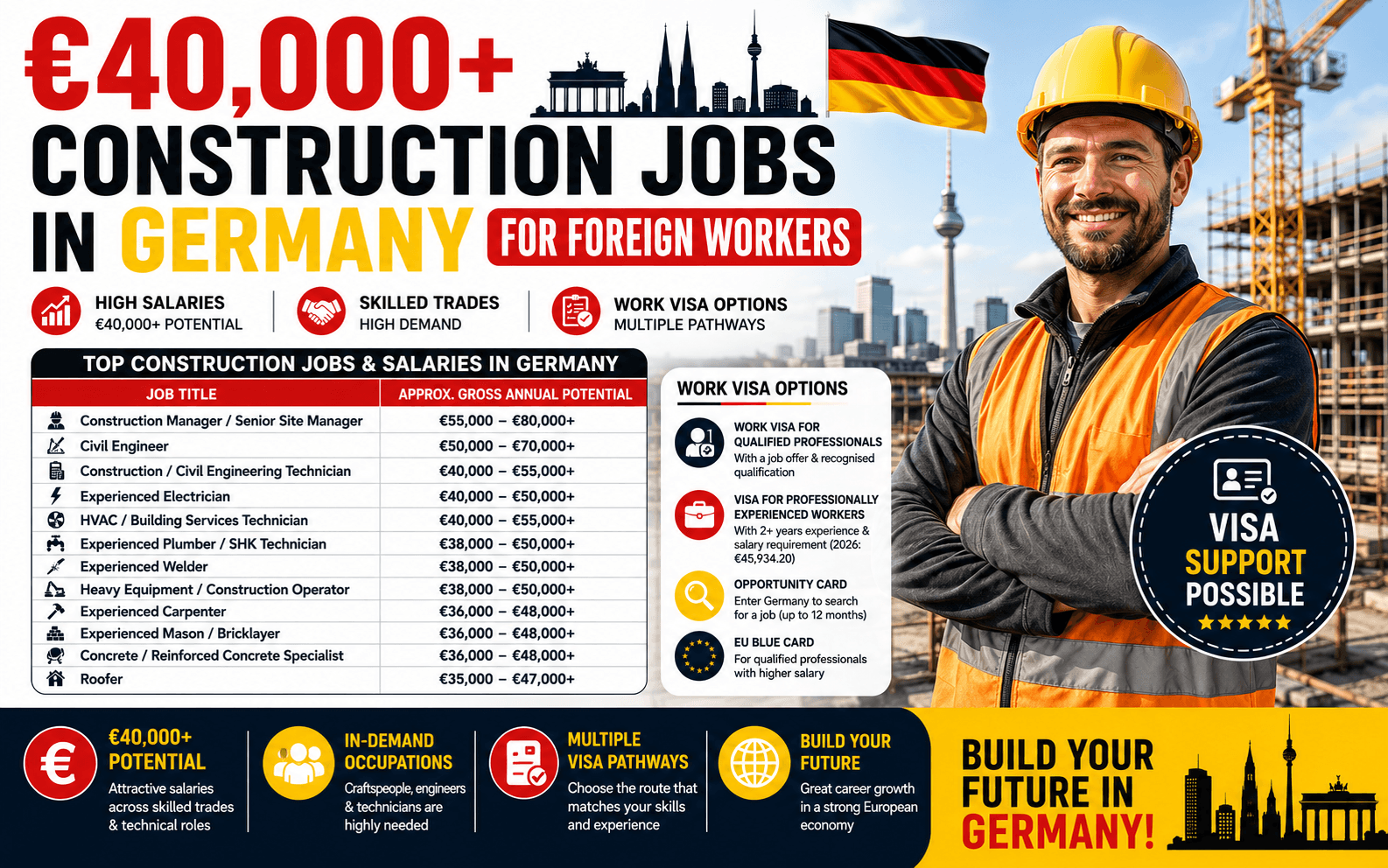
Germany has one of Europe’s largest economies and a substantial construction, engineering and skilled-trades sector.
For foreign workers, this creates opportunities across building construction, infrastructure, technical building services, electrical work, plumbing, carpentry, masonry, civil engineering and construction management.
Experienced workers in a number of these occupations can earn €40,000 per year or more.
However, Germany is different from countries where overseas applicants simply search for jobs advertised as “visa sponsorship.”
The German immigration system provides several possible routes for qualified foreign workers.
Depending on your qualifications and experience, you may be able to enter Germany through:
- A work visa for qualified professionals
- A visa for professionally experienced workers
- The Opportunity Card
- An EU Blue Card for qualifying professional positions
- A recognition-related immigration route
- Vocational training in Germany
The right route depends heavily on your occupation, qualifications, experience and job offer.
This guide explains €40,000+ construction jobs in Germany for foreign workers, including potential salaries, in-demand construction occupations, qualifications, German work visas and how overseas workers can prepare.
Can Construction Workers Earn More Than €40,000 in Germany?
Yes.
€40,000 per year equals approximately:
€3,333 gross per month
before income tax, social insurance and other applicable deductions.
That level is achievable in a range of skilled construction careers.
Workers with specialized skills, recognised qualifications, extensive experience or management responsibilities can potentially earn substantially more.
Examples include:
- Construction managers
- Civil engineers
- Site managers
- Electrical technicians
- Electricians
- HVAC specialists
- Plumbers
- Welders
- Heavy-equipment operators
- Skilled carpenters
- Experienced bricklayers and masons
- Construction technicians
However, €40,000 should not be interpreted as the guaranteed starting salary for every construction worker.
General helpers and entry-level workers can earn less.
Examples of €40,000+ Construction Careers in Germany
Salary varies by location, collective agreement, experience, employer and specialization. The following ranges should therefore be used as broad planning estimates rather than guaranteed offers.
| Construction Career | Approximate Gross Annual Potential |
|---|---|
| Construction Manager / Senior Site Manager | €55,000–€80,000+ |
| Civil Engineer | €50,000–€70,000+ |
| Construction / Civil Engineering Technician | €40,000–€55,000+ |
| Experienced Electrician | €40,000–€50,000+ |
| HVAC / Building Services Technician | €40,000–€55,000+ |
| Experienced Plumber / SHK Technician | €38,000–€50,000+ |
| Experienced Welder | €38,000–€50,000+ |
| Heavy Equipment / Construction Machinery Operator | €38,000–€50,000+ |
| Experienced Carpenter | €36,000–€48,000+ |
| Experienced Mason / Bricklayer | €36,000–€48,000+ |
| Concrete / Reinforced Concrete Specialist | €36,000–€48,000+ |
| Roofer | €35,000–€47,000+ |
These figures are indicative salary ranges, not government-mandated wages.
Actual offers can fall below or above them.
Calculate Your Estimated German Take-Home Pay
Germany has income tax and mandatory social-security contributions that can significantly affect the difference between gross and net salary.
Therefore, a €45,000 salary does not mean you receive €45,000 in your bank account.
Use the calculator below to estimate your income when comparing construction opportunities.
Enter an hourly wage, choose a country, and estimate monthly gross pay, tax and take-home income.
Planning estimate only. The preset uses a simplified flat percentage. Actual tax and payroll deductions can differ based on income level, province/state/region, allowances, social contributions, marital status and local tax rules.
The result is intended for general planning.
Germany’s actual deductions depend on factors such as income, tax class, social-insurance status and personal circumstances.
For an exact calculation, use current German tax information or seek professional advice.
1. Construction Manager
Potential earnings: €55,000–€80,000+
Construction managers oversee building and infrastructure projects.
Their responsibilities can include:
- Managing construction teams
- Coordinating subcontractors
- Monitoring project schedules
- Managing budgets
- Ordering materials
- Monitoring quality
- Reviewing technical documents
- Enforcing safety procedures
- Communicating with engineers and clients
- Managing project deadlines
Experienced construction managers can earn considerably more than €40,000.
However, management is generally not an entry-level route.
Employers may expect:
- Construction-related education
- Several years of experience
- Project-management experience
- Leadership ability
- Knowledge of German building practices
- Strong communication skills
German-language ability can be particularly important because construction managers need to communicate with workers, contractors, clients and authorities.
2. Civil Engineer
Potential earnings: €50,000–€70,000+
Civil engineers work on projects such as:
- Buildings
- Roads
- Bridges
- Rail infrastructure
- Water systems
- Structural projects
- Industrial facilities
Responsibilities can include designing structures, supervising construction, reviewing calculations and coordinating technical work.
Engineering positions can provide some of the stronger salaries within the wider construction industry.
Foreign engineers should investigate whether their degree needs formal comparability or recognition for the particular immigration route and position they intend to use.
3. Construction Technician
Potential earnings: €40,000–€55,000+
Construction and civil engineering technicians can work between engineering professionals and site trades.
They may:
- Interpret technical drawings
- Prepare project documentation
- Perform measurements
- Support cost calculations
- Monitor site progress
- Assist engineers
- Coordinate construction activities
- Perform quality checks
Workers with strong technical training and practical experience can move above the €40,000 threshold.
4. Electrician
Potential earnings for experienced workers: €40,000–€50,000+
Electricians are important throughout German construction and technical building services.
They can install and maintain:
- Electrical wiring
- Distribution systems
- Lighting
- Building controls
- Industrial electrical equipment
- Safety systems
Experience in modern building systems can strengthen a worker’s earning potential.
Relevant areas include:
- Building automation
- Industrial electrical systems
- Renewable-energy systems
- Smart-building technology
- Control systems
Foreign electricians should clearly document their vocational training and professional experience.
5. HVAC and Building Services Technician
Potential earnings: €40,000–€55,000+
Germany’s construction industry extends beyond the physical building shell.
Modern buildings require sophisticated heating, ventilation, air-conditioning and building-services systems.
Workers can specialise in:
- Heating systems
- Ventilation
- Air conditioning
- Building controls
- Energy-efficient systems
- Heat pumps
- Maintenance
- Installation
Technical building services can provide strong opportunities for skilled workers because Germany continues to modernise buildings and energy systems.
6. Plumber / SHK Technician
Potential earnings: €38,000–€50,000+
In Germany, plumbing work is often connected with the wider field of sanitary, heating and air-conditioning technology.
The German abbreviation SHK refers to:
Sanitär, Heizung, Klima
or sanitary, heating and climate technology.
Workers can install and maintain:
- Water systems
- Sanitary equipment
- Heating systems
- Pipes
- Boilers
- Heat pumps
- Ventilation equipment
Experienced technicians can move beyond €40,000, particularly with valuable specialist skills.
7. Welder
Potential earnings: €38,000–€50,000+
Welders work across construction, manufacturing and industrial projects.
Their duties can involve:
- Structural steel
- Pipe welding
- Fabrication
- Industrial equipment
- Metal structures
- Repair work
Your exact welding skills matter.
Instead of simply writing:
“Welder – 5 years experience”
describe the processes you know.
For example:
- MIG/MAG
- TIG
- MMA
- Structural steel welding
- Stainless steel
- Pipe welding
- Fabrication
- Technical drawing interpretation
Relevant certifications can make an application stronger.
8. Heavy Construction Equipment Operator
Potential earnings: €38,000–€50,000+
Construction machinery operators can work with:
- Excavators
- Loaders
- Bulldozers
- Cranes
- Road-building machinery
- Earthmoving equipment
Infrastructure and large construction projects rely heavily on experienced machinery operators.
Foreign workers should document:
- Equipment operated
- Years of experience
- Safety training
- Licences
- Major projects
- Maintenance knowledge
A worker with extensive excavator experience is more useful to an employer than an applicant who simply says “machine operator.”
9. Carpenter
Potential earnings for experienced workers: €36,000–€48,000+
Germany has a strong skilled-trades tradition.
Carpenters can work on:
- Timber structures
- Roof structures
- Building frames
- Renovations
- Interior structures
- Doors
- Windows
- Formwork
Experienced workers can approach or exceed €40,000 depending on employer, location and specialization.
Germany’s official skilled-worker portal identifies craftspeople among professions with employment demand.
10. Mason / Bricklayer
Potential earnings for experienced workers: €36,000–€48,000+
Masonry remains an important building trade.
Germany’s official skilled-worker portal specifically identifies masons among in-demand vocational training professions in construction and finishing.
Workers can construct:
- Walls
- Foundations
- Building structures
- Masonry systems
- Structural components
Experienced foreign masons should provide evidence of vocational training and employment history.
11. Concrete and Reinforced Concrete Worker
Potential earnings: €36,000–€48,000+
Concrete specialists work on:
- Foundations
- Structural concrete
- Reinforced concrete
- Bridges
- Commercial buildings
- Infrastructure
- Industrial construction
Germany’s official skilled-worker portal also identifies concrete and reinforced-concrete construction as an in-demand construction training area.
Workers with reinforcement, formwork and structural concrete experience should highlight those skills clearly.
12. Roofer
Potential earnings: €35,000–€47,000+
Roofers construct, repair and maintain building roofs.
Their work can include:
- Tiles
- Waterproofing
- Insulation
- Roof structures
- Cladding
- Energy-efficient roofing systems
Experienced workers can approach or exceed €40,000 depending on the employer and specialization.
Germany Needs Skilled Construction and Craft Workers
Germany’s official “Make it in Germany” portal identifies craftspeople as an area where workers are needed.
It also lists thousands of vacancies in the broader category covering:
Construction, architecture, surveying and technical building services.
The construction industry’s vocational training information specifically highlights demand for occupations such as:
- Concrete and reinforced-concrete workers
- Scaffolders
- Glaziers
- Painters and varnishers
- Masons
- Stucco workers
This does not mean every construction worker automatically qualifies for a visa.
It does show that skilled trades are an important part of Germany’s labour market.
Can Foreigners Work in Construction in Germany?
Yes.
EU and EFTA citizens generally have different freedom-of-movement rules.
Workers from countries outside the EU or EFTA may need an appropriate visa or residence permit.
Several immigration routes can potentially apply to construction professionals.
The correct route depends on factors including:
- Qualifications
- Professional experience
- Occupation
- Salary
- Employer
- Recognition status
- Age
- Whether the profession is regulated
Option 1: Work Visa for Qualified Professionals
Germany offers a work visa for qualified professionals.
This route can apply to workers who have completed qualified vocational training or academic education.
Generally, you need:
- A recognised vocational qualification or comparable academic qualification
- A specific job offer in Germany
- Qualified employment
An important point is that the job must be a qualified position.
Simple auxiliary or helper work is not sufficient for this route.
This matters for construction applicants.
A trained carpenter, electrician or technical specialist may have a stronger route than someone applying only for general site-helper work.
Does Your Job Have to Match Your Qualification?
Under the current rules for the work visa for qualified professionals, the employment does not necessarily have to be directly related to your qualification.
However, regulated professions still require the appropriate professional licence.
The job itself must also qualify as skilled employment.
Special Rule for Workers Over 45
If you are over 45 and are coming to Germany for employment for the first time, an additional rule can apply.
As of 2026, the official skilled-worker portal states that the job generally needs to provide at least:
€55,770 gross per year
or you need to demonstrate adequate pension provision.
Therefore, a €40,000 construction offer may not by itself satisfy this particular condition for a first-time worker over 45.
Applicants should check their individual situation carefully.
Option 2: Visa for Professionally Experienced Workers
Germany also has a particularly interesting route for workers with professional experience.
The visa for professionally experienced workers can allow qualified workers to enter employment in a non-regulated profession without first obtaining full formal German recognition of their qualification.
This can be useful for some skilled construction workers.
However, there are important requirements.
Qualification Requirement
You generally need either:
- A vocational qualification recognised by the country where you obtained it, or
- An academic qualification recognised by that country.
For vocational qualifications, the training generally needs to have lasted at least two years.
Certain qualifications from German Chambers of Commerce Abroad may also qualify.
Professional Experience Requirement
You generally need at least:
Two years of qualified professional experience during the previous five years
related to the occupation you intend to perform.
This makes documented work history extremely important.
2026 Salary Requirement for Professionally Experienced Workers
For this visa route, the German government’s official skilled-worker portal currently states that the job must generally provide gross annual earnings of at least:
€45,934.20 in 2026
unless the employer is bound by a collective agreement and pays according to that agreement.
This distinction is important.
An advertised €40,000 construction position may be a good salary, but it does not automatically satisfy the salary requirement for this specific immigration route.
Always match the job offer to the visa route you intend to use.
Option 3: Opportunity Card
Germany’s Opportunity Card, or Chancenkarte, allows qualifying foreign nationals to enter Germany to search for suitable employment.
This can be useful if you do not yet have a German job offer.
There are two main ways to qualify.
Route One: Recognised Qualification
If your foreign vocational or academic qualification is fully recognised in Germany, you may qualify directly as a skilled worker without using the points system.
Route Two: Points System
Otherwise, you generally need to meet basic qualification and language requirements and obtain at least:
6 points
under the Opportunity Card points system.
Opportunity Card Qualification Requirements
For the points route, you generally need:
- A university degree recognised by the state where it was obtained, or
- A state-recognised vocational qualification involving at least two years of training.
You also need qualifying language skills.
The basic language requirement can generally be satisfied with:
German at A1 level
or
English at B2 level.
Additional German-language ability can give you more points.
Opportunity Card Financial Requirement
You need to show that you can support yourself while searching for work.
For 2026, the official German portal states a financing benchmark of approximately:
€1,091 net per month.
This can generally be demonstrated through mechanisms such as a blocked account or declaration of commitment.
How Long Can You Stay With the Opportunity Card?
The initial job-search Opportunity Card can generally be issued for:
Up to 12 months.
During this period, you can search for suitable employment.
The Opportunity Card is not mandatory.
You can also search for German jobs from your home country and apply for an appropriate work visa after receiving an offer.
Can You Work While Using the Opportunity Card?
Yes, within the applicable limits.
The Opportunity Card allows limited employment while you search for qualifying work.
This can help applicants gain exposure to the German labour market.
However, the purpose of the initial card is job searching rather than unrestricted long-term employment.
Once you obtain qualifying employment, you may need to move to the appropriate residence title.
Do You Need German Language Skills?
Legally, the answer depends on your immigration route and circumstances.
Practically, German can make an enormous difference in construction.
Construction sites involve:
- Safety instructions
- Technical terminology
- Supervisors
- Equipment instructions
- Building plans
- Regulations
- Team communication
- Emergency procedures
Therefore, even when a particular visa route does not legally require advanced German, employers may still prefer workers who can communicate effectively.
For skilled construction work, reaching A2 or B1 German can substantially improve your practical employability.
B2 can be even more useful for supervisory and professional roles.
Do Foreign Qualifications Need Recognition?
Sometimes.
Recognition requirements depend on:
- Your profession
- Your qualification
- Your immigration route
For the work visa for qualified professionals, a foreign vocational qualification generally needs German recognition, while academic qualifications need to be comparable.
For the professionally experienced worker route, formal German recognition may not be necessary for non-regulated professions, although your foreign qualification still needs to meet the route’s requirements.
Germany’s recognition system compares foreign vocational qualifications with German reference occupations.
The process can result in:
- Full recognition
- Partial recognition
- No recognition
The official portal says recognition assessments generally take around three to four months once the necessary documentation is available.
What Documents Should Foreign Construction Workers Prepare?
Start collecting documents before applying.
Useful documents include:
- Passport
- Professional CV
- Vocational qualification
- Apprenticeship certificate
- University qualification where applicable
- Employment certificates
- Detailed employer references
- Payslips
- Social-insurance or tax records
- Trade licences
- Welding certificates
- Machinery licences
- Safety certificates
- Language certificates
- Qualification recognition documents
- Portfolio of completed work where appropriate
Translations may be required.
Check the exact requirements of the German authority handling your case.
How to Prove Construction Experience
Do not rely only on your CV.
Suppose you claim:
“5 years’ experience as a carpenter.”
Support that statement.
Useful evidence could include:
- Employment letters
- Employment contracts
- Payslips
- Tax documents
- Social-insurance records
- Apprenticeship records
- Trade certificates
Employer letters should ideally explain your duties.
How to Write a German Construction CV
Your experience should be specific.
Instead of:
Carpenter — ABC Construction — 2019–2025
write something like:
Carpenter — ABC Construction — 2019–2025
- Constructed timber roof structures.
- Installed doors, windows and interior fittings.
- Built concrete formwork.
- Read and interpreted technical drawings.
- Operated woodworking machinery and power tools.
- Completed residential and commercial projects.
- Followed site safety procedures.
- Supervised junior workers.
This gives employers a much clearer picture of your abilities.
Where Can Foreign Workers Find German Construction Jobs?
You can search through:
- Germany’s official skilled-worker job listings
- Federal Employment Agency resources
- Construction company websites
- Engineering companies
- Skilled-trade businesses
- Infrastructure contractors
- Recruitment agencies
- Professional job portals
Useful searches include:
“Bau Jobs Deutschland”
“Elektriker Jobs Deutschland”
“Maurer Jobs Deutschland”
“Schweißer Jobs Deutschland”
“Zimmerer Jobs Deutschland”
“Anlagenmechaniker SHK Jobs”
“Baumaschinenführer Jobs Deutschland”
“Bauleiter Jobs Deutschland”
Learning basic German job titles can dramatically improve your search results.
Useful German Construction Job Titles
Here are some terms worth learning:
Bauleiter — Construction/Site Manager
Maurer — Mason/Bricklayer
Zimmerer — Carpenter
Elektroniker — Electrical technician/electrician depending on specialization
Schweißer — Welder
Dachdecker — Roofer
Gerüstbauer — Scaffolder
Baumaschinenführer — Construction machinery operator
Anlagenmechaniker SHK — Sanitary, heating and air-conditioning technician
Beton- und Stahlbetonbauer — Concrete and reinforced-concrete worker
Searching using German occupation names can uncover vacancies that English-only searches miss.
Can General Construction Labourers Get a Skilled Worker Visa?
This requires care.
Germany’s work visa for qualified professionals requires qualified employment.
The official guidance specifically says auxiliary tasks are not sufficient.
Therefore, someone whose job consists entirely of unskilled construction-helper duties should not assume that the qualified-professional route applies.
This is one reason skilled trades are important.
A trained mason, carpenter, electrician, HVAC technician or other qualified construction professional can have different immigration possibilities from a general helper.
Does Germany Have “Visa Sponsorship”?
The phrase is commonly used online, but Germany does not work exactly like every other country.
A German employer can provide the job offer or employment contract needed for your work-visa application.
Depending on the visa, the Federal Employment Agency may also need to approve the employment.
The authorities can check whether working conditions such as salary and working hours are comparable with those offered to domestic workers.
Therefore, do not focus only on advertisements containing the words:
“Visa sponsorship.”
Focus on legitimate employers offering qualified jobs that satisfy the requirements of an appropriate German immigration route.
Can Construction Workers Earn €50,000?
Yes.
Experienced workers in specialist trades, technical roles and supervision can reach or exceed €50,000.
Examples can include:
- Experienced electricians
- HVAC specialists
- Senior construction technicians
- Construction supervisors
- Specialist welders
- Site managers
Actual salaries vary considerably.
Can Construction Workers Earn €60,000?
Yes.
Construction management, engineering and senior technical roles can exceed €60,000.
A worker should not assume that every trade position pays this amount, though.
Higher earnings usually correspond with:
- Experience
- Responsibility
- Specialist knowledge
- Management
- Qualifications
- Location
Can Construction Managers Earn €70,000?
Yes.
Experienced site and construction managers can potentially reach €70,000 or more.
Major projects and senior responsibilities can push salaries higher.
However, German language ability can become increasingly important at management level.
Which German Regions Have Construction Opportunities?
Opportunities can be found across Germany, including:
- Berlin
- Hamburg
- Munich
- Frankfurt
- Cologne
- Düsseldorf
- Stuttgart
- Leipzig
- Dortmund
- Hanover
- Bremen
- Nuremberg
Do not choose based only on salary.
Housing costs vary substantially.
For example, a higher salary in Munich can be offset by significantly higher accommodation costs.
Salary Versus Cost of Living
Suppose you receive:
Offer A: €48,000 in an expensive city
and
Offer B: €43,000 in a lower-cost city.
Offer A is not automatically financially better.
Compare:
- Net income
- Rent
- Transportation
- Utilities
- Food
- Commuting
- Working hours
- Overtime
- Benefits
The salary calculator earlier in this article can help you begin comparing offers.
Avoid German Job and Visa Scams
Be cautious with advertisements promising:
“Guaranteed Germany work visa”
“€6,000 monthly construction labourer job”
“Pay €5,000 for sponsorship”
“No qualifications needed”
“Guaranteed Opportunity Card”
“Guaranteed German permanent residence”
No recruiter can guarantee government visa approval.
Verify employers and job offers independently.
Do not submit fake experience documents.
Do not buy employment letters.
Do not claim a skilled trade you have never performed.
German authorities can request evidence supporting your qualifications and experience.
How Long Could Moving to Germany Take?
There is no single timeline for everyone.
Your journey may include:
- Learning German
- Preparing your CV
- Gathering qualification documents
- Applying for recognition where necessary
- Searching for jobs
- Completing interviews
- Receiving an employment contract
- Preparing your visa application
- Attending an appointment
- Waiting for government processing
- Receiving your visa
- Preparing to travel
Recognition alone can take several months in some cases.
Use our planning tool below to estimate the stages of your journey.
Choose your destination and preferred entry route, then tell us how far you have progressed.
Timeline results are planning estimates only and are not a guarantee of visa approval or travel date.
This is a planning tool.
It is not an official German government processing-time calculator and cannot predict whether your visa will be approved.
Frequently Asked Questions
Can foreigners get construction jobs in Germany?
Yes. Foreign nationals can work in Germany when they meet the employment and immigration requirements applicable to them.
Can construction workers earn €40,000?
Yes. Numerous experienced skilled-trade and technical construction workers can reach or exceed €40,000, although salaries vary significantly.
Does Germany need construction workers?
Germany’s official skilled-worker portal identifies craftspeople as an area of demand and lists construction-related vacancies. It also identifies several construction and finishing occupations as in demand.
Can a foreign carpenter work in Germany?
Potentially. Your qualification, experience, job offer and intended immigration route determine the requirements.
Can a bricklayer work in Germany?
Potentially. Masonry is among the construction trades identified by Germany’s official skilled-worker portal.
Can electricians work in Germany?
Yes, subject to the relevant employment, qualification and immigration requirements.
Do I need a German job offer?
For the work visa for qualified professionals and the professionally experienced worker visa, you generally need a concrete job offer.
The Opportunity Card can allow eligible workers to enter Germany to search for employment without already having a permanent qualifying job offer.
What is the Opportunity Card?
The Opportunity Card is a German residence route that allows eligible non-EU/EFTA nationals to search for employment in Germany.
How long does the Opportunity Card last?
The initial job-search card can generally be issued for up to 12 months.
How many points do I need?
Applicants using the points-system route generally need at least six points after meeting the basic requirements.
Do I need German?
Requirements vary by immigration route. For the Opportunity Card points route, the basic language requirement can generally be met with German A1 or English B2.
However, learning German can substantially improve your employment prospects in construction.
Do I need qualification recognition?
It depends on your occupation and visa route. The work visa for qualified professionals generally requires recognition or comparability. The professionally experienced worker route can allow qualified employment in non-regulated occupations without formal German recognition, subject to its other requirements.
How much must professionally experienced workers earn?
For 2026, the general gross annual salary threshold for the professionally experienced worker route is €45,934.20, unless an applicable collective agreement changes how the salary condition is met.
What if I am over 45?
For certain first-time employment immigration cases, workers over 45 generally need a salary of at least €55,770 in 2026 or proof of adequate pension provision.
Can the Opportunity Card guarantee a job?
No.
It gives eligible applicants an opportunity to search for employment. It does not guarantee that an employer will hire you.
Final Thoughts
Germany can offer attractive opportunities for experienced foreign construction professionals.
A salary of €40,000 or more is achievable in several areas, particularly skilled trades, technical construction occupations, engineering and management.
Potential careers include:
Construction management
Civil engineering
Construction technology
Electrical work
HVAC and building services
Plumbing
Welding
Heavy-equipment operation
Carpentry
Masonry
Concrete construction
Roofing
However, salary should not be your only consideration.
Germany’s immigration rules strongly distinguish between qualified workers and simple auxiliary employment.
Your vocational training, degree, professional experience, recognition status and German-language ability can therefore be extremely important.
Germany also offers more than one immigration route.
A qualified worker with recognised credentials may use the work visa for qualified professionals.
Someone with substantial experience in a non-regulated occupation may investigate the professionally experienced worker route.
A qualifying worker without a job offer may consider the Opportunity Card.
The strongest approach is therefore to identify your real occupation, document your experience, determine whether your qualification needs recognition, improve your German and target legitimate employers offering jobs that match an appropriate immigration pathway.
Do that before paying a recruiter or making major travel plans.
MimBlog is an independent information website and is not a recruitment agency, employer, immigration authority or government agency. Salaries are estimates and may vary by employer, experience and location. Job availability and immigration requirements can change. Always verify vacancies, eligibility and visa requirements through employers and official government sources.