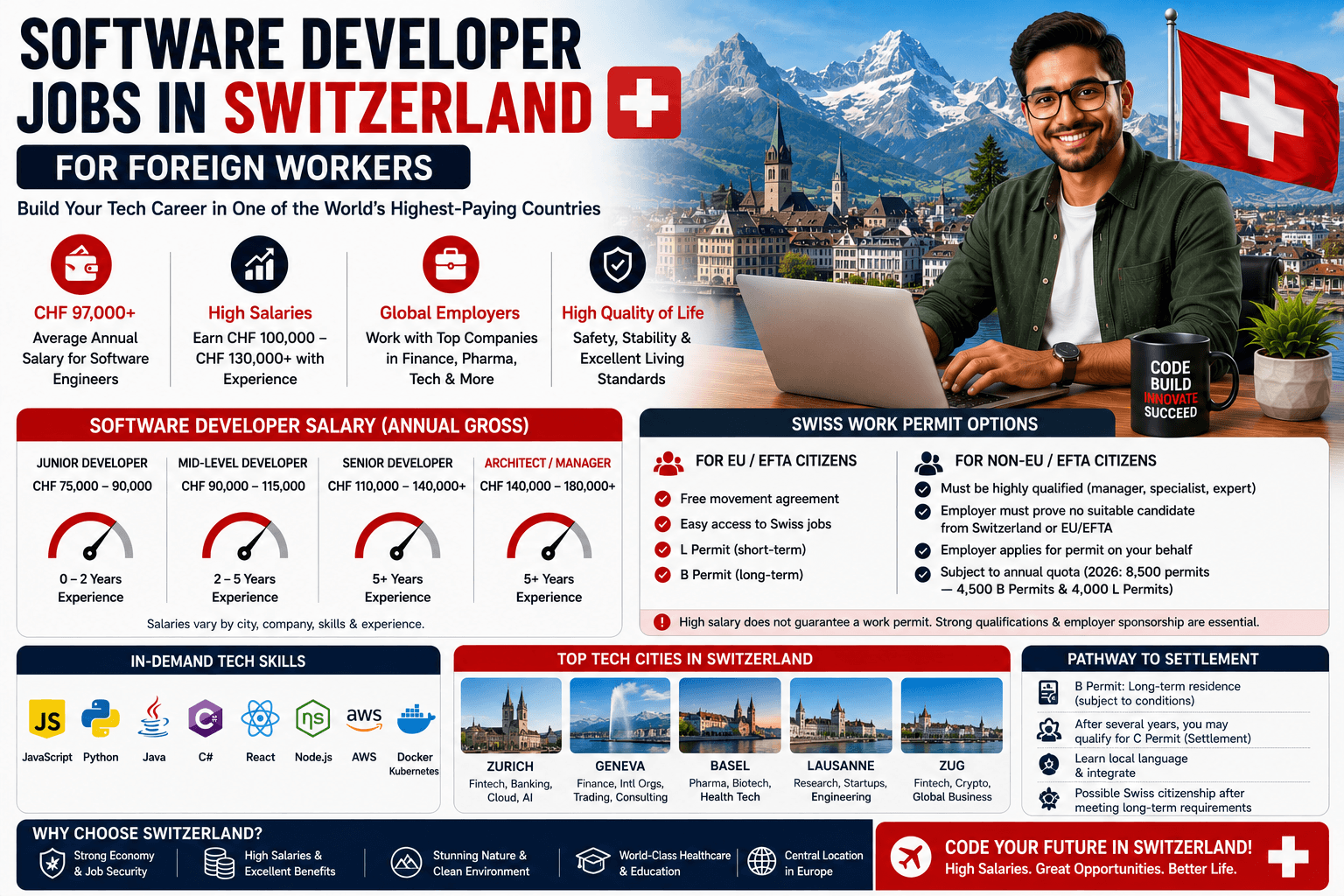
Switzerland is one of Europe’s highest-paying destinations for experienced software developers and technology professionals.
Foreign developers can find opportunities across:
- Software engineering
- Banking technology
- Fintech
- Artificial intelligence
- Cybersecurity
- Pharmaceuticals
- Cloud computing
- Data
- Insurance technology
- Telecommunications
For experienced software professionals, annual salaries above:
CHF 90,000
are common enough to make Switzerland particularly attractive.
Current Swiss salary-market data places average software engineer compensation at approximately:
CHF 97,000 per year
while experienced developers and specialists can earn:
CHF 100,000–CHF 130,000+
depending on their skills, employer and location.
Senior engineers, architects and technology managers can earn considerably more.
However, Switzerland is also one of the more difficult European destinations for workers coming from outside the:
EU/EFTA.
For third-country nationals, a strong software CV and a job offer are not always enough.
The worker generally needs to be highly qualified, while the employer must satisfy additional Swiss labour-market and immigration requirements.
Therefore:
high salary ≠ automatic Swiss work permit.
This guide explains software developer jobs in Switzerland for foreign workers, including salaries, skills, B and L permits and the important differences between EU/EFTA and non-EU/EFTA applicants.
Why Software Developers Consider Switzerland
Switzerland combines:
- High technology salaries
- Strong economy
- International employers
- Major financial sector
- Pharmaceutical industry
- High living standards
Technology professionals work throughout sectors including:
- Banking
- Insurance
- Pharmaceuticals
- Manufacturing
- Consulting
- Telecommunications
- Research
- E-commerce
Switzerland is not simply a banking destination.
Its technology workforce supports some of Europe’s most sophisticated financial, scientific and industrial systems.
Software Engineer Salary in Switzerland
Current Swiss employment-market data places average software engineer compensation around:
CHF 97,000 per year.
Actual salaries can vary significantly.
Junior developers can earn below this figure.
Experienced professionals can move comfortably above:
CHF 100,000.
Highly specialised or senior professionals can earn:
CHF 130,000+
depending on the position.
Example Software Developer Salary Levels
An illustrative salary progression might look like:
| Career Level | Example Annual Gross Salary |
|---|---|
| Junior Developer | CHF 75,000–CHF 90,000 |
| Mid-Level Developer | CHF 90,000–CHF 115,000 |
| Senior Developer | CHF 110,000–CHF 140,000+ |
| Lead Engineer | CHF 130,000–CHF 160,000+ |
| Architect/Manager | CHF 140,000–CHF 180,000+ |
These are broad planning ranges rather than guaranteed market salaries.
What Does CHF 100,000 Mean Monthly?
An annual gross salary of:
CHF 100,000
equals approximately:
CHF 8,333 per month.
At CHF 120,000:
CHF 10,000 per month.
At CHF 150,000:
CHF 12,500 per month.
At CHF 180,000:
CHF 15,000 per month.
These are gross calculations before applicable deductions.
Enter an hourly wage, choose a country, and estimate monthly gross pay, tax and take-home income.
Planning estimate only. The preset uses a simplified flat percentage. Actual tax and payroll deductions can differ based on income level, province/state/region, allowances, social contributions, marital status and local tax rules.
Use the salary calculator for planning only. Actual Swiss take-home income depends on canton, municipality, tax status, social contributions, pension arrangements and individual circumstances.
Switzerland’s High Cost of Living
High salaries should not be considered in isolation.
Switzerland also has high costs for:
- Housing
- Health insurance
- Restaurants
- Services
- Childcare
Zurich and Geneva can be particularly expensive.
A CHF 100,000 salary can therefore provide a very different lifestyle from the same numerical salary in a lower-cost country.
Foreign workers should compare:
gross salary → deductions → health insurance → housing → transportation → disposable income.
Software Developer Jobs in Zurich
Zurich is Switzerland’s largest technology and financial employment centre.
Software opportunities exist across:
- Banking
- Fintech
- Insurance
- Software
- Artificial intelligence
- Cloud computing
- Consulting
Current salary data also indicates that technology compensation in Zurich can be among the country’s stronger levels.
Developers with financial-services experience can find specialised opportunities.
Software Developer Jobs in Geneva
Geneva has opportunities connected with:
- Financial services
- International organisations
- Trading
- Consulting
- Software
- Cybersecurity
French can be particularly valuable in Geneva.
However, international organisations and multinational companies can also operate extensively in English.
Software Developer Jobs in Basel
Basel is particularly important for:
- Pharmaceuticals
- Biotechnology
- Healthcare technology
- Data
- Enterprise software
Software professionals with experience in regulated industries can find specialised opportunities.
Software Developer Jobs in Lausanne
Lausanne has a strong research and technology ecosystem.
Opportunities can exist across:
- Software
- Artificial intelligence
- Engineering
- Research
- Startups
The wider Lake Geneva region also contains international employers.
Software Developer Jobs in Zug
Zug has developed an international business and technology ecosystem.
Potential opportunities exist across:
- Fintech
- Software
- Digital assets
- Enterprise technology
- International corporate operations
Salary levels can be high, although housing can also be expensive.
Programming Languages
Swiss employers recruit developers with skills including:
- Java
- Python
- JavaScript
- TypeScript
- C#
- C++
- Go
- SQL
Frameworks and technologies can include:
- React
- Angular
- Node.js
- Spring
- .NET
- Django
Java Developer Jobs
Java is important in:
- Banking
- Insurance
- Enterprise software
- Financial technology
Useful complementary skills include:
- Spring Boot
- Microservices
- Kubernetes
- Cloud computing
- SQL
Python Developer Jobs
Python is widely used in:
- Artificial intelligence
- Data
- Finance
- Backend development
- Automation
- Scientific computing
Useful frameworks include:
- Django
- Flask
- FastAPI
C++ Developer Jobs
C++ can be particularly valuable across:
- Engineering
- Financial systems
- Robotics
- Scientific computing
- High-performance applications
Frontend Developer Jobs
Common frontend skills include:
- HTML
- CSS
- JavaScript
- TypeScript
- React
- Angular
- Vue
Employers can also value:
- Accessibility
- Testing
- Performance optimisation
Full-Stack Developer Jobs
Full-stack developers can work across both frontend and backend systems.
Typical combinations include:
React + Node.js + PostgreSQL + AWS
or:
Angular + Java + Spring + Azure.
Cloud Computing
Cloud skills are increasingly valuable.
Major platforms include:
- AWS
- Microsoft Azure
- Google Cloud
Related technologies include:
- Docker
- Kubernetes
- Terraform
- Linux
- CI/CD
Artificial Intelligence
Switzerland has a strong research ecosystem and opportunities involving:
- Machine learning
- Computer vision
- Generative AI
- Robotics
- Scientific AI
Developers with advanced AI experience can target:
- Research organisations
- Technology companies
- Financial institutions
- Pharmaceutical businesses
Do You Need a Degree?
Employer requirements vary.
Common qualifications include:
- Computer Science
- Software Engineering
- Information Technology
- Computer Engineering
- Mathematics
For non-EU/EFTA applicants, qualifications become especially important because Swiss authorities generally restrict third-country employment to:
managers, specialists and other highly qualified workers.
A degree plus substantial professional experience can therefore significantly strengthen the immigration case.
EU/EFTA Workers
Switzerland operates a dual immigration system.
EU/EFTA citizens generally have significantly easier access to Swiss employment under Switzerland’s free-movement arrangements.
Depending on the duration and circumstances of employment, the worker can use:
- Notification procedures
- L permit
- B permit
where applicable.
Non-EU/EFTA Workers
The rules are considerably stricter for workers from outside the EU/EFTA.
Third-country nationals generally need to be:
highly qualified.
Swiss authorities describe this group as including:
- Managers
- Specialists
- Other qualified professionals
Applicants will normally need strong qualifications and professional experience.
Employer Must Apply
For a non-EU/EFTA software developer, the Swiss employer plays a central role.
The employer generally applies for the worker’s permit.
This means the worker cannot simply obtain a standard Swiss employment permit independently and then search freely for any job.
Labour Market Priority
For third-country recruitment, the employer generally needs to demonstrate that it could not find an appropriate candidate from:
Switzerland
or:
the EU/EFTA labour market
for the position.
This makes overseas recruitment more difficult than in countries with broader skilled-worker immigration programmes.
Why Senior Developers Have an Advantage
Because Switzerland restricts third-country recruitment, employers are more likely to justify international hiring for candidates with specialised expertise.
Examples include:
- Senior Software Engineer
- Cloud Architect
- Security Engineer
- AI Specialist
- Quantitative Developer
- Platform Engineer
- Technical Lead
A generic junior developer profile can be harder to sponsor from outside Europe.
Salary and Employment Conditions
The employer must also provide salary and employment conditions that are customary for:
- The occupation
- The industry
- The region
A high salary by itself does not bypass immigration requirements.
Swiss Work Permit Quotas
Switzerland applies annual quotas to certain third-country permits.
For 2026, the maximum quota for qualified workers and specialists from third countries remains:
8,500 permits.
This consists of:
4,500 B residence permits
and:
4,000 L short-term permits.
The existence of quotas is another reason third-country applicants should not assume a job offer automatically results in a permit.
B Permit
The:
B permit
is commonly associated with longer-term residence.
For foreign workers, the exact conditions depend on factors including:
- Nationality
- Employment
- Immigration category
A B permit should not be described simply as:
“permanent residence.”
It is a residence permit with specific conditions.
L Permit
The:
L permit
is generally used for shorter stays.
It can be relevant to temporary employment arrangements.
The exact duration and renewal possibilities depend on the worker’s circumstances.
B Permit vs L Permit
A simplified distinction is:
L permit → shorter-term stay
B permit → longer residence
but immigration rights differ depending on nationality and circumstances.
Applicants should verify the exact permit conditions applying to them.
Is There a Swiss Tech Visa?
No single immigration product should be described as:
“the Switzerland tech visa.”
Technology professionals use Switzerland’s general employment and residence framework.
Eligibility depends on the worker’s:
- Nationality
- Qualifications
- Employment
- Salary
- Professional experience
and the employer’s ability to satisfy the labour-market requirements.
Entry Visa
Some foreign nationals also need a visa to enter Switzerland after the employment authorisation process.
Whether an entry visa is required depends partly on nationality.
The work-permit approval and entry-visa process should therefore not be treated as identical.
Registration After Arrival
Foreign workers generally need to register with the relevant local authority after arriving in Switzerland.
For workers subject to this requirement, registration normally needs to take place within:
14 days
and before starting employment.
Applicants should follow the instructions issued by the relevant canton.
Cantonal Authorities
Switzerland is highly decentralised.
Cantonal authorities play an important role in immigration administration.
This means processing can vary depending on where the employer and worker are located.
How Long Does a Swiss Work Permit Take?
There is no universal processing period covering every foreign software developer.
The process can involve:
- Job search.
- Employment contract.
- Employer work-permit application.
- Cantonal review.
- Federal review where required.
- Entry visa where required.
- Travel.
- Local registration.
- Employment.
The timeline can vary according to:
- Canton
- Nationality
- Permit type
- Employer
- Application complexity
Choose your destination and preferred entry route, then tell us how far you have progressed.
Timeline results are planning estimates only and are not a guarantee of visa approval or travel date.
Use the wait-time calculator only as a planning estimate. It does not guarantee employer approval, cantonal processing time, federal approval, visa issuance, B permit issuance or L permit issuance.
Can Software Developers Get Swiss Permanent Residence?
Potentially over the long term.
Switzerland’s settlement permit is commonly known as the:
C permit.
Eligibility depends on factors including:
- Nationality
- Years of residence
- Integration
- Other legal requirements
The qualifying period can differ between nationalities and circumstances.
Therefore:
B permit ≠ automatic C permit.
Can Software Developers Bring Family?
Foreign workers holding qualifying Swiss residence status can potentially bring eligible family members under applicable family-reunification rules.
Requirements depend on factors including:
- Nationality
- Permit
- Housing
- Family relationship
Applicants relocating with family should verify the conditions applying to their specific permit.
Language Skills
Switzerland has several official languages.
The most useful language depends heavily on location.
For example:
Zurich → German
Geneva → French
Lausanne → French
Basel → German
English is widely used in many international technology teams.
However, local-language ability can increase:
- Job opportunities
- Integration
- Career progression
Remote Swiss Software Jobs
Foreign developers can potentially work remotely for Swiss companies while remaining abroad.
Possible arrangements include:
- Contracting
- Foreign subsidiary
- Employer of record
However:
remote Swiss employment ≠ Swiss residence permission.
Relocating physically to Switzerland requires appropriate immigration authorisation.
Building a Swiss Software CV
Swiss employers often value:
- Technical depth
- Reliability
- Relevant experience
- Clear documentation
Focus on measurable achievements.
Instead of:
“Developed financial applications.”
write:
“Built transaction services processing CHF 500 million in annual payment volume while maintaining 99.99% availability.”
when accurate.
GitHub Portfolio
Developers can demonstrate their skills through:
- Production applications
- APIs
- Automated tests
- Open-source contributions
- Documentation
- Cloud deployments
Senior candidates should also demonstrate:
- System design
- Architecture
- Scalability
- Technical leadership
Use a specialised professional headline.
For example:
Senior Backend Engineer | Java | Kubernetes | AWS
is stronger than:
Software Developer Looking for Work.
How to Find Swiss Software Jobs
Useful searches include:
- Software Engineer Switzerland international applicants
- Software Developer Zurich foreign workers
- Software Engineer Switzerland relocation
- Senior Backend Engineer Zurich
- Software Developer Geneva English
- Software Engineer Basel international
Non-EU/EFTA applicants should particularly target:
- Large international employers
- Specialist technology companies
- Employers with international hiring experience
Job Scams
Be cautious of claims such as:
“Guaranteed Swiss work permit.”
“Pay CHF 15,000 for B permit.”
“Guaranteed Switzerland tech visa.”
“No qualifications needed for CHF 150,000 job.”
Swiss immigration decisions cannot legitimately be guaranteed by recruiters.
Switzerland vs Germany Software Jobs
Germany generally offers broader immigration pathways for non-EU technology professionals, including:
- EU Blue Card
- Skilled-worker routes
- Experienced IT provisions
Switzerland can offer higher salaries but stricter third-country recruitment rules.
Switzerland vs Netherlands Software Jobs
The Netherlands provides the:
Highly Skilled Migrant
programme through recognised sponsors.
Switzerland relies on its dual labour-market system and strict requirements for third-country workers.
For a non-EU applicant, the Netherlands can therefore be easier from an immigration perspective.
Switzerland vs Canada Software Jobs
Canada offers:
- Express Entry
- Provincial nomination
- Employer-supported work permits
Switzerland provides high salaries but a more restrictive system for third-country recruitment.
Applicants should consider immigration prospects alongside compensation.
Frequently Asked Questions
Can foreigners get software developer jobs in Switzerland?
Yes. However, requirements depend heavily on nationality. Non-EU/EFTA workers face stricter rules.
How much do software engineers earn?
Current Swiss salary-market data places average software engineer earnings at roughly CHF 97,000 annually, with experienced specialists often earning more.
Can software developers earn CHF 100,000+?
Yes. Experienced and senior developers can earn above CHF 100,000.
Is Switzerland easy for non-EU software developers?
It can be competitive. Third-country workers generally need to be highly qualified, and employers face additional labour-market requirements.
Does the employer apply for the work permit?
For third-country employment, the employer generally plays the central role in applying for the necessary authorisation.
What is the 2026 third-country quota?
Switzerland has kept up to 8,500 permits available for qualified third-country workers and specialists in 2026: 4,500 B permits and 4,000 L permits.
Is a B permit permanent residence?
No. A B permit is a residence permit. Swiss settlement status is generally associated with the C permit.
Is there a special Swiss tech visa?
No. Software developers use the applicable Swiss employment and residence framework.
Does a CHF 100,000 salary guarantee a permit?
No.
Can software developers eventually obtain a C permit?
Potentially, after satisfying the applicable residence and integration requirements.
Final Thoughts
Switzerland is one of Europe’s most attractive destinations for highly skilled software developers seeking strong compensation.
Software professionals can build careers across:
- Zurich
- Geneva
- Basel
- Lausanne
- Zug
and industries including:
- Banking
- Fintech
- Pharmaceuticals
- Artificial intelligence
- Cloud computing
- Insurance
- Scientific technology
Current salary-market data places average software engineer compensation at approximately:
CHF 97,000 per year
while experienced and specialised developers can earn:
CHF 100,000–CHF 130,000+
and senior leadership roles can go higher.
For EU/EFTA citizens, access to Swiss employment is generally easier under free-movement arrangements.
For non-EU/EFTA applicants, the situation is substantially more selective.
Third-country professionals generally need to be:
highly qualified
and the employer usually needs to demonstrate that an appropriate worker could not be found in Switzerland or the EU/EFTA labour market.
Switzerland also maintains quotas for third-country workers.
For 2026, the maximum remains:
8,500 permits
split between:
4,500 B permits
and:
4,000 L permits.
Therefore:
software job ≠ automatic Swiss work permit
CHF 100,000 salary ≠ guaranteed immigration approval
and:
B permit ≠ automatic permanent settlement.
The strongest approach for a non-EU/EFTA applicant is:
develop specialised high-value software skills → build substantial professional experience → target international Swiss employers → secure a highly skilled position → let the employer begin the permit process → complete the applicable cantonal and federal immigration requirements.
MimBlog is an independent information website and is not a recruitment agency, employer, immigration authority or government agency. Salaries are estimates and may vary by employer, experience and location. Job availability and immigration requirements can change. Always verify vacancies, eligibility and visa requirements through employers and official government sources.