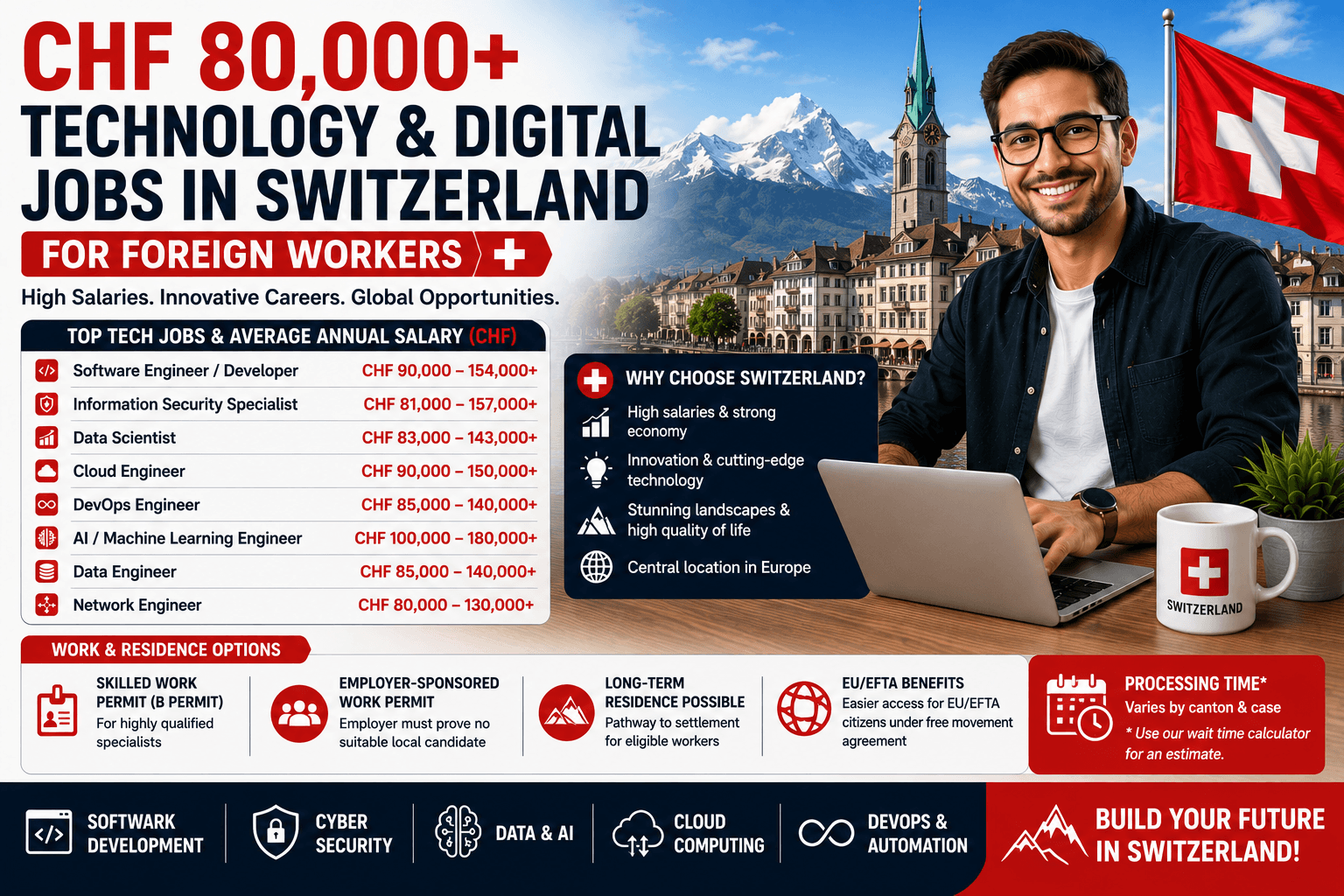
Switzerland offers some of Europe’s highest-paying technology careers, with opportunities across software engineering, cybersecurity, data science, cloud computing, artificial intelligence, fintech, telecommunications and digital infrastructure.
For experienced technology professionals, salaries above:
CHF 80,000 per year
are realistic across many occupations.
Current Swiss salary data shows average annual pay around:
- CHF 96,986 for Software Engineers
- CHF 100,000 for Data Scientists
- CHF 110,250 for Information Security Specialists
- CHF 80,000 for ICT Specialists
These figures vary by experience, canton, employer and speciality.
Switzerland can therefore be attractive to highly skilled foreign technology workers.
However, immigration rules are significantly different for EU/EFTA nationals and workers from countries outside the EU/EFTA.
For third-country nationals, including applicants from many African, Asian and American countries, Switzerland generally restricts employment permits to highly qualified managers, specialists and skilled professionals.
This guide explains CHF 80,000+ technology and digital jobs in Switzerland for foreign workers, including salaries, major tech careers, work permits and immigration requirements.
Why Work in Technology in Switzerland?
Switzerland combines a high-income economy with major industries that depend heavily on technology.
Tech professionals can work in:
- Banking
- Fintech
- Pharmaceuticals
- Insurance
- Telecommunications
- Manufacturing
- Consulting
- Software
- Artificial intelligence
- Research
- Healthcare technology
- Engineering
Technology jobs are concentrated in cities including:
- Zurich
- Geneva
- Basel
- Lausanne
- Bern
- Zug
Switzerland also has significant research activity and a strong concentration of multinational businesses.
What Does CHF 80,000 Per Year Mean?
A salary of:
CHF 80,000 per year
equals approximately:
CHF 6,667 gross per month.
At 40 hours per week, the simple hourly equivalent is:
approximately CHF 38.46.
Salary Examples
| Annual Gross | Approx. Monthly Gross |
|---|---|
| CHF 70,000 | CHF 5,833 |
| CHF 80,000 | CHF 6,667 |
| CHF 90,000 | CHF 7,500 |
| CHF 100,000 | CHF 8,333 |
| CHF 120,000 | CHF 10,000 |
| CHF 150,000 | CHF 12,500 |
| CHF 180,000 | CHF 15,000 |
These are simple gross calculations.
Enter an hourly wage, choose a country, and estimate monthly gross pay, tax and take-home income.
Planning estimate only. The preset uses a simplified flat percentage. Actual tax and payroll deductions can differ based on income level, province/state/region, allowances, social contributions, marital status and local tax rules.
Use the calculator for planning only. Actual Swiss take-home income depends on canton, municipality, social-insurance deductions, pension contributions, taxation arrangements and personal circumstances.
Swiss Salary Data
Switzerland’s Federal Statistical Office provides the official Salarium statistical salary calculator.
Salarium uses data from the Swiss Earnings Structure Survey and currently bases its estimates on 2024 private-sector earnings data covering approximately 1.7 million employees.
The Federal Statistical Office warns that Salarium estimates are informational and are not salary recommendations.
This is important because Switzerland does not have one universal technology salary.
Location and professional profile can strongly affect earnings.
Software Engineer Jobs in Switzerland
Software engineering is one of the most attractive Swiss technology careers.
Potential titles include:
- Software Engineer
- Software Developer
- Backend Developer
- Frontend Developer
- Full-Stack Developer
- Application Developer
- Embedded Software Engineer
Current Jobs.ch salary data shows a nationwide average full-time Software Engineer salary of approximately:
CHF 96,986 per year.
The figure includes bonuses and 13th-month salary where applicable.
For workers aged roughly 25–35, the same dataset shows averages around CHF 90,000.
Experienced workers can earn considerably more.
Software Engineering Skills
Common skills include:
- Java
- Python
- JavaScript
- TypeScript
- C#
- C++
- React
- Angular
- Node.js
- .NET
- SQL
Additional high-value skills can include:
- Kubernetes
- Docker
- Terraform
- AWS
- Azure
- Microservices
- CI/CD
Cybersecurity Jobs in Switzerland
Cybersecurity is especially important in Switzerland because of its concentration of:
- Banks
- Insurance companies
- Pharmaceutical companies
- Multinationals
- Financial institutions
Potential positions include:
- Cyber Security Specialist
- Information Security Analyst
- Security Engineer
- SOC Analyst
- Penetration Tester
- Security Consultant
- Security Architect
- Cloud Security Engineer
Current Jobs.ch salary data for information-security specialists shows an average annual salary around:
CHF 110,250.
Workers with 6–8 years of experience average roughly CHF 110,000 in that dataset, while more experienced professionals can earn substantially more.
Cybersecurity Skills
Employers can value:
- SIEM
- Network security
- Cloud security
- Incident response
- Identity management
- Vulnerability management
- Penetration testing
Relevant certifications can include:
- CISSP
- CISM
- CCSP
- Security+
Data Scientist Jobs
Switzerland provides data-science opportunities across:
- Banking
- Pharmaceuticals
- Insurance
- Technology
- Research
- Consulting
Current Jobs.ch salary data shows a nationwide average Data Scientist salary of approximately:
CHF 100,000 annually.
Workers with 3–5 years of experience average close to CHF 100,000 in that dataset.
Professionals with longer experience can move above CHF 120,000.
Data Science Skills
Useful skills include:
- Python
- R
- SQL
- Statistics
- Machine learning
- Data visualisation
- Cloud computing
Advanced positions may favour postgraduate qualifications.
Artificial Intelligence Jobs
Switzerland has strong AI and research activity.
Potential careers include:
- AI Engineer
- Machine Learning Engineer
- Applied Scientist
- NLP Engineer
- Computer Vision Engineer
- AI Researcher
AI professionals can work in:
- Robotics
- Pharmaceuticals
- Banking
- Research
- Manufacturing
- Medical technology
Useful skills include:
- Python
- PyTorch
- TensorFlow
- Machine learning
- Mathematics
- Statistics
- Cloud computing
Cloud Engineer Jobs
Swiss organisations increasingly depend on cloud infrastructure.
Potential roles include:
- Cloud Engineer
- Cloud Architect
- Platform Engineer
- Infrastructure Engineer
- Cloud Security Engineer
Common technologies include:
- AWS
- Azure
- Google Cloud
- Kubernetes
- Docker
- Terraform
- Linux
DevOps Engineer Jobs
DevOps professionals support software deployment and infrastructure automation.
Useful technologies include:
- Git
- CI/CD
- Kubernetes
- Docker
- Terraform
- Linux
- AWS
- Azure
Experienced DevOps and platform engineers can comfortably exceed the CHF 80,000 threshold depending on employer and location.
ICT Specialist Jobs
ICT Specialist is a broader category that can include support, infrastructure and systems positions.
Current Jobs.ch salary data reports a nationwide average of approximately:
CHF 80,000 per year.
This makes CHF 80,000 a useful baseline for the broader technology pillar, while specialised occupations such as software engineering, cybersecurity and data science frequently average higher.
Fintech Jobs
Zurich and Geneva are important financial centres.
This creates technology careers across:
- Banking software
- Payments
- Cybersecurity
- Data
- Quantitative technology
- Cloud infrastructure
- Risk technology
Potential positions include:
- Software Engineer
- Quant Developer
- Data Engineer
- Security Specialist
- DevOps Engineer
Pharmaceutical Technology Jobs
Basel is particularly important for pharmaceutical and life-sciences employers.
Technology positions can include:
- Data Science
- Bioinformatics
- Cloud Engineering
- Software Development
- AI
- Cybersecurity
- IT Infrastructure
Professionals combining technology with scientific knowledge can have particularly strong profiles.
Technology Jobs in Zurich
Zurich is Switzerland’s largest technology and financial employment centre.
Major sectors include:
- Banking
- Fintech
- Software
- Insurance
- AI
- Consulting
Salary data for Data Scientists, for example, shows an average around CHF 105,052 in Zurich in the current Jobs.ch dataset.
Zurich also has very high living costs, particularly housing.
Applicants should compare:
salary + taxes + rent + transport + insurance
rather than salary alone.
Technology Jobs in Geneva
Geneva offers opportunities across:
- Banking
- International organisations
- Finance
- Consulting
- Technology
French can significantly increase access to the wider local labour market.
Technology Jobs in Basel
Basel is particularly strong in:
- Pharmaceuticals
- Biotechnology
- Life sciences
- Data
- Digital health
Current Data Scientist salary data shows an average around CHF 120,000 in Basel-Stadt, although sample sizes and individual jobs vary.
Technology Jobs in Lausanne
Lausanne offers opportunities linked to:
- Research
- Software
- AI
- Engineering
- Startups
French is valuable, although international technical teams may operate in English.
Technology Jobs in Zug
Zug has multinational businesses and technology employers.
Current Data Scientist salary data shows an average around CHF 113,700 in Zug.
Languages
Switzerland has several official languages.
Depending on location, employers may value:
- German
- French
- Italian
English is widely used in many international technology environments.
However:
English-only opportunities are more limited than the entire Swiss job market.
Learning the main language of your canton can significantly improve employment opportunities.
Can Foreigners Work in Switzerland?
Yes.
But the rules depend heavily on nationality.
Switzerland uses a dual labour-market admission system.
EU/EFTA nationals generally have easier access under Switzerland’s agreement on the free movement of persons.
Third-country nationals face stricter admission rules.
Third-Country Technology Workers
For applicants from outside the EU/EFTA, Switzerland generally admits only highly qualified workers.
The State Secretariat for Migration says successful candidates are normally:
- Managers
- Specialists
- Other highly skilled professionals
and generally have a university or higher-education qualification plus several years of professional experience.
Technology professionals with strong experience can therefore fit the profile, but approval is never automatic.
Employer Must Apply
For most third-country workers:
the Swiss employer applies for the work permit.
The employer must normally demonstrate that no suitable candidate was available from Switzerland or the EU/EFTA labour market.
This means Switzerland is not generally a country where a non-EU applicant simply obtains an open technology work visa first and then looks for any job.
Labour Market Priority
Swiss labour-market rules give priority to workers already available from:
- Switzerland
- EU countries
- EFTA countries
before employers can recruit most third-country nationals.
This makes highly specialised technology expertise valuable.
An employer needs a stronger reason to recruit an overseas candidate.
Salary and Employment Conditions
Foreign workers must receive salary and employment conditions consistent with local standards for the:
- Region
- Profession
- Sector
Swiss authorities can examine these conditions during the work-permit process.
Work Permit Quotas in 2026
Switzerland limits the number of permits available for third-country workers.
For 2026, the Federal Council kept the maximum at:
8,500 qualified workers and specialists from third countries.
This includes:
- 4,500 B residence permits
- 4,000 L short-stay permits
Therefore, even a highly qualified technology worker can still be subject to the quota system.
B Permit
A B permit is generally a residence permit.
For third-country employment, the available number is controlled through the annual quota system.
The exact permit issued depends on the employment and immigration circumstances.
L Permit
The L permit is generally used for shorter-duration residence.
Switzerland allocated 4,000 L permits for qualifying third-country workers in 2026.
EU/EFTA Technology Workers
EU/EFTA nationals generally have substantially easier access to Swiss employment.
For short employment periods of up to three months or 90 days per calendar year, qualifying EU/EFTA employment can use Switzerland’s notification procedure rather than a traditional permit process.
Different rules apply for longer stays.
UK Workers
Switzerland also has separate quota arrangements for UK nationals following Brexit.
For 2026, Switzerland made available:
- 2,100 B permits
- 1,400 L permits
for UK nationals in employment.
Does Switzerland Have a Tech Visa?
There is no universal:
“Swiss Technology Visa.”
Technology professionals generally immigrate under normal Swiss employment-permit rules.
Their technology skills can make them more competitive because Switzerland prioritises highly qualified specialists.
Is CHF 80,000 Enough for a Work Permit?
There is no simple universal salary threshold stating:
CHF 80,000 = Swiss work permit.
Authorities examine:
- Occupation
- Qualifications
- Experience
- Labour-market need
- Employer
- Salary
- Local conditions
- Permit quota
A highly specialised worker earning above CHF 100,000 can still need to satisfy the same underlying immigration rules.
Recognition of Qualifications
Most technology occupations are not regulated in the same way as professions such as medicine.
However, qualifications remain important for third-country immigration because Swiss authorities generally expect highly qualified applicants.
Foreign degrees, professional history and specialist experience can therefore be central to an employer’s permit application.
Can Self-Taught Developers Move to Switzerland?
It is possible for employers to hire self-taught professionals.
But immigration is more difficult for non-EU/EFTA applicants without traditional qualifications because Switzerland’s official criteria strongly emphasise highly qualified workers.
A very experienced specialist with exceptional professional achievements may have a stronger case than a beginner without formal qualifications.
Remote Swiss Technology Jobs
A foreign professional can potentially work remotely for a Swiss business while remaining abroad.
Possible arrangements include:
- Contractor
- Foreign subsidiary
- Employer of record
However:
remote Swiss job ≠ Swiss residence permit.
To physically relocate and work in Switzerland, the correct Swiss immigration permission is still required.
How Long Does a Swiss Work Permit Take?
There is no single processing time that applies to every Swiss technology worker.
The process can involve:
- Employer recruitment.
- Employer preparation of the work-permit application.
- Cantonal labour-market assessment.
- Federal immigration review where required.
- Visa process for applicants who require an entry visa.
- Travel and local registration.
Applicants should plan for variation between cantons and cases.
Choose your destination and preferred entry route, then tell us how far you have progressed.
Timeline results are planning estimates only and are not a guarantee of visa approval or travel date.
Use the wait-time calculator only as a planning estimate. It does not guarantee Swiss work-permit processing time, quota availability, visa issuance, employer approval or residence permission.
Entering Switzerland After Approval
Depending on nationality, a worker may also require an entry visa after the work permit has been authorised.
Switzerland’s migration authority states that new residents must generally register with the local authorities no later than 14 days after entering Switzerland and before taking up employment.
How to Find Swiss Tech Jobs
Useful searches include:
- Software Engineer Switzerland foreign workers
- Software Developer Zurich English jobs
- Cyber Security Switzerland English jobs
- Data Scientist Switzerland jobs
- Cloud Engineer Zurich
- IT Specialist Switzerland
- Technology jobs Switzerland international applicants
Applicants should focus particularly on employers that genuinely need specialist expertise.
Build a Strong Technology CV
For Switzerland, measurable professional expertise is particularly important.
Instead of:
“Responsible for software development.”
write:
“Designed a cloud platform serving 1.2 million monthly requests and reduced infrastructure costs by 30%.”
where accurate.
Useful evidence can include:
- Years of specialist experience
- Large-scale systems
- Revenue impact
- Security improvements
- Automation
- Technical leadership
- Patents
- Research
- High-value certifications
GitHub and Portfolio
Software professionals can strengthen their profile using:
- GitHub
- Open-source contributions
- Technical case studies
- Production applications
- Research publications
This can help demonstrate why an employer should recruit them internationally.
Technology Job Scams
Be cautious of claims such as:
“Guaranteed Swiss work permit.”
“Pay CHF 15,000 for sponsorship.”
“No qualification needed for Switzerland.”
“Guaranteed B permit.”
“Guaranteed permanent residence.”
Swiss work permits are issued by government authorities, not recruiters.
Switzerland vs Germany Tech Jobs
Germany generally provides more accessible skilled-worker immigration pathways for non-EU professionals.
Germany offers options including:
- EU Blue Card
- Skilled-worker visas
- Opportunity Card
Switzerland can offer higher salaries, but third-country labour-market access is more restrictive.
Switzerland vs Netherlands Tech Jobs
The Netherlands provides the Highly Skilled Migrant route through recognised sponsors.
Switzerland does not have an identical sponsorship system.
Instead, third-country employers generally need to demonstrate labour-market priority and satisfy quota requirements.
Switzerland vs Canada Tech Jobs
Canada offers pathways such as:
- Express Entry
- Provincial Nominee Programs
- Employer-supported work permits
Switzerland is far more restrictive for most non-EU/EFTA applicants.
However, highly specialised professionals can still find excellent Swiss opportunities.
Frequently Asked Questions
Can foreigners get technology jobs in Switzerland?
Yes. Foreign professionals work across software, cybersecurity, data, finance and other Swiss technology sectors.
Can tech workers earn CHF 80,000?
Yes. Current salary data shows average earnings of approximately CHF 96,986 for Software Engineers, CHF 100,000 for Data Scientists and CHF 110,250 for Information Security Specialists.
Can non-EU workers get Swiss work permits?
Yes, but Switzerland generally limits third-country work permits to highly qualified managers, specialists and skilled professionals.
Does the employer apply for the permit?
Generally yes for third-country employment.
Does Switzerland have visa sponsorship?
Employers can support work-permit applications, but Switzerland does not operate exactly like countries that use a broad sponsorship-licence system.
How many third-country permits are available in 2026?
Switzerland set a maximum of 8,500 for qualified third-country workers: 4,500 B permits and 4,000 L permits.
Is CHF 80,000 enough for a work permit?
Not automatically. Qualifications, occupation, salary conditions, employer need, labour-market priority and quotas all matter.
Is English enough?
Some international technology teams work in English, but German, French or Italian significantly increases opportunities depending on the canton.
Can a self-taught developer move to Switzerland?
Potentially, but third-country immigration rules strongly favour highly qualified specialists with substantial professional experience.
Is a Swiss work permit guaranteed?
No.
Final Thoughts
Switzerland offers some of Europe’s strongest earning opportunities for skilled technology professionals.
Current salary data shows approximately:
CHF 96,986 average for Software Engineers
CHF 100,000 average for Data Scientists
CHF 110,250 average for Information Security Specialists
and:
CHF 80,000 average for broader ICT Specialists.
This makes:
CHF 80,000+
a realistic salary target for many experienced technology workers.
Foreign workers can pursue opportunities across:
- Software Engineering
- Cybersecurity
- Data Science
- Artificial Intelligence
- Cloud Computing
- DevOps
- Fintech
- Pharmaceutical Technology
However, immigration is considerably stricter for non-EU/EFTA nationals.
Swiss authorities generally expect third-country candidates to be highly qualified specialists, and employers normally need to demonstrate that a suitable Swiss or EU/EFTA worker was not available.
For 2026, Switzerland has also capped third-country employment admissions at:
8,500 qualified workers and specialists.
The strongest approach is:
develop specialised technology expertise → build substantial professional experience → target employers that genuinely need international specialists → secure a strong employment offer → allow the employer to pursue the appropriate Swiss work permit → complete any required visa and registration process.
Next in this Technology & Digital Jobs series: AED 100,000+ Technology & Digital Jobs in UAE for Foreign Workers.
MimBlog is an independent information website and is not a recruitment agency, employer, immigration authority or government agency. Salaries are estimates and may vary by employer, experience and location. Job availability and immigration requirements can change. Always verify vacancies, eligibility and visa requirements through employers and official government sources.