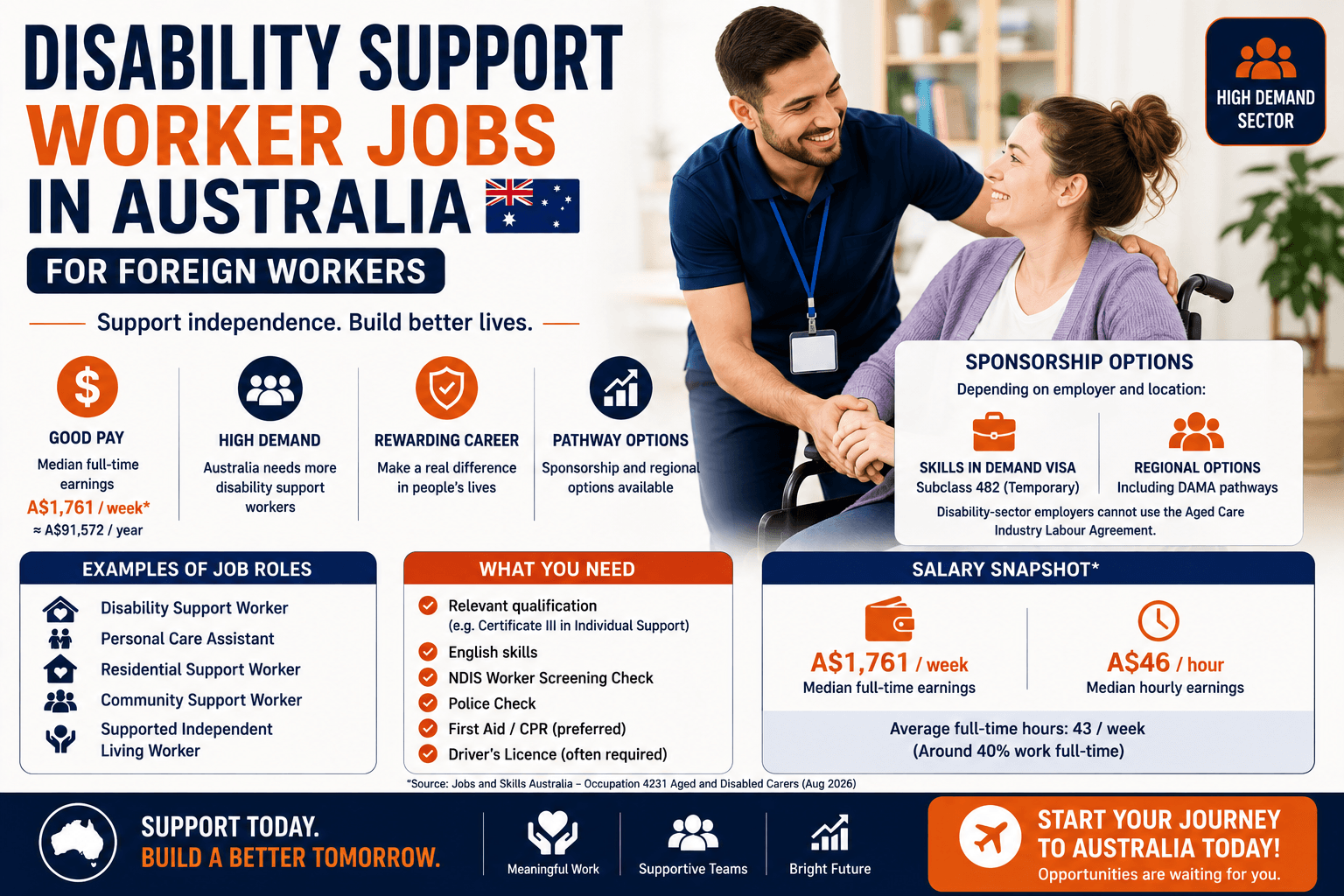
Disability support work is one of Australia’s major Healthcare & Support career areas.
Workers help people living with physical, intellectual, sensory, neurological and other disabilities participate in everyday life as independently as possible.
For foreign workers, disability support can be attractive because many positions are practical care careers rather than university-level medical professions.
Potential job titles include:
- Disability Support Worker
- Disability Services Officer
- Personal Care Worker
- Community Support Worker
- Residential Support Worker
- Lifestyle Support Worker
- Individual Support Worker
- Supported Independent Living Worker
- Aged or Disabled Carer
Pay can also be attractive.
Australia’s official occupation profile groups Aged and Disabled Carers together. Current Jobs and Skills Australia data reports median full-time earnings of approximately:
A$1,761 per week
and median hourly earnings of approximately:
A$46 per hour.
If A$1,761 were earned every week for 52 weeks, the simple annual equivalent would be:
A$91,572.
However, this should not be interpreted as a guaranteed disability support worker salary.
Actual earnings vary considerably according to employment status, classification, hours, employer, location and shifts.
This guide explains disability support worker jobs in Australia for foreign workers, including salaries, qualifications, NDIS employment, working conditions and possible immigration routes.
What Does a Disability Support Worker Do?
Disability support workers help clients live as independently as possible.
The goal is not simply to perform tasks for a person.
Good disability support focuses on helping clients exercise:
- Choice
- Independence
- Dignity
- Community participation
- Personal control
The job can therefore be very different from traditional hospital employment.
Typical Disability Support Worker Duties
Depending on the client’s support plan, duties can include:
- Personal care
- Showering and dressing
- Mobility assistance
- Meal preparation
- Household support
- Community participation
- Shopping
- Transportation
- Companionship
- Supporting appointments
- Medication assistance within authorised scope
- Helping clients pursue hobbies
- Supporting communication
- Maintaining records
- Reporting changes in wellbeing
Some clients require only a few hours of assistance.
Others need 24-hour support.
Disability Support Worker Salary in Australia
Official Jobs and Skills Australia data for the broader Aged and Disabled Carers occupation currently reports:
A$1,761 median full-time weekly earnings
and:
A$46 median hourly earnings.
Average full-time hours are approximately:
43 hours per week.
However, only around:
40%
of workers in the broader occupation work full-time hours.
This is important.
A worker earning a strong hourly rate may still have substantially lower annual income if they work limited weekly hours.
A$1,761 Per Week Annually
A simple calculation gives:
A$1,761 × 52 = A$91,572 per year.
Monthly equivalent:
approximately A$7,631.
This is a mathematical annualisation of the median full-time weekly figure, not a promised salary.
Disability Support Salary Examples
For planning purposes:
| Weekly Gross Income | Approx. Annual Gross |
|---|---|
| A$1,000 | A$52,000 |
| A$1,200 | A$62,400 |
| A$1,400 | A$72,800 |
| A$1,600 | A$83,200 |
| A$1,761 | A$91,572 |
| A$2,000 | A$104,000 |
Actual earnings depend on your contract.
Hourly Pay Examples
At 38 paid hours per week:
| Hourly Rate | Approx. Annual Gross |
|---|---|
| A$30 | A$59,280 |
| A$32 | A$63,232 |
| A$35 | A$69,160 |
| A$40 | A$79,040 |
| A$46 | A$90,896 |
| A$50 | A$98,800 |
These are examples rather than guaranteed Australian award rates.
Enter an hourly wage, choose a country, and estimate monthly gross pay, tax and take-home income.
Planning estimate only. The preset uses a simplified flat percentage. Actual tax and payroll deductions can differ based on income level, province/state/region, allowances, social contributions, marital status and local tax rules.
Use the salary calculator for planning. Your actual tax, superannuation arrangements and take-home income depend on your employment and individual circumstances.
Why Disability Support Pay Can Vary
Two workers with the same job title can receive different weekly income.
Factors include:
- Employment classification
- Experience
- Employer
- Qualification
- Weekly hours
- Casual vs permanent employment
- Overnight shifts
- Weekends
- Public holidays
- Overtime
- Location
This is why applicants should compare the complete employment contract rather than just the advertised hourly figure.
Penalty Rates
Disability support frequently operates outside normal Monday-to-Friday office hours.
Clients can require support:
- Early morning
- Evening
- Overnight
- Saturday
- Sunday
- Public holidays
Depending on the applicable award or enterprise agreement, penalty rates and other additional payments can apply.
Workers willing to accept certain shifts may therefore earn more than someone working only ordinary weekday hours.
Casual Disability Support Jobs
Casual employment is common in parts of the support sector.
Casual workers can receive a higher hourly rate because of casual loading but generally do not receive the same paid-leave entitlements as permanent employees.
Do not compare a casual hourly rate directly with a permanent hourly rate without considering the total employment package.
Full-Time Disability Support Jobs
Full-time work provides more predictable weekly hours.
This can make:
- Budgeting
- Renting
- Saving
- Immigration planning
easier.
However, official occupational statistics show that part-time employment is substantial within Aged and Disabled Carers.
Foreign workers should specifically ask employers about:
guaranteed weekly hours.
What Is the NDIS?
The National Disability Insurance Scheme, or:
NDIS
is a major part of Australia’s disability-support system.
It provides funding to eligible people with disability so they can access reasonable and necessary supports.
Many disability-support providers deliver services to NDIS participants.
As a result, foreign applicants searching for disability work will frequently encounter:
- NDIS providers
- NDIS participants
- NDIS support workers
- NDIS screening requirements
Do Disability Support Workers Work for the Government?
Not necessarily.
Workers can be employed by:
- Private disability providers
- Non-profit organisations
- Community organisations
- Supported accommodation providers
- Specialist disability organisations
Some workers can also operate in different employment or contractor arrangements.
Foreign workers should be particularly careful about contractor arrangements because employment rights and immigration implications can differ.
Supported Independent Living Jobs
Supported Independent Living, commonly called:
SIL
helps eligible people with disability live more independently.
Workers can provide support in shared or individual accommodation.
Duties can include:
- Personal care
- Cooking
- Household tasks
- Community participation
- Behavioural support
- Medication-related assistance
- Daily routines
SIL services can operate 24 hours a day.
Therefore, shift work is common.
Residential Disability Support
Residential support workers help people living in supported accommodation.
The work can involve:
- Morning routines
- Personal care
- Meal preparation
- Activities
- Appointments
- Evening routines
- Overnight support
Workers can support several residents during a shift.
Community Support Worker Jobs
Community support workers help clients participate outside their homes.
Activities can include:
- Shopping
- Sports
- Education
- Employment
- Social activities
- Medical appointments
- Community programmes
A driver’s licence can be particularly useful for these jobs.
Personal Care Work
Some disability clients need significant assistance with personal activities.
Workers may help with:
- Bathing
- Toileting
- Dressing
- Grooming
- Eating
- Mobility
Applicants need to be comfortable with the practical realities of personal-care employment.
This is not simply a companionship job.
Do You Need a University Degree?
Generally, ordinary disability-support positions do not require a university degree.
This makes the occupation accessible to workers from vocational backgrounds.
However:
No university degree does not mean no qualifications or training.
Employers can require specific certificates, screening and practical competencies.
Certificate III in Individual Support
One of the most relevant Australian vocational qualifications is:
Certificate III in Individual Support
particularly where training relates to disability.
The qualification can help workers develop skills for providing person-centred support.
Foreign applicants may already have overseas qualifications.
Whether an overseas qualification satisfies an employer depends on the position and assessment involved.
Certificate IV in Disability Support
Workers who want deeper disability-specific training can also encounter qualifications such as:
Certificate IV in Disability Support.
Higher-level training can support career progression and more complex responsibilities.
Useful Training
Depending on the employer and client group, useful training can include:
- First aid
- CPR
- Manual handling
- Medication assistance
- Infection control
- Behaviour support
- Safe transfers
- Mental-health awareness
Some employers provide parts of this training after recruitment.
Do You Need Experience?
Experience is highly valuable.
Relevant experience can include:
- Disability support
- Elderly care
- Personal care
- Healthcare assistance
- Community services
- Nursing support
- Residential care
Foreign applicants should document their work history carefully.
Employment References
Strong employment references should ideally show:
- Employer name
- Job title
- Employment dates
- Weekly hours
- Duties
- Supervisor/contact details
This can help both employers and immigration authorities understand your actual experience.
NDIS Worker Screening Check
Certain workers delivering NDIS supports can need an:
NDIS Worker Screening Check.
The check assesses whether a person poses an unacceptable risk to people with disability.
Requirements depend on the work being performed and applicable state or territory arrangements.
Foreign workers should expect screening to be an important part of employment.
Police Check
Employers can also require criminal-history checks.
Because disability workers can support vulnerable clients inside private homes and residential facilities, background screening is taken seriously.
Working With Children Check
Some disability-support roles involve children.
Depending on the state or territory and position, a:
Working With Children Check
or equivalent clearance can be required.
Driver’s Licence
A driver’s licence is frequently useful.
Some workers need to:
- Drive clients
- Attend appointments
- Travel between homes
- Support community activities
A vacancy may specify an Australian driver’s licence or other transport requirements.
Always read the job description.
Can Foreigners Work as Disability Support Workers in Australia?
Yes, provided they have legal Australian work rights and satisfy the employment requirements.
The more difficult question for someone living overseas is:
Can an Australian disability employer sponsor me specifically for this occupation?
That requires a more careful answer.
Does Australia Sponsor Disability Support Workers?
Employer-sponsored pathways can exist depending on:
- Exact occupation
- Employer
- Location
- Migration programme
- Labour agreement
- Applicant qualifications
- Work experience
But foreign applicants should not assume that disability support has the same sponsorship pathway as aged care.
Aged Care Labour Agreement Does NOT Automatically Cover Disability Providers
This is one of the most important points in this article.
Australia has an:
Aged Care Industry Labour Agreement
which can allow eligible aged-care providers to sponsor overseas direct-care workers.
However, Australian government guidance states that:
disability-sector organisations cannot access the Aged Care Industry Labour Agreement.
This means a disability employer cannot simply advertise:
“Aged Care Labour Agreement sponsorship”
because it employs disability support workers.
Why the Difference Matters
Aged care and disability support are frequently grouped together in occupational statistics.
They can also involve similar personal-care duties.
But:
similar job duties do not make the immigration programmes identical.
A foreign worker needs to identify:
- The exact occupation.
- The industry of the employer.
- The location.
- The immigration programme.
- Whether the employer can actually nominate that occupation.
DAMA Opportunities
Government guidance directs disability-sector employers to consider other options, including whether a relevant:
Designated Area Migration Agreement — DAMA
could apply.
DAMAs are regional agreements designed to address specific workforce shortages.
They can provide access to occupations or concessions not available through standard programmes.
But availability depends on the region and current agreement.
What Is a DAMA?
A Designated Area Migration Agreement is an arrangement between the Australian Government and a designated regional authority.
A DAMA can allow approved employers within the designated region to access specified occupations and migration concessions.
It does NOT mean:
anyone can apply directly for a DAMA visa.
Usually, an employer within the designated area needs to participate and nominate the worker through the applicable process.
Regional Disability Support Jobs
This makes regional job searches particularly important.
Foreign workers should investigate opportunities beyond:
- Sydney
- Melbourne
- Brisbane
Regional employers can face different workforce shortages and immigration arrangements.
Potential locations can include areas of:
- South Australia
- Northern Territory
- Western Australia
- Queensland
- Victoria
- New South Wales
- Tasmania
The relevant migration programme must be checked for the specific location.
Skills in Demand Visa
Australia’s:
Skills in Demand visa — subclass 482
is an employer-sponsored temporary work visa.
Eligibility depends on the occupation, employer and stream or labour-agreement arrangement.
Foreign disability workers should not assume their informal job title automatically qualifies.
The relevant occupation classification matters.
Employer Nomination Scheme
Subclass 186 provides permanent employer-sponsored migration pathways.
Again, eligibility depends on the applicable stream, occupation and applicant circumstances.
A disability support job itself does not automatically create subclass 186 eligibility.
Skilled Employer Sponsored Regional Visa
Subclass 494 is another employer-sponsored route relevant to eligible regional employment.
Occupation eligibility and employer requirements apply.
This can make regional opportunities worth investigating.
Disability Support and Permanent Residence
A disability-support career can potentially form part of a longer Australian immigration strategy.
But there is no universal rule stating:
“Work as a disability support worker and receive PR.”
Permanent migration depends on the visa route and eligibility at the time of application.
Australia Skilled Visa Processing Priorities
Australia gives healthcare occupations elevated priority under current skilled-visa processing priorities.
However, priority processing does not:
- Make an occupation eligible
- Create sponsorship
- Remove visa requirements
- Guarantee approval
It only affects processing priority where the application otherwise qualifies.
How Long Can the Process Take?
A foreign worker can need time for:
- Qualifications
- English preparation
- Job searching
- Interviews
- Employer checks
- Nomination
- Visa application
- Health examination
- Character checks
- Travel preparation
There is no guaranteed timeline.
Choose your destination and preferred entry route, then tell us how far you have progressed.
Timeline results are planning estimates only and are not a guarantee of visa approval or travel date.
Use the result as a planning estimate only. Australian recruitment, nomination and visa processing times vary.
Disability Support Jobs in Sydney
Sydney has a large disability-services market and many NDIS providers.
Potential employment includes:
- SIL
- Community participation
- Personal care
- Residential support
- Home support
The major challenge is cost of living.
Applicants should compare salary against housing costs.
Disability Support Jobs in Melbourne
Melbourne also has a large disability-support sector.
Workers can find opportunities across metropolitan suburbs rather than only central Melbourne.
Transport requirements can be important because clients may live across a wide area.
Disability Support Jobs in Brisbane
Brisbane and surrounding areas provide disability-support opportunities through private and community providers.
Applicants should also investigate broader Queensland locations.
Disability Support Jobs in Adelaide
Adelaide provides another significant disability-support market.
South Australia also has regional migration arrangements that can be relevant to some employers and occupations.
Always verify current eligibility before making immigration plans.
Disability Support Jobs in Perth
Perth has an extensive disability-services sector.
Western Australia’s size means workers outside metropolitan Perth can also be required.
Regional opportunities can be worth investigating.
How to Find Disability Support Jobs
Useful searches include:
- Disability support worker Australia
- NDIS support worker jobs
- SIL support worker Australia
- Community support worker Australia
- Disability support worker sponsorship
- Disability support worker regional Australia
- Personal care worker disability
- Disability support DAMA jobs
Do not search only for “visa sponsorship.”
Search for genuine employers first.
How to Improve Your Chances
Get Relevant Qualifications
Individual Support or disability-specific training can improve employability.
Build Practical Experience
Hands-on care experience matters.
Improve Your English
Workers need to communicate with clients, families and healthcare teams.
Get a Driver’s Licence
Transport ability can dramatically increase the number of vacancies available.
Prepare Strong References
Clearly document your duties and hours.
Consider Regional Australia
Do not restrict your search to the biggest cities.
Disability Support Worker Career Progression
Workers can progress into positions such as:
- Senior Support Worker
- Team Leader
- Support Coordinator
- Residential Supervisor
- Disability Services Officer
- Community Services roles
- Management
Additional education can create further opportunities.
Disability Support vs Aged Care
The two sectors overlap.
Both can involve:
- Personal care
- Mobility
- Daily living
- Community participation
However, the client groups and service systems differ.
Aged care primarily supports older people.
Disability support serves people living with disability across different age groups.
Most importantly for foreign applicants:
the Aged Care Industry Labour Agreement is specifically for the aged-care sector and cannot simply be used by disability-sector organisations.
Disability Support vs Nursing
Disability support workers are not Registered Nurses.
Nurses have clinical responsibilities and professional registration.
Disability workers generally focus on everyday support, independence and participation.
Some clients have complex medical needs, but support workers must remain within their training and authorised scope.
Disability Support vs Personal Care Assistant
The roles can overlap significantly.
However, the exact occupational classification matters for immigration.
Never assume that changing a job title on a CV changes your migration occupation.
Disability Support Job Scams
Be cautious of advertisements promising:
- Guaranteed disability support visa
- Guaranteed Australian PR
- Automatic subclass 482 sponsorship
- Aged Care Labour Agreement sponsorship from a disability-only provider
- No experience or qualification required
- A$100,000 guaranteed income
- Paid job offers
These claims can misrepresent Australia’s immigration system.
Never Pay for Sponsorship
Be extremely cautious if someone asks you to buy:
- An Australian job
- Sponsorship
- Employment references
- Nomination documents
- A fake qualification
A genuine employer hires you because it needs your services.
Frequently Asked Questions
Can foreigners become disability support workers in Australia?
Yes, provided they have appropriate Australian work rights and satisfy employer requirements.
How much do disability support workers earn?
Jobs and Skills Australia groups the occupation under Aged and Disabled Carers, where current median full-time earnings are approximately A$1,761 per week and median hourly earnings approximately A$46.
Is A$91,572 a guaranteed salary?
No. It is the simple annual equivalent of A$1,761 for 52 weeks. Actual earnings vary.
Do disability support workers need a university degree?
Ordinary support positions generally do not require a university degree, although vocational qualifications and training are commonly important.
Is Certificate III useful?
Yes. Certificate III in Individual Support with relevant disability training is commonly associated with support work.
Can disability employers use the Aged Care Industry Labour Agreement?
Australian government guidance says disability-sector organisations cannot access that aged-care agreement.
Can a disability worker get sponsorship?
Potentially, depending on the occupation, employer, region and migration programme. It is not automatic.
What is a DAMA?
A Designated Area Migration Agreement allows approved employers in particular regions to access specified migration arrangements designed around local workforce shortages.
Do I need an NDIS Worker Screening Check?
Workers in certain risk-assessed NDIS roles can require an NDIS Worker Screening Check.
Can disability support lead to PR?
Potentially through an eligible migration pathway, but the occupation itself does not guarantee permanent residence.
Final Thoughts
Disability support is a major part of Australia’s Healthcare & Support workforce.
Current official data for the broader Aged and Disabled Carers occupation reports median full-time earnings of approximately:
A$1,761 per week
and median hourly earnings around:
A$46.
For foreign workers, however, salary is only one part of the decision.
The immigration pathway requires particular attention.
Australia’s dedicated Aged Care Industry Labour Agreement creates important sponsorship opportunities for direct-care workers employed in aged care.
But:
disability-sector organisations cannot simply use that agreement.
Foreign disability workers may need to investigate standard employer-sponsored programmes, regional opportunities and relevant DAMA arrangements depending on the occupation and employer.
That distinction can prevent applicants from falling for misleading “disability support visa sponsorship” advertisements.
For related opportunities, read Aged Care Jobs in Australia for Foreign Workers, Caregiver Jobs in Australia for Foreign Workers, and A$60,000+ Healthcare & Support Jobs in Australia for Foreign Workers.
The Australia Healthcare & Support cluster can next expand into Registered Nurse Jobs in Australia for Foreign Workers, followed by Personal Care Assistant Jobs in Australia With Visa Sponsorship.
MimBlog is an independent information website and is not a recruitment agency, employer, immigration authority or government agency. Salaries are estimates and may vary by employer, experience and location. Job availability and immigration requirements can change. Always verify vacancies, eligibility and visa requirements through employers and official government sources.
2 thoughts on “Disability Support Worker Jobs in Australia for Foreign Workers: Salary & Requirements”