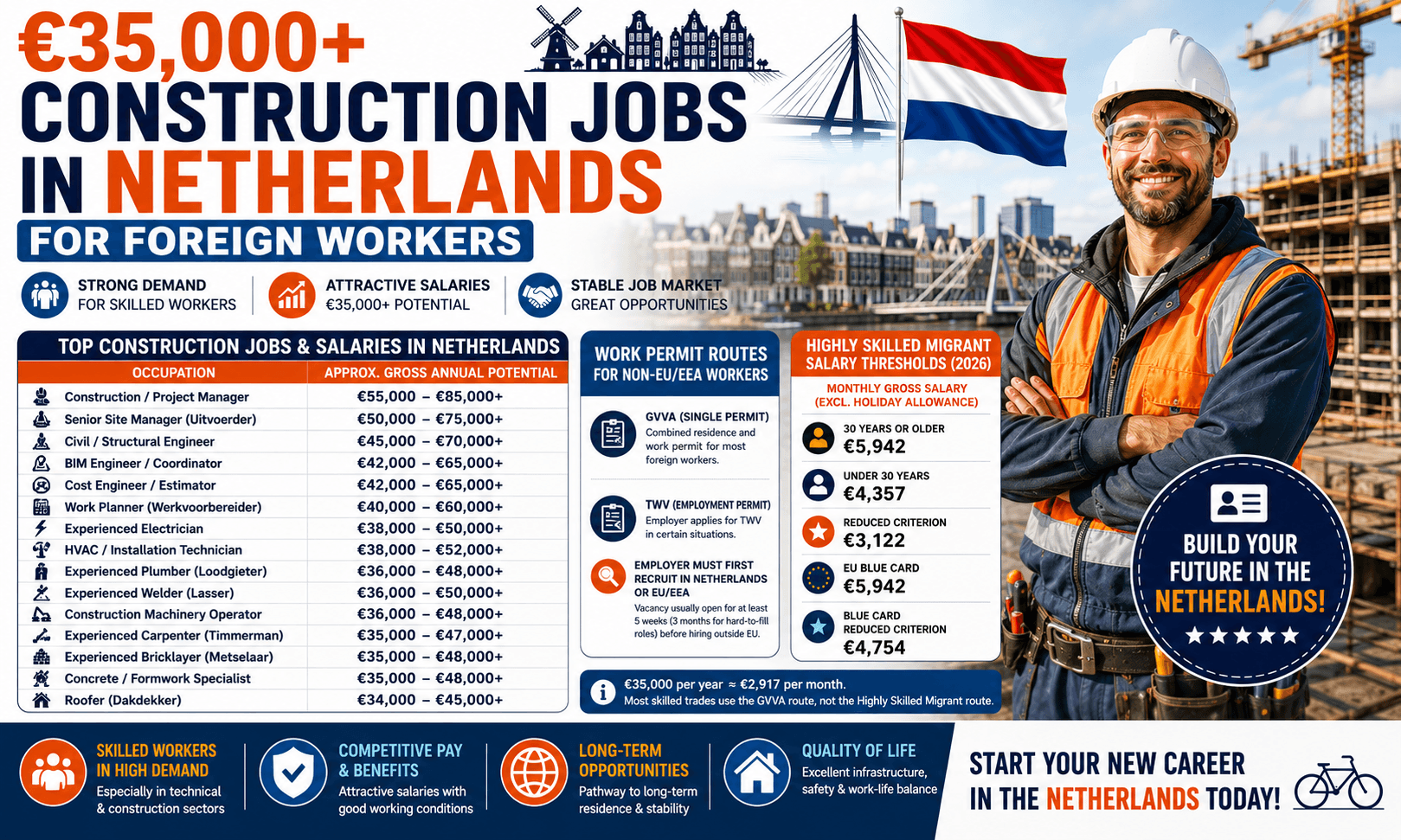
The Netherlands has a highly developed construction, engineering and technical-services sector.
Foreign workers can find opportunities across residential construction, infrastructure, civil engineering, electrical installation, plumbing, HVAC, welding, carpentry, machinery operation and construction management.
For experienced workers, annual gross earnings of €35,000 or more are realistic across a number of construction occupations.
However, there is an important issue foreign applicants need to understand.
A construction job paying €35,000 does not automatically qualify you for the Dutch Highly Skilled Migrant programme.
The Netherlands has several different routes for foreign workers.
Depending on your nationality, occupation, salary and employer, you may work through:
- A Combined Residence and Work Permit, known as a GVVA
- A separate TWV employment permit in applicable cases
- The Highly Skilled Migrant programme
- The European Blue Card
- Other specialised work-residence routes
For many practical construction trades, the regular work-permit system may be more relevant than the Highly Skilled Migrant route.
This guide explains €35,000+ construction jobs in the Netherlands for foreign workers, including salaries, occupations, work permits, qualifications and realistic routes for workers from outside Europe.
Can Construction Workers Earn More Than €35,000 in the Netherlands?
Yes.
A gross annual salary of €35,000 equals approximately:
€2,917 per month
before tax and other deductions.
Experienced tradespeople can potentially exceed that amount.
Professional construction roles can earn considerably more.
Examples include:
- Construction managers
- Project managers
- Civil engineers
- Structural engineers
- Site engineers
- BIM specialists
- Quantity surveyors and cost engineers
- Electricians
- Plumbers
- HVAC technicians
- Welders
- Machinery operators
- Carpenters
- Concrete specialists
However, salary varies significantly according to your experience, employer, collective labour agreement, location and occupation.
Examples of €35,000+ Construction Jobs in the Netherlands
The ranges below are broad market estimates designed to help workers compare occupations. They are not guaranteed salaries or immigration thresholds.
| Construction Occupation | Approximate Gross Annual Potential |
|---|---|
| Construction / Project Manager | €55,000–€85,000+ |
| Senior Site Manager | €50,000–€75,000+ |
| Civil / Structural Engineer | €45,000–€70,000+ |
| BIM Engineer / BIM Coordinator | €42,000–€65,000+ |
| Cost Engineer / Construction Estimator | €42,000–€65,000+ |
| Site / Work Planner | €40,000–€60,000+ |
| Experienced Electrician | €38,000–€50,000+ |
| HVAC / Installation Technician | €38,000–€52,000+ |
| Experienced Plumber | €36,000–€48,000+ |
| Experienced Welder | €36,000–€50,000+ |
| Construction Machinery Operator | €36,000–€48,000+ |
| Experienced Carpenter | €35,000–€47,000+ |
| Experienced Bricklayer | €35,000–€48,000+ |
| Concrete / Formwork Specialist | €35,000–€48,000+ |
| Roofer | €34,000–€45,000+ |
Workers with overtime, shift allowances, specialist certifications or supervisory responsibilities may earn more.
Calculate Your Estimated Take-Home Pay
Dutch salaries are normally advertised as gross earnings.
Tax and social-security deductions affect how much you actually receive.
Use the calculator below to estimate your potential take-home income.
Enter an hourly wage, choose a country, and estimate monthly gross pay, tax and take-home income.
Planning estimate only. The preset uses a simplified flat percentage. Actual tax and payroll deductions can differ based on income level, province/state/region, allowances, social contributions, marital status and local tax rules.
This is a general planning tool.
It is not an official Dutch tax calculator, and your actual deductions depend on your personal circumstances and current tax rules.
1. Construction Project Manager
Potential earnings: €55,000–€85,000+
Construction project managers oversee projects from planning through completion.
Their responsibilities can include:
- Managing project budgets
- Coordinating contractors
- Monitoring deadlines
- Managing procurement
- Reviewing contracts
- Monitoring quality
- Managing risks
- Communicating with clients
- Coordinating engineers and architects
Experienced project managers can earn considerably more than €35,000.
International workers with technical degrees, strong experience and project-management skills can be attractive to large Dutch engineering and construction companies.
2. Site Manager
Potential earnings: €50,000–€75,000+
A site manager may be called a:
Uitvoerder
in Dutch construction vacancies.
Site managers supervise day-to-day construction work.
Responsibilities can include:
- Supervising workers
- Coordinating subcontractors
- Monitoring safety
- Checking project progress
- Organising materials
- Reviewing drawings
- Monitoring quality
Dutch-language ability can be particularly valuable because site managers must communicate with workers, subcontractors and suppliers.
3. Civil Engineer
Potential earnings: €45,000–€70,000+
The Netherlands has major infrastructure and engineering activity.
Civil engineers can work on:
- Roads
- Bridges
- Rail
- Water infrastructure
- Flood protection
- Buildings
- Tunnels
- Ports
- Urban development
The Netherlands is particularly well known for infrastructure, water management and complex civil-engineering projects.
Foreign civil engineers with relevant degrees and experience can therefore find opportunities.
4. Structural Engineer
Potential earnings: €45,000–€70,000+
Structural engineers design and assess the structural systems used in:
- Buildings
- Bridges
- Industrial facilities
- Infrastructure
- Steel structures
- Concrete structures
Strong technical qualifications are normally required.
Knowledge of European standards and engineering software can strengthen an application.
5. BIM Engineer or BIM Coordinator
Potential earnings: €42,000–€65,000+
Building Information Modelling is widely used across modern European construction.
BIM professionals can coordinate:
- Architectural models
- Structural models
- Electrical systems
- Mechanical systems
- Plumbing systems
- Construction sequencing
Useful software skills can include:
- Revit
- Navisworks
- AutoCAD
- BIM 360
- Solibri
- Civil 3D
Strong BIM experience can make foreign applicants particularly attractive for technical roles.
6. Construction Estimator / Cost Engineer
Potential earnings: €42,000–€65,000+
Cost engineers and estimators help determine what construction projects will cost.
They may:
- Prepare estimates
- Analyse drawings
- Calculate materials
- Review tenders
- Analyse labour requirements
- Monitor project costs
- Prepare commercial reports
In Dutch vacancies, you may also see related terms such as:
Calculator
or
Kostendeskundige
depending on the role.
7. Work Planner
Potential earnings: €40,000–€60,000+
A common Dutch construction occupation is:
Werkvoorbereider
This role is similar to a work planner or project preparation specialist.
A werkvoorbereider may:
- Prepare construction schedules
- Order materials
- Coordinate drawings
- Plan labour
- Communicate with suppliers
- Support site management
- Track project progress
Learning Dutch construction job titles can significantly improve your job search.
8. Electrician
Potential earnings for experienced workers: €38,000–€50,000+
Electricians remain important throughout Dutch construction and technical services.
They can work in:
- Residential buildings
- Commercial properties
- Industrial facilities
- Renewable-energy projects
- Data centres
- Infrastructure
The Dutch labour market continues to experience shortages in several technical occupations, including electrical engineering and installation-related professions.
Experienced electricians should clearly document:
- Qualifications
- Apprenticeship training
- Electrical systems worked on
- Industrial experience
- Safety training
- Years of employment
9. HVAC and Installation Technician
Potential earnings: €38,000–€52,000+
Technical building services are especially important in the Netherlands.
Workers can specialise in:
- Heating
- Ventilation
- Air conditioning
- Heat pumps
- Mechanical building systems
- Energy-efficient installations
The Dutch term:
Installatiemonteur
appears frequently in technical job advertisements.
Specialists with modern energy-system knowledge can be valuable as Dutch buildings transition toward more energy-efficient technology.
10. Plumber
Potential earnings: €36,000–€48,000+
Plumbers install and maintain:
- Water systems
- Drainage
- Sanitary systems
- Heating equipment
- Pipework
The Dutch term for plumber is:
Loodgieter
Plumbers continue to be among the technical occupations where Dutch employers can experience recruitment difficulties.
11. Welder
Potential earnings: €36,000–€50,000+
Welders can work across construction, shipbuilding, engineering, fabrication and industrial maintenance.
Useful skills include:
- MIG/MAG
- TIG
- MMA
- Pipe welding
- Structural steel
- Stainless steel
- Aluminium
Foreign workers should identify their welding procedures and certifications instead of simply writing “experienced welder.”
For example:
TIG Pipe Welder — 6 years
is much more informative than:
Welder — 6 years.
12. Heavy Construction Machinery Operator
Potential earnings: €36,000–€48,000+
Construction machinery operators can operate:
- Excavators
- Loaders
- Bulldozers
- Cranes
- Earthmoving equipment
- Road-building machinery
The Dutch term:
Machinist
can appear in some machinery-related job advertisements.
Workers should document exactly which machines they can operate.
13. Carpenter
Potential earnings: €35,000–€47,000+
Carpenters can work on:
- Timber structures
- Roof structures
- Formwork
- Interior construction
- Doors
- Windows
- Renovation projects
The Dutch term for carpenter is:
Timmerman
Experienced carpenters can exceed €35,000 depending on location, working hours and employer.
14. Bricklayer
Potential earnings: €35,000–€48,000+
Bricklayers remain important in residential and commercial construction.
The Dutch term is:
Metselaar
Workers may build:
- Exterior walls
- Interior walls
- Brick façades
- Masonry structures
Experience with European brickwork standards can improve employability.
15. Concrete and Formwork Worker
Potential earnings: €35,000–€48,000+
Concrete workers can specialise in:
- Formwork
- Reinforcement
- Concrete placement
- Structural concrete
- Foundations
- Bridges
Large infrastructure and commercial projects can require skilled concrete workers.
Is There Demand for Construction Workers in the Netherlands?
Yes, particularly in technical occupations.
The Dutch Employee Insurance Agency, UWV, reported that labour-market demand remained greater than the supply of jobseekers during the first quarter of 2026.
Technical occupations continued to experience important shortages.
Examples highlighted by UWV include:
- Electrical engineers
- Machinery mechanics
- Plumbers
However, there is an important distinction.
UWV also indicates that the labour market for general construction and industrial helpers is less tight than for many skilled technical occupations.
That means:
being a skilled tradesperson is significantly different from being an unskilled construction helper.
This distinction is also important when an employer considers recruiting someone from outside Europe.
Can Foreigners Work in Construction in the Netherlands?
Yes.
Your work-permit requirements depend largely on your nationality.
Citizens of the Netherlands, other EEA countries and Switzerland generally do not need a Dutch work permit.
For workers from outside the EEA and Switzerland, different rules normally apply.
In many situations, the employer needs permission to employ the foreign worker.
Two important terms are:
TWV
and
GVVA.
What Is a TWV?
TWV stands for:
Tewerkstellingsvergunning
It is a Dutch employment permit.
In situations where a TWV is required, the employer normally applies for it.
A TWV is particularly relevant in some shorter-term employment situations and specific categories of workers.
What Is a GVVA?
GVVA stands for:
Gecombineerde Vergunning voor Verblijf en Arbeid.
In English, it is commonly called the:
Single Permit
or
Combined Residence and Work Permit.
It combines permission to:
- Reside in the Netherlands
- Work in the Netherlands
For many non-EEA workers coming to work in the Netherlands for more than three months, the GVVA can be the relevant route.
GVVA Requirements for Regular Employment
The Dutch immigration authorities impose several conditions.
These can include:
- Meeting general immigration requirements
- Meeting applicable income requirements
- Working for a properly registered employer
- Receiving normal salary according to the applicable collective agreement or market conditions
An especially important condition relates to recruitment.
For regular employment, the employer generally needs to have looked first for a suitable worker in:
The Netherlands
and
EU/EEA countries.
This can make overseas recruitment for ordinary construction work more difficult than many online advertisements suggest.
Employer Must Search the European Labour Market
For regular work permits, Dutch rules generally require employers to demonstrate that they could not find a suitable candidate within the Netherlands, EU/EEA or Switzerland.
The employer normally needs to register the vacancy with UWV.
Government guidance states that a vacancy normally needs to have been open for at least five weeks.
For vacancies considered difficult to fill, the recruitment period may extend to at least three months.
This is one reason shortage occupations are particularly important for foreign applicants.
If an occupation is genuinely difficult to recruit locally, an employer may have a stronger reason to consider overseas workers.
Does a €35,000 Salary Qualify for a GVVA?
The regular paid-employment income requirement is significantly lower than the Highly Skilled Migrant salary threshold.
For the period from 1 July through 31 December 2026, IND lists the standard gross SV salary requirement for paid employment at:
€2,337 per month excluding holiday allowance
or:
€2,523.96 including holiday allowance.
However, meeting this income requirement does not automatically qualify you for a work permit.
The employer still needs to satisfy the applicable labour-market and employment conditions.
What Is the Highly Skilled Migrant Route?
The Netherlands also operates a residence programme for:
Highly Skilled Migrants
or:
Kennismigranten.
This is a very different system from the ordinary GVVA route.
Only an employer that is a recognised sponsor with the Dutch Immigration and Naturalisation Service, IND, can apply for a Highly Skilled Migrant permit.
The salary must also meet a specific threshold.
2026 Highly Skilled Migrant Salary Thresholds
For 2026, the monthly gross salary requirements excluding holiday allowance are:
| Category | 2026 Minimum Gross Monthly Salary |
|---|---|
| Highly Skilled Migrant aged 30 or over | €5,942 |
| Highly Skilled Migrant under 30 | €4,357 |
| Reduced salary criterion | €3,122 |
| European Blue Card | €5,942 |
| Reduced European Blue Card criterion | €4,754 |
These salary levels are important for construction applicants.
Why €35,000 Usually Does Not Qualify for Highly Skilled Migrant Status
A €35,000 annual salary works out to approximately:
€2,917 per month.
That is below even the €3,122 reduced Highly Skilled Migrant criterion.
It is also far below:
€4,357 per month for many workers under 30
and
€5,942 per month for workers aged 30 or older.
Therefore, do not assume that a €35,000 construction job can use the Highly Skilled Migrant route.
For many tradespeople, another work-permit route is more realistic.
Which Construction Workers Could Potentially Use the Highly Skilled Migrant Route?
Higher-paid professional construction workers have a better chance of meeting the salary threshold.
Examples could include:
- Senior construction managers
- Senior project managers
- Senior civil engineers
- Specialist structural engineers
- Senior BIM professionals
- Engineering managers
However, salary alone is not enough.
The employer must also be an IND-recognised sponsor.
For example, an experienced construction manager earning more than €75,000 could potentially meet the salary criterion.
An electrician earning €42,000 generally would not meet the standard Highly Skilled Migrant salary threshold.
Recognised Sponsor Requirement
For the Highly Skilled Migrant programme, the Dutch employer must be recognised by IND.
This is extremely important.
A company saying:
“We sponsor visas”
does not automatically mean it can employ someone under the Highly Skilled Migrant scheme.
Applicants can check whether an employer appears in IND’s public register of recognised sponsors.
European Blue Card
The EU Blue Card is another possible route for highly qualified workers.
For 2026, the standard Dutch European Blue Card salary requirement is:
€5,942 gross per month excluding holiday allowance.
A reduced criterion of:
€4,754 per month
can apply in qualifying circumstances.
This route is much more relevant to highly qualified engineers and professional construction specialists than ordinary building trades.
Can an Electrician Get a Dutch Work Permit?
Potentially.
An experienced electrician may qualify for regular employment when:
- A Dutch employer genuinely wants to hire them
- The employer meets the applicable recruitment rules
- The employment satisfies salary and working-condition requirements
- The applicant meets immigration requirements
UWV continues to identify shortages in several technical occupations.
However, shortage does not create an automatic visa.
Can a Plumber Get a Work Permit?
Potentially.
Plumbers are among the technical occupations where Dutch employers continue to experience labour-market shortages.
Again, this does not remove the work-permit requirements.
The employer must complete the appropriate process.
Can Welders Work in the Netherlands?
Yes, foreign welders do work in the Netherlands.
For overseas recruitment, employers may be particularly interested in specialised skills such as:
- TIG pipe welding
- Stainless steel
- Structural fabrication
- Certified welding procedures
The stronger and more specialised your experience, the more competitive your application becomes.
Can Carpenters Work in the Netherlands?
Potentially.
Experienced carpenters can find work in housing, renovation, commercial construction and formwork.
However, general work-permit conditions still apply for non-EEA applicants.
Can General Construction Labourers Get Work Permits?
This can be considerably harder.
The Netherlands may have technical labour shortages, but that does not mean every general construction-helper role faces the same shortage.
UWV labour-market information indicates that general helpers in construction and industry face a less tight labour market than many specialist technical professions.
Employers also need to consider available workers from the Netherlands and wider European labour market before recruiting many non-EEA workers through the ordinary permit system.
Therefore, applicants with a specific trade generally have a stronger profile than applicants offering only general labour.
Skills That Can Improve Your Chances
Foreign construction workers should develop specific skills.
For example:
Instead of:
Construction worker
you could become:
Certified TIG Pipe Welder
or:
Industrial Electrician
or:
HVAC Installation Technician
or:
Formwork Carpenter
or:
Excavator Operator
Specialisation gives an employer a clearer reason to hire you.
Do You Need Dutch Language Skills?
Not every construction job legally requires Dutch.
Some international construction and engineering companies operate partly in English.
However, Dutch can be extremely valuable.
Construction workers need to understand:
- Safety instructions
- Supervisor directions
- Site notices
- Technical terminology
- Emergency procedures
For supervisory occupations, Dutch can become even more important.
Learning at least basic Dutch can therefore improve your employment prospects.
Useful Dutch Construction Job Titles
Searching in Dutch can reveal substantially more vacancies.
Some useful terms are:
Bouwprojectmanager — Construction Project Manager
Uitvoerder — Site Manager / Construction Supervisor
Werkvoorbereider — Work Planner / Project Preparation Specialist
Bouwkundig Ingenieur — Building/Construction Engineer
Civiel Ingenieur — Civil Engineer
Elektricien / Elektromonteur — Electrician
Installatiemonteur — Installation Technician
Loodgieter — Plumber
Lasser — Welder
Timmerman — Carpenter
Metselaar — Bricklayer
Dakdekker — Roofer
Machinist — Machinery Operator in relevant contexts
Use combinations such as:
“Lasser vacatures Nederland”
“Timmerman vacatures”
“Elektromonteur vacatures Nederland”
“Werkvoorbereider bouw vacatures”
“Uitvoerder bouw vacatures”
How to Find Construction Jobs in the Netherlands
Foreign workers can search through:
- Dutch construction companies
- Engineering consultancies
- Infrastructure contractors
- Technical installation companies
- International recruitment agencies
- Specialist employment websites
- Employer career pages
Do not rely only on searches such as:
“Netherlands visa sponsorship jobs.”
Try occupation-specific searches.
For example:
“Civil Engineer Netherlands recognised sponsor”
“Construction Manager Netherlands highly skilled migrant”
“Electrician Netherlands foreign workers”
“Welder Netherlands work permit”
“HVAC Technician Netherlands jobs”
Specific searches generally produce better opportunities.
Documents Foreign Workers Should Prepare
Useful documents can include:
- Valid passport
- Professional CV
- Trade certificate
- University degree where applicable
- Apprenticeship certificate
- Employment references
- Payslips
- Tax or social-insurance records
- Welding certificates
- Machinery licences
- Safety qualifications
- Professional registration where applicable
- Portfolio of previous projects
Your experience should be verifiable.
How to Write Your Construction CV
Avoid vague descriptions.
Instead of writing:
Electrician — 2018–2025
write:
Industrial Electrician — 2018–2025
- Installed electrical distribution systems.
- Performed industrial cable installation.
- Diagnosed electrical faults.
- Read technical drawings.
- Installed control panels.
- Maintained electrical motors.
- Worked on commercial and industrial construction projects.
- Followed site electrical safety procedures.
This gives employers a much clearer idea of what you can do.
Safety Qualifications
Construction companies may require occupational safety training.
The Netherlands commonly uses safety certification such as:
VCA
for workers in construction, industrial and technical environments.
The exact certification required depends on the employer and job.
Having relevant recognised safety qualifications can strengthen your application.
Salary Versus Cost of Living
A €40,000 salary can sound attractive.
However, housing costs can be significant in parts of the Netherlands.
Particularly expensive areas can include:
- Amsterdam
- Utrecht
- Rotterdam
- The Hague
Always compare:
- Gross salary
- Net salary
- Rent
- Transport
- Health insurance
- Utilities
- Food
- Commuting
A higher salary in an expensive city may not automatically leave you with more disposable income.
Health Insurance
People who live or work in the Netherlands can become subject to Dutch health-insurance requirements.
Therefore, health insurance should be included when estimating your monthly budget.
Do not compare salaries using tax alone.
Avoid Fake Netherlands Job Offers
Foreign workers should be cautious with anyone advertising:
“Guaranteed Netherlands visa sponsorship”
“Pay €4,000 for a work permit”
“€6,000 monthly construction labourer”
“No experience required”
“100% work visa approval”
No private recruiter can guarantee Dutch government approval.
Verify:
- Employer
- Company registration
- Employment contract
- Salary
- Work location
- Permit type
If someone claims the position uses the Highly Skilled Migrant programme, check whether the employer is an IND-recognised sponsor.
Never Pay for Fake Experience
Do not purchase:
- Employment letters
- Qualifications
- Trade certificates
- Welding certifications
- Experience records
Government authorities and employers can check documents.
False information can damage both your job application and immigration application.
How Long Could Moving to the Netherlands Take?
Your process could include:
- Preparing your CV
- Gathering trade certificates
- Searching for employers
- Interviews
- Receiving a job offer
- Employer recruitment requirements
- Work/residence permit application
- Immigration processing
- Entry visa procedures where required
- Travel
- Registration after arrival
There is no guaranteed timeline.
Use the estimator below to plan your journey.
Choose your destination and preferred entry route, then tell us how far you have progressed.
Timeline results are planning estimates only and are not a guarantee of visa approval or travel date.
This tool provides an estimate only.
It is not an official IND or UWV processing-time calculator and cannot predict whether your application will be approved.
Frequently Asked Questions
Can foreigners work in construction in the Netherlands?
Yes.
Workers from outside the EEA and Switzerland generally need appropriate permission to work, while EEA and Swiss nationals normally do not require a Dutch work permit.
Can construction workers earn €35,000?
Yes.
Experienced skilled tradespeople and construction professionals can reach or exceed €35,000.
What is a GVVA?
The GVVA is the Dutch Combined Residence and Work Permit.
It allows qualifying non-EEA workers to live and work in the Netherlands.
What is a TWV?
A TWV is an employment permit. In situations where it applies, the employer normally obtains it from UWV.
Does an employer have to look for European workers first?
For regular employment permits, this is generally an important part of the process.
The employer normally has to search within the Netherlands and the EU/EEA before recruiting a non-EEA worker.
Is there demand for electricians?
Yes.
Dutch labour-market information continues to identify shortages in technical occupations, including electrical-related roles.
Are plumbers in demand?
Yes.
Plumbers are among the technical occupations specifically highlighted by UWV as experiencing labour shortages.
Does €35,000 qualify for the Highly Skilled Migrant programme?
Generally, no.
€35,000 per year is approximately €2,917 per month, which is below the standard 2026 Highly Skilled Migrant salary thresholds.
What is the 2026 Highly Skilled Migrant salary for someone aged 30 or older?
€5,942 gross per month excluding holiday allowance.
What about workers younger than 30?
The 2026 threshold is €4,357 gross per month excluding holiday allowance.
What is the reduced criterion?
The reduced Highly Skilled Migrant salary criterion is €3,122 per month in 2026.
It only applies in qualifying circumstances.
Can an electrician use the Highly Skilled Migrant programme?
Potentially, but a typical electrician salary may not meet the programme’s salary threshold.
The employer must also be an IND-recognised sponsor.
Can a construction manager qualify?
Potentially.
Senior construction managers with sufficiently high salaries may meet the income requirement, provided the other Highly Skilled Migrant conditions are satisfied.
Do I need Dutch?
Not always as an immigration requirement, but Dutch can significantly improve employability and workplace safety.
Is English enough?
Some international engineering and construction companies operate in English.
Practical trade positions are more likely to benefit from Dutch because workers need to communicate on-site.
Does having a shortage occupation guarantee a visa?
No.
A labour shortage can improve employment prospects but does not remove immigration requirements.
Final Thoughts
The Netherlands offers attractive opportunities for foreign construction workers, particularly applicants with strong technical or professional skills.
Workers earning €35,000 or more can be found across occupations such as:
Electricians
Plumbers
HVAC technicians
Welders
Carpenters
Bricklayers
Construction machinery operators
Site supervisors
BIM specialists
Civil engineers
Construction managers
However, foreign applicants need to understand the difference between Dutch immigration routes.
The Highly Skilled Migrant programme has relatively high salary requirements.
In 2026, the threshold is €5,942 per month for a highly skilled migrant aged 30 or older and €4,357 for one younger than 30. A reduced €3,122 criterion exists only in qualifying situations.
Therefore, a normal €35,000–€45,000 skilled-trade job generally should not be marketed as a Highly Skilled Migrant opportunity.
For many non-EEA tradespeople, the regular Dutch work-permit system involving a GVVA or TWV can be more relevant.
Even then, an employer generally needs to demonstrate that a suitable worker could not be found in the Netherlands or wider European labour market.
This makes specialist skills particularly valuable.
An experienced TIG welder, industrial electrician, HVAC technician or highly skilled machinery operator can present a stronger recruitment case than someone applying only as a general construction helper.
Build documented expertise, search using Dutch occupation names, verify employers and determine the correct work-permit route before paying anyone or making travel plans.
MimBlog is an independent information website and is not a recruitment agency, employer, immigration authority or government agency. Salaries are estimates and may vary by employer, experience and location. Job availability and immigration requirements can change. Always verify vacancies, eligibility and visa requirements through employers and official government sources.