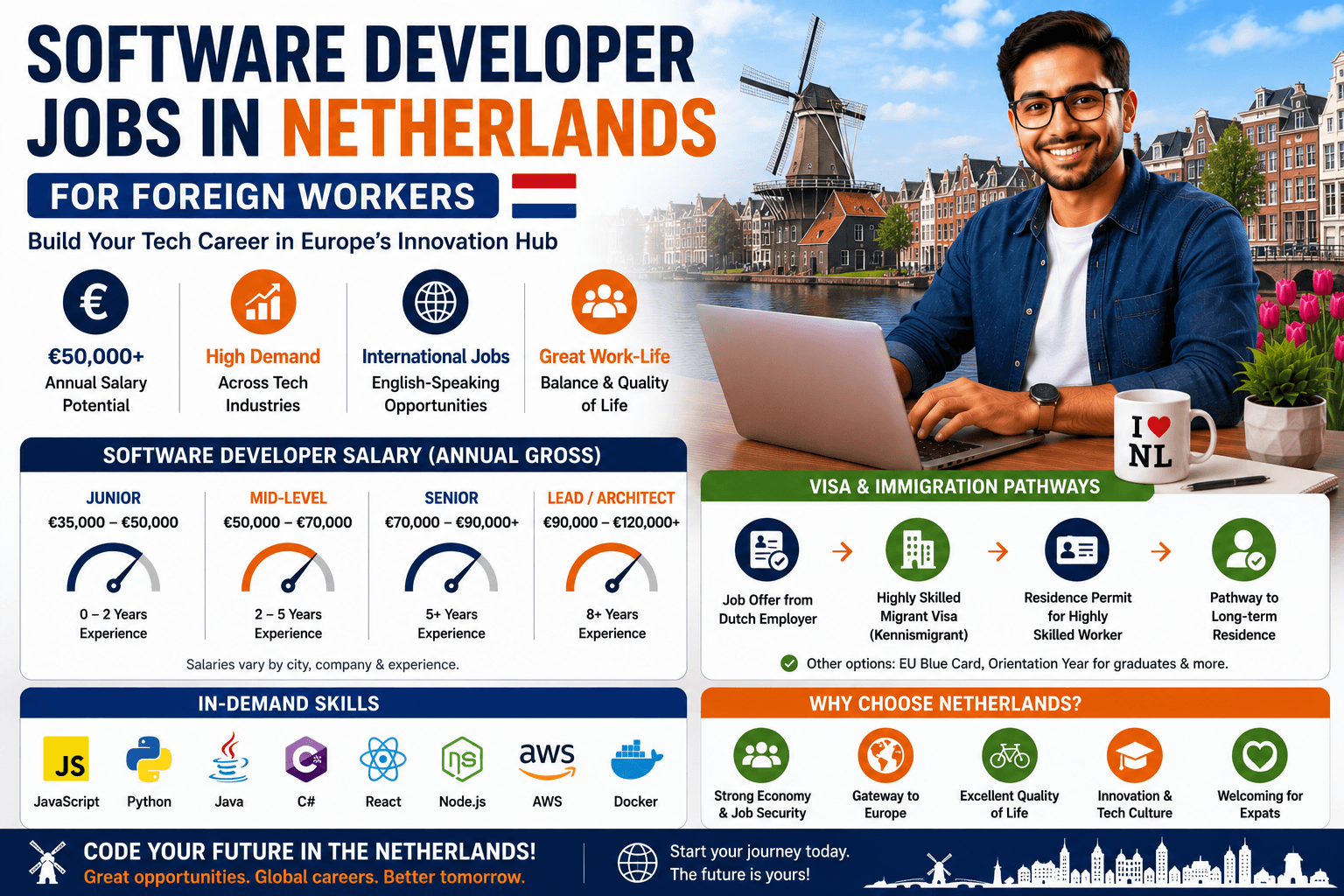
The Netherlands is one of Europe’s most attractive technology markets for international software developers.
Foreign technology professionals can find opportunities across:
- Software development
- Fintech
- Artificial intelligence
- Cloud computing
- Semiconductors
- Cybersecurity
- E-commerce
- Logistics technology
- Enterprise software
Experienced software developers can earn:
€50,000+ per year
while senior software engineers, architects, technical leads and specialised developers can earn substantially more.
The Netherlands is also attractive to international technology workers because English is widely used in the country’s technology industry.
For non-EU/EEA workers, one of the most important immigration options is the:
Highly Skilled Migrant — kennismigrant — residence route.
Other possibilities can include the:
- EU Blue Card
- Orientation Year for highly educated persons
- Other employment residence routes
However:
a Dutch software job does not automatically give a foreign worker the right to live or work in the Netherlands.
The employer, salary, immigration route and applicant must satisfy the applicable requirements.
This guide explains software developer jobs in the Netherlands for foreign workers, including salaries, skills, highly skilled migrant requirements and other immigration options.
Why Software Developers Consider the Netherlands
The Netherlands has built a strong international technology economy.
Software professionals can work across:
- Financial services
- Semiconductor technology
- E-commerce
- Logistics
- Telecommunications
- Artificial intelligence
- Cloud computing
- Enterprise technology
- Startups
Major technology employment centres include:
- Amsterdam
- Eindhoven
- Rotterdam
- Utrecht
- The Hague
English-speaking workplaces are common in the international technology sector.
That makes the Netherlands particularly attractive to developers who do not yet speak Dutch.
Can Software Developers Earn €50,000+?
Yes.
Experienced software professionals can earn above:
€50,000 annually.
Salary depends on:
- Experience
- Employer
- City
- Technical speciality
- Industry
- Management responsibility
Junior developers can earn below this threshold.
Senior developers can earn substantially more.
Example Software Developer Salaries
An illustrative salary progression might look like:
| Career Level | Example Annual Gross Salary |
|---|---|
| Junior Developer | €35,000–€50,000 |
| Mid-Level Developer | €50,000–€70,000 |
| Senior Developer | €65,000–€90,000+ |
| Lead Engineer | €80,000–€110,000+ |
| Architect/Manager | €90,000–€120,000+ |
These are broad planning examples rather than guaranteed market salaries.
Actual compensation varies by company and role.
What Does €50,000 Mean Monthly?
A gross annual salary of:
€50,000
equals approximately:
€4,167 per month.
At €60,000:
€5,000 per month.
At €80,000:
approximately €6,667 per month.
At €100,000:
approximately €8,333 per month.
These amounts are before deductions.
Enter an hourly wage, choose a country, and estimate monthly gross pay, tax and take-home income.
Planning estimate only. The preset uses a simplified flat percentage. Actual tax and payroll deductions can differ based on income level, province/state/region, allowances, social contributions, marital status and local tax rules.
Use the salary calculator for planning only. Actual Dutch take-home pay depends on income tax, social insurance, pension arrangements and individual circumstances.
Software Developer Jobs in Amsterdam
Amsterdam is the Netherlands’ largest international technology employment centre.
Opportunities exist across:
- Fintech
- Software
- E-commerce
- Cloud computing
- Artificial intelligence
- Digital media
- SaaS
Many multinational companies use English as an important workplace language.
Amsterdam can offer attractive salaries.
However, housing can be expensive and difficult to secure.
Foreign workers should compare compensation with:
- Rent
- Transportation
- Health insurance
- Taxes
- General living costs
before accepting an offer.
Software Developer Jobs in Eindhoven
Eindhoven is one of Europe’s important high-technology centres.
The region is particularly strong in:
- Semiconductors
- Embedded software
- Engineering
- Hardware
- Industrial technology
- Artificial intelligence
Developers with experience in:
- C++
- Embedded systems
- Firmware
- Computer engineering
can find specialised opportunities.
Software Developer Jobs in Rotterdam
Rotterdam has opportunities connected with:
- Logistics
- Shipping
- Fintech
- Enterprise software
- Digital infrastructure
Its large port and logistics economy also create technology careers involving:
- Automation
- Supply-chain systems
- Data
- Industrial software
Software Developer Jobs in Utrecht
Utrecht has technology employment across:
- Software
- Consulting
- Financial services
- Healthcare technology
- Enterprise IT
Its central location also provides access to employers across the Randstad region.
Software Developer Jobs in The Hague
The Hague has opportunities connected with:
- Government technology
- Cybersecurity
- International organisations
- Telecommunications
- Consulting
Some sensitive positions can have nationality or security requirements.
Programming Languages
Dutch employers recruit developers with skills including:
- JavaScript
- TypeScript
- Python
- Java
- C#
- C++
- Go
- PHP
- SQL
Frameworks can include:
- React
- Angular
- Vue
- Node.js
- Spring
- .NET
- Django
- Laravel
Backend Developer Jobs
Backend developers can work with:
- APIs
- Databases
- Authentication
- Distributed systems
- Cloud services
- Enterprise applications
Common technologies include:
- Java
- Python
- C#
- Node.js
- Go
- PHP
Java Developer Jobs
Java remains important across:
- Banking
- Fintech
- Enterprise technology
- Government systems
- Large-scale applications
Experience with:
- Spring
- Microservices
- Kubernetes
- Cloud computing
can strengthen a Java developer’s profile.
Python Developer Jobs
Python is used extensively in:
- Backend systems
- Data
- Artificial intelligence
- Automation
- Machine learning
Useful technologies include:
- Django
- Flask
- FastAPI
- SQL
- AWS
- Azure
C++ Developer Jobs
The Eindhoven technology region creates specialised opportunities for C++ developers.
C++ can be used in:
- Semiconductor technology
- Embedded systems
- Robotics
- High-performance applications
Frontend Developer Jobs
Frontend skills can include:
- HTML
- CSS
- JavaScript
- TypeScript
- React
- Angular
- Vue
Employers also value:
- Accessibility
- Testing
- Responsive design
- Performance optimisation
Full-Stack Developer Jobs
Full-stack developers work across multiple parts of an application.
Example stacks include:
React + Node.js + PostgreSQL + AWS
or:
Angular + Java + Spring + Azure.
Cloud Computing
Cloud experience is increasingly important.
Major platforms include:
- AWS
- Microsoft Azure
- Google Cloud
Related skills include:
- Docker
- Kubernetes
- Terraform
- Linux
- CI/CD
DevOps
Software developers can progress into:
- DevOps Engineer
- Platform Engineer
- Site Reliability Engineer
These roles combine:
- Programming
- Infrastructure
- Automation
- Cloud computing
Artificial Intelligence
The Netherlands has opportunities across:
- Machine learning
- Generative AI
- Data science
- Computer vision
- AI infrastructure
Developers who combine software engineering with AI expertise can target specialised positions.
Semiconductor Software Jobs
The Netherlands has an internationally important semiconductor ecosystem.
Technology professionals can work across:
- Software engineering
- Embedded systems
- Machine control
- Data
- Hardware integration
- Systems engineering
Eindhoven is particularly important for these careers.
Do You Need Dutch?
Not for every technology job.
Many international companies hire software developers who work primarily in English.
This is particularly common in:
- Amsterdam
- Eindhoven
- Rotterdam
- Utrecht
However, learning Dutch can still improve:
- Employment options
- Social integration
- Long-term career progression
- Access to smaller employers
Do You Need a Degree?
Not every Dutch technology employer requires the same academic background.
Common qualifications include:
- Computer Science
- Software Engineering
- Information Technology
- Computer Engineering
Experienced developers can sometimes compete without a traditional computer science degree.
However, immigration requirements are separate from employer preferences.
Certain residence routes can impose specific educational or salary requirements.
EU/EEA and Swiss Citizens
Citizens of EU/EEA countries and Switzerland generally have much easier access to the Dutch labour market than third-country nationals.
They normally do not need the same employer-sponsored immigration process as non-EU/EEA workers.
The following sections are particularly relevant to foreign workers who need Dutch immigration permission.
Highly Skilled Migrant
The:
Highly Skilled Migrant — kennismigrant
route is one of the Netherlands’ most important immigration pathways for international technology professionals.
A qualifying foreign worker can obtain residence for highly skilled employment where the requirements are satisfied.
Recognised Sponsor
For the Highly Skilled Migrant route, the employer normally needs to be recognised by the Dutch Immigration and Naturalisation Service:
IND
as a recognised sponsor.
This is extremely important for overseas applicants.
A company offering you a software job is not automatically able to use the highly skilled migrant procedure.
Salary Criterion
The Highly Skilled Migrant route uses minimum salary criteria.
The applicable amount can depend on factors including:
- Age
- Immigration category
- Whether a reduced criterion applies
The thresholds are updated periodically.
Therefore, applicants should verify the current IND salary criterion when applying.
A salary of:
€50,000
does not automatically prove eligibility.
The monthly salary and applicable immigration calculation must satisfy the current rule.
Market-Conform Salary
In addition to meeting the applicable threshold, the offered salary needs to satisfy the relevant requirements concerning market conformity.
Employers cannot simply create an unrealistic job arrangement solely to meet immigration rules.
Employer Applies
The recognised sponsor generally plays an important role in submitting the residence application.
This differs from immigration systems where the worker completes almost the entire process independently.
EU Blue Card
The Netherlands also participates in the:
EU Blue Card
system.
The EU Blue Card is a separate route from the Highly Skilled Migrant scheme.
It can be attractive to qualifying highly educated professionals and can provide advantages related to mobility within the European Union under applicable rules.
Applicants should compare:
Highly Skilled Migrant vs EU Blue Card
rather than assuming one is automatically better.
Highly Skilled Migrant vs EU Blue Card
The Highly Skilled Migrant route is strongly connected to:
IND recognised sponsors.
The EU Blue Card has its own:
- Qualification
- Salary
- Employment
requirements.
The better route depends on the worker’s:
- Employer
- Salary
- Qualifications
- Long-term European plans
Orientation Year
The Netherlands offers an:
Orientation Year — zoekjaar
residence permit for qualifying highly educated graduates.
Eligible graduates can use the period to search for employment or start certain qualifying activities.
The route can be particularly attractive because qualifying workers can potentially benefit from a reduced Highly Skilled Migrant salary criterion.
Eligibility rules apply.
Not every foreign graduate automatically qualifies.
30% Ruling
Foreign workers sometimes hear about the Dutch:
30% ruling.
This is a tax facility rather than an immigration visa.
Qualifying employees recruited from abroad can potentially receive tax advantages where the current requirements are satisfied.
The rules have changed several times.
Therefore:
foreign software developer ≠ automatic 30% ruling.
Applicants should verify current Dutch tax rules before including the benefit in salary negotiations.
Health Insurance
Workers living in the Netherlands can need Dutch health insurance under the applicable rules.
This should be considered when calculating actual living costs.
Employment Contract
A genuine Dutch software employment contract should clearly state:
- Employer
- Position
- Salary
- Working hours
- Employment conditions
Foreign workers should understand whether the salary quoted includes items such as:
- Holiday allowance
- Bonuses
- Pension contributions
before comparing offers.
Holiday Allowance
Dutch employees can receive statutory holiday allowance under applicable employment rules.
Applicants should check whether a salary advertisement:
- Includes holiday allowance
- Excludes it
- Lists it separately
This can affect salary comparisons.
How Long Does Dutch Immigration Take?
A typical international software worker’s process can include:
- Job search.
- Interviews.
- Employment offer.
- Employer immigration application.
- IND processing.
- Entry visa where required.
- Travel.
- Local registration.
- Residence-document collection.
The exact process varies according to:
- Nationality
- Residence route
- Employer
- Applicant circumstances
Choose your destination and preferred entry route, then tell us how far you have progressed.
Timeline results are planning estimates only and are not a guarantee of visa approval or travel date.
Use the wait-time calculator only as a planning estimate. It does not guarantee IND processing time, recognised-sponsor approval, residence permission, entry visa issuance or permanent residence.
Can Software Developers Get Permanent Residence?
Potentially.
Foreign workers who legally live in the Netherlands for the required period and satisfy the applicable conditions can potentially qualify for:
permanent residence
or other long-term residence status.
Requirements can include factors such as:
- Lawful residence
- Residence history
- Income
- Civic integration
depending on the route.
Therefore:
Highly Skilled Migrant residence ≠ automatic permanent residence.
Dutch Citizenship
Some long-term residents can eventually become eligible for Dutch citizenship where they satisfy the applicable requirements.
Citizenship has additional rules beyond simply working in the Netherlands for several years.
Nationality and dual-citizenship rules can also matter.
Can Your Family Join You?
Highly skilled workers can potentially bring qualifying family members under applicable Dutch family immigration rules.
Eligibility depends on:
- Residence status
- Family relationship
- Other immigration requirements
Applicants relocating with family should include housing, childcare, insurance and other costs in their financial planning.
Changing Employers
Highly Skilled Migrants can potentially change employers.
However, immigration conditions continue to matter.
The new employer generally needs to satisfy the requirements applicable to the worker’s residence category.
A worker should not assume that existing residence permission means they can freely move to any Dutch employer without immigration consequences.
Remote Dutch Software Jobs
Foreign developers can potentially work remotely for Netherlands-based companies while remaining abroad.
Possible arrangements include:
- Independent contracting
- Overseas subsidiary
- Employer of record
However:
remote Dutch employment ≠ Dutch residence permission.
A worker needs appropriate immigration status to relocate physically to the Netherlands.
Building a Dutch Tech CV
Focus on measurable achievements.
Instead of:
“Worked on cloud applications.”
write:
“Migrated 20 production services to cloud infrastructure and reduced monthly hosting costs by 28%.”
when accurate.
Useful metrics include:
- Users
- Revenue
- Cost savings
- Performance
- Uptime
- Automation
- Security
GitHub
A developer portfolio can demonstrate:
- Production applications
- APIs
- Automated tests
- Open-source contributions
- Documentation
- Cloud deployment
Quality is more valuable than uploading dozens of unfinished tutorial projects.
Use a precise headline.
For example:
Senior Full-Stack Engineer | React | Node.js | AWS
is clearer than:
IT Specialist Seeking Opportunities.
Finding Software Jobs in the Netherlands
Useful searches include:
- Software Developer Netherlands visa sponsorship
- Software Engineer Netherlands foreign workers
- Highly Skilled Migrant software engineer Netherlands
- Software Developer Amsterdam relocation
- Backend Developer Netherlands international applicants
- Software Engineer Eindhoven English
Also look for terms such as:
- Visa support
- Relocation
- Recognised sponsor
- International candidates
- English-speaking
Check the IND Sponsor Register
Before assuming an employer can sponsor a Highly Skilled Migrant, applicants should verify whether the company is currently recognised by the IND where recognition is required for the route.
This can prevent wasted applications.
Job Scams
Foreign applicants should be cautious of advertisements claiming:
“Guaranteed Netherlands work visa.”
“Guaranteed highly skilled migrant sponsorship.”
“Pay €10,000 for Dutch residence.”
“Guaranteed permanent residence.”
A legitimate employer cannot guarantee the IND’s final immigration decision.
Netherlands vs Germany Software Jobs
Germany offers:
- EU Blue Card
- Qualified professional routes
- Special provisions for experienced IT workers
- Opportunity Card
The Netherlands offers:
- Highly Skilled Migrant
- EU Blue Card
- Orientation Year
The Netherlands can be particularly attractive to developers seeking English-speaking international workplaces.
Netherlands vs UK Software Jobs
The UK primarily uses:
Skilled Worker sponsorship
for this type of relocation.
The Netherlands’ Highly Skilled Migrant programme depends heavily on:
IND recognised employers
and salary requirements.
Netherlands vs Canada Software Jobs
Canada provides:
- Express Entry
- Provincial Nominee Programs
- Employer-supported work permits
The Netherlands provides an employment-focused European residence framework with potential routes toward longer-term residence.
The best destination depends on the worker’s priorities.
Frequently Asked Questions
Can foreigners get software developer jobs in the Netherlands?
Yes. Dutch employers can recruit foreign software professionals where employment and immigration requirements are satisfied.
Can software developers earn €50,000+?
Yes. Experienced developers can earn above €50,000 annually, while senior professionals can earn substantially more.
Do I need Dutch?
Not for every technology position. Many international companies operate in English.
What is a Highly Skilled Migrant?
It is an employment residence route for qualifying highly skilled foreign workers.
Does my employer need to be a recognised sponsor?
For the Highly Skilled Migrant procedure, recognised-sponsor status is normally an important requirement.
Is €50,000 enough for sponsorship?
Not automatically. The applicable monthly salary criterion depends on the immigration category and current IND thresholds.
Can I use the EU Blue Card?
Potentially, if your employment, qualifications, salary and other circumstances meet the requirements.
What is the Orientation Year?
It is a residence option for qualifying highly educated graduates that allows them to seek employment or undertake qualifying activities in the Netherlands.
Can a Highly Skilled Migrant eventually obtain permanent residence?
Potentially, after satisfying the required lawful residence period and other applicable conditions.
Does a Dutch software job guarantee a visa?
No.
Final Thoughts
The Netherlands offers strong opportunities for foreign software developers.
Technology careers are concentrated in:
- Amsterdam
- Eindhoven
- Rotterdam
- Utrecht
- The Hague
with opportunities across:
- Software
- Fintech
- Artificial intelligence
- Cloud computing
- E-commerce
- Semiconductors
- Logistics technology
Experienced software professionals can earn:
€50,000+ annually
while senior engineers and specialists can earn considerably more.
For non-EU/EEA technology workers, one of the most important immigration routes is the:
Highly Skilled Migrant programme.
The employer’s:
IND recognised-sponsor status
and the worker’s:
applicable salary criterion
are particularly important.
Other potential options include:
EU Blue Card
and:
Orientation Year
for qualifying applicants.
However:
software job ≠ automatic residence
€50,000 salary ≠ automatic Highly Skilled Migrant eligibility
and:
recognised sponsor ≠ guaranteed immigration approval.
The strongest strategy is:
build specialised software skills → document measurable professional experience → target international Dutch employers → check recognised-sponsor status → confirm the current salary criterion → select the appropriate residence route → apply with complete documentation.
MimBlog is an independent information website and is not a recruitment agency, employer, immigration authority or government agency. Salaries are estimates and may vary by employer, experience and location. Job availability and immigration requirements can change. Always verify vacancies, eligibility and visa requirements through employers and official government sources.