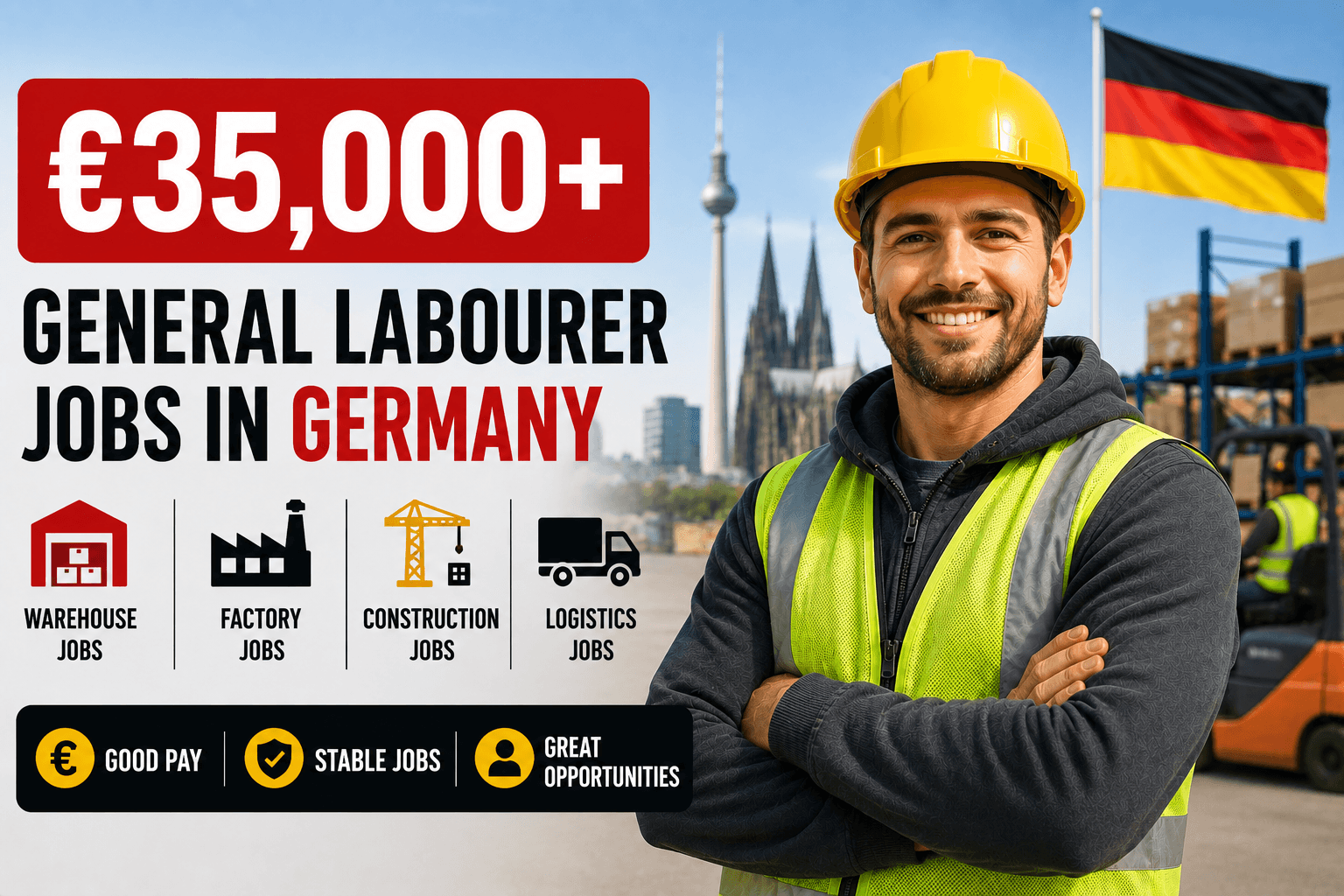
Germany has one of Europe’s largest industrial economies, creating extensive employment across manufacturing, logistics, warehousing, construction, food production, automotive supply chains and industrial services. General Labourers support these industries by moving materials, preparing worksites, packing products, assisting production teams and performing practical duties that keep businesses operating.
For foreign workers who already have the legal right to work in Germany, many General Labourer positions can be accessible without a university degree. Practical experience, reliability, physical ability and German-language skills can be more important than academic education for many entry-level positions.
Annual gross earnings of around €35,000+ are possible in stronger-paying full-time labour positions, particularly where workers have warehouse equipment skills, industrial experience, construction knowledge, night shifts or overtime.
For example:
€2,500 per month = €30,000 annually.
€2,750 per month = €33,000 annually.
€3,000 per month = €36,000 annually.
€3,250 per month = €39,000 annually.
€3,500 per month = €42,000 annually.
€4,000 per month = €48,000 annually.
However, basic entry-level Helper jobs can pay below €35,000.
Foreign applicants also need to distinguish between jobs available in Germany and jobs that provide a viable immigration pathway from overseas.
Germany has expanded legal migration opportunities for qualified workers, but this does not mean every basic Labourer vacancy can sponsor a worker from outside the European Union.
General Labourer vacancy ≠ automatic German work visa.
How Much Do General Labourers Earn in Germany?
General Labourer wages vary according to industry, location and experience.
Warehouse Helpers can earn less than skilled Forklift Operators.
Production Helpers can earn less than experienced Machine Operators.
Construction Labourers can earn more when they possess specialist experience.
Shift allowances can also increase income.
A simple monthly salary comparison looks like this:
€2,400 monthly = €28,800 annually.
€2,600 monthly = €31,200 annually.
€2,800 monthly = €33,600 annually.
€3,000 monthly = €36,000 annually.
€3,200 monthly = €38,400 annually.
€3,500 monthly = €42,000 annually.
€4,000 monthly = €48,000 annually.
These are gross amounts before German taxes and social-insurance deductions.
Enter an hourly wage, choose a country, and estimate monthly gross pay, tax and take-home income.
Planning estimate only. The preset uses a simplified flat percentage. Actual tax and payroll deductions can differ based on income level, province/state/region, allowances, social contributions, marital status and local tax rules.
Use the salary calculator to estimate gross and take-home earnings. Actual net salary depends on income tax, social-security contributions, health insurance, pension insurance, unemployment insurance, long-term care insurance, tax class and personal circumstances.
German Job Titles Foreign Workers Should Know
Understanding German job titles can dramatically improve job searches.
Employers do not always advertise positions using English titles such as “General Labourer.”
Useful terms include:
Helfer — Helper.
Lagerhelfer — Warehouse Helper.
Lagermitarbeiter — Warehouse Employee.
Kommissionierer — Order Picker.
Produktionshelfer — Production Helper.
Produktionsmitarbeiter — Production Employee.
Verpacker — Packer.
Gabelstaplerfahrer — Forklift Driver.
Bauhelfer — Construction Helper.
Fabrikarbeiter — Factory Worker.
Montagehelfer — Assembly Helper.
Reinigungskraft — Cleaner.
Küchenhilfe — Kitchen Helper.
Umzugshelfer — Moving Helper.
Searching with German job titles can produce significantly more vacancies than English-only searches.
Warehouse General Labourer Jobs
Germany is one of Europe’s most important logistics centres.
Its central location allows businesses to distribute products throughout the European Union.
Warehouses require employees to receive deliveries, organise inventory and prepare shipments.
Large logistics operations exist around Frankfurt, Hamburg, Berlin, Cologne, Leipzig, Dortmund, Düsseldorf and other cities.
Warehouse work can involve early, late and night shifts.
Lagerhelfer Jobs
Lagerhelfer is one of the most useful terms for applicants seeking entry-level warehouse employment.
Workers can unload goods and prepare orders.
Some positions require limited previous experience.
Employers can provide workplace training.
German language ability can improve opportunities because workers need to understand instructions and safety information.
Lagermitarbeiter Jobs
Lagermitarbeiter generally means Warehouse Employee.
Responsibilities can include receiving products, stock organisation, picking orders and preparing shipments.
Larger companies increasingly use warehouse-management systems.
Basic computer and scanner skills can therefore be valuable.
Kommissionierer Jobs
Kommissionierer means Order Picker.
Workers locate goods and prepare customer orders.
The occupation is common in supermarket distribution, e-commerce, automotive logistics and manufacturing.
Employees can use handheld scanners or voice-picking systems.
Accuracy and productivity are important.
Gabelstaplerfahrer Jobs
Gabelstaplerfahrer means Forklift Driver.
Workers operate forklifts and move pallets around warehouses.
Forklift experience can substantially improve a warehouse worker’s earning potential.
Employers can require recognised training or proof of competence.
A worker who begins as a Lagerhelfer can potentially progress into forklift operation.
Factory General Labourer Jobs
Germany is internationally known for manufacturing.
Factories produce vehicles, machinery, chemicals, pharmaceuticals, electronics, food products, building materials and consumer goods.
General Labourers support production operations.
Workers can supply raw materials, inspect products and package finished goods.
Manufacturing is particularly important in southern and western Germany.
Produktionshelfer Jobs
Produktionshelfer is one of Germany’s most common entry-level production job titles.
Workers assist manufacturing operations.
Duties can include preparing materials and monitoring simple production processes.
Shift work is common.
Workers who develop machinery skills can progress into stronger-paying positions.
Produktionsmitarbeiter Jobs
Produktionsmitarbeiter means Production Employee.
The title can cover a wider range of responsibilities than Produktionshelfer.
Workers can perform assembly, production and quality-control tasks.
Industrial experience can increase salary potential.
Automotive Factory Jobs
Germany has a globally important automotive sector.
Vehicle manufacturers and suppliers require extensive production and logistics work.
Automotive factories can employ Production Workers, Assembly Workers, Material Handlers and Machine Operators.
Workers can find opportunities around major automotive manufacturing regions.
Technical experience is particularly valuable.
Assembly Worker Jobs
Assembly workers can see German titles such as Montagemitarbeiter or Montagehelfer.
Workers assemble components and finished products.
Manufacturing experience and attention to detail are important.
Some assembly operations are highly automated.
Workers who understand machinery can have stronger progression opportunities.
Food Production Jobs
Germany has extensive food and beverage manufacturing.
Workers can prepare, process and package products.
Food factories can operate multiple shifts.
Strict hygiene procedures apply.
Some positions involve refrigerated environments.
Workers should examine working conditions before accepting employment.
Packaging Jobs
Verpacker positions involve packing products.
Employees can prepare goods for shipment and inspect packaging.
Basic packaging jobs can pay below the €35,000 benchmark.
Night shifts, industrial agreements and overtime can increase total compensation.
Construction General Labourer Jobs
Germany has ongoing residential, commercial and infrastructure construction.
Construction Labourers support skilled tradespeople.
Workers can carry materials and prepare worksites.
Outdoor conditions can be challenging during winter.
Construction experience can provide a route toward specialised occupations.
Bauhelfer Jobs
Bauhelfer means Construction Helper.
This is one of the main German search terms for entry-level construction labour.
Workers assist skilled employees.
Tasks can include transporting materials and cleaning worksites.
Experience can eventually lead to more specialised construction positions.
Demolition Labourer Jobs
Demolition workers assist with removing structures and materials.
Workers need appropriate protective equipment.
The work can involve dust and heavy debris.
Special procedures apply where hazardous materials are involved.
Road Construction Labourer Jobs
Germany maintains an extensive road and transport network.
Infrastructure companies require workers for road construction and maintenance.
Labourers can prepare sites and assist machinery operators.
Road construction experience can provide progression toward equipment operation.
Industrial Labourer Jobs
Germany’s industrial economy creates substantial demand for practical workers.
Industrial Labourers can work in factories, processing plants and engineering businesses.
Employees can move materials and maintain work areas.
Industrial experience is particularly valuable because it can lead to machinery and technical roles.
Metal Industry Jobs
Metal manufacturers employ Production Helpers and Material Handlers.
Workers can support fabrication and processing.
Experience around industrial machinery can improve salary prospects.
Safety awareness is essential.
Employees can eventually progress into more specialised metalworking occupations.
Moving Helper Jobs
German moving companies employ Umzugshelfer.
Workers carry furniture and load vehicles.
Physical fitness is essential.
Employees frequently work directly with customers.
Workers with suitable driving qualifications can potentially move into driving responsibilities.
Cleaning Jobs
Reinigungskraft is the common German term for Cleaner.
Employment exists in offices, hotels, hospitals, factories and public buildings.
Basic cleaning salaries can be below €35,000.
Industrial and specialised cleaning can pay more.
German-language ability can increase the range of available positions.
General Labourer Jobs in Berlin
Berlin has logistics, construction, manufacturing and service employment.
Warehouses operate around the metropolitan region.
Construction continues across residential and commercial projects.
Berlin is highly international, which can make some English-speaking workplaces easier to find.
However, German still significantly expands employment options.
General Labourer Jobs in Munich
Munich and Bavaria have strong automotive, manufacturing, engineering and construction economies.
Salaries can be relatively high.
However, Munich is one of Germany’s most expensive housing markets.
A higher salary can quickly be reduced by accommodation costs.
Workers should compare net income with rent before relocating.
General Labourer Jobs in Frankfurt
Frankfurt is a major transportation and logistics centre.
Frankfurt Airport creates substantial cargo and logistics activity.
The wider Rhine-Main region has warehousing, construction and manufacturing employment.
Housing can be expensive.
Workers living outside central Frankfurt can potentially reduce costs.
General Labourer Jobs in Hamburg
Hamburg is home to one of Europe’s most important ports.
The city’s economy creates logistics, warehouse and industrial employment.
Port-related businesses require workers throughout the supply chain.
Construction and manufacturing also provide opportunities.
General Labourer Jobs in Cologne
Cologne and the surrounding North Rhine-Westphalia region have extensive industrial and logistics employment.
The region’s dense population creates strong distribution networks.
Nearby Düsseldorf, Dortmund, Duisburg and Essen provide additional opportunities.
General Labourer Jobs in Stuttgart
Stuttgart is one of Germany’s major automotive and engineering centres.
Manufacturing and supplier companies employ Production Workers and Logistics Workers.
Technical and machinery skills are particularly valuable.
Housing costs can be relatively high.
Do General Labourer Jobs Require a Degree?
Many do not.
Entry-level Warehouse Helpers, Packers and Production Helpers can often begin without university education.
Employers typically value reliability and practical ability.
However:
no university degree required for the job ≠ no qualification requirements for immigration.
Germany’s immigration system can treat qualified workers differently from workers seeking basic entry-level employment.
This distinction is extremely important for non-EU applicants.
EU and EEA Workers
Citizens of European Union and European Economic Area countries generally have much easier access to the German labour market than third-country nationals.
They can normally work without obtaining the same type of employment visa required by someone moving directly from outside the EU.
This means many German General Labourer vacancies are easily accessible to EU workers but not necessarily to applicants living in Africa, Asia or other non-EU regions.
Third-Country Nationals
Workers from outside the EU generally need an appropriate residence status allowing employment.
Germany has expanded skilled immigration.
However, many of its main employment migration pathways focus on qualified workers.
Someone seeking an ordinary Warehouse Helper or Production Helper job should therefore not assume the employer can simply issue visa sponsorship.
The worker’s qualifications and immigration pathway matter.
Skilled Worker Immigration
Germany has employment pathways for qualified professionals with recognised vocational or academic qualifications.
This can include skilled trades and technical occupations.
A qualified electrician, mechanic or industrial technician can therefore have immigration options that are different from those of an entry-level General Labourer.
This is one reason skill development is important.
Professionally Experienced Workers
Germany also has routes designed for certain workers with recognised foreign qualifications and professional experience.
Eligibility depends on the occupation, qualification, experience, salary and other requirements.
This should not be confused with an unrestricted visa for basic labour jobs.
Having several years of informal labour experience does not automatically make someone eligible.
Opportunity Card
Germany’s Opportunity Card can allow qualifying third-country nationals to enter Germany to search for employment when they meet the applicable requirements.
Eligibility is based on factors such as recognised qualifications or the points system and other requirements.
The Opportunity Card is not a “General Labourer visa.”
Applicants still need to qualify for the immigration route.
The card can provide more flexibility for eligible jobseekers, but it should not be marketed as guaranteed access to any German job.
EU Blue Card
The EU Blue Card targets qualifying highly skilled employment.
Ordinary General Labourer jobs are not the type of positions people should normally associate with the Blue Card.
Applicants should be cautious when recruiters advertise warehouse or cleaning employment together with “EU Blue Card sponsorship.”
That is a major warning sign.
Ausbildung
Germany’s vocational-training system, known as Ausbildung, can provide another path for people who want to develop recognised skills.
Training exists across many occupations.
German-language ability is usually extremely important.
Someone considering long-term employment in Germany can benefit from becoming qualified rather than remaining permanently in entry-level labour.
Does General Labour Lead to Permanent Residence?
Not automatically.
German permanent residence depends on the person’s immigration status, length of residence, contributions, language ability and other requirements applicable to their route.
A General Labourer job by itself does not provide permanent residence.
Therefore:
German labour job ≠ automatic permanent residence.
German Language Requirements
German ability is one of the biggest factors affecting General Labour opportunities.
Some international warehouses and factories can operate partly in English.
However, many workplaces use German for:
safety instructions,
supervisor communication,
training,
equipment procedures,
shift coordination,
and workplace documentation.
Someone with B1 or B2 German can often access considerably more opportunities than an English-only applicant.
Language learning can therefore directly improve employment prospects.
Shift Work
German factories and logistics centres commonly operate multiple shifts.
Workers can have early, late and night schedules.
Shift allowances can increase earnings.
Manufacturing employees can also work weekends depending on the operation.
Workers should compare the complete compensation package.
Overtime
Overtime can increase annual earnings.
However, German working-time rules and employment agreements regulate hours.
Some employers compensate overtime with additional pay.
Others can provide time off.
Workers should understand the contract before assuming overtime will significantly increase income.
Paid Leave
Germany generally provides strong employee protections compared with many labour markets.
Workers can receive paid annual leave and statutory protections.
The exact employment package depends on the contract and applicable collective agreements.
Applicants should compare more than the gross salary.
Health Insurance
Health insurance is mandatory in Germany.
Employees generally contribute through payroll alongside the employer.
This means healthcare costs are integrated differently from systems where workers purchase separate private insurance independently.
Payroll deductions reduce take-home salary.
Social Insurance
German employees can contribute to:
health insurance,
pension insurance,
unemployment insurance,
long-term care insurance,
and other applicable social-security arrangements.
Therefore, €3,000 gross monthly salary is not €3,000 available to spend.
Enter an hourly wage, choose a country, and estimate monthly gross pay, tax and take-home income.
Planning estimate only. The preset uses a simplified flat percentage. Actual tax and payroll deductions can differ based on income level, province/state/region, allowances, social contributions, marital status and local tax rules.
Use the calculator to estimate what a gross salary could mean for your monthly budget.
Cost of Living
Germany’s cost of living varies significantly.
Munich is particularly expensive.
Frankfurt, Hamburg and Berlin can also have costly housing.
Smaller cities can provide cheaper accommodation.
Workers should calculate:
net salary − rent − utilities − food − transportation − phone/internet − personal expenses.
Public transportation can reduce the need for a car in many German cities.
Transportation
Germany has extensive trains, trams and buses.
This can make commuting easier than in countries where industrial workers need cars.
However, warehouses and factories can be located in industrial areas with limited late-night transport.
Workers on night shifts should investigate transport before accepting employment.
Workplace Safety
German workplaces have strict safety requirements.
General Labourers should follow employer training.
Construction and industrial workers can need helmets, safety footwear, high-visibility clothing, gloves and hearing or eye protection.
Workers should never operate machinery without appropriate training.
How Long Does the German Work Process Take?
The timeline depends heavily on the worker’s nationality and immigration status.
An EU citizen or someone already holding unrestricted German work rights can apply directly for suitable jobs.
A third-country national seeking to move to Germany must first identify the immigration route for which they qualify.
That can involve qualification recognition, employer documentation, visa applications and residence procedures.
The process therefore cannot be reduced to one universal number.
Choose your destination and preferred entry route, then tell us how far you have progressed.
Timeline results are planning estimates only and are not a guarantee of visa approval or travel date.
The wait-time calculator provides a planning estimate only. It does not guarantee employer recruitment, qualification recognition, visa approval, processing time, entry into Germany, residence permission, employment duration or permanent residence.
Can Family Members Come?
Family-reunification options depend on the worker’s residence status.
Qualifying workers can potentially bring eligible family members under applicable rules.
However, a General Labourer employment offer itself does not automatically provide family immigration rights.
Applicants should check the rules applying to their specific residence permit.
General Labourer Job Scams in Germany
Foreign workers should be careful with advertisements promising easy German visas.
Warning signs include:
“Germany General Labour visa guaranteed.”
“Warehouse job with EU Blue Card.”
“No qualification, no language, permanent residence guaranteed.”
“Pay €5,000 for employer sponsorship.”
“Opportunity Card guaranteed with no eligibility assessment.”
“Factory job automatically gives German PR.”
Germany does recruit foreign workers.
That does not mean immigration rules disappear for entry-level jobs.
Applicants should verify both the employer and the immigration pathway.
Building a German General Labourer CV
Germany commonly uses the term Lebenslauf for CV.
Workers should clearly describe practical experience.
Instead of:
“Worked in warehouse.”
write:
“Received deliveries, picked customer orders, prepared shipments and organised warehouse inventory.”
For production:
“Supplied production materials, inspected finished goods, packaged products and maintained clean production areas.”
If possible, applicants can prepare a German-language version of their CV.
Language ability should be stated accurately.
Never claim a German level you cannot demonstrate.
Skills That Can Increase Your Salary
General Labour can provide a starting point.
Workers can improve their prospects by learning:
forklift operation,
industrial machinery,
CNC operation,
welding,
electrical work,
mechanical maintenance,
construction trades,
logistics systems,
and quality control.
A Produktionshelfer can become a Machine Operator.
A Lagerhelfer can become a Forklift Driver.
A Bauhelfer can develop a skilled construction trade.
These changes can improve both salary and long-term immigration prospects.
How to Find General Labourer Jobs in Germany
Useful searches include:
General Labourer jobs Germany
Lagerhelfer Deutschland
Lagermitarbeiter Deutschland
Kommissionierer Deutschland
Produktionshelfer Deutschland
Produktionsmitarbeiter Deutschland
Bauhelfer Deutschland
Gabelstaplerfahrer Deutschland
Verpacker Deutschland
Montagehelfer Deutschland
and:
Helfer Jobs Deutschland.
Foreign applicants should separately investigate their legal immigration pathway.
Do not interpret an ordinary German vacancy as automatic visa sponsorship.
Frequently Asked Questions
Can General Labourers earn €35,000+ in Germany?
Yes. A worker earning approximately €3,000 gross per month receives around €36,000 annually. Industrial, construction, equipment and shift-based positions can potentially earn more.
Do General Labourer jobs require a degree?
Many entry-level positions do not require university education.
Can foreigners work as General Labourers?
Yes, if they have the legal right to work in Germany.
Can non-EU workers apply?
Yes, but third-country nationals generally need an appropriate immigration pathway and residence status permitting employment.
Does every warehouse job offer a work visa?
No.
Is the Opportunity Card a General Labourer visa?
No. Applicants must satisfy the Opportunity Card requirements.
Can a Warehouse Helper get an EU Blue Card?
The EU Blue Card is intended for qualifying highly skilled employment and should not be treated as an ordinary warehouse-work route.
Is German language necessary?
Not every job requires fluent German, but German ability substantially increases opportunities and workplace integration.
Does General Labour automatically lead to German permanent residence?
No.
Final Thoughts
Germany provides extensive General Labour employment across warehousing, manufacturing, automotive production, construction, logistics, food processing, packaging and industrial services.
Workers earning approximately €3,000 gross monthly can make around €36,000 annually, while employees with industrial, construction, machinery or shift experience can potentially earn more.
For foreign workers, however, the immigration situation depends heavily on nationality and qualifications.
EU workers have significantly easier labour-market access.
Third-country nationals need to identify an appropriate immigration pathway.
Remember:
German vacancy ≠ automatic work visa
warehouse shortage ≠ unrestricted overseas recruitment
Opportunity Card ≠ guaranteed job
EU Blue Card ≠ General Labourer visa
and:
General Labour employment ≠ automatic permanent residence.
For workers who already have German work rights, General Labour can provide a useful entry into Europe’s largest industrial economy. For overseas applicants, the strongest strategy is to combine German-language ability with recognised vocational, technical or equipment skills that can open access to better-paid and more immigration-relevant occupations.
MimBlog is an independent information website and is not a recruitment agency, employer, immigration authority or government agency. Salaries are estimates and may vary by employer, experience and location. Job availability and immigration requirements can change. Always verify vacancies, eligibility and visa requirements through employers and official government sources.