
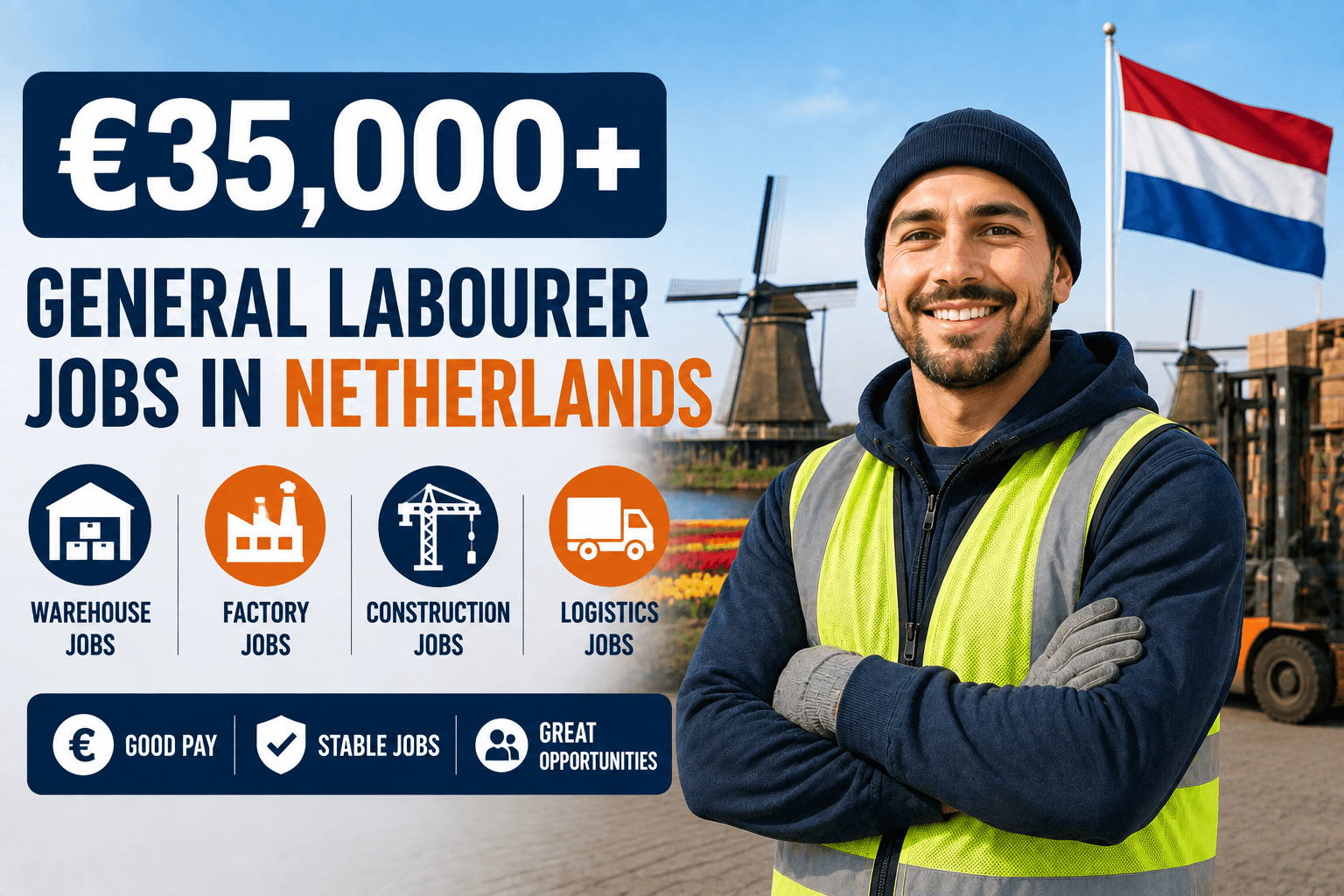
The Netherlands is one of Europe’s most important logistics, warehousing and distribution centres. Rotterdam operates Europe’s largest seaport, Schiphol is a major international cargo hub, and large warehouse networks connect Dutch businesses with customers throughout the European Union. Alongside logistics, the country has substantial manufacturing, food production, agriculture-related processing and construction industries.
These sectors create regular demand for General Labourers, Warehouse Workers, Order Pickers, Production Workers, Packers, Forklift Drivers and Construction Helpers.


For workers who already have the legal right to work in the Netherlands, many of these jobs can be accessible without university education.
Annual gross earnings around €35,000+ are possible in stronger full-time positions, particularly where workers have equipment experience, technical abilities, shift premiums or overtime.
For example:
€2,500 per month = €30,000 annually.
€2,750 per month = €33,000 annually.
€3,000 per month = €36,000 annually.
€3,250 per month = €39,000 annually.
€3,500 per month = €42,000 annually.
€4,000 per month = €48,000 annually.
However, basic entry-level packing, cleaning and warehouse jobs can pay below €35,000.
Foreign applicants also need to distinguish between finding a Dutch job and qualifying for Dutch employment immigration.
The Netherlands has a large international workforce, but that does not mean every warehouse or factory vacancy provides visa sponsorship for someone living outside the European Union.
General Labourer vacancy ≠ automatic Netherlands work visa.
How Much Do General Labourers Earn in Netherlands?
General Labourer salaries depend on industry and responsibilities.
Basic Warehouse Workers and Packers can earn close to applicable minimum or collective-agreement rates.
Forklift Operators can earn more.
Experienced Construction Labourers and technical Production Workers can receive stronger salaries.
Shift allowances can also make a significant difference.
A worker earning €3,000 gross monthly receives approximately €36,000 annually before tax.
At €3,250 monthly, annual gross earnings reach €39,000.
At €3,500 monthly, the figure reaches €42,000.
Workers should always distinguish gross salary from net salary.
Dutch income tax and social contributions affect the amount ultimately available for spending.
Enter an hourly wage, choose a country, and estimate monthly gross pay, tax and take-home income.
Planning estimate only. The preset uses a simplified flat percentage. Actual tax and payroll deductions can differ based on income level, province/state/region, allowances, social contributions, marital status and local tax rules.
Use the salary calculator to estimate monthly and annual earnings. The result is a planning estimate. Actual Dutch take-home pay depends on taxation, tax credits, pension arrangements and the worker’s individual circumstances.
Dutch Job Titles Foreign Workers Should Know
Searching only for “General Labourer Netherlands” can cause applicants to miss thousands of relevant vacancies.
Useful Dutch job titles include:
Magazijnmedewerker — Warehouse Worker.
Orderpicker — Order Picker.
Productiemedewerker — Production Worker.
Logistiek Medewerker — Logistics Worker.
Heftruckchauffeur — Forklift Driver.
Reachtruckchauffeur — Reach Truck Driver.
Inpakker — Packer.
Bouwmedewerker — Construction Worker.
Bouwhelper — Construction Helper.
Schoonmaker — Cleaner.
Keukenhulp — Kitchen Helper.
Verhuizer — Moving Worker.
Applicants should search both Dutch and English titles.
Warehouse General Labourer Jobs
Warehousing is one of the most visible sources of entry-level work in the Netherlands.
The country’s geographic position makes it a natural European distribution centre.
Products arriving through Rotterdam or Schiphol can be distributed to Germany, Belgium, France and other European markets.
Warehouses employ workers to receive shipments, organise inventory and prepare orders.
Magazijnmedewerker Jobs
Magazijnmedewerker is a common warehouse job title.
Workers can receive goods, move inventory and prepare shipments.
Large facilities can operate multiple shifts.
Some employers recruit workers through staffing agencies.
Workers should understand whether the employment contract is directly with the company or with an employment agency.
Orderpicker Jobs
Order Pickers select products for customer orders.
Workers can use handheld scanners, voice-picking systems and warehouse-management technology.
Speed and accuracy are important.
Some distribution centres require workers to walk considerable distances during a shift.
Cold-storage Order Pickers can work in refrigerated environments.
Logistiek Medewerker Jobs
Logistiek Medewerker means Logistics Worker.
These positions can involve receiving products, stock control, loading and dispatch.
The job can provide broader responsibilities than basic order picking.
Experience can lead to supervisory or inventory positions.
Heftruckchauffeur Jobs
Heftruckchauffeur means Forklift Driver.
Workers move pallets and products throughout warehouses.
Forklift experience can improve earning potential.
Employers can require appropriate certification or demonstrated competence.
Reachtruckchauffeur Jobs
Reach Truck Drivers operate equipment designed for high warehouse racking.
Large Dutch distribution centres commonly use reach trucks.
Workers with this skill can have stronger job prospects than applicants limited to manual warehouse work.
Equipment experience can therefore provide an important salary advantage.
Rotterdam Logistics Jobs
Rotterdam is home to Europe’s largest seaport.
The port supports enormous logistics, shipping, warehousing and industrial activity.
Workers can find employment throughout the wider Rotterdam region.
Jobs can involve warehouses, container-related operations and industrial facilities.
Not every port job is entry level.
Some positions require specialised safety training or technical qualifications.
Schiphol Airport Logistics Jobs
Amsterdam Airport Schiphol supports international passenger and cargo operations.
The wider airport region contains logistics and warehouse businesses.
Cargo operations create practical employment.
Security and background requirements can apply to certain airport jobs.
Applicants should carefully examine individual vacancy requirements.
Factory General Labourer Jobs
The Netherlands has manufacturing across food production, chemicals, electronics, machinery and other industries.
Factory Labourers support production processes.
Workers can prepare materials and package finished products.
Shift work is common.
Employees who develop machinery skills can progress into stronger-paying positions.
Productiemedewerker Jobs
Productiemedewerker means Production Worker.
It is one of the most common job titles for factory employment.
Workers can operate around production lines and inspect finished goods.
Many employers provide on-the-job training.
Experience with automated production equipment can increase salary potential.
Food Production Jobs
The Netherlands has a substantial food-processing industry.
Factories process meat, dairy products, vegetables, baked goods and packaged foods.
Production Workers can prepare ingredients and package products.
Some jobs involve refrigerated environments.
Food-safety rules must be followed carefully.
Packaging Jobs
Inpakker is a common term for Packer.
Workers prepare products for distribution.
Basic packing jobs can pay less than €35,000 annually.
Shift allowances and overtime can increase earnings.
Workers should check guaranteed weekly hours before estimating annual income.
Construction General Labourer Jobs
The Netherlands has residential, commercial and infrastructure construction.
Construction Labourers assist skilled tradespeople.
Workers can move materials and maintain worksites.
Practical construction experience can improve employment prospects.
Dutch-language ability can also be important because construction teams need clear safety communication.
Bouwhelper Jobs
Bouwhelper generally means Construction Helper.
Workers support experienced construction employees.
Responsibilities can include transporting materials and preparing tools.
The role can provide exposure to skilled trades.
Workers who develop recognised construction skills can potentially move into higher-paying positions.
Civil Construction Jobs
Dutch infrastructure includes roads, bridges, ports, flood-management systems and utilities.
Civil construction companies require practical workers.
However, specialised infrastructure employment can require safety qualifications and experience.
Workers with machinery skills can earn more than basic Labourers.
Cleaning Jobs
Schoonmaker means Cleaner.
Cleaning employment exists in offices, hotels, hospitals, factories and public facilities.
Entry-level cleaning salaries can fall below €35,000.
Industrial and specialised cleaning can provide stronger compensation.
Evening and early-morning schedules are common.
Moving Jobs
Verhuizer means Moving Worker.
Workers transport furniture and other belongings.
Physical strength is important.
Customer-service ability can also matter.
Employees with appropriate driving qualifications can potentially progress into moving-truck driving.
General Labourer Jobs in Amsterdam
Amsterdam has construction, hospitality, logistics and service employment.
Schiphol and surrounding industrial areas provide additional opportunities.
However, Amsterdam housing is extremely expensive.
Workers should not evaluate a vacancy using salary alone.
A €3,000 monthly salary can feel very different depending on accommodation costs.
General Labourer Jobs in Rotterdam
Rotterdam is one of the strongest locations for logistics and industrial employment.
The port creates an enormous supply chain.
Warehousing, transportation, shipping and manufacturing businesses operate throughout the region.
Workers with forklift and logistics experience can be particularly competitive.
General Labourer Jobs in Eindhoven
Eindhoven has a strong technology and manufacturing economy.
The wider North Brabant region contains factories, distribution centres and industrial businesses.
Production Workers and Warehouse Workers can find substantial opportunities.
Technical manufacturing experience can improve earning potential.
General Labourer Jobs in Tilburg
Tilburg has become an important logistics and distribution location.
Large warehouses operate around the region.
Order Picker, Warehouse Worker and Forklift Driver positions are common.
The city’s location provides access to major European transport routes.
General Labourer Jobs in Venlo
Venlo is strategically located near the German border.
This makes the area important for logistics.
Distribution businesses can serve both Dutch and German markets.
Warehouse employment is therefore a major part of the regional labour market.
General Labourer Jobs in Utrecht
Utrecht’s central location makes it important for distribution and services.
Construction and logistics jobs are available throughout the surrounding region.
Housing costs can be high.
Workers should investigate nearby towns when comparing accommodation.
General Labourer Jobs in The Hague
The Hague has construction, cleaning, logistics and service employment.
The surrounding South Holland region provides additional industrial opportunities.
Workers can commute between multiple nearby cities because Dutch transport links are extensive.
General Labourer Jobs in North Brabant
North Brabant is particularly important for manufacturing and logistics.
Eindhoven, Tilburg and surrounding municipalities contain factories and warehouses.
Workers can find Production, Logistics and Warehouse positions.
Equipment and technical experience can provide stronger earning potential.
Do General Labourer Jobs Require a Degree?
Many do not.
Basic warehouse, packing and production positions commonly focus on practical ability.
Workers can receive on-the-job training.
Construction Helpers can also begin without university education.
However:
no university degree required ≠ no Dutch immigration requirements.
Someone can meet every employer requirement for a warehouse job and still lack legal permission to work in the Netherlands.
EU and EEA Workers
EU and EEA nationals generally have substantially easier access to the Dutch labour market.
They can normally work without needing the same employer-sponsored work authorization required for many third-country nationals.
This means a Dutch employer can often hire an EU Warehouse Worker relatively easily.
Recruiting the same worker directly from a non-EU country can involve additional immigration requirements.
Third-Country Nationals
Workers from outside the EU/EEA generally need appropriate authorization.
Depending on the circumstances, this can involve a work permit or combined residence and work authorization.
Employers can therefore be less willing to recruit overseas applicants for ordinary entry-level labour when workers with existing European work rights are available.
Applicants should understand this before spending money on recruiters.
GVVA
The GVVA is a combined residence and work permit used in qualifying situations for third-country nationals who intend to work in the Netherlands for longer periods.
The employer can have an important role in the process.
Requirements depend on the employment and applicant.
A General Labourer vacancy does not automatically qualify simply because an employer wants to hire someone.
TWV
A TWV is a Dutch work permit used in certain employment situations.
Depending on the worker and duration of employment, an employer can need this authorization.
Labour-market requirements can apply.
Foreign applicants should not assume that a Dutch employment contract alone gives them the right to begin working.
Highly Skilled Migrant Route
The Netherlands has a Highly Skilled Migrant immigration route.
This route is associated with qualifying skilled employment and salary requirements.
Ordinary General Labourer, Packer or basic Warehouse Worker jobs should not normally be advertised as Highly Skilled Migrant opportunities.
Be cautious of recruiters claiming otherwise.
Recognised Sponsor Does Not Mean Every Job Is Sponsored
A Dutch employer can be recognised as a sponsor for immigration purposes.
That does not mean every vacancy it advertises qualifies for every immigration route.
A company might employ engineers, IT professionals, Warehouse Workers and Cleaners.
The fact that the company can sponsor a highly skilled engineer does not mean its basic Warehouse Worker vacancy automatically provides the same immigration option.
Therefore:
recognised sponsor ≠ every job provides sponsorship.
Staffing Agency Jobs
Temporary employment agencies play a significant role in Dutch warehousing and production.
Agencies can recruit workers for distribution centres and factories.
Some provide accommodation and transportation.
Workers should carefully review deductions.
If housing and transport costs are deducted from salary, the advertised hourly wage does not tell the full financial story.
Applicants should understand:
the employer,
the agency,
guaranteed hours,
housing cost,
transport cost,
insurance,
and contract duration.
Employer-Provided Housing
Some agency jobs include accommodation.
This can make relocation easier.
However, workers should examine whether housing is connected directly to employment.
Losing a job can create housing difficulties when both are tied together.
Workers should also understand exactly how much accommodation costs.
“Accommodation provided” does not always mean accommodation is free.
Dutch Language Requirements
The Netherlands has a high level of English proficiency.
This makes English-speaking warehouse and production jobs easier to find than in some European countries.
However, Dutch still provides a major advantage.
Workers with Dutch ability can communicate with more employers and supervisors.
Language ability can also help with long-term integration and career progression.
Shift Work
Warehouses and factories can operate around the clock.
Employees can work morning, evening and night shifts.
Shift allowances can increase total earnings.
Weekend work can also be available.
Workers should check the applicable collective labour agreement or employment contract.
Overtime
Busy logistics periods can create overtime opportunities.
However, overtime should not be treated as guaranteed.
Workers should build financial plans around contracted hours.
Any additional earnings can then be treated as extra income.
Holiday Allowance
Dutch employment commonly includes holiday allowance.
This can form an important part of annual compensation.
Workers should understand whether salary advertisements include or exclude holiday allowance when comparing offers.
Two jobs showing similar hourly rates can have different overall packages.
Health Insurance
People living or working in the Netherlands can have Dutch health-insurance obligations depending on their circumstances.
Workers need to budget for health insurance.
Some agencies can arrange insurance and deduct the cost from wages.
Employees should examine payslips carefully.
Cost of Living
Dutch wages can appear attractive, but housing is a major challenge.
Amsterdam is particularly expensive.
Rotterdam, Utrecht, Eindhoven and other cities have also experienced housing pressure.
Workers should calculate:
net salary − rent − health insurance − transportation − food − utilities − phone/internet − personal expenses.
A worker earning €36,000 in a cheaper location can potentially save more than someone earning €40,000 while paying very high Amsterdam rent.
Transportation
The Netherlands has extensive public transportation and cycling infrastructure.
Many workers commute by bicycle.
However, large distribution centres can be located in industrial parks outside city centres.
Agencies sometimes provide worker transport.
Applicants should check whether transport is free or deducted from salary.
Workplace Safety
Warehouse and construction workers operate around vehicles and machinery.
Employees should receive appropriate training.
Protective equipment can include safety shoes, high-visibility clothing, helmets, gloves and hearing protection.
Forklift equipment should only be operated by properly trained workers.
How Long Does the Netherlands Work Process Take?
The timeline depends heavily on the applicant’s nationality and existing work rights.
An EU/EEA worker can generally enter the Dutch labour market much more easily.
A third-country national can require employer-supported authorization before beginning employment.
The process can involve employer documentation, immigration applications and residence procedures.
Different permit categories have different processing requirements.
Choose your destination and preferred entry route, then tell us how far you have progressed.
Timeline results are planning estimates only and are not a guarantee of visa approval or travel date.
The wait-time calculator provides a planning estimate only. It does not guarantee employer sponsorship, work authorization, residence approval, visa issuance, entry into the Netherlands, employment duration or permanent residence.
Can Family Members Come?
Family options depend on the worker’s residence status.
Some residence permits allow qualifying family reunification.
Other circumstances can involve additional conditions.
A Warehouse Worker or General Labourer employment contract by itself does not automatically provide family immigration rights.
Workers should verify the requirements attached to their specific residence permit.
Does General Labour Lead to Permanent Residence?
Not automatically.
Permanent residence depends on immigration status, qualifying residence and other applicable requirements.
Working in a Dutch warehouse for several years does not automatically guarantee permanent residence.
Therefore:
General Labourer job ≠ automatic Dutch permanent residence.
General Labourer Job Scams
Foreign applicants should be cautious about supposed Netherlands sponsorship offers.
Warning signs include:
“Guaranteed Netherlands warehouse visa.”
“Pay €4,000 for recognised sponsor job.”
“Packing job qualifies for Highly Skilled Migrant visa.”
“No permit required after receiving contract.”
“Accommodation and visa guaranteed before employer interview.”
“General Labour job automatically gives EU permanent residence.”
Applicants should verify the company, employment agency and immigration route.
Do not pay large sums simply for an employment offer.
Building a Netherlands General Labourer CV
A CV should clearly demonstrate practical experience.
Instead of:
“Warehouse Worker.”
write:
“Picked customer orders, prepared shipments, received incoming goods and organised inventory using handheld scanning equipment.”
For production:
“Supported production lines, prepared materials, inspected products and packaged finished goods.”
Equipment experience should be highlighted.
Applicants should mention forklift or reach-truck experience accurately.
Language ability should also be included.
Skills That Can Increase Your Salary
General Labour employment can provide an entry point.
Workers can progress by learning:
forklift operation,
reach-truck operation,
machine operation,
industrial maintenance,
technical production,
construction trades,
inventory systems,
and logistics coordination.
A Warehouse Worker can become a Forklift Driver.
A Production Worker can become a Machine Operator.
A Construction Helper can develop a trade.
These skills can improve both salary and employment stability.
How to Find General Labourer Jobs in Netherlands
Useful searches include:
General Labourer jobs Netherlands
Magazijnmedewerker vacatures
Orderpicker Nederland
Logistiek Medewerker vacatures
Productiemedewerker Nederland
Heftruckchauffeur vacatures
Reachtruckchauffeur Nederland
Inpakker vacatures
Bouwhelper Nederland
and:
English speaking warehouse jobs Netherlands.
Foreign applicants should investigate work authorization separately.
An ordinary vacancy should never be interpreted as automatic immigration sponsorship.
Frequently Asked Questions
Can General Labourers earn €35,000+ in Netherlands?
Yes. A worker earning approximately €3,000 gross monthly receives about €36,000 annually. Equipment, construction, industrial and shift-based positions can potentially pay more.
Do General Labourer jobs require university education?
Many entry-level positions do not.
Can foreigners work as General Labourers?
Yes, provided they have appropriate Dutch work authorization.
Are English-speaking warehouse jobs available?
Yes. The Netherlands has many international logistics businesses where English can be used, although Dutch ability increases opportunities.
Can non-EU workers get warehouse jobs?
They can, but they generally face additional work and residence authorization requirements compared with EU/EEA workers.
Does every recognised sponsor offer visa sponsorship?
No. Recognition as a sponsor does not mean every vacancy qualifies for every immigration route.
Is a Warehouse Worker a Highly Skilled Migrant?
Ordinary entry-level warehouse work should not generally be confused with the Highly Skilled Migrant route.
Does General Labour automatically lead to permanent residence?
No.
Final Thoughts
The Netherlands provides extensive General Labour employment across warehousing, logistics, manufacturing, food production, packaging, construction and industrial operations.
Rotterdam’s enormous port, Schiphol’s cargo operations and the country’s central European location make logistics particularly important.
Workers earning around €3,000 gross per month can reach approximately €36,000 annually, while employees with forklift, reach-truck, construction, industrial or technical experience can potentially earn more.
For foreign applicants, however, immigration eligibility must be considered separately from job availability.
Remember:
Dutch vacancy ≠ automatic work permit
recognised sponsor ≠ every job is sponsored
warehouse job ≠ Highly Skilled Migrant route
accommodation provided ≠ accommodation is free
and:
General Labour employment ≠ automatic permanent residence.
For workers who already have Dutch or EU work rights, General Labour can provide a practical entry into one of Europe’s strongest logistics economies. For overseas applicants, language ability, equipment qualifications and technical skills can substantially improve both employment prospects and long-term career options.